Thank you for visiting SNEWPapers!
Sign up free
The North Carolina Standard
Raleigh, Wake County, North Carolina
What is this article about?
Reports from Mexico City detail the termination of the armistice on September 7, 1847, leading to battles at Molino del Rey, Chapultepec, and the capture of the city by U.S. forces under Gen. Scott on September 13-14. Mexican accounts claim initial repulses but confirm American victory, with losses including Gens. Bravo and Leon killed, Santa Anna wounded.
Merged-components note: These components form a single continuous article reporting on the latest developments in the Mexican War, split likely due to columnar layout or parsing boundaries.
Clipping
OCR Quality
Full Text
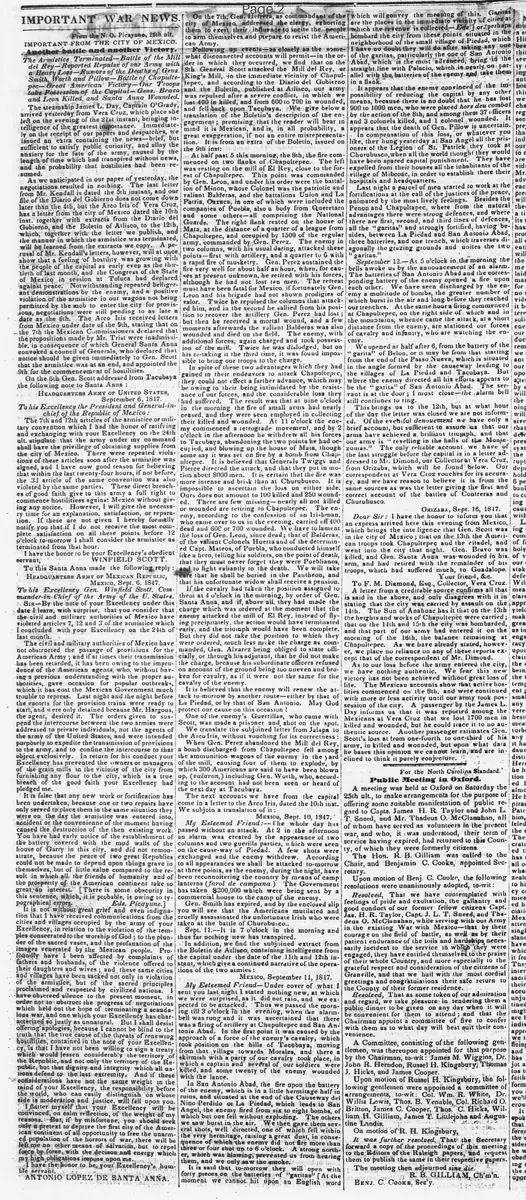
Another battle and another Victory.
The Armistice Terminated—Battle of the Mill— a Heavy Loss—Rumors of the Deaths of Gens. del Rey—Reported Repulse of our Army with take Possession of the Capital—Gens. Bravo pec—Great American Victory—Our Troops Smith, Worth and Pillow—Battle of Chapulte— and Leon Killed, and Santa Anna Wounded.
The steamship James L. Day, Captain O'Grady, arrived yesterday from Vera Cruz, which place she left on the evening of the 21st instant, bringing intelligence of the greatest importance. Immediately on the receipt of our papers and despatches, we issued an extra containing the news—brief, but sufficient to satisfy public curiosity, and allay the anxiety for the fate of the army, caused by the length of time which had transpired without news, and the probability that hostilities had been resumed.
As we anticipated in our paper of yesterday, the negotiations resulted in nothing. The last letter from Mr. Kendall is dated the 5th instant, and our file of the Diario del Gobierno does not come down later than the 4th, but the Arco Iris of Vera Cruz, has a letter from the city of Mexico dated the 10th inst. together with extracts from the Diario del Gobierno, and the Boletin of Jalisco, to the 12th, which, together with the letter we publish, and the manner in which the armistice was terminated, will be learned from the extracts we copy. A perusal of Mr. Kendall's letters, however, will at once show that a feeling of hostility was growing with the people of the capital as early even as the thirtieth of last month, and the Congress of the State of Mexico in session at Toluca had declared against peace. Notwithstanding repeated belligerent demonstrations by the enemy, and a positive violation of the armistice in our wagons not being permitted by the mob to enter the city for provisions, negotiations were still pending to as late a date as the 6th. The Arco Iris received letters from Mexico under date of the 9th, stating that on the 7th the Mexican Commissioners declared that the propositions made by Mr. Trist were inadmissible, in consequence of which General Santa Anna convoked a council of Generals, who declared that notice should be given immediately to Gen. Scott that the armistice was at an end, and appointed the 9th for the commencement of hostilities.
On the 6th Gen. Scott addressed from Tacubaya the following note to Santa Anna:
HEADQUARTERS ARMY OF UNITED STATES,
September 6, 1847.
To his Excellency the President and General-in-chief of the Republic of Mexico:
The 7th and 12th articles of the armistice or military convention which I had the honor of ratifying and exchanging with your Excellency on the 24th ult. stipulate that the army under my command shall have the privilege of obtaining supplies from the city of Mexico. There were repeated violations of these articles soon after the armistice was signed, and I have now good reason for believing that within the last twenty-four hours, if not before, the 3d article of the same convention was also violated by the same parties. These direct breaches of good faith give to this army a full right to commence hostilities against Mexico without giving any notice. However, I will give the necessary time for an explanation, satisfaction, or reparation. If these are not given I hereby formally notify you that if I do not receive the most complete satisfaction on all these points before 12 o'clock to-morrow I shall consider the armistice as terminated from that hour.
I have the honor to be your Excellency's obedient servant,
WINFIELD SCOTT.
To this Santa Anna made the following reply:
HEADQUARTERS ARMY OF MEXICAN REPUBLIC.
Mexico, Sept. 6, 1847.
To his Excellency Gen. Winfield Scott, Commander-in-Chief of the Army of the U. States.
SIR—By the note of your Excellency under this date I learn, with surprise, that you consider that the civil and military authorities of Mexico have violated articles 7, 12 and 3 of the armistice which I concluded with your Excellency on the 21st of last month.
The civil and military authorities of Mexico have not obstructed the passage of provisions for the American Army; and if at times their transmission has been retarded, it has been owing to the imprudence of the American agents, who, without having a previous understanding with the proper authorities, gave occasion for popular outbreaks, which it has cost the Mexican Government much trouble to repress. Last night and the night before the escorts for the provision trains were ready to start, and were only detained because Mr. Hargous, the agent, desired it. The orders given to suspend the intercourse between the two armies were addressed to private individuals, not the agents of the army of the United States, and were intended purposely to expedite the transmission of provisions to the army, and to confine the intercourse to that object exclusively. In return for his conduct your Excellency has prevented the owners or managers of the grain mills in the vicinity of the city from furnishing any flour to the city, which is a true breach of the good faith your Excellency had pledged me.
It is false that any new work or fortification has been undertaken, because one or two repairs have only served to place them in the same situation they were on the day the armistice was entered into, accident or the convenience of the moment having caused the destruction of the then existing work. You have had early notice of the establishment of the battery covered with the mud walls of the house of Garry in this city, and did not remonstrate, because the peace of two great Republics could not be made to depend upon things grave in themselves, but of little value compared to the result in which all the friends of humanity and of the prosperity of the American continent take so great an interest. [There is some obscurity in this sentence, which, it is probable, is owing to typographical errors. Eds. Picayune.]
It is not without great grief and even indignation that I have received communications from the cities and villages occupied by the army of your Excellency, in relation to the violation of the temples consecrated to the worship of God; to the plunder of the sacred vases, and the profanation of the images venerated by the Mexican people. Profoundly have I been affected by complaints of fathers and husbands, of the violence offered to their daughters and wives; and these same cities and villages have been sacked not only in violation of the armistice, but of the sacred principles proclaimed and respected by civilized nations. I have observed silence to the present moment, in order not to obstruct the progress of negotiations which held out the hope of terminating a scandalous war, and one which your Excellency has characterized so justly as unnatural. But I shall desist offering apologies, because I cannot be blind to the truth that the true cause of the threats of renewing hostilities, contained in the note of your Excellency, is that I have not been willing to sign a treaty which would lessen considerably the territory of the Republic, and not only the territory of the Republic, but that dignity and integrity which all nations defend to the last extremity. And if these considerations have not the same weight in the mind of your Excellency, the responsibility before the world, who can easily distinguish on whose side is moderation and justice, will fall upon you.
I flatter myself that your Excellency will be convinced, on calm reflection, of the weight of my reasons. But, if by misfortune, you should seek only a pretext to deprive the first city of the American continent of all opportunity to free the unarmed population of the horrors of war, there will be left me no other means of salvation, but to repel force by force with the decision and energy which my high obligations impose upon me.
I have the honor to be, your Excellency's humble servant,
ANTONIO LOPEZ DE SANTA ANNA.
On the 7th, Gen. Herrera, as commandant of the city of Mexico, addressed the clergy, exhorting them to exert their influence to incite the people to arm themselves and prepare to resist the American Army.
Following up events as closely as the somewhat disconnected accounts will permit—in the order in which they occurred, we find that on the 8th, General Scott attacked the Mill del Rey, or King's Mill, in the immediate vicinity of Chapultepec, and according to the Diario del Gobierno and the Boletin, published at Jalisco, our army was repulsed after a severe conflict, in which we lost 400 in killed, and from 600 to 700 in wounded and fell back upon Tacubaya. We give below a translation of the Boletin's description of the engagement; premising that the reader will bear in mind it is Mexican, and is, in all probability, a great exaggeration, if not an entire misrepresentation. It is from an extra of the Boletin, issued on the 9th inst.
At half past 5 this morning, the 8th, the fire commenced on two flanks of Chapultepec. The left was resting on the mill of El Rey, close to the forest of Chapultepec. This point was commanded by Gen. Leon, and under his order were the battalion of Minon, whose Colonel was the patriotic and valiant Balderas, and the battalions Union and La Patria, Oaxaca, in one of which were included the companies of Puebla, also a body from Queretaro and some others—all comprising the National Guards. The right flank rested on the house of Mata, at the distance of a quarter of a league from Chapultepec, and occupied by 1500 of the regular army, commanded by Gen. Perez. The enemy in two columns, with his usual daring, attacked these points—first with artillery, and a quarter to 6 with a rapid fire of musketry. Gen. Perez sustained the fire very well for about half an hour, when, for causes as present unknown, he retired with his forces, although he had not lost ten men. The retreat must have been fatal for Mexico, if fortunately Gen. Leon and his brigade had not shown prodigies of valor. Twice he repulsed the columns that attacked him, and in the second he sallied from his position to recover the artillery Gen. Perez had lost; but then he received a mortal wound, and a few moments afterwards the valiant Balderas was also wounded and died on the field. The enemy, with additional forces, again charged and took possession of the mill. Twice he was dislodged, but on his re-taking it the third time, it was found impossible to bring our troops to the charge.
In spite of these two advantages which they had gained in their endeavors to attack Chapultepec, they could not effect a farther advance, which may be owing to their being intimidated by the resistance of our forces, and the considerable loss they had suffered. The result was that at nine o'clock in the morning the fire of small arms had nearly ceased, and they were seen employed in collecting their killed and wounded. At 11 o'clock the enemy commenced a retrograde movement, and by 2 o'clock in the afternoon he withdrew all his forces to Tacubaya, abandoning the two points he had occupied, and blowing up the house of Mata, though some say it was set on fire by a bomb from Chapultepec. It is believed that Generals Twiggs and Pierce directed the attack, and that they put in motion about 8000 men. It is certain that the fire was more intense and brisk than at Churubusco. It is impossible to ascertain the loss on either side. Ours does not amount to 100 killed and 250 wounded. There are few missing—nearly all not killed or wounded are retiring to Chapultepec. The enemy, according to the confession of an Irishman, who came over to us in the evening, carried off 400 dead and 600 or 700 wounded. We have to lament the loss of Gen. Leon, since dead; that of Balderas, of the valiant Colonels Huerta and of the determined Capt. Mateos, of Puebla, who conducted himself like a hero, telling his soldiers, on the point of death, that they must never forget they were Pueblianos, and to fight valiantly to the death. We will take care that he shall be buried in the Pantheon, and that his unfortunate widow shall receive a pension.
If the cavalry had taken the position assigned to them at 4 o'clock in the morning, by order of Gen. Santa Anna, and if, above all, they had made the charge which was ordered at the moment that the enemy attacked the mill of El Rey, instead of flying precipitately, the action would have terminated early, and the triumph would have been complete. But they did not take the position to which they were ordered, much less make the charge as commanded, Gen. Alvarez being obliged to state officially or through his adjutant, that he did not make the charge, because his subordinate officers refused on account of the ground being too uneven and broken for cavalry, as if it were not the same for the cavalry of the enemy.
It is believed that the enemy will renew the attack to-morrow by another route—either by that of La Piedad, or by that of San Antonio. May God protect our cause on this occasion!
One of the enemy's Guerrillas, who came with Scott, was made a prisoner and shot on the spot. We translate the subjoined letter from Jalapa to the Arco Iris, without vouching for its correctness:
When Gen. Perez abandoned the Mill del Rey, a bomb discharged from Chapultepec fell among the ammunition wagons of the enemy in the yard of the mill, causing four of them to explode, by which 300 Americans are said to have been blown up, (ralaron,) including Gen. Worth, who, according to the account had not been seen or heard of the next day at Tacubaya.
The next accounts we have from the capital come in a letter to the Arco Iris, dated the 10th inst. We subjoin a translation of it:
Mexico, Sept. 10, 1847.
My Esteemed Friend:—The whole day has passed without an attack. At 2 in the afternoon an alarm was created by the appearance of two columns and two guerilla parties, which were seen on the cause-way of Piedad. A few shots were exchanged and the enemy withdrew. According to all appearances we shall be attacked to-morrow at three points, as the enemy, during the night, have been reconnoitering the country by means of camp lanterns (farol de campana.) The Government has taken $300,000 which were being sent by a commercial house to the camp of the enemy. Gen. Smith has expired, and by the enclosed slip you will see that the Americans mutilated and cruelly assassinated the unfortunate Irish who were taken at the battle of Churubusco.
Sept. 11.—It is 7 o'clock in the morning and thus far nothing new has transpired.
In addition, we find the subjoined extract from the Boletin de Jalisco, containing intelligence from the capital under the date of the 11th and 12th instant, which gives a continued narrative of the operations of the two armies:
Mexico, September 11, 1847.
My Esteemed Friend—Under cover of what I sent you last night I stated nothing new, at which we were surprised, as it did not rain, and we expected to be attacked. Thus we passed the morning till 3 o'clock in the evening, when the alarm-bell was rung and it was ascertained that there was a firing of artillery at Chapultepec and San Antonio Abad. In the first point it was caused by the approach of a force of the enemy's cavalry, which took position on the hills of Tacubaya, moving from that village towards Morales, and there a skirmish with a party of our cavalry took place, in which a captain and several of our soldiers were killed, and some twenty of the enemy wounded with the lance.
In San Antonio Abad, the fire upon the battery of the enemy, which is in a little hermitage half in ruins, and situated at the end of the Causeway del Nino Perdido or La Piedad, which leads to San Angel, the enemy fired from six to eight bombs, of which but one fell without exploding. The others we saw burst in the air. We then gave them several shots, well directed, one of which fell within the very hermitage, raising a great dust, in consequence of which the enemy did not fire more than three or four shot up to 6 o'clock. A strong norther, which was blowing, prevented us from hearing them, and we only saw the smoke.
It is said that to-morrow they will open with forty pieces on the batteries of 'garitas.' At the moment we cannot hit upon an English word.
neighborhood of the small village of Piedad. What I have no doubt they will do after taking any one of the garitas, particularly the one of San Antonio Abad, which is the most advanced, being in a straight line with Palacio, which is nearly on a parallel with the batteries of the enemy and take them in a flank.
It appears that the enemy convinced of the impossibility of reducing the capital by any other means, because there is no doubt that he has lost by the action of the 8th, 900 to 1000 men, who were placed hors de combat and 3 colonels killed, and 1 colonel wounded. It appears that the death of Gen. Pillow is uncertain. In compensation of this loss, or whatever you like, they hung yesterday at San Angel all the prisoners of the Legion of St. Patrick they took at Churubusco, when all the world thought they would have been spared capital punishment. They have expelled from their houses all the inhabitants of the village of Mixcoac, in order to establish there their hospitals and headquarters.
Last night a parcel of men started to work at the fortifications at the call of the justices of the peace, animated by the most lively feelings. Besides the advantages there were strong defences, and where there are first, second, and third lines of defences, all the 'garitas' and strongly fortified, having besides, between La Piedad and San Antonio Abad, three batteries, and one trench, which traverses diagonally the grazing grounds and unites the two garitas.
September 12.—At 5 o'clock in the morning the bells awoke us by the announcement of an alarm. The batteries of San Antonio Abad and the corresponding battery of the enemy opened a fire upon each other. We have seen discharged by the enemy a multitude of bombs, the greater number of which burst in the air and long before they reached our trenches. At the same hour a firing commenced at Chapultepec, on the right side of which and in the mountains, whence came the attack, at a short distance from the enemy, are stationed our forces of cavalry and infantry, who are watching the enemy.
We opened at half after 6, from the battery of the 'garita' of Belen, or it may be from that starting from the end of the Paso Nueva, which is situated in the angle formed by the causeway leading to the villages of La Piedad and Tacubaya. But where the enemy directed all his efforts appears to be the 'garita' of San Antonio Abad. The servant is at the door; I must close—the alarm bell still continues to ring.
This brings us to the 12th, but at what hour of the day the letter was closed we are not informed. Of the eventful denouement we have only a brief account, but sufficient to assure us that our arms have achieved a brilliant triumph, and that our army is 'revelling in the halls of the Montezumas.' The only reliable account we have of the last struggle before the capital is in a letter addressed to Mr. Dimond, our Collector at Vera Cruz, from Orizaba, which will be found below. Our correspondent at Vera Cruz vouches for its accuracy, and we have reason to believe it is from the same sources as was the letter giving the first and correct account of the battles of Contreras and Churubusco.
ORIZABA, Sept. 16, 1847.
Dear Sir: I have the honor to inform you that an express arrived here this evening from Mexico, which brings the intelligence that Gen. Scott was in the city of Mexico; that on the 13th the American troops took Chapultepec and the citadel, and went into the city that night. Gen. Bravo was killed, and Gen. Santa Anna was wounded in his arm, and had retired with the remainder of his troops, which had suffered much, to Guadalupe.
Your friend, &c.
To F. M. Dimond, Esq., Collector, Vera Cruz.
A letter from a creditable source confirms all that is said in the above, and only disagrees with it in stating that the city was carried by assault on the 14th. The Sun of Anahuac has it that on the 13th the heights and works of Chapultepec were carried; that on the 14th and 15th the city was bombarded and that part of our army had entered it on the morning of the 16th, the balance remaining at Chapultepec. As we have already stated, however, we place no reliance on any of these reports except that of the correspondent of Mr. Dimond.
As to our loss before the army entered the city, we have nothing authentic. We fear this new victory has not been achieved without great loss of life. The Mexican accounts show that active hostilities commenced on the 8th, and were continued with more or less activity until our army took possession of the city. A passenger by the James L. Day informs us that it was reported among the Mexicans at Vera Cruz that we lost 1700 men in killed and wounded, but he could trace it to no authentic source. Another passenger estimates Gen. Scott's loss at from one-fourth to one-third of his army, in killed and wounded, but upon what data he bases this opinion we cannot learn, and are inclined to think it purely conjecture.
What sub-type of article is it?
What keywords are associated?
What entities or persons were involved?
Where did it happen?
Foreign News Details
Primary Location
City Of Mexico
Event Date
September 6 16, 1847
Key Persons
Outcome
u.s. forces captured mexico city after battles at molino del rey and chapultepec; mexican losses include gens. bravo and leon killed, santa anna wounded; u.s. estimated losses 1700 killed and wounded; mexican accounts claim 400-1000 u.s. casualties in initial engagements.
Event Details
Armistice terminated September 7 after failed negotiations; U.S. attacked Molino del Rey September 8, Mexican accounts claim repulse with heavy U.S. losses; skirmishes continued September 9-12; U.S. captured Chapultepec and entered Mexico City September 13-14, achieving victory.