Thank you for visiting SNEWPapers!
Sign up free
The New Hampshire Gazette
Portsmouth, Rockingham County, New Hampshire
What is this article about?
1810 spotted fever epidemic ravages Barre, MA, with 70 cases and 7 deaths in days; spreads to nearby towns. Physicians detail symptoms like pains, eruptions, delirium; advocate stimuli, warm baths over depletion; report 3/25 child deaths, non-contagious nature; society investigates origins possibly from spoiled food.
Merged-components note: This is a continuation of the same article on spotted fever across pages 1 and 2, with sequential reading order and direct text flow.
Clippings
1 of 2
OCR Quality
Full Text
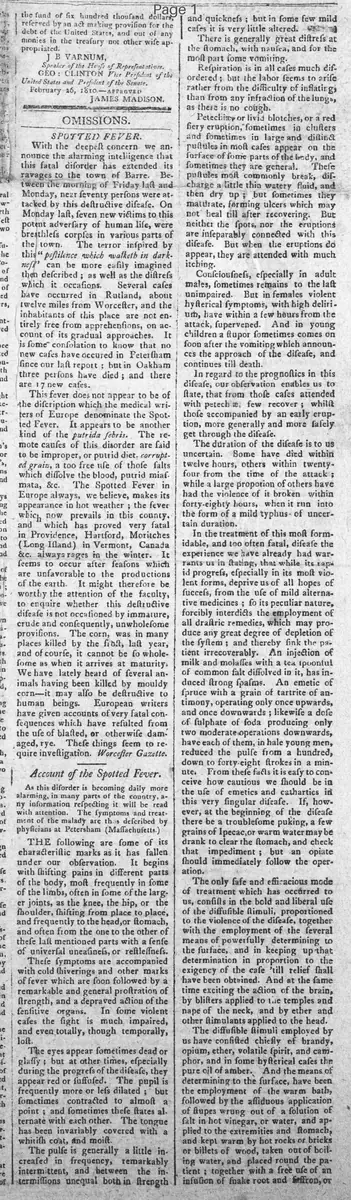
With the deepest concern we announce the alarming intelligence that this fatal disorder has extended its ravages to the town of Barre. Between the morning of Friday last and Monday, near seventy persons were attacked by this destructive disease. On Monday last, seven new victims to this potent adversary of human life, were breathless corpses in various parts of the town. The terror inspired by this "pestilence which walketh in darkness" can be more easily imagined than described; as well as the distress which it occasions. Several cases have occurred in Rutland, about twelve miles from Worcester, and the inhabitants of this place are not entirely free from apprehensions, on account of its gradual approaches. It is some consolation to know that no new cases have occurred in Petersham since our last report; but in Oakham three persons have died; and there are 17 new cases.
This fever does not appear to be of the description which the medical writers of Europe denominate the Spotted Fever. It appears to be another kind of the putrida febris. The remote causes of this disorder are said to be improper, or putrid diet, corrupted grain, a too free use of those salts which dissolve the blood, putrid miasmata, &c. The Spotted Fever in Europe always, we believe, makes its appearance in hot weather; the fever which now prevails in this county, and which has proved very fatal in Providence, Hartford, Moriches (Long Island) in Vermont, Canada &c. always rages in the winter. It seems to occur after seasons which are unfavorable to the productions of the earth. It might therefore be worthy the attention of the faculty, to enquire whether this destructive disease is not occasioned by immature, crude and consequently, unwholesome provisions. The corn, was in many places killed by the frost, last year, and of course, it cannot be so wholesome as when it arrives at maturity. We have lately heard of several animals having been killed by mouldy corn--it may also be destructive to human beings. European writers have given accounts of very fatal consequences which have resulted from the use of blighted, or otherwise damaged, rye. These things seem to require investigation. Worcester Gazette.
Account of the Spotted Fever.
As this disorder is becoming daily more alarming, in many parts of the country, any information respecting it will be read with attention. The symptoms and treatment of the malady are thus described by physicians at Petersham (Massachusetts.)
THE following are some of its characteristic marks as it has fallen under our observation. It begins with shifting pains in different parts of the body, most frequently in some of the limbs, often in some of the larger joints, as the knee, the hip, or the shoulder, shifting from place to place, and frequently to the head, or stomach, and often from the one to the other of these last mentioned parts with a sense of universal uneasiness, or restlessness. These symptoms are accompanied with cold shiverings and other marks of fever which are soon followed by a remarkable and general prostration of strength, and a depraved action of the sensitive organs. In some violent cases the sight is much impaired, and even totally, though temporarily, lost.
The eyes appear sometimes dead or glassy; but at other times, especially during the progress of the disease, they appear red or suffused. The pupil is frequently more or less dilated; but sometimes contracted to almost a point; and sometimes these states alternate with each other. The tongue has been invariably covered with a whitish coat, and moist.
The pulse is generally a little increased in frequency, remarkably intermittent, and between the intermissions unequal both in strength and quickness; but in some few mild cases it is very little altered.
There is generally great distress at the stomach, with nausea, and for the most part some vomiting.
Respiration is in all cases much disordered: but the labor seems to arise rather from the difficulty of inflating than from any infraction of the lungs, as there is no cough.
Petechiae or livid blotches, or a red fiery eruption, sometimes in clusters and sometimes in large and distinct pustules in most cases appear on the surface of some parts of the body, and sometimes they are general. These pustules most commonly break, discharge a little thin watery fluid, and then dry up; but sometimes they maturate, forming ulcers which may not heal till after recovering. But neither the petechiae, nor the eruptions are inseparably connected with this disease. But when the eruptions do appear, they are attended with much itching.
Consciousness, especially in adult males, sometimes remains to the last unimpaired. But in females violent hysterical symptoms, with high delirium, have within a few hours from the attack, supervened. And in young children a stupor sometimes comes on soon after the vomiting which announces the approach of the disease, and continues till death.
In regard to the prognostics in this disease, our observation enables us to state, that from those cases attended with petechiae, few recover; whilst those accompanied by an early eruption, more generally and more safely get through the disease.
The duration of the disease is to us uncertain. Some have died within twelve hours, others within twenty-four from the time of the attack while a large proportion of others have had the violence of it broken within forty-eight hours, when it run into the form of a mild typhus- of uncertain duration.
In the treatment of this most formidable, and too often fatal, disease the experience we have already had warrants us in stating, that while its rapid progress, especially in its most violent forms, deprive us of all hopes of success, from the use of mild alternative medicines; so its peculiar nature, forcibly interdicts the employment of all drastic remedies, which may produce any great degree of depletion of the system; and thereby sink the patient irrecoverably. An injection of milk and molasses with a tea spoonful of common salt dissolved in it, has induced strong pains. An emetic of pruce with a grain of tartrate of antimony, operating only once upwards, and once downwards: likewise a dose of sulphate of soda producing only two moderate operations downwards, have each of them, in hale young men, reduced the pulse from a hundred, down to forty-eight strokes in a minute. From these facts it is easy to conceive how cautious we should be in the use of emetics and cathartics in this very singular disease. If, however, at the beginning of the disease there be a troublesome puking, a few grains of Ipecac, or warm water may be drank to clear the stomach, and check that impediment; but an opiate should immediately follow the operation.
The only safe and efficacious mode of treatment which has occurred to us, consists in the bold and liberal use of the diffusible stimuli, proportioned to the violence of the disease, together with the employment of the several means of powerfully determining to the surface, and in keeping up that determination in proportion to the exigency of the case 'till relief shall have been obtained. And at the same time exciting the action of the brain, by blisters applied to the temples and nape of the neck, and by ether and other stimulants applied to the head.
The diffusible stimuli employed by us have consisted chiefly of brandy, opium, ether, volatile spirit, and camphor, and in some hysterical cases the pure oil of amber. And the means of determining to the surface, have been the employment of the warm bath, followed by the assiduous application of stupes wrung out of a solution of salt in hot vinegar, or water, and applied to the extremities and stomach, and kept warm by hot rocks or bricks or billets of wood, taken out of boiling water, and placed round the patient; together with a free use of an infusion of snake root and saffron, or pennyroyal, with much of the above mentioned diffusible stimuli, as appear best adapted to the case, and frequently cupped warm. By these means, a gentle and universal sweating is induced, and should be continued until the disorder gives way.
To what extent the most powerful of these diffusible stimuli may be safely and necessarily employed, the following facts will show. A young woman aged about 20 years, who recovered from the disorder, being very violently attacked, and a high delirium with great distress supervening, took more than a quart of brandy, and not less than twenty grains of good Turkey opium, aided by the above means of determining to the surface, in less than twelve hours, and before any material mitigation of her disorder could be obtained, and what is truly wonderful, without the least appearance of intoxication. Indeed we have been obliged, frequently to exhibit ten grains of opium for a dose in some of the most violent cases attended with strong pains, and have never known it to produce stupor in a single instance.
In one instance only have we employed the lancet. A man about twenty-eight years of age, having been violently attacked, and attended by strong pains; on the third day, his pains having been subdued, was exercised with extreme difficulty of breathing, and great oppression at the breast, and exhibiting at the same time a strangulated countenance, which symptoms appearing to arise from a surcharge of the vessels of the lungs, owing to their inaction rather than their inflammation, sixteen ounces of blood was taken away merely to restore the equilibrium. This had the happiest effect in relieving those distressing symptoms. But these symptoms returning on the fourth day, the operation was repeated, and with the same salutary effects. The blood did not exhibit the usual marks of an inflammatory diathesis, but on standing remained destitute of the inflammatory buff, and its coagulum was of a loose texture and tender.
Out of twenty-five cases, which have been subjected to the above mode of treatment, only three have as yet proved fatal, and those were patients under four years of age. The others are in a hopeful way of recovery.
Great alarm has been excited on account of the supposed infectious nature of this disease. But for the consolation of the people we can say, that from the most careful observation we have been able to make, we cannot discover a single instance, in which it clearly appears, that the disease has been communicated from one to another by contagion.
And as we are of the opinion, that none can be affected by this disease, but those in whom a certain change in the state of the body, commonly called the state of predisposition, has been effected by the influence of a certain morbid quality in the atmosphere, which state of predisposition disposes the moving powers, upon the application of any exciting morbid cause, to produce those specific morbid affections, which characterize this particular disease; and as we are furthermore of the opinion, that the only rational means of checking the progress of this, or any other epidemic, consists in removing the state of predisposition; and as the strong impression made on the system by the application of cold water suddenly applied to the surface, appears to be one of the most probable means of destroying this state of predisposition by dissolving the chain connecting those morbid affections; we cannot but strongly recommend the adoption of the cold bath, either by plunging, showering, or affusion, which may be employed three successive mornings, (the weather being fair) then omitting it three, and thus proceeding to the third time, as a most probable means of arresting the progress of this malignant disease, and of preventing its extending its ravages.
ABRAHAM HASKELL.
MASON SPOONER,
JACOB HOLMES.
Peterham, March 9, 1810.
Massachusetts Medical Society.
At a meeting of the Counsellors of the Massachusetts Medical Society, on the 7th February 1810.
VOTED—That a committee be appointed to collect information respecting the history and treatment of a malignant disease, now prevalent in the County of Worcester—commonly called SPOTTED FEVER; which has prevailed within five years past in Hartford, Connecticut, and Providence, Rhode Island, and report at the next meeting of the Society or Counsellors.
DR. FISKE.
Committee.
Dr. PAINE, J.
From the Records,
JOHN C. WARREN, Rec. Sec.
N. B. Any communication upon the above subject to the Committee or to Dr. Thomas Welsh, Corresponding Secretary of the Medical Society, at Boston, will be thankfully received.
What sub-type of article is it?
What themes does it cover?
What keywords are associated?
What entities or persons were involved?
Where did it happen?
Story Details
Key Persons
Location
Worcester County, Massachusetts (Barre, Rutland, Petersham, Oakham)
Event Date
March 1810
Story Details
Outbreak of spotted fever in Barre, Massachusetts, with nearly 70 cases and 7 deaths between Friday and Monday; additional cases and deaths in nearby towns. Description of symptoms including shifting pains, fever, prostration, eruptions; treatment using stimuli like brandy and opium, warm baths, avoiding depletion; low fatality rate in treated cases; not contagious; recommendation of cold baths to prevent predisposition. Medical society forms committee to investigate.