Thank you for visiting SNEWPapers!
Sign up free
The Jasper Weekly Courier
Jasper, Dubois County, Indiana
What is this article about?
Various newspapers react to the acquittal of General Orville E. Babcock in his trial for involvement in the Whisky Ring conspiracy in St. Louis, criticizing the verdict as influenced by President Grant's administration, judicial bias, and fabricated testimony, viewing it as a failure of justice despite legal acquittal.
Clipping
OCR Quality
Full Text
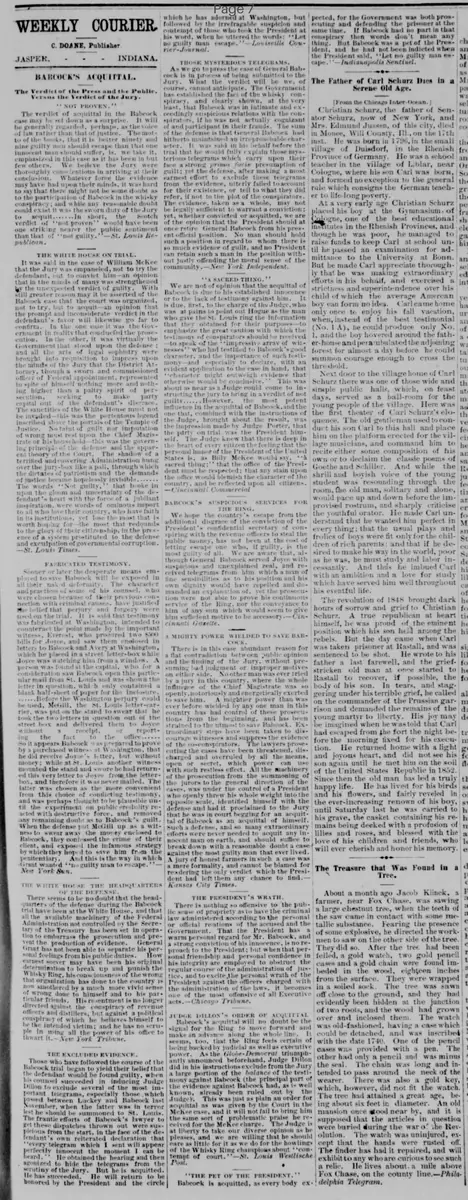
The Verdict of the Press and the Public.
Versus the Verdict of the Jury.
"NOT PROVEN."
The verdict of acquittal in the Babcock case may be set down as a surprise. It will be generally regarded, perhaps, as the voice of law rather than that of justice. The motto of the books, that it is better ninety and nine guilty men should escape than that one innocent man should suffer, is, we take it, emphasized in this case as it has been in but few others. We believe the Jury were thoroughly conscientious in arriving at their conclusion. Whatever force the evidence may have had upon their minds, it was hard to say that there might not be some doubt as to the participation of Babcock in the whisky conspiracy; and while any reasonable doubt could exist it was the sworn duty of the Jury to acquit. In short, the Scotch verdict of "not proven" would have been one striking nearer the public sentiment than that of "not guilty." - St. Louis Republican.
THE WHITE HOUSE ON TRIAL.
It was said in the case of William McKee that the Jury was empaneled, not to try the defendant, but to convict him - an opinion that in the minds of many was strengthened by the unexpected verdict of guilty. With still greater reason may it be asserted of the Babcock case that the court was organized, not to try, but to acquit - an opinion that the prompt and inconsiderate verdict in the defendant's favor will likewise go far to confirm. In the one case it was the Government in reality that conducted the prosecution. In the other, it was virtually the Government that stood upon the defense; and all the arts of legal sophistry were brought into requisition to impress upon the minds of the Jury that the District Attorney, though a sworn and commissioned officer of Federal appointment, represented in spite of himself nothing more and nothing higher than a paltry spirit of persecution, seeking to make party capital out of the defendant's disgrace. The sanctities of the White House must not be invaded - this was the portentous legend inscribed above the portals of the Temple of Justice. No taint of guilt nor imputation of wrong must rest upon the Chief Magistrate or his household - this was the governing principle of the defense and the apparent theory of the Court. The shadow of a terrified and covering Administration hung over the jury-box like a pall, through which the dictates of patriotism and the demands of justice became hopelessly invisible. The words "Not guilty," that broke in upon the gloom and uncertainty of the defendant's heart with the force of a jubilant inspiration, were words of ominous import to all who love their country, who have faith in its institutions, yet lose the most that is worth hoping for, the most that redounds to the glory of their citizenship, in the presence of a system prostituted to the defense and exculpation of governmental corruption. - St. Louis Times.
FABRICATED TESTIMONY.
Sooner or later the desperate means employed to save Babcock will be exposed in all their naked deformity. The character and practices of some of his counsel, who were chosen because of their previous connection with criminal causes, have justified the belief that perjury and forgery were used on the trial. It is said that testimony was fabricated at Washington, intended to counteract the point made by the important witness, Everest, who procured two $50 bills for Joyce, and saw them enclosed in letter to Babcock and Avery at Washington, which he placed in a street letter-box while Joyce was watching him from a window. A person was found at the capital, who for a consideration saw Babcock open this particular mail from St. Louis and was shown the letter in question, which only contained a blank half-sheet of paper for the inclosure. Before the Washington perjury could be used, McGill, the St. Louis letter-carrier, was put on the stand to swear that he took the two letters in question out of the street box and delivered them to Joyce without receipt or reporting the fact to the office. So it appears Babcock was prepared to prove by a purchased witness at Washington, that he did receive Joyce's letter, but without money; while at St. Louis another witness mounted the stand and swore he had returned this very letter to Joyce from the letter-box, and therefore it was never mailed. The latter was chosen as the more convenient from this choice of conflicting testimony, and was perhaps thought to be plausible until the experiment on public credulity reacted with destructive force, and removed any remaining doubt as to Babcock's guilt. When the defense put McGill up as a witness to swear away the money enclosed to Babcock, they confessed the crime of their client, and exposed the infamous strategy by which they hoped to save him from the penitentiary. And this is the way in which Grant wanted "no guilty man to escape." - New York Sun.
THE WHITE HOUSE THE HEADQUARTERS OF THE DEFENSE.
There seems to be no doubt that the headquarters of the defense during the Babcock trial have been at the White House, and that all the available machinery of the Federal Administration not controlled by the Secretary of the Treasury has been set in operation to embarrass the prosecution and prevent the production of evidence. General Grant has not been able to separate his personal feelings from his public duties. How earnest soever may have been his original determination to break up and punish the Whisky Ring, his consciousness of the wrong that organization has done to the country is now smothered by a much more vivid sense of wrong done to himself and to his particular friends. His resentment is no longer directed against the conspiracy of revenue officers and distillers, but against a political conspiracy of which he believes himself to be the intended victim; and he has no scruple in using all the power of his office to thwart it. - New York Tribune.
THE EXCLUDED EVIDENCE.
Those who have followed the course of the Babcock trial began to yield their belief that the defendant would be found guilty, when his counsel succeeded in inducing Judge Dillon to exclude several of the most important telegrams, especially those which passed between Luckey and Babcock last November, when the latter was in terror lest he should be summoned to St. Louis. The frantic efforts of Babcock's lawyers to get these dispatches thrown out were suspicious from the start, in the face of the defendant's own reiterated declaration that "every telegram which I sent will appear perfectly innocent the moment I can be heard." He obtained the hearing and then agonized to hide the telegrams from the scrutiny of the Jury. But he is acquitted. He has succeeded. He will return to be honored by the President and the circle which he has adorned at Washington, but followed by the irrefragable suspicion and contempt of those who took the President at his word, when he uttered the words: "Let no guilty man escape." - Louisville Courier-Journal.
THOSE MYSTERIOUS TELEGRAMS.
As we go to press the case of General Babcock is in process of being submitted to the Jury. What the verdict will be we, of course, cannot anticipate. The Government has established the fact of the whisky conspiracy, and clearly shown, at the very least, that Babcock was in intimate and exceedingly suspicious relations with the conspirators, if he was not actually cognizant of and participant in their frauds. The sum of the defense is that General Babcock had hitherto maintained an irreproachable character. It was said in his behalf before the trial that he would fully explain those mysterious telegrams which carry upon their face a strong prima facie presumption of guilt; yet the defense, after making a most earnest effort to exclude these telegrams from the evidence, utterly failed to account for their existence, or tell to what they did refer, if not to the plot of the conspirators. The evidence, taken as a whole, may not be legally sufficient to warrant a conviction; yet, whether convicted or acquitted, we are of the opinion that the President should at once retire General Babcock from his present official position. No man should hold such a position in regard to whom there is so much evidence of guilt, and no President can retain such a man in the position without justly offending the moral sense of the community. - New York Independent.
"A SACRED THING."
We are not of opinion that the acquittal of Babcock is due to his established innocence or to the lack of testimony against him. It is due, first, to the charge of the Judge, who was at pains to point out Hogue as the man who gave the St. Louis ring the information that they obtained for their purposes - to emphasize the great caution with which the testimony of conspirators should be received - to speak of the "impressive array of witnesses" who had testified to Babcock's good character, and the importance of such testimony - and especially to declare, with an evident application to the case in hand, that "character might outweigh evidence that otherwise would be conclusive." This was about as near as a Judge could come to instructing the jury to bring in a verdict of not guilty. However, the most potent influence in the acquittal of Babcock, and the one that, combined with the instructions of the Judge, brought about the result, was the impression made by Judge Porter, that the party on trial was the President himself. The Judge knew that there is deep in the heart of every citizen the feeling that the personal honor of the President of the United States is, as Bill McKee would say, "a sacred thing;" that the office of the President must be respected; that any stain upon the office would blemish the character of the country, and be reflected upon all citizens. - Cincinnati Commercial.
BABCOCK'S SUSPICIOUS SERVICES FOR THE RING.
We hope the country's escape from the additional disgrace of the conviction of the President's confidential secretary of conspiring with the revenue officers to steal the public money, has not been at the cost of letting escape one who, if guilty, is the most guilty of all. We are aware that, although General Babcock served Joyce with suspicious and unexplained zeal, and received telegrams from him which a man of fine sensibilities as to his position and his own dignity would have repelled and demanded an explanation of, yet the prosecution were not able to prove his continuous service of the Ring, nor the conveyance to him of any sum which would seem to give him sufficient motive to be accessory. - Cincinnati Gazette.
A MIGHTY POWER WIELDED TO SAVE BABCOCK.
There is in this case abundant reason for a flat contradiction between public opinion and the finding of the Jury, without presuming bad judgment or improper motives on either side. No other man was ever tried by a jury in this country, where the whole influence of the Chief Magistrate was so openly, notoriously and energetically exerted to save him. A mightier power than was ever before wielded by any one man in this country has had control of these prosecutions from the beginning, and has been strained to the utmost to save Babcock. Extraordinary steps have been taken to discourage witnesses and suppress the evidence of the co-conspirators. The lawyers prosecuting the cases have been threatened, discharged and overruled by all the means, open or secret, which power can use with such restless effect. All the machinery of the prosecution from the summoning of the jurors to the general direction of the cases, was under the control of a President who openly threw his whole weight into the opposite scale, identified himself with the defense and had it proclaimed to the Jury that he was in court begging for an acquittal of Babcock as an acquittal of himself. Such a defense, and so many extraordinary efforts were never needed to acquit any innocent man on earth, and should suffice to break down with a reasonable doubt a case against the most guilty man that ever lived. A jury of honest farmers in such a case was a mere formality, and cannot be blamed for rendering the only verdict which the President had left them any chance to find. - Kansas City Times.
THE PRESIDENT'S WRATH.
There is nothing so offensive to the public sense of propriety as to have the criminal law administered according to the personal or official relations of the accused and the Government. That the President has a warm personal regard for Mr. Babcock, and a strong conviction of his innocence, is no reproach to the President; but when that personal friendship and personal confidence in his integrity are employed to obstruct the regular course of the administration of justice, and to excite the personal wrath of the President against the officers charged with the administration of the laws, it becomes one of the most offensive of all Executive acts. - Chicago Tribune.
JUDGE DILLON'S ORDER OF ACQUITTAL
Babcock's acquittal will no doubt be the signal for the Ring to move forward and make an advance along the whole line. It seems, too, that the Ring feels certain of being backed by judicial as well as executive power. As the Globe-Democrat triumphantly announced beforehand, Judge Dillon did in his instructions exclude from the Jury a large portion of the balance of the testimony against Babcock (the principal part of the evidence against Babcock had, as is well known, already been ruled out by the Judge). This was just as plain an order for acquittal as was given by the Court in the McKee case, and it will not fail to bring him the same sort of problematic praise he received for the McKee charge. The Judge is at liberty to take our diverse opinion as he pleases, and we are willing that he should care as little for it as we do for the howlings of the Whisky Ring champions about "contempt of court." - St. Louis Westliche Post.
"THE PET OF THE PRESIDENT."
Babcock is acquitted, as everybody expected, for the Government was both prosecuting and defending the prisoner at the same time. If Babcock had no part in that conspiracy then words don't mean anything. But Babcock was a pet of the President, and he had not been indicted when the President said, "Let no guilty man escape." - Indianapolis Sentinel.
What sub-type of article is it?
What keywords are associated?
What entities or persons were involved?
Where did it happen?
Domestic News Details
Primary Location
St. Louis
Key Persons
Outcome
babcock acquitted by jury on charge of conspiracy in whisky ring; public and press view it as 'not proven' rather than not guilty, suspecting influence from white house and judicial bias.
Event Details
General Babcock, aide to President Grant, tried in St. Louis for participation in Whisky Ring fraud; jury returns not guilty verdict amid excluded evidence, suspicious telegrams, fabricated testimony, and perceived executive interference to protect the administration.