Thank you for visiting SNEWPapers!
Sign up free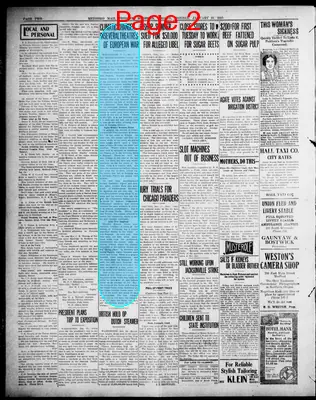
Medford Mail Tribune.
Medford, Jackson County County, Oregon
What is this article about?
On January 18, the National Geographic Society issued a statement describing varied winter climatic conditions in European war theaters, from severe cold in East Prussia and Russian Poland to milder weather in France and Belgium, impacting military operations.
Clipping

OCR Quality
Full Text
IN SEVERAL THEATRES
OF EUROPEAN WAR
WASHINGTON, D. C., Jan. 18.—The National Geographic society today gave out a statement which throws some light upon climatic conditions in the several theaters of the European war. It says:
"From the blood-congealing cold of East Prussia, Russian Poland, and eastern Galicia to the pleasant cool of the southeastern Black Sea coast all manner of winter weather is embraced in the zone of military operations. There is a wide range of temperatures and a diversity of other climatic conditions to be met in the preparations of the various armies. For the most part, however, the war zone follows the belt of severe winter conditions. From East Prussia, on the northeast, through northern Austria, northern France to Flanders winter is harsh upon those who are forced to live out of doors. Where in this belt, it is not intensely cold, it is chill and wet and just as hard to bear as the crisp, stinging bleakness of Russian Steppes.
Light Winter Western Front
"In general, the climate of France is temperate from boundary to boundary. In the south of France, the olive tree, the orange and lime, are grown, while, in the north, are grown those apples which need a sharp tinge of frost to bring out their best qualities. Winter seldom brings intense cold to northern or northwestern France, or to the lowlying fields of Belgium. There are very few days skating in this part of the war zone, but there are days and weeks, especially, on the low plains of the coast, when it is bitterly chill, and when the monotonous feathery drizzle only gives way to thick, yellow fog. The snows that fall in Belgium and in northern France are spongy with wetness.
"As one goes northeastward through Germany, winter and summer, alike, become more and more severe. In northwestern Germany, the summers are not very hot, the mean temperature being about 63 degrees, and the winters here are also mild, the temperature falling but little below 30 degrees Fahrenheit. Throughout southern and central Germany the same mildness in weather, in general, predominates. But in West Prussia, Posen, Silesia and East Prussia, the regions affected by present war operations, winter is savage and summer oppressive.
Like New England
"Russian Poland, whose most southerly boundary is north of the latitude of Winnipeg, has a winter somewhat similar to the winter of New England. An even cold, with little snow, but with often razor-edged winds from the northward, characterizes the central plain of Russian Poland, where the greatest operations in the eastern theater are now taking place. In northern and central Galicia, winter becomes more severe and trying. There is a greater snowfall, lower temperatures, and the winds from the Steppes of the north are still more frequent and much more difficult to withstand. Icy gales for days at a time shriek out of the north over Galicia's plains.
"Most of the waters in this eastern theater of war, freeze over early. All the rivers of the White Sea basin are frozen by November 20, and remain frozen on an average of 167 days. The rivers of the Baltic and Caspian Sea basins freeze about December 20. The Volga remains frozen about 150 days in the north and about 90 days at Astrakhan. The Don remains frozen 100 to 112 days; the Dnieper, 83 to 122 days; the Duna, 125 days, and the Vistula about 80 days at Warsaw."
What sub-type of article is it?
What keywords are associated?
What entities or persons were involved?
Where did it happen?
Foreign News Details
Primary Location
European War Theaters
Event Date
Jan. 18
Key Persons
Event Details
The National Geographic Society issued a statement detailing diverse winter weather conditions across European war zones, including severe cold in East Prussia, Russian Poland, and eastern Galicia; milder, wet conditions in northern France and Belgium; and varying severity in Germany, with river freezing periods noted in the east.