Thank you for visiting SNEWPapers!
Sign up free
Editorial
January 25, 1810
Norfolk Gazette And Publick Ledger
Norfolk, Virginia
What is this article about?
An editorial defends the British Orders in Council by refuting Mr. Milton's argument that they fail to achieve national policy goals, explaining how they cripple French resources while boosting British profits from trade previously handled by neutrals, using a numerical example to illustrate the advantage to Britain in wartime capabilities.
Clipping
OCR Quality
95%
Excellent
Full Text
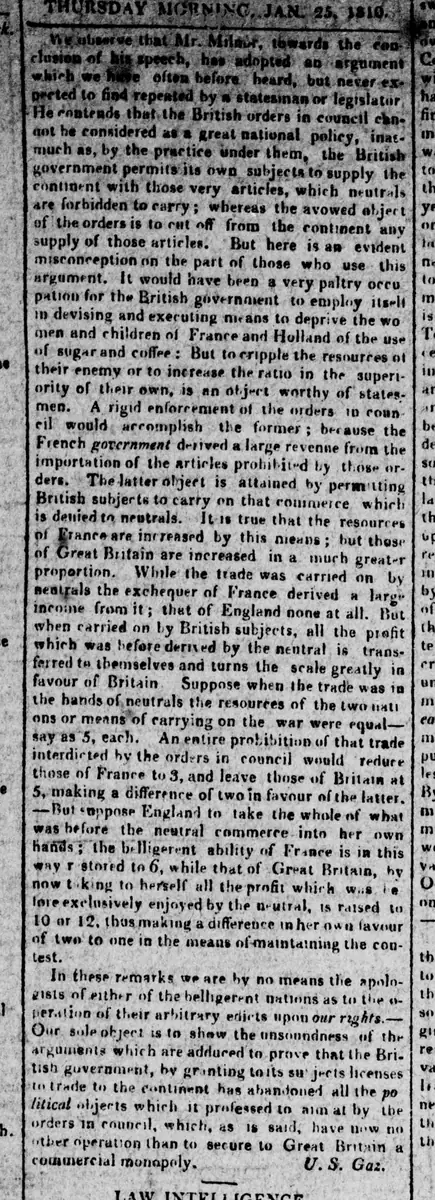
We observe that Mr. Milton, towards the conclusion of his speech, has adopted an argument which we have often before heard, but never expected to find repeated by a statesman or legislator. He contends that the British orders in council cannot be considered as a great national policy, inasmuch as, by the practice under them, the British government permits its own subjects to supply the continent with those very articles, which neutrals are forbidden to carry; whereas the avowed object of the orders is to cut off from the continent any supply of those articles. But here is an evident misconception on the part of those who use this argument. It would have been a very paltry occupation for the British government to employ itself in devising and executing means to deprive the women and children of France and Holland of the use of sugar and coffee: But to cripple the resources of their enemy or to increase the ratio in the superiority of their own, is an object worthy of statesmen. A rigid enforcement of the orders in council would accomplish the former; because the French government derived a large revenue from the importation of the articles prohibited by those orders. The latter object is attained by permitting British subjects to carry on that commerce which is denied to neutrals. It is true that the resources of France are increased by this means; but those of Great Britain are increased in a much greater proportion. While the trade was carried on by neutrals the exchequer of France derived a large income from it; that of England none at all. But when carried on by British subjects, all the profit which was before derived by the neutral is transferred to themselves and turns the scale greatly in favour of Britain. Suppose when the trade was in the hands of neutrals the resources of the two nations or means of carrying on the war were equal—say as 5, each. An entire prohibition of that trade interdicted by the orders in council would reduce those of France to 3, and leave those of Britain at 5, making a difference of two in favour of the latter.—But suppose England to take the whole of what was before the neutral commerce—into her own hands; the belligerent ability of France is in this way reduced to 6, while that of Great Britain, by now taking to herself all the profit which was before exclusively enjoyed by the neutral, is raised to 10 or 12, thus making a difference in her own favour of two to one in the means of maintaining the contest.
In these remarks we are by no means the apologists of either of the belligerent nations as to the operation of their arbitrary edicts upon our rights.—Our sole object is to show the unsoundness of the arguments which are adduced to prove that the British government, by granting to its subjects licenses to trade to the continent has abandoned all the political objects which it professed to aim at by the orders in council, which, as is said, have now no other operation than to secure to Great Britain a commercial monopoly.
U.S. Gaz.
In these remarks we are by no means the apologists of either of the belligerent nations as to the operation of their arbitrary edicts upon our rights.—Our sole object is to show the unsoundness of the arguments which are adduced to prove that the British government, by granting to its subjects licenses to trade to the continent has abandoned all the political objects which it professed to aim at by the orders in council, which, as is said, have now no other operation than to secure to Great Britain a commercial monopoly.
U.S. Gaz.
What sub-type of article is it?
Trade Or Commerce
Foreign Affairs
War Or Peace
What keywords are associated?
British Orders In Council
Neutral Trade
British Commerce
French Resources
War Means
Commercial Monopoly
What entities or persons were involved?
Mr. Milton
British Government
French Government
Neutrals
Editorial Details
Primary Topic
Defense Of British Orders In Council
Stance / Tone
Refutation Of Criticism, Explanatory Defense
Key Figures
Mr. Milton
British Government
French Government
Neutrals
Key Arguments
British Orders In Council Aim To Cripple Enemy Resources And Boost Own Superiority
Permitting British Subjects To Trade Achieves Policy Goals By Transferring Profits From Neutrals
Rigid Enforcement Would Deprive France Of Revenue But Allowing British Trade Increases Britain's Advantage More
Numerical Example: Neutral Trade Equalizes Resources At 5 5; Prohibition Favors Britain 5 3; British Takeover Favors 10 12 To 6
Argument Shows Unsoundness Of Claims That Orders Only Secure Commercial Monopoly