Thank you for visiting SNEWPapers!
Sign up free
The Delta Independent
Delta, Delta County, Colorado
What is this article about?
In this philosophical essay, U.S. Secretary of Commerce Herbert Hoover defends American individualism, arguing that progress stems from individual instincts, ideals, and self-interest balanced with altruism, critiquing socialism and autocracy while emphasizing equality of opportunity and leadership from the masses.
Clipping
OCR Quality
Full Text
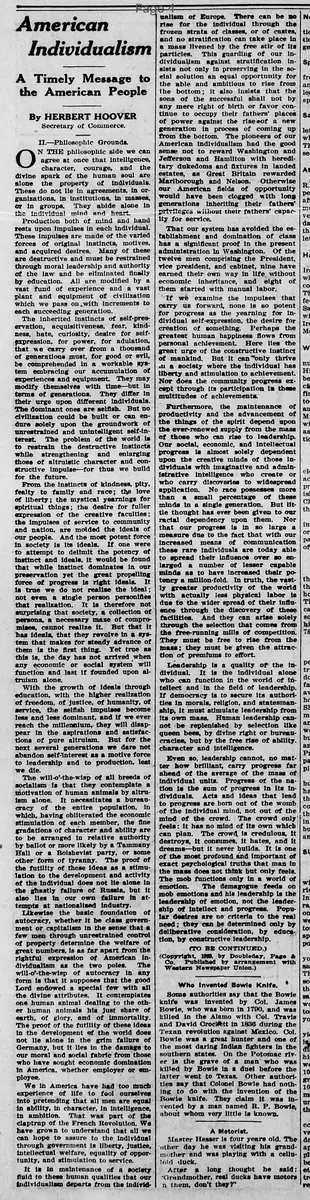
A Timely Message to the American People
By HERBERT HOOVER
Secretary of Commerce.
II.--Philosophic Grounds.
ON the philosophic side we can agree at once that intelligence, character, courage, and the divine spark of the human soul are alone the property of individuals. These do not lie in agreements, in organizations, in institutions, in masses, or in groups. They abide alone in the individual mind and heart.
Production both of mind and hand rests upon impulses in each individual. These impulses are made of the varied forces of original instincts, motives, and acquired desires. Many of these are destructive and must be restrained through moral leadership and authority of the law and be eliminated finally by education. All are modified by a vast fund of experience and a vast plant and equipment of civilization which we pass on with increments to each succeeding generation.
The inherited instincts of self-preservation, acquisitiveness, fear, kindness, hate, curiosity, desire for self-expression, for power, for adulation, that we carry over from a thousand generations must, for good or evil, be comprehended in a workable system embracing our accumulation of experiences and equipment. They may modify themselves with time but in terms of generations. They differ in their urge upon different individuals. The dominant ones are selfish. But no civilization could be built or can endure solely upon the groundwork of unrestrained and unintelligent self-interest. The problem of the world is to restrain the destructive instincts while strengthening and enlarging those of altruistic character and constructive impulse for thus we build for the future.
From the instincts of kindness, pity, fealty to family and race; the love of liberty; the mystical yearnings for spiritual things; the desire for fuller expression of the creative faculties; the impulses of service to community and nation, are molded the ideals of our people. And the most potent force in society is its ideals. If one were to attempt to delimit the potency of instinct and ideals, it would be found that while instinct dominates in our preservation yet the great propelling force of progress is right ideals. It is true we do not realize the ideal; not even a single person personifies that realization. It is therefore not surprising that society, a collection of persons, a necessary maze of compromises, cannot realize it. But that it has ideals, that they revolve in a system that makes for steady advance of them is the first thing. Yet true as this is, the day has not arrived when any economic or social system will function and last if founded upon altruism alone.
With the growth of ideals through education, with the higher realization of freedom, of justice, of humanity, of service, the selfish impulses become less and less dominant, and if we ever reach the millennium, they will disappear in the aspirations and satisfactions of pure altruism.
But for the next several generations we dare not abandon self-interest as a motive force to leadership and to production, lest we die.
The will-o'-the-wisp of all breeds of socialism is that they contemplate a motivation of human animals by altruism alone. It necessitates a bureaucracy of the entire population, in which, having obliterated the economic stimulation of each member, the fine gradations of character and ability are to be arranged in relative authority by ballot or more likely by a Tammany Hall or a Bolshevist party, or some other form of tyranny. The proof of the futility of these ideas as a stimulation to the development and activity of the individual does not lie alone in the ghastly failure of Russia, but it also lies in our own failure in attempts at nationalized industry.
Likewise the basic foundation of autocracy, whether it be class government or capitalism in the sense that a few men through unrestrained control of property determine the welfare of great numbers, is as far apart from the rightful expression of American individualism as the two poles. The will-o'-the-wisp of autocracy in any form is that it supposes that the good Lord endowed a special few with all the divine attributes. It contemplates one human animal dealing to the other human animals his just share of earth, of glory, and of immortality. The proof of the futility of these ideas in the development of the world does not lie alone in the grim failure of Germany, but it lies in the damage to our moral and social fabric from those who have sought economic domination in America, whether employer or employee.
We in America have had too much experience of life to fool ourselves into pretending that all men are equal in ability, in character, in intelligence, in ambition. That was part of the claptrap of the French Revolution. We have grown to understand that all we can hope to assure to the individual through government is liberty, justice, intellectual welfare, equality of opportunity, and stimulation to service.
It is in maintenance of a society fluid to these human qualities that our individualism departs from the individualism of Europe.
There can be no rise for the individual through the frozen strata of classes, or of castes, and no stratification can take place in a mass livened by the free stir of its particles.
This guarding of our individualism against stratification insists not only in preserving in the social solution an equal opportunity for the able and ambitious to rise from the bottom; it also insists that the sons of the successful shall not by any mere right of birth or favor continue to occupy their fathers' places of power against the rise of a new generation in process of coming up from the bottom. The pioneers of our American individualism had the good sense not to reward Washington and Jefferson and Hamilton with hereditary dukedoms and fixtures in landed estates, as Great Britain rewarded Marlborough and Nelson. Otherwise our American fields of opportunity would have been clogged with long generations inheriting their fathers' privileges without their fathers' capacity for service.
That our system has avoided the establishment and domination of class has a significant proof in the present administration in Washington. Of the twelve men comprising the President, vice president, and cabinet, nine have earned their own way in life without economic inheritance, and eight of them started with manual labor.
If we examine the impulses that carry us forward, none is so potent for progress as the yearning for individual self-expression, the desire for creation of something. Perhaps the greatest human happiness flows from personal achievement. Here lies the great urge of the constructive instinct of mankind. But it can only thrive in a society where the individual has liberty and stimulation to achievement. Nor does the community progress except through its participation in these multitudes of achievements.
Furthermore, the maintenance of productivity and the advancement of the things of the spirit depend upon the ever-renewed supply from the mass of those who can rise to leadership. Our social, economic, and intellectual progress is almost solely dependent upon the creative minds of those individuals with imaginative and administrative intelligence who create or who carry discoveries to widespread application.
No race possesses more than a small percentage of these minds in a single generation. But little thought has ever been given to our racial dependency upon them. Nor that our progress is in so large a measure due to the fact that with our increased means of communication these rare individuals are today able to spread their influence over so enlarged a number of lesser capable minds as to have increased their potency a million-fold. In truth, the vastly greater productivity of the world with actually less physical labor is due to the wider spread of their influence through the discovery of these facilities. And they can arise solely through the selection that comes from the free-running mills of competition. They must be free to rise from the mass; they must be given the attraction of premiums to effort.
Leadership is a quality of the individual. It is the individual alone who can function in the world of intellect and in the field of leadership. If democracy is to secure its authorities in morals, religion, and statesmanship, it must stimulate leadership from its own mass. Human leadership cannot be replenished by selection like queen bees, by divine right or bureaucracies, but by the free rise of ability, character and intelligence.
Even so, leadership cannot, no matter how brilliant, carry progress far ahead of the average of the mass of individual units. Progress of the nation is the sum of progress in its individuals. Acts and ideas that lead to progress are born out of the womb of the individual mind, not out of the mind of the crowd. The crowd only feels; it has no mind of its own which can plan. The crowd is credulous. It destroys, it consumes, it hates, and it dreams—but it never builds. It is one of the most profound and important of exact psychological truths that man in the mass does not think but only feels. The mob functions only in a world of emotion.
The demagogue feeds on mob emotions and his leadership is the leadership of emotion, not the leadership of intellect and progress. Popular desires are no criteria to the real need; they can be determined only by deliberative consideration, by education, by constructive leadership.
(TO BE CONTINUED.)
(Copyright, 1923, by Doubleday, Page & Co. Published by arrangement with Western Newspaper Union.)
What sub-type of article is it?
What themes does it cover?
What keywords are associated?
What entities or persons were involved?
Where did it happen?
Story Details
Key Persons
Location
America
Event Date
1923
Story Details
Hoover philosophically grounds American individualism in individual intelligence, instincts, and ideals, advocating balance of self-interest and altruism for progress, critiquing socialism's reliance on pure altruism and autocracy's elite control, emphasizing equality of opportunity, fluid society without classes, and leadership rising from the masses.