Thank you for visiting SNEWPapers!
Sign up free
Freeland Tribune
Freeland, Luzerne County, Pennsylvania
What is this article about?
Wisconsin Supreme Court issues warning to attorneys and courts against robbing and depleting estates in custody, in decision on Speiser v. Merchants' Exchange Bank case, refusing receiver compensation and criticizing misconduct.
Clipping
OCR Quality
Full Text
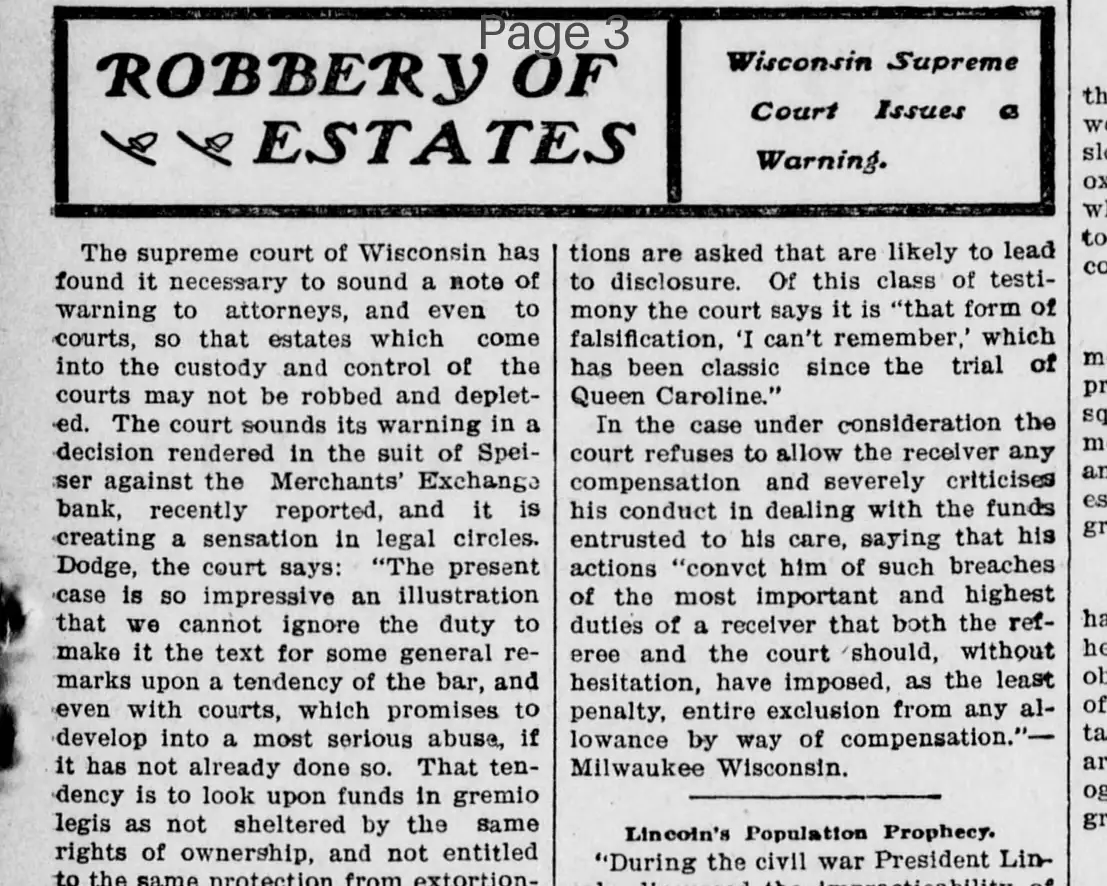
Wisconsin Supreme Court Issues Warning.
The supreme court of Wisconsin has found it necessary to sound a note of warning to attorneys, and even to courts, so that estates which come into the custody and control of the courts may not be robbed and depleted. The court sounds its warning in a decision rendered in the suit of Speiser against the Merchants' Exchange bank, recently reported, and it is creating a sensation in legal circles.
In the case under consideration the court refuses to allow the receiver any compensation and severely criticises his conduct in dealing with the funds entrusted to his care, saying that his actions "convict him of such breaches of the most important and highest duties of a receiver that both the referee and the court should, without hesitation, have imposed, as the least penalty, entire exclusion from any allowance by way of compensation."
The present case is so impressive an illustration that we cannot ignore the duty to make it the text for some general remarks upon a tendency of the bar, and even with courts, which promises to develop into a most serious abuse, if it has not already done so. That tendency is to look upon funds in gremio legis as not sheltered by the same rights of ownership, and not entitled to the same protection from extortionate and unreasonable charges, as if they had remained under the custody and control of their owners.
Some of the demands made against such funds could be justified only upon the view that they are already divested from private ownership; that any part thereof which ultimately reaches those to whom they really belong does so only by grace, or by way of free gift, so that any deduction therefrom, however illogical in character or excessive in amount, cannot be subject for complaint by any one.
After pointing out that receivers and trustees should be restrained to reasonable charges, the court continues: "Only in the wise discretion and firmness of the courts can there be found prevention or remedy for the abuse and disgrace of judicial conservation of estates from their enemies, only to permit their destruction by the very salvars. If such abuses continue, the beneficent power of a court of equity to take to its sheltering arms a litigated estate while rights to it are being established will become a mockery worse than the avoided perils as it is more effective. The record before us presents one of the most extreme cases of affirmative misconduct on the part of a receiver within the history of the court."
There has been a tendency upon the part of witnesses to assert the failure to remember when questions are asked that are likely to lead to disclosure. Of this class of testimony the court says it is "that form of falsification. 'I can't remember,' which has been classic since the trial of Queen Caroline."
In the case under consideration the court says: "The present actions convict him of such breaches..."
What sub-type of article is it?
What keywords are associated?
What entities or persons were involved?
Where did it happen?
Domestic News Details
Primary Location
Wisconsin
Event Date
Recently Reported
Key Persons
Outcome
court refuses receiver any compensation and criticizes his conduct as breaches of duty, imposing exclusion from allowance.
Event Details
Wisconsin Supreme Court warns attorneys and courts against robbing estates in custody, in decision on Speiser v. Merchants' Exchange Bank, highlighting tendency to impose extortionate charges on funds in gremio legis and criticizing receiver's misconduct.