Thank you for visiting SNEWPapers!
Sign up free
Gazette Of The United States And Daily Evening Advertiser
Philadelphia, Philadelphia County, Pennsylvania
What is this article about?
Robespierre addresses the French National Convention, denouncing a proclamation by the Duke of York issued to British and Hanoverian troops in response to a French decree forbidding the capture of English or Hanoverian soldiers as prisoners. He argues against clemency toward tyrants and emphasizes unity against internal and external threats.
Clipping
OCR Quality
Full Text
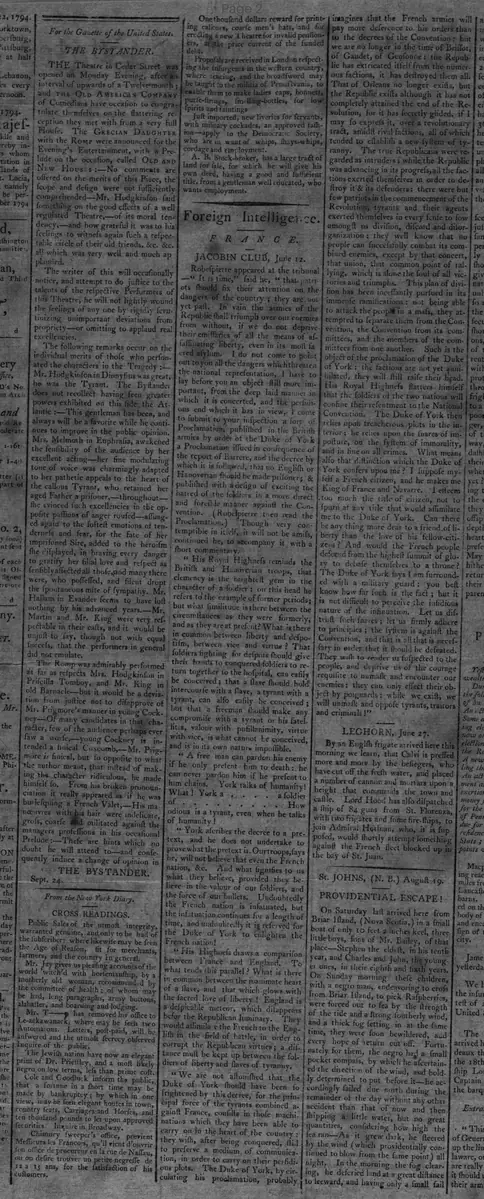
CROSS READINGS.
Public Sales of the utmost integrity, warranted genuine, and only to be had of the subscriber: where likewise may be seen the Age of Reason, fit for merchants, farmers, and the country in general.
Mr. Jay gives us pleasing accounts of the world 'witch'd with horsemanship, by a motherly old woman, recommended by the committee of health; of whom may be had, long paragraphs, army buttons, alabaster, and boarding and lodging.
Mr. has removed his office to Le-backawanack, where may be seen two Automatons. Letters, post-paid, will be answered and the utmost secrecy observed. Inquire of the public.
The Jewish nation have now an elegant print of Dr. Priestly, and a most likely negro on low terms, less than prime cost.
Cole and Goodluck inform the public, that a fortune in a short time may be made by bankruptcy; by which in one view, may be seen elegant houses in town, country seats, Carriages and Horses, and ten thousand pounds to let upon approved securities. Inquire in Broadway.
Chimney sweeper's office, prevents
Messieurs les Francais, qu'il vient d'ouvrir un office de procureur en la rue de Nassau, ou on desire trouver un petite negresse de 12 a 15 ans, for the satisfaction of his customers.
One thousand dollars reward for printing calicoes, coarse men's hats, and erecting a new Theatre for invalid pensioners, at the price current of the funded debt.
Proposals are received in London respecting the insurgents in the western country, where fencing, and the broadsword may be taught to the militia of Pennsylvania, to enable them to make ladies caps, bonnets, purse-strings, smelling-bottles, for low spirits and faintings.
Just imported, new liveries for servants, with military cockades, an approved fashion--apply to the Democratic Society, who are in want of whips, shays-whips, cordage and employment.
A. B. Stock-broker, has a large tract of land for sale, for which he will give his own deed, having a good and sufficient title, from a gentleman well educated, who wants employment.
Robespierre appeared at the tribune "It is time," said he, "that patriots should fix their attention on the dangers of the country; they are not yet past. In vain the armies of the Republic shall triumph over our enemies from without, if, we do not deprive their emissaries of all the means of assassinating liberty, even in its most sacred asylum. I do not come to point out to you all the dangers which threaten the national representation, I have to lay before you an object still more important, from the deep laid manner in which it is concerted, and the perfidious end which it has in view, I come to submit to your inspection a sort of Proclamation, published in the British armies by order of the Duke of York a Proclamation issued in consequence of the report of Barrere, and the decree by which it is followed, that no English or Hanoverian should be made prisoner; & published with a design of exciting the hatred of the soldiers in a more direct and forcible manner against the Convention. (Robespierre then read the Proclamation.) Though very contemptible in itself, it will not be amiss, continued he, to accompany it with a short commentary.
"His Royal Highness reminds the British and Hanoverian troops, that clemency is the brightest gem in the character of a soldier: on this head he refers to the example of former periods; but what similitude is there between the circumstances as they were formerly, and as they are at present? What is there in common between liberty and despotism, between vice and virtue? That soldiers fighting for despots should give their hands to conquered soldiers to return together to the hospital, can easily be conceived; that a slave should hold intercourse with a slave, a tyrant with a tyrant, can also easily be conceived; but that a freeman should make any compromise with a tyrant or his satellites, valour with pusillanimity, virtue with vice, is what cannot be conceived, and is in its own nature impossible.
"A free man can pardon his enemy if he only presents him to death: he can never pardon him if he presents to him chains. York talks of humanity! What! York a soldier of How odious is a tyrant, even when he talks of humanity!
"York ascribes the decree to a pretext, and he does not undertake to prove what the pretext is. Our troops, says he, will not believe that even the French nation, &c. And what signifies to us what they believe, provided they believe in the valour of our soldiers, and the force of our bullets. Undoubtedly the French nation is infatuated, but the infatuation continues for a length of time, and undoubtedly it is reserved for the Duke of York to enlighten the French nation!
"His Highness draws a comparison between France and England. To what tends this parallel? What is there in common between the inanimate heart of a slave, and that which glows with the sacred love of liberty! England is a despicable meteor, which disappears before the Republican luminary. They would assimilate the French to the English in the field of battle, in order to corrupt the Republican virtues; a distance must be kept up between the soldiers of liberty and slaves of tyranny.
"We are not astonished that the Duke of York should have been so frightened by this decree, for the principal force of the tyrants combined against France, consists in those machinations which they have been able to carry on in the heart of the country: they wish, after being conquered, still to preserve a medium of communication, in order to carry on their perfidious plots. The Duke of York, by circulating his proclamation, probably imagines that the French armies will pay more deference to his orders than we are no longer in the time of Brissot to the decrees of the Convention: but of Gaudet, of Genonville: the Republic lie has extricated itself from the numerous factions, it has destroyed them all. That of Orleans no longer exists, but the Republic exists although it has not completely attained the end of the Revolution, for it has secretly glided, if I may so express it, over a revolutionary tract, amidst rival factions, all of which tended to establish a new system of tyranny. The true Republicans were regarded as intruders; while the Republic was advancing in its progress, all the factions exerted themselves in order to destroy it & its defenders: there were but few patriots in the commencement of the Revolution, tyrants and their agents exerted themselves in every sense to sow amongst us division, discord and disorganization: they well know that no people can successfully combat its combined enemies, except by that concert, that union, that common point of rallying, which is alone the soul of all victories and triumphs. This plan of division has been incessantly pursued in its immense ramifications: not being able to attack the people in a mass, they attempted to separate them from the Convention, the Convention from its committees, and the members of the committees from one another. Such is the object of the proclamation of the Duke of York: the factions are not yet annihilated, they will still raise their head. His Royal Highness flatters himself that the soldiers of the two nations will confine their resentment to the National Convention. The Duke of York then relies upon treacherous plots in the interior; he relies upon the snares of imposture, on the system of immorality, and in fine on all crimes. What means also that distinction which the Duke of York confers upon me? I suppose myself a French citizen, and he makes me King of France and Navarre. I esteem too much the title of citizen, not to spurn at any title that would assimilate me to the Duke of York. Can there be any thing more dear to a friend of liberty than the love of his fellow-citizens? And would the French people descend from the highest summit of glory to debase themselves to a throne? The Duke of York says I am surrounded ed with a military guard: you best know how far such is the fact; but it is not difficult to perceive the insidious nature of the insinuation. Let us distrust such snares; let us firmly adhere to principles; the system is against the Convention, and that is all that is necessary in order that it should be defeated. They wish to render us suspected to the people, and deprive us of the courage requisite to unmask and encounter our enemies; they can only effect their object by poignards: while we exist, we will unmask and oppose tyrants, traitors and criminals!"
What sub-type of article is it?
What keywords are associated?
What entities or persons were involved?
Where did it happen?
Foreign News Details
Primary Location
France
Key Persons
Event Details
Robespierre appeared at the tribune and warned of ongoing dangers to the Republic, presenting and commenting on a proclamation by the Duke of York to British and Hanoverian troops, issued in response to a French decree based on Barère's report that no English or Hanoverian should be made prisoner. He read the proclamation and provided a commentary rejecting clemency toward tyrants, emphasizing differences between liberty and despotism, and urging unity against internal factions and external enemies.