Thank you for visiting SNEWPapers!
Sign up free
Atlanta Daily World
Atlanta, Fulton County, Georgia
What is this article about?
Albert Anderson recounts his involvement in supporting Harvey Clark, a Black man facing mob violence and racial discrimination while trying to move into Cicero, Illinois, in 1951. Clark demonstrates determination and composure in press interviews, affirming his intent to return despite opposition.
Clipping
OCR Quality
Full Text
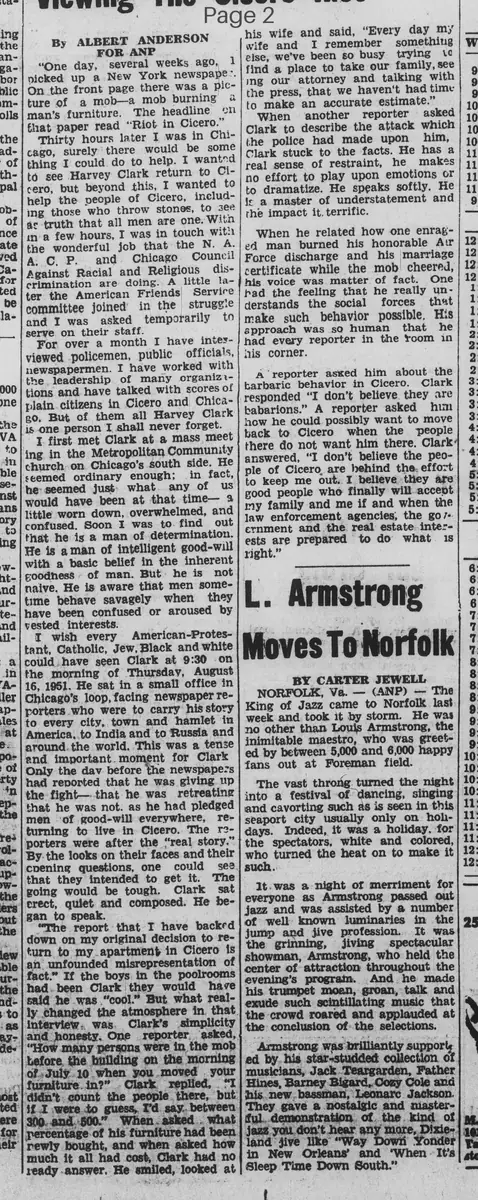
"One day, several weeks ago, I picked up a New York newspaper. On the front page there was a picture of a mob-a mob burning a man's furniture. The headline in that paper read "Riot in Cicero."
Thirty hours later I was in Chicago, surely there would be something I could do to help. I wanted to see Harvey Clark return to Cicero, but beyond this, I wanted to help the people of Cicero, including those who throw stones, to see as truth that all men are one. Within a few hours, I was in touch with the wonderful job that the N. A. A. C. P. and Chicago Council Against Racial and Religious Discrimination are doing. A little later the American Friends Service Committee joined in the struggle and I was asked temporarily to serve on their staff.
For over a month I have interviewed policemen, public officials, newspapermen. I have worked with the leadership of many organizations and have talked with scores of plain citizens in Cicero and Chicago. But of them all Harvey Clark is one person I shall never forget.
I first met Clark at a mass meeting in the Metropolitan Community church on Chicago's south side. He seemed ordinary enough; in fact, he seemed just what any of us would have been at that time - a little worn down, overwhelmed, and confused. Soon I was to find out that he is a man of determination. He is a man of intelligent good-will with a basic belief in the inherent goodness of man. But he is not naive. He is aware that men sometimes behave savagely when they have been confused or aroused by vested interests.
I wish every American-Protestant, Catholic, Jew, Black and white could have seen Clark at 9:30 on the morning of Thursday, August 16, 1951. He sat in a small office in Chicago's loop, facing newspaper reporters who were to carry his story to every city, town and hamlet in America, to India and to Russia and around the world. This was a tense and important moment for Clark. Only the day before the newspapers had reported that he was giving up the fight that he was retreating that he was not, as he had pledged men of good-will everywhere, returning to live in Cicero. The reporters were after the "real story." By the looks on their faces and their opening questions, one could see that they intended to get it. The going would be tough. Clark sat erect, quiet and composed. He began to speak.
"The report that I have backed down on my original decision to return to my apartment in Cicero is an unfounded misrepresentation of fact." If the boys in the poolrooms had been Clark they would have said he was "cool." But what really changed the atmosphere in that interview was Clark's simplicity and honesty. One reporter asked, "How many persons were in the mob before the building on the morning of July 10 when you moved your furniture in?" Clark replied, "I didn't count the people there, but if I were to guess, I'd say between 300 and 500." When asked what percentage of his furniture had been newly bought, and when asked how much it all had cost, Clark had no ready answer. He smiled, looked at his wife and said, "Every day my wife and I remember something else, we've been so busy trying to find a place to take our family, seeing our attorney and talking with the press, that we haven't had time to make an accurate estimate."
When another reporter asked Clark to describe the attack which the police had made upon him, Clark stuck to the facts. He has a real sense of restraint. He makes no effort to play upon emotions or to dramatize. He speaks softly. He is a master of understatement and the impact is terrific.
When he related how one enraged man burned his honorable Air Force discharge and his marriage certificate while the mob cheered, his voice was matter of fact. One had the feeling that he really understands the social forces that make such behavior possible. His approach was so human that he had every reporter in the room in his corner.
A reporter asked him about the barbaric behavior in Cicero. Clark responded "I don't believe they are barbarians." A reporter asked him how he could possibly want to move back to Cicero when the people there do not want him there. Clark answered, "I don't believe the people of Cicero are behind the effort to keep me out. I believe they are good people who finally will accept my family and me if and when the law enforcement agencies, the government and the real estate interests are prepared to do what is right."
What sub-type of article is it?
What themes does it cover?
What keywords are associated?
What entities or persons were involved?
Where did it happen?
Story Details
Key Persons
Location
Cicero, Chicago
Event Date
July 10, 1951; August 16, 1951
Story Details
Harvey Clark faces mob violence and burning of his furniture in Cicero on July 10, 1951, due to racial prejudice. Despite reports of retreat, on August 16, 1951, he affirms his determination to return, impressing reporters with his composure and belief in people's goodness, supported by civil rights organizations.