Thank you for visiting SNEWPapers!
Sign up free
New York Daily Tribune
New York, New York County, New York
What is this article about?
1860 New York City government inauguration: Fernando Wood returns as mayor amid political tensions; review of Tiemann's veto-heavy term; new officers, board compositions, and critiques of structure, responsibility, and unqualified officials.
Clipping
OCR Quality
Full Text
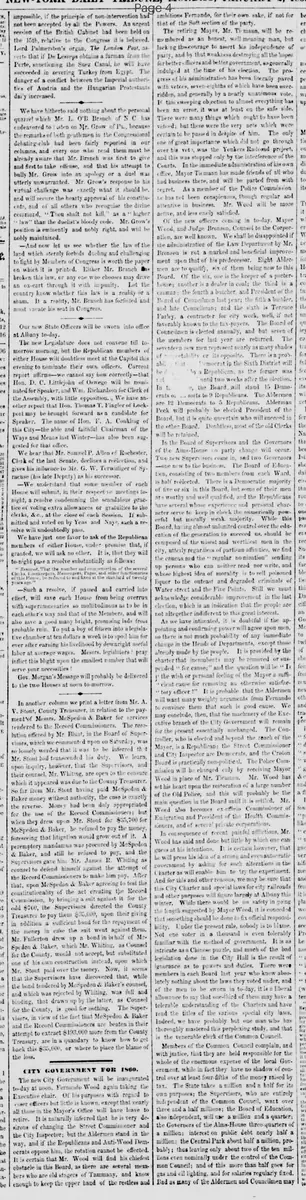
The new City Government will be inaugurated to-day at noon, Fernando Wood again taking the Executive chair. Of his purposes with regard to lesser officers but little is known, except that nearly all those in the Mayor's Office will have leave to retire. It is naturally inferred that he is very desirous of changing the Street Commissioner and the City Inspector: but the Aldermen stand in the way, and if the Republicans and Anti-Wood Democrats oppose him, the rotation cannot be effected.
It is certain that Mr. Wood will find his chiefest obstacle in this Board, as there are several members who are old stagers of Tammany, and know enough to keep the upper hand of the restless and ambitious Fernando, for their own sake, if not for that of the Soft section of the party.
The retiring Mayor, Mr. Tiemann, will be remembered as an honest, well-meaning man, but lacking the courage to assert his independence of party, and by that weakness destroying all the hopes for better officers and better government, so generally indulged at the time of his election. The progress of his administration has been literally paved with vetoes, seven-eighths of which have been over-ridden, and generally by a nearly unanimous vote. If this sweeping objection to almost everything has been an error, it was at least on the safe side. There were many things which ought to have been vetoed: but these were the very acts which were certain to be passed in despite of him. The only one of great importance which did not go through over his veto, was the Yonkers Railroad project and this was stopped only by the interference of the Courts. In the immediate administration of his own office, Mayor Tiemann has made friends of all who had business there, and will be parted from with regret. As a member of the Police Commission he has not been conspicuous, though regular and attentive in business. Mr. Wood will be more active, and less easily satisfied.
Of the new officers coming in to-day, Mayor Wood, and Judge Bronson, Counsel to the Corporation, are well known. We shall be disappointed if the administration of the Law Department by Mr. Bronson is not a marked and beneficial improvement upon that of his predecessor. Eight Aldermen are to qualify, six of them being new to this Board. Of the six, one is the keeper of a porter-house: another is a dealer in coal: the third is a carpenter: the fourth a butcher, and President of the Board of Councilmen last year: the fifth a builder, and late Councilman: and the sixth is Terence Farley, a contractor for city work, well, if not favorably known to the tax-payers. The Board of Councilmen is elected annually, and but seven of the members for last year are returned. The seventeen new men represent nearly as many shades of respectability or its opposite. There is a probability that the seat of the Democrat in the Sixth District will be contested by a Republican, as the former was not filled until two weeks after the election. In this, the Board will stand 15 Democrats of all sorts to 9 Republicans. The Aldermen are 12 Democrats to 5 Republicans. Alderman Peck will probably be elected President of the Board, but it is quite uncertain who will succeed in the other Board. Doubtless, most of the old Clerks will be retained.
In the Board of Supervisors and the Governors of the Alms-House no party change will occur. Two new Supervisors come in, and two Governors - one new to the business. The Board of Education, consisting of two members from each Ward, is half re-elected. There is a Democratic majority of five or six in this Board, but some of their men are worthy and well qualified, and the Republicans have several whose experience and personal character serve to keep in check the numerically powerful but morally weak majority. While this Board, having almost unlimited control over the education of the generation to succeed us, should be composed of the wisest and worthiest men in the city, utterly regardless of partisan affinities, we find the caucus and the "regular nomination" sending up persons who can neither read nor write, and whose highest idea of morality is to sell poisoned liquor to the outcast and degraded criminals of Water street and the Five Points. Still we must acknowledge considerable improvement in the last election, which is an indication that the people are not altogether indifferent to this great interest.
As we have intimated, it is doubtful if the appointing and confirming power will agree upon men, so there is not much probability of any immediate change in the heads of Departments, except those already made by the people. It is provided by the charter that incumbents may be removed or suspended "for cause;" and the question will be "Is the wish or personal feeling of the Mayor a sufficient cause for removing an otherwise satisfactory officer?" It is probable that the Aldermen will want many weighty arguments from Fernando to convince them that such is good cause. We may conclude, then, that the machinery of the Executive branch of the City Government will remain for the present essentially unchanged. The Controller, who is elected and beyond the reach of the Mayor, is a Republican: the Street Commissioner and City Inspector are Democrats, and the Croton Board is practically non-political. The Police Commission will be changed only by receiving Mayor Wood in place of Mr. Tiemann. Mr. Wood has set his heart upon the restoration of a large number of the Old Police, and this will probably be the main question in the Board until it is settled. Mr. Wood also becomes ex-officio Commissioner of Emigration and President of the Health Commissioners, and of several private corporations.
In consequence of recent painful afflictions, Mr. Wood has said and done but little by which one can guess at his intentions. It is certain however, that he will press his idea of a strong and even autocratic government by asking for such alterations in the Charter as will enable him to try the experiment. And for this and other reasons, we may be sure that this City Charter and special laws for city railroads and other purposes will figure largely at Albany this winter. While there would be no safety in going the length suggested by Mayor Wood, it is conceded that something should be done to fix official responsibility. Under the present rule, nobody is to blame. Not one voter in a thousand is even tolerably familiar with the method of government. It is as intricate as a Chinese puzzle, and much of the bad legislation done in the City Hall is the result of ignorance as to powers and duties. There were members in each Board last year who knew absolutely nothing about the laws they voted under, and of the men to be sworn in to-day, it is a liberal allowance to say that one-third of them may have a tolerable understanding of the Charters and have read the titles of the various special city laws. Indeed, we have probably but one man who has thoroughly mastered this perplexing study, and that is the venerable clerk of the Common Council.
Members of the Common Council complain, and with justice, that they are held responsible for the whole of the enormous expense of the local Government, while in fact they have no shadow of control over at least four-fifths of the money raised by tax. The State takes a million and a half for its own purposes; the Supervisors, who are entirely independent of the Common Council, want over three and a half millions: the Board of Education, also independent, will use a million and a quarter: the Governors of the Alms-House three quarters of a million: interest on public debt nearly half a million: the Central Park about half a million, probably: thus leaving only about two of the ten millions even nominally under the control of the Common Council; and of this more than half goes for gas and oil lighting, and for salaries regularly fixed. Bad as many of the Aldermen and Councilmen may be, foolishly and wickedly as they may have squandered the people's money, it is certainly unfair to charge everything upon them, while they are but one of five money-spending bodies all independent of each other.
But both the Local and the State Legislatures meet to-day, and between the new measures concerning us which will soon be projected in each, perhaps the people who earn and pay may find amusement and instruction, if not satisfaction, in watching the movements of those who are to eat up the Ten Million Budget for 1860.
What sub-type of article is it?
What themes does it cover?
What keywords are associated?
What entities or persons were involved?
Where did it happen?
Story Details
Key Persons
Location
New York City
Event Date
1860
Story Details
The article reports on the inauguration of Fernando Wood as New York City Mayor in 1860, reviews the honest but weak administration of outgoing Mayor Tiemann marked by overridden vetoes, describes new officers including Judge Bronson and various aldermen from diverse backgrounds, notes compositions of boards like Aldermen (12 Democrats to 5 Republicans) and Councilmen (15 Democrats to 9 Republicans), discusses no major party changes in Supervisors and Alms-House Governors, highlights issues in the Board of Education with unqualified members, anticipates conflicts in appointments and police restoration, and critiques the complex city charter leading to irresponsibility and calls for reforms.