Thank you for visiting SNEWPapers!
Sign up free
Henderson Daily Dispatch
Henderson, Vance County, North Carolina
What is this article about?
During U.S. landings at Cape Gloucester, New Britain, Japanese bombs sank an American destroyer and coastal transport ship, as announced by Navy Secretary Knox on Dec. 28. Marines advanced on the airfield amid light resistance, while at Arawe, patrols repelled enemy counterattacks.
Merged-components note: Continuation of the same article across pages.
Clippings
1 of 2
OCR Quality
Full Text
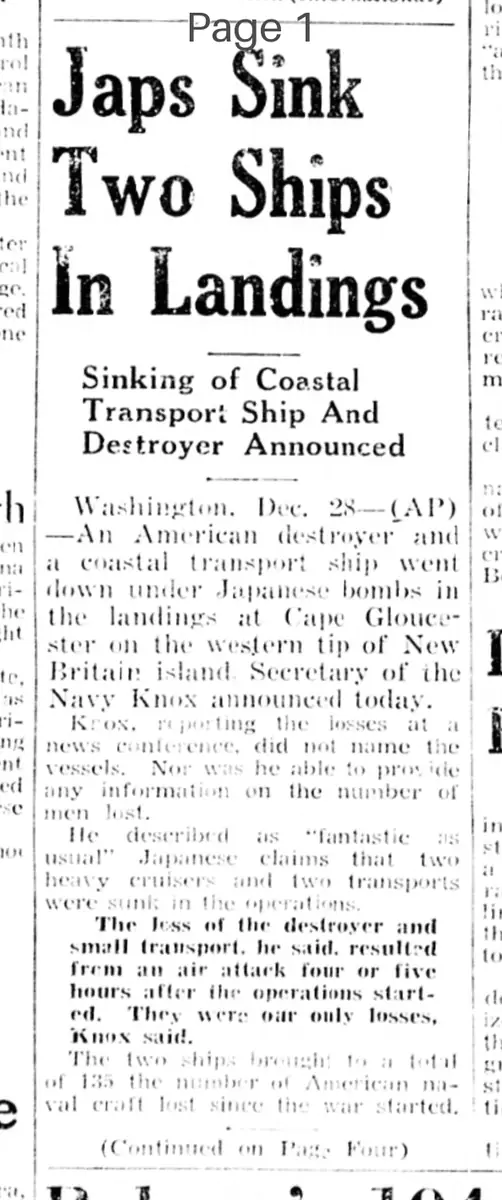
Sinking of Coastal Transport Ship And Destroyer Announced
Washington, Dec. 28--(AP)--An American destroyer and a coastal transport ship went down under Japanese bombs in the landings at Cape Gloucester on the western tip of New Britain island. Secretary of the Navy Knox announced today.
Knox, reporting the losses at a news conference, did not name the vessels. Nor was he able to provide any information on the number of men lost.
He described as "fantastic as usual" Japanese claims that two heavy cruisers and two transports were sunk in the operations.
The loss of the destroyer and small transport, he said, resulted from an air attack four or five hours after the operations started. They were our only losses, Knox said.
The two ships brought to a total of 135 the number of American naval craft lost since the war started.
(Continued on Page Four)
Japs Sink Two Ships
In Landings
(Continued from Page One)
No details on the destroyer were
given, but Knox said the small
transport was only about 100 feet
long.
Meanwhile, light and medium
tanks moved along the road to
the Cape Gloucester airdrome
as
American
Marines spread
their invasion front on two
beachheads in western New
Britain.
The
jungle-tested
Leather-
necks drove enemy opposition
from Target Hill, a 450-foot
hump near Borgen Bay which
was pounded heavily from the
air and by naval warships be-
fore the Marines landed early
Sunday morning. Japanese re-
sistance on the hill failed the
first day.
Marine artillery began shelling
the Cape Gloucester airdrome, and
light and medium tanks were last
reported rumbling along the coastal
track six miles west and north of
the Gloucester airfields.
In addition, Japanese positions at
Borgen Bay also came under attack
of the artillery batteries.
On the Arawe front, 60 miles
northeast of Gloucester, advance
patrols of the U. S. Sixth Army
were
forced to withdraw under
three enemy counterattacks, but a
spokesman at Allied headquarters
said the Americans made such a
firm stand that the enemy broke
contact the following morning.
The army patrols are now fan-
ning out again to the north and east.
the spokesman said. The American
troops landed at Arawe, on the
southwest coast of the island. De-
cember 15.
What sub-type of article is it?
What keywords are associated?
What entities or persons were involved?
Where did it happen?
Foreign News Details
Primary Location
Cape Gloucester, New Britain
Event Date
Dec. 28 (Announcement); Landings Early Sunday Morning; Arawe Dec. 15
Key Persons
Outcome
american destroyer and coastal transport ship sunk; no men lost details; total u.s. naval losses since war: 135; japanese claims of sinking two cruisers and two transports dismissed; light enemy resistance at cape gloucester; u.s. patrols repelled counterattacks at arawe
Event Details
Japanese bombs sank U.S. destroyer and small transport during landings at Cape Gloucester. Marines advanced on airdrome with tank support, overran Target Hill near Borgen Bay after pre-invasion bombardment. Artillery shelled airfield and Japanese positions. At Arawe, U.S. Sixth Army patrols withdrew under counterattacks but held firm, resuming advance.