Thank you for visiting SNEWPapers!
Sign up free
The Kentucky Gazette
Lexington, Fayette County, Kentucky
What is this article about?
A letter to the Kentucky Gazette refuting a 'Layman's' biblical defense of slavery. The author argues that scriptural permissions for bondage were specific to ancient Jews, do not apply to modern Americans, violate natural equality, and condemns slavery as theft and inhumanity. Signed 'GELON.'
Merged-components note: This is a continuation of the letter to the editor across pages, signed GELON. The label was changed from 'editorial' for the second part to 'letter_to_editor' as it matches the format and content of a reader letter responding to another piece.
Clippings
1 of 2
OCR Quality
Full Text
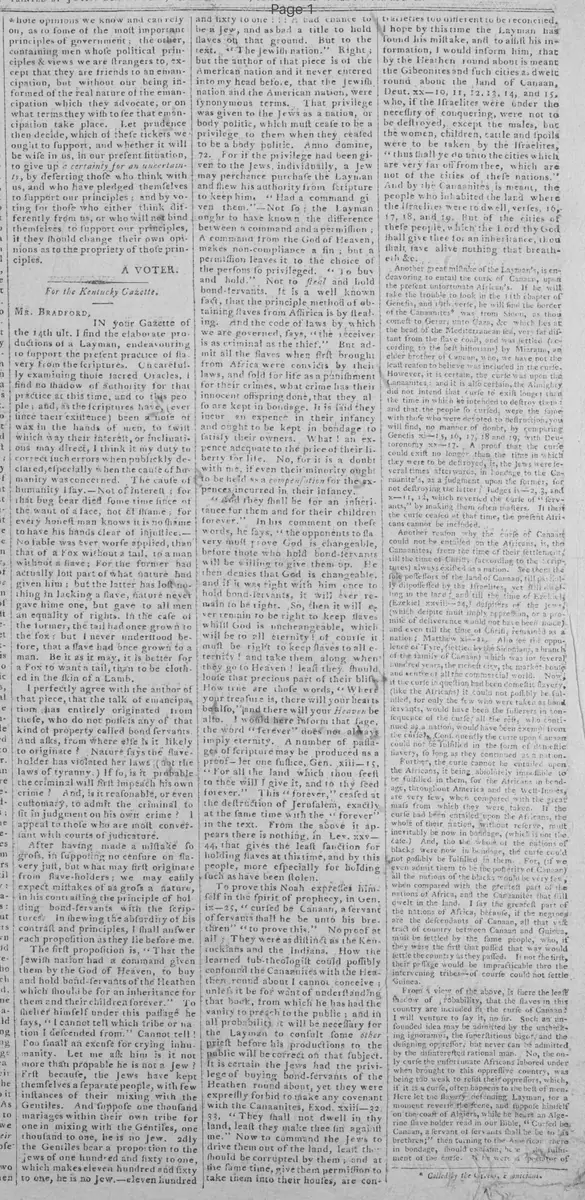
MR. BRADFORD,
IN your Gazette of the 14th ult. I find the elaborate productions of a Layman, endeavouring to support the present practice of slavery from the scriptures. Carefully examining those sacred Oracles, I find no shadow of authority for that practice at this time, and to this people; and, as the scriptures have, (ever since their existence) been a nose of wax in the hands of men, to twist which way their interest, or inclinations may direct, I think it my duty to correct such errors when publicly declared, especially when the cause of humanity was concerned. The cause of humanity I say. Not of interest: for that bug bear died some time since of the want of a face, not of shame: for every honest man knows it is no shame to have his hands clear of injustice. No fable was ever worse applied, than that of a Fox without a tail, to a man without a slave: For the former had actually lost part of what nature had given him; but the latter has lost nothing in lacking a slave, nature never gave him one, but gave to all men an equality of rights. In the case of the former, the tail had once grown to the fox; but I never understood before, that a slave had once grown to a man. Be it as it may, it is better for a Fox to want a tail, than to be clothed in the skin of a Lamb.
I perfectly agree with the author of that piece, that the talk of emancipation has entirely originated from those, who do not possess any of that kind of property called bond servants. And asks, from where else is it likely to originate? Nature says the slave-holder has violated her laws (not the laws of tyranny.) If so, is it probable the criminal will first impeach his own crime! And, is it reasonable, or even customary, to admit the criminal to sit in judgment on his own crime? I appeal to those who are most conversant with courts of judicature.
After having made a mistake so gross, in supposing no censure on slavery just, but what may first originate from slave-holders; we may easily expect mistakes of as gross a nature, in his contrasting the principle of holding bond-servants with the scriptures. In shewing the absurdity of his contrast and principles, I shall answer each proposition as they lie before me.
The first proposition is, That the Jewish nation had a command given them by the God of Heaven, to buy and hold bond-servants of the Heathen which should be for an inheritance for them and their children forever. To shelter himself under this passage he says, "I cannot tell which tribe or nation I descended from." Cannot tell! Too small an excuse for crying inhumanity. Let me ask him is it not more than probable he is not a Jew? First because, the Jews have kept themselves a separate people, with few instances of their mixing with the Gentiles. And suppose one thousand marriages within their own tribe for one in mixing with the Gentiles, one thousand to one, he is no Jew. 2dly the Gentiles bear a proportion to the Jews of one hundred and sixty to one, which makes eleven hundred and sixty to one, he is no Jew.-eleven hundred and sixty to one!! A bad chance to be a Jew, and as bad a title to hold slaves on that ground. But to the text. "The Jewish nation." Right; but the author of that piece is of the American nation and it never entered into my head before, that the Jewish nation and the American nation, were synonymous terms. That privilege was given to the Jews as a nation, or body politic, which must cease to be a privilege to them when they ceased to be a body politic. Anno Domini, 72. For if the privilege had been given to the Jews, individually, a Jew may perchance purchase the Layman and shew his authority from scripture to keep him. "Had a command given them." Not so: the Layman ought to have known the difference between a command and a permission; A command from the God of Heaven, makes non-compliance a sin; but a permission leaves it to the choice of the persons so privileged. To buy and hold. Not to steal and hold bond-servants. It is a well known fact, that the principal method of obtaining slaves from Africa is by stealing. And the code of laws by which we are governed, says, "the receiver is as criminal as the thief." But admit all the slaves when first brought from Africa were convicts by their laws, and sold for life as a punishment for their crimes, what crime has their innocent offspring done, that they also are kept in bondage. It is said they incur an expense in their infancy and ought to be kept in bondage to satisfy their owners. What! an expense adequate to the price of their liberty for life. No, for it is a doubt with me, if even their minority ought to be held as a compensation for the expenses incurred in their infancy.
"And they shall be for an inheritance for them and for their children forever." In his comment on these words, he says, "the opponents to slavery must prove God is chargeable, before those who hold bond-servants will be willing to give them up. He then denies that God is changeable, and if it was right with him once to hold bond-servants, it will ever remain to be right. So, then it will ever remain to be right to keep slaves whilst God is unchangeable, which will be to all eternity! of course it must be right to keep slaves to all eternity! and take them along when they go to Heaven! lest they should loose that precious part of their bliss. How true are those words, "Where your treasure is, there will your hearts be also," and there will your Heaven be also. I would here inform that sage, the word "forever" does not always imply eternity. A number of passages of scripture may be produced as a proof-let one suffice, Gen. xiii-15, "For all the land which thou seest to thee will I give it, and to thy seed forever." This "forever," ceased at the destruction of Jerusalem, exactly at the same time with the "forever" in the text. From the above it appears there is nothing, in Lev. xxv-44, that gives the least sanction for holding slaves at this time, and by this people, more especially for holding such as have been stolen.
To prove this Noah expressed himself in the spirit of prophecy, in Gen. ix-25, "cursed be Canaan, a servant of servants shall he be unto his brethren." To prove this. No proof at all; They were as distinct as the Kentuckians and the Indians. How the learned tub-theologian could possibly confound the Canaanites with the Heathen round about I cannot conceive; unless it be for want of understanding that book, from which he has had the vanity to preach to the public; and in all probability it will be necessary for the Layman to consult some other priest before his productions to the public will be correct on that subject.
It is certain the Jews had the privilege of buying bond-servants of the Heathen round about, yet they were expressly forbid to make any covenant with the Canaanites, Exod. xxiii-32, 33, "They shall not dwell in thy land, lest they make thee sin against me." Now to command the Jews to drive them out of the land, lest they should be corrupted by them; and at the same time, give them permission to take them into their houses, are contrarieties too different to be reconciled,
I hope by this time the Layman has found his mistake, and to assist his information, I would inform him, that by the Heathen round about is meant the Gibeonites and such cities as dwelt round about the land of Canaan, Deut. xx-10, 11, 12, 13, 14, and 15, who, if the Israelites were under the necessity of conquering, were not to be destroyed, except the males, but the women, children, cattle and spoils were to be taken by the Israelites, "thus shall ye do unto the cities which are very far off from thee, which are not of the cities of these nations." And by the Canaanites is meant, the people who inhabited the land where the Israelites were to dwell, verses, 16. 17, 18, and 19. But of the cities of these people, which the Lord thy God shall give thee for an inheritance, thou shalt, have alive nothing that breatheth &c.
Another great mistake of the Layman's, is endeavoring to entail the curse of Canaan, upon the present unfortunate Africans. If he will take the trouble to look in the 10th chapter of Genesis, and 19th verse, he will find the border of the Canaanites was from Sidon, as thou comest to Gerar; unto Gaza, &c which lies at the head of the Mediterranean sea, very far distant from the slave coast, and was settled (according to the best historians) by Mizraim, an elder brother of Canaan, who, we have not the least reason to believe was included in the curse. However, it is certain, the curse was upon the Canaanites: and it is also certain, the Almighty did not intend that curse to exist longer than the time in which he intended to destroy them: and that the people so cursed, were the same with those who were devoted to destruction, you will find, no manner of doubt, by comparing Genesis xi-15, 16, 17, 18 and 19, with Deuteronomy xx-17. A proof that the curse could exist no longer than the time in which they were to be destroyed, is, the Jews were several times afterwards, in bondage to the Canaanites, as a judgment upon the former, for not destroying the latter Judges iv-2. 3, and x-11, 13, which reversed the curse of "servants," by making them often masters. If then the curse ceased at that time, the present Africans cannot be included.
Another reason why the curse of Canaan could not be entailed on the Africans. is, the Canaanites, from the time of their settlement; till the time of Christ, (according to the scriptures) always existed as a nation. See the sole possessors of the land of Canaan, till partly dispossessed by the Israelites, yet still dwelling in the land; and till the time of Ezekiel (Ezekiel xxviii-24,) despisers (the Jews which despite must imply oppression, or a promise of deliverance would not have been made) and even till the time of Christ, remained as a nation; Matthew xi-21. Also see the opulence of Tyre, (settled by the Sidonians, a branch of the family of Canaan) which was for several hundred years, the richest city, the market house and center of all the commercial world. Now if the curse in question had been domestic slavery, (like the Africans) it could not possibly be fulfilled, for only the few who were taken as bond servants, would have been the sufferers in consequence of the curse; all the rest, who continued as a nation, would have been exempt from the curse. Consequently the curse upon Canaan could not be fulfilled in the form of domestic slavery, so long as they continued as a nation.
Further, the curse cannot be entailed upon the Africans, it being absolutely impossible to be fulfilled in them, for the Africans in bondage, throughout America and the west-Indies, are very few, when compared with the great mass from which they were taken. If the curse had been entailed upon the Africans, the whole of their nation, without reserve, must inevitably be now in bondage, (which is not the case.) And, tho the whole of the nations of blacks were now in bondage, the curse could not possibly be fulfilled in them. For, (if we even admit them to be the posterity of Canaan) all the nations of the blacks would be very few when compared with the greatest part of the nations of Africa, and the Canaanites that still dwelt in the land, I say the greatest part of the nations of Africa, because, if the negroes are the descendants of Canaan, all that vast tract of country between Canaan and Guinea, must be settled by the same people, who, if they were the first that passed that way would settle the country as they passed. If not the first, their passage would be impracticable thro the intervening tribes--of course could not settle Guinea.
From a view of the above, is there the least shadow of probability, that the slaves in this country are included in the curse of Canaan? I will venture to say it, no sir. Such an unfounded idea may be admitted by the unthinking ignoramus, the superstitious bigot, and the designing oppressor, but never can be admitted by the disinterested rational man. No, the only curse the unfortunate Africans labored under when brought to this oppressive country, was being too weak to resist their oppressors, which, if it is a curse, often happens to the best of men.
Here let the slavery defending Layman, for a moment reverse the scene, and suppose himself on the coast of Algiers, while he hears an Algerian slave holder read in our Bible, "Cursed be Canaan, a servant of servants shall he be to his brethren;" then turning to the American there in bondage, should exclaim, he is the fulfillment of the curse.
Now if he were a spectator of
* Called by the Cretans, Ionians.
Ah! such a scene, what would be his language—or rather, what the feelings of his heart? How would his soul be fired with just indignation at the profanation of the Scriptures, when appropriated as a covering for the basest of crimes?
And will not such indignation devolve upon himself, if he be the oppressor of as innocent, if not a more innocent people than the Americans? But I forbear. May the conscience of every slave holder, never forbear an application to himself.
GELON.
What sub-type of article is it?
What themes does it cover?
What keywords are associated?
What entities or persons were involved?
Letter to Editor Details
Author
Gelon
Recipient
Mr. Bradford
Main Argument
scriptural permissions for slavery were specific to the ancient jewish nation and do not authorize modern american slavery, which violates natural equality, involves theft from africa, and condemns innocent offspring to bondage; the curse of canaan does not apply to africans.
Notable Details