Thank you for visiting SNEWPapers!
Sign up free
Rhode Island American, Statesman And Providence Gazette
Providence, Providence County, Rhode Island
What is this article about?
Proceedings of the 21st Congress on Tuesday, March 9, and Wednesday: Senate debates Foot resolutions, changes meeting time, considers bills on lights for vessels, coins, and deaf institutions; rejects Maj. Lee's nomination. House seats new member, reports bills, debates judiciary and Arkansas court powers, rejects franking extension.
Clipping
OCR Quality
Full Text
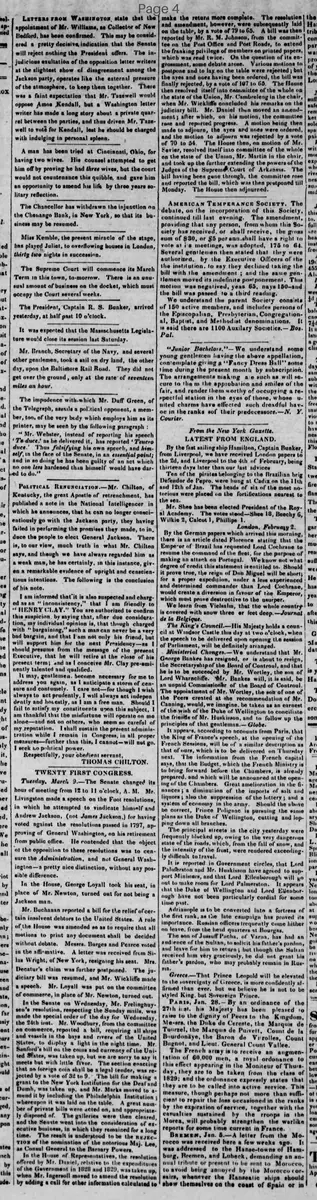
Tuesday, March 9.—The Senate changed its hour of meeting from 12 to 11 o'clock, A. M. Mr. Livingston made a speech on the Foot resolutions, in which he attempted to vindicate himself and Andrew Jackson, (not James Jackson,) for having voted against the resolutions passed in 1797, approving of General Washington, on his retirement from public office. He contended that the object of the opposition to these resolutions was to censure the Administration, and not General Washington—a pretty nice distinction, without any possible difference.
In the House, George Loyall took his seat, in place of Mr. Newton, turned out for not being a Jackson man. Mr. Buchanan reported a bill for the relief of certain insolvent debtors to the United States. A rule of the House was amended so as to require that all motions to print any document shall be decided without debate. Messrs. Burges and Pearce voted in the affirmative. A letter was received from Silas Wright, of New York, resigning his seat. Mrs. Decatur's claim was further postponed. The judiciary bill was resumed, and Mr. Wickliffe made a speech. Mr. Loyall was put on the committee of commerce, in place of Mr. Newton, turned out.
In the Senate on Wednesday, Mr. Frelinghuysen's resolution, respecting the Sunday mails, was made the special order of the day for Wednesday, the 24th inst. Mr. Woodbury, from the committee on commerce, reported a bill, requiring all ships and vessels in the bays and rivers of the United States, to display a light in the night time. Mr. Sanford's bill on the coins and currency of the United States, was taken up, but we are sorry to say it meets but with little favor. The section enacting that no foreign coin shall be a legal tender, was rejected by a vote of 32 to 9. The bill for making a grant to the New York Institution for the Deaf and Dumb, was taken up, and Mr. Marks moved to amend it by including the Philadelphia Institution; whereupon it was laid on the table. A great number of private bills were acted on, and appropriately disposed of. The galleries were then cleared, and the Senate went into the consideration of executive business, in which they remained for a long time. The result is understood to be the Rejection of the nomination of the notorious Maj. Lee as Consul General to the Barbary Powers.
In the House of Representatives, the resolution offered by Mr. Daniel, relative to the expenditures of the Government in 1828 and 1829, was taken up, when Mr. Ingersoll moved to amend the resolution by adding a call for other information calculated to make the return more complete. The resolution and amendment, however, were subsequently laid on the table, by a vote of 79 to 65. A bill was then reported by Mr. R. M. Johnson, from the committee on the Post Office and Post Roads, to extend the franking privilege of members on printed papers, which was read twice. On the question of its engrossment, some debate arose. Various motions to postpone and to lay on the table were rejected; but the ayes and noes having been ordered, the bill was finally rejected, by a vote of 107 to 65. The House then resolved itself into committee of the whole on the state of the Union, Mr. Cambreleng in the chair, when Mr. Wickliffe concluded his remarks on the judiciary bill. Mr. Daniel then moved an amendment; after which, on his motion, the committee rose and reported progress. A motion being then made to adjourn, the ayes and noes were ordered, and the motion to adjourn was rejected by a vote of 70 to 54. The House then, on motion of Mr. Sevier, resolved itself into committee of the whole on the state of the Union, Mr. Martin in the chair, and took up the bill further extending the powers of the Judges of the Supreme Court of Arkansas. The bill having been gone through, the committee rose and reported the bill, which was then postponed till Monday. The House then adjourned.
What sub-type of article is it?
What keywords are associated?
What entities or persons were involved?
Where did it happen?
Domestic News Details
Primary Location
Washington, D.C.
Event Date
Tuesday, March 9 And Wednesday
Key Persons
Outcome
senate rejects section on foreign coins (32-9), lays deaf institution bill on table, rejects maj. lee's nomination; house lays resolution on expenditures on table (79-65), rejects franking privilege bill (107-65), rejects adjournment (70-54), postpones arkansas court bill to monday; george loyall seated replacing mr. newton; silas wright resigns.
Event Details
The 21st Congress convened with Senate changing meeting time to 11 A.M., Mr. Livingston speaking on Foot resolutions defending votes against 1797 Washington resolutions; House seats George Loyall replacing Mr. Newton, reports insolvent debtors bill, amends printing rule, receives Silas Wright's resignation, postpones Mrs. Decatur's claim, resumes judiciary bill with Mr. Wickliffe's speech, appoints Loyall to commerce committee. On Wednesday, Senate sets Sunday mails resolution for March 24, reports vessel lights bill, considers but rejects part of coins bill, amends and tables deaf institutions grant, disposes private bills, rejects Maj. Lee's nomination in executive session. House debates and tables expenditures resolution, reports and rejects franking bill, debates judiciary bill in committee, considers and postpones Arkansas Supreme Court bill.