Thank you for visiting SNEWPapers!
Sign up free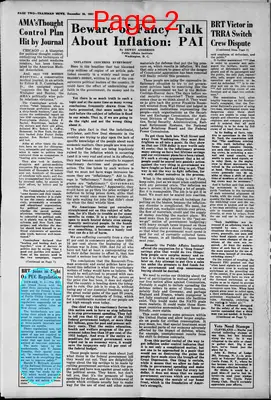
Story
December 24, 1951
Trainman News
Indianapolis, Marion County, Indiana
What is this article about?
In Newark, NJ, the BRT unions and Pennsy challenge PUC's proposed frequent physical exams for railroad workers, citing no proven safety benefits despite current annual or biennial requirements for those over/under 40.
Clipping
OCR Quality
98%
Excellent
Full Text
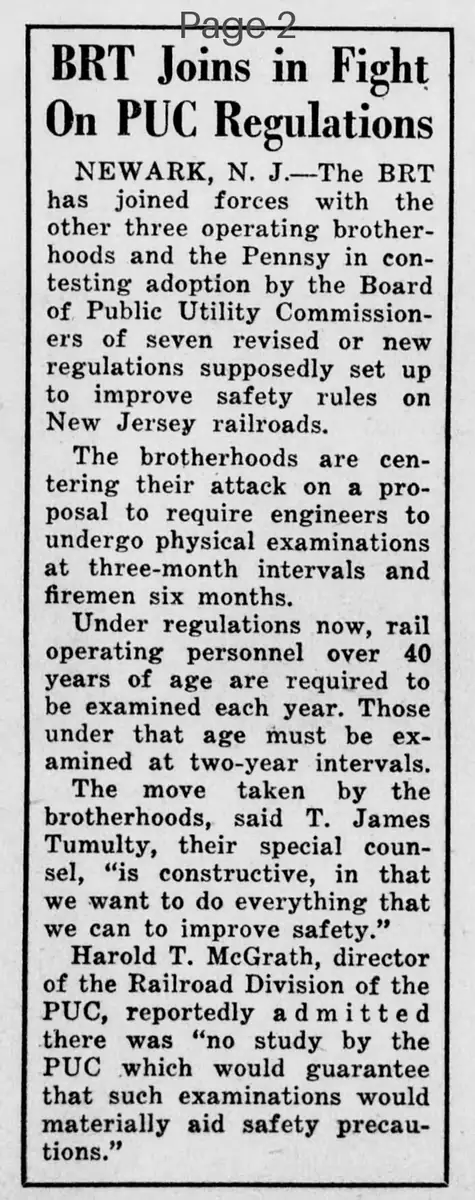
BRT Joins in Fight On PUC Regulations
NEWARK, N. J.--The BRT has joined forces with the other three operating brotherhoods and the Pennsy in contesting adoption by the Board of Public Utility Commissioners of seven revised or new regulations supposedly set up to improve safety rules on New Jersey railroads.
The brotherhoods are centering their attack on a proposal to require engineers to undergo physical examinations at three-month intervals and firemen six months.
Under regulations now, rail operating personnel over 40 years of age are required to be examined each year. Those under that age must be examined at two-year intervals.
The move taken by the brotherhoods, said T. James Tumulty, their special counsel, "is constructive, in that we want to do everything that we can to improve safety."
Harold T. McGrath, director of the Railroad Division of the PUC, reportedly admitted there was "no study by the PUC which would guarantee that such examinations would materially aid safety precautions."
NEWARK, N. J.--The BRT has joined forces with the other three operating brotherhoods and the Pennsy in contesting adoption by the Board of Public Utility Commissioners of seven revised or new regulations supposedly set up to improve safety rules on New Jersey railroads.
The brotherhoods are centering their attack on a proposal to require engineers to undergo physical examinations at three-month intervals and firemen six months.
Under regulations now, rail operating personnel over 40 years of age are required to be examined each year. Those under that age must be examined at two-year intervals.
The move taken by the brotherhoods, said T. James Tumulty, their special counsel, "is constructive, in that we want to do everything that we can to improve safety."
Harold T. McGrath, director of the Railroad Division of the PUC, reportedly admitted there was "no study by the PUC which would guarantee that such examinations would materially aid safety precautions."
What sub-type of article is it?
Historical Event
What themes does it cover?
Justice
What keywords are associated?
Railroad Safety
Labor Dispute
Physical Examinations
Puc Regulations
What entities or persons were involved?
T. James Tumulty
Harold T. Mcgrath
Where did it happen?
Newark, N. J.
Story Details
Key Persons
T. James Tumulty
Harold T. Mcgrath
Location
Newark, N. J.
Story Details
The BRT joins other brotherhoods and Pennsy to contest PUC's new safety regulations requiring more frequent physical exams for railroad engineers and firemen, arguing lack of evidence for improved safety.