Thank you for visiting SNEWPapers!
Sign up free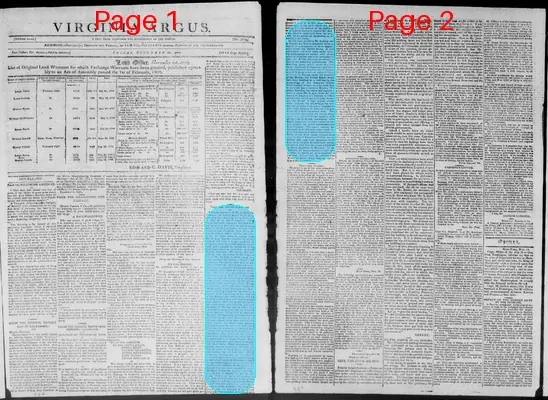
Virginia Argus
Richmond, Virginia
What is this article about?
Editorial from Boston Chronicle blames pro-British American factions for sabotaging Mr. Erskine's diplomatic negotiations, accusing them of plotting with British minister Canning to undermine US government, potentially leading to civil war; urges electing true American patriots.
Merged-components note: This is a continuation of the editorial piece from the Boston Chronicle discussing Mr. Erskine, Jackson, and British influence in America; the domestic_news label on the second part is incorrect as the content is opinionated and analytical.
Clippings
1 of 2
OCR Quality
Full Text
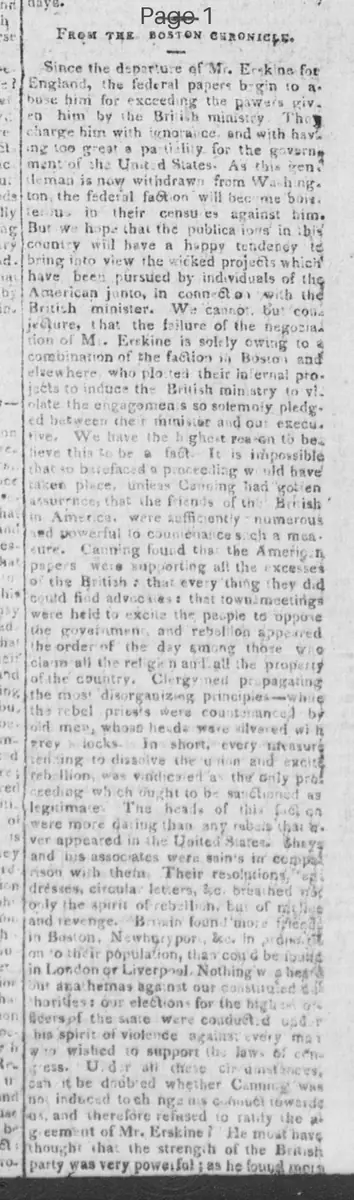
Since the departure of Mr. Erskine for England, the federal papers begin to abuse him for exceeding the powers given to him by the British ministry. They charge him with ignorance, and with having too great a partiality for the government of the United States. As this gentleman is now withdrawn from Washington, the federal faction will become bolder, in their censures against him.
But we hope that the publications in this country will have a happy tendency to bring into view the wicked projects which have been pursued by individuals of the American junto, in connection with the British minister. We cannot but conclude, that the failure of the negotiation of Mr. Erskine is solely owing to a combination of the faction Boston and elsewhere who plotted their infernal projects to induce the British ministry to violate the engagements so solemnly pledged between the British minister and our executive. We have the highest reason to believe this to be a fact. It is impossible that so barefaced a proceeding would have taken place, unless Canning had gotten assurance, that the friends of the British in America were sufficiently numerous and powerful to countenance such a measure. Canning found that the American papers were supporting all the excesses of the British: that every thing they did could find advocates: that town-meetings were held to excite the people to oppose the government, and rebellion appeared the order of the day among those who claimed all the religion and all the property of the country. Clergy men propagating the most disorganizing principles—while the rebel presses were countenanced by old men, whose grey locks, in short, every thing tending to dissolve the union and excite rebellion, was vindicated as the only proceeding which ought to be sanctioned as legitimate. The heads of this faction were more daring than any rebel that ever appeared in the United States. Shays and his associates were innocents in comparison with them. Their resolutions, addresses, circular-letters, &c. breathed not only the spirit of rebellion, but of malice and revenge. Bentin found more friends in Boston, Newberryport, &c. in proportion to their population, than could be found in London or Liverpool. Nothing when General Hamilton was brought against our constituted authorities: or election for the highest office of the state were conducted under this spirit of violence against every man who wished to support the law, congress. Under all these circumstances,
Can it be doubted whether Canning was not induced to change his conduct towards us, and therefore refused to ratify the agreement of Mr. Erskine? He must have thought that the strength of the British party was very powerful; as he found more British feeling in America than in England. advocates than he at first contemplated. Encouraged by the spirit which was prevailing, and the success of the elections, there is every reason to suppose that Jackson's mission originated from the prospects which presented themselves so favorable to his views.
In this state of affairs, Mr. Erskine was to become a victim to measures to be adopted in consequence of these appearances within the United States. A new experiment was to be made under existing circumstances; another trial of the strength of parties was to be attempted to place the British influence paramount to that of the American government. The American junto rallied under this new banner displayed by Canning; and there is every reason to suppose, that if the success of Bonaparte had not checked the operations in Europe under the direction of the British, the United States would have been involved in a civil war by the proceedings of this desperate faction, which seemed to have no other wish than to prostrate our country to Britain. We cannot therefore but repeat our expectations that when Mr. Erskine finds that this faction in America are desirous to reflect on his honor and integrity, in order to support the British in their present claims under Jackson, he will divulge the base motives of some of the junto, whose conduct while residing in America it is probable he is well acquainted with. This was exactly the case in the course of our revolution. Church, Duke, together with all theribe of British emissaries, were finally discovered in their traitorous correspondence by secret communications from England. We cannot suppose that the ministry would have taken such unprecedented ground unless they were confident of the most ample support from their friends in America. Neither can we believe that such high measures would have been adopted by individuals among us unless they had the same confidence in being supported in England. In our elections, we must endeavor to place men in office to whom no such suspicion is attached. Let us have the advocates for American honor, rather than the vindicators of British perfidy.
What sub-type of article is it?
What keywords are associated?
What entities or persons were involved?
Editorial Details
Primary Topic
Failure Of Erskine Negotiation Due To Pro British American Factions
Stance / Tone
Strongly Anti Pro British Faction And Pro American Government
Key Figures
Key Arguments