Thank you for visiting SNEWPapers!
Sign up free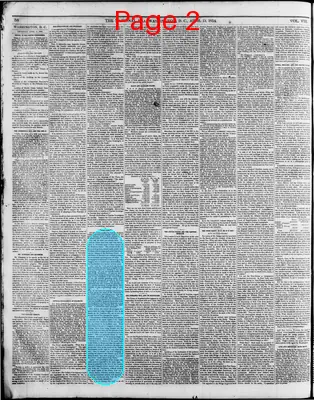
Editorial
April 13, 1854
The National Era
Washington, District Of Columbia
What is this article about?
Editorial argues that excluding slavery from Nebraska does not violate equal rights of Southern States, citing Judge Douglas's 1850 speech and inconsistencies like bans on slave trade and slaves in D.C. It critiques pro-slavery logic as absurd.
Clipping
OCR Quality
98%
Excellent
Full Text
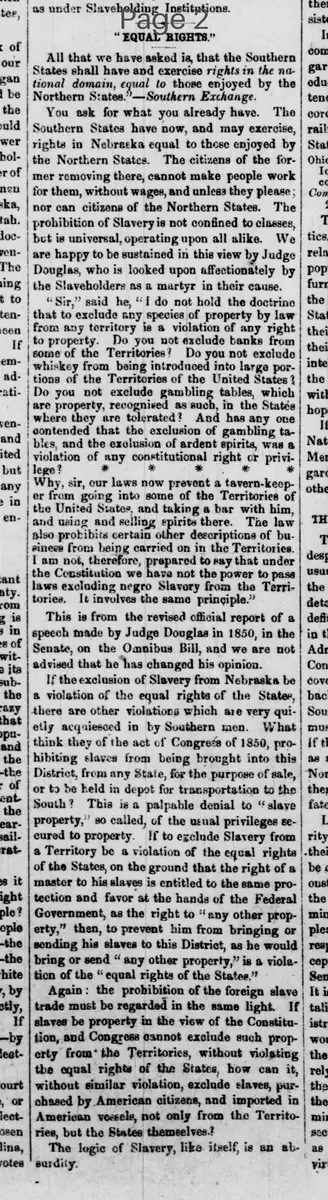
"EQUAL RIGHTS."
All that we have asked is, that the Southern States shall have and exercise rights in the national domain, equal to those enjoyed by the Northern States."—Southern Exchange.
You ask for what you already have. The Southern States have now, and may exercise rights in Nebraska equal to those enjoyed by the Northern States. The citizens of the former removing there, cannot make people work for them, without wages, and unless they please; nor can citizens of the Northern States. The prohibition of Slavery is not confined to classes, but is universal, operating upon all alike. We are happy to be sustained in this view by Judge Douglas, who is looked upon affectionately by the Slaveholders as a martyr in their cause.
"Sir," said he, "I do not hold the doctrine that to exclude any species of property by law from any territory is a violation of any right to property. Do you not exclude banks from some of the Territories? Do you not exclude whiskey from being introduced into large portions of the Territories of the United States? Do you not exclude gambling tables, which are property, recognised as such, in the States where they are tolerated? And has any one contended that the exclusion of gambling tables, and the exclusion of ardent spirits, was a violation of any constitutional right or privilege?
Why, sir, our laws now prevent a tavern-keeper from going into some of the Territories of the United States, and taking a bar with him, and using and selling spirits there. The law also prohibits certain other descriptions of business from being carried on in the Territories. I am not, therefore, prepared to say that under the Constitution we have not the power to pass laws excluding negro Slavery from the Territories. It involves the same principle."
This is from the revised official report of a speech made by Judge Douglas in 1850, in the Senate, on the Omnibus Bill, and we are not advised that he has changed his opinion.
If the exclusion of Slavery from Nebraska be a violation of the equal rights of the States, there are other violations which are very quietly acquiesced in by Southern men. What think they of the act of Congress of 1850, prohibiting slaves from being brought into this District, from any State, for the purpose of sale or to be held in depot for transportation to the South? This is a palpable denial to "slave property," so called, of the usual privileges secured to property. If to exclude Slavery from a Territory be a violation of the equal rights of the States, on the ground that the right of a master to his slaves is entitled to the same protection and favor at the hands of the Federal Government, as the right to "any other property," then, to prevent him from bringing or sending his slaves to this District, as he would bring or send "any other property," is a violation of the "equal rights of the States."
Again: the prohibition of the foreign slave trade must be regarded in the same light. If slaves be property in the view of the Constitution, and Congress cannot exclude such property from the Territories, without violating the equal rights of the States, how can it, without similar violation, exclude slaves, purchased by American citizens, and imported in American vessels, not only from the Territories, but the States themselves?
The logic of Slavery, like itself, is an absurdity.
Should Congress pass an act, authorizing the hemp-growers of Missouri to remove to Nebraska, and hold their slaves there, but prohibiting the introduction of slaves from any other quarter; or, should it allow the immigrant from the South in that Territory to hold a certain number of slaves, but forbid the Northern immigrant to hold any, it would be guilty of a wicked and wanton discrimination: but there can be no violation of the equal rights of any State, so long as the citizens of all are allowed to immigrate into United States Territory, and are there placed by the laws on an equal footing.
Were Utah at this moment "a Sovereign State," and should the Mormons claim the right of settling in Nebraska with their seraglios, on the ground of the equality of the States, would the slaveholders deny the power of Congress, or the Territorial Legislature, to pass laws for the prohibition of polygamy or bigamy? If consistent, they would; for, to exclude polygamy from United States territory, while a single State recognised it as one of its institutions, would, according to the reasoning of these gentlemen, be a violation of its equal right to the public domain!
All that we have asked is, that the Southern States shall have and exercise rights in the national domain, equal to those enjoyed by the Northern States."—Southern Exchange.
You ask for what you already have. The Southern States have now, and may exercise rights in Nebraska equal to those enjoyed by the Northern States. The citizens of the former removing there, cannot make people work for them, without wages, and unless they please; nor can citizens of the Northern States. The prohibition of Slavery is not confined to classes, but is universal, operating upon all alike. We are happy to be sustained in this view by Judge Douglas, who is looked upon affectionately by the Slaveholders as a martyr in their cause.
"Sir," said he, "I do not hold the doctrine that to exclude any species of property by law from any territory is a violation of any right to property. Do you not exclude banks from some of the Territories? Do you not exclude whiskey from being introduced into large portions of the Territories of the United States? Do you not exclude gambling tables, which are property, recognised as such, in the States where they are tolerated? And has any one contended that the exclusion of gambling tables, and the exclusion of ardent spirits, was a violation of any constitutional right or privilege?
Why, sir, our laws now prevent a tavern-keeper from going into some of the Territories of the United States, and taking a bar with him, and using and selling spirits there. The law also prohibits certain other descriptions of business from being carried on in the Territories. I am not, therefore, prepared to say that under the Constitution we have not the power to pass laws excluding negro Slavery from the Territories. It involves the same principle."
This is from the revised official report of a speech made by Judge Douglas in 1850, in the Senate, on the Omnibus Bill, and we are not advised that he has changed his opinion.
If the exclusion of Slavery from Nebraska be a violation of the equal rights of the States, there are other violations which are very quietly acquiesced in by Southern men. What think they of the act of Congress of 1850, prohibiting slaves from being brought into this District, from any State, for the purpose of sale or to be held in depot for transportation to the South? This is a palpable denial to "slave property," so called, of the usual privileges secured to property. If to exclude Slavery from a Territory be a violation of the equal rights of the States, on the ground that the right of a master to his slaves is entitled to the same protection and favor at the hands of the Federal Government, as the right to "any other property," then, to prevent him from bringing or sending his slaves to this District, as he would bring or send "any other property," is a violation of the "equal rights of the States."
Again: the prohibition of the foreign slave trade must be regarded in the same light. If slaves be property in the view of the Constitution, and Congress cannot exclude such property from the Territories, without violating the equal rights of the States, how can it, without similar violation, exclude slaves, purchased by American citizens, and imported in American vessels, not only from the Territories, but the States themselves?
The logic of Slavery, like itself, is an absurdity.
Should Congress pass an act, authorizing the hemp-growers of Missouri to remove to Nebraska, and hold their slaves there, but prohibiting the introduction of slaves from any other quarter; or, should it allow the immigrant from the South in that Territory to hold a certain number of slaves, but forbid the Northern immigrant to hold any, it would be guilty of a wicked and wanton discrimination: but there can be no violation of the equal rights of any State, so long as the citizens of all are allowed to immigrate into United States Territory, and are there placed by the laws on an equal footing.
Were Utah at this moment "a Sovereign State," and should the Mormons claim the right of settling in Nebraska with their seraglios, on the ground of the equality of the States, would the slaveholders deny the power of Congress, or the Territorial Legislature, to pass laws for the prohibition of polygamy or bigamy? If consistent, they would; for, to exclude polygamy from United States territory, while a single State recognised it as one of its institutions, would, according to the reasoning of these gentlemen, be a violation of its equal right to the public domain!
What sub-type of article is it?
Slavery Abolition
Constitutional
What keywords are associated?
Equal Rights
Slavery Exclusion
Nebraska Territory
Judge Douglas
Slave Trade Prohibition
Constitutional Power
What entities or persons were involved?
Southern States
Northern States
Judge Douglas
Slaveholders
Congress
Mormons
Editorial Details
Primary Topic
Exclusion Of Slavery From Nebraska Territories
Stance / Tone
Anti Slavery Argument Defending Territorial Exclusion
Key Figures
Southern States
Northern States
Judge Douglas
Slaveholders
Congress
Mormons
Key Arguments
Southern States Already Have Equal Rights In Nebraska
Prohibition Of Slavery Applies Universally To All Citizens
Excluding Slavery From Territories Does Not Violate Property Rights, Per Judge Douglas 1850 Speech
Congress 1850 Act Bans Slaves In D.C. For Sale, Denying Equal Property Privileges
Foreign Slave Trade Prohibition Contradicts Equal Rights Claim For Slavery
Logic Of Slavery Is Absurd
Discriminatory Laws Favoring Specific Slaveholders Would Be Unjust, But Equal Footing For All Is Not
Excluding Polygamy From Territories Would Similarly Be Justified Despite State Recognition