Thank you for visiting SNEWPapers!
Sign up free
Editorial
November 25, 1786
Fowle's New Hampshire Gazette And General Advertiser
Portsmouth, Rockingham County, New Hampshire
What is this article about?
An editorial condemning profane swearing as an insult to the Deity, a vice that erodes piety, virtue, and societal security through oaths. It argues against excuses like habit or passion, urging self-control and respect for sacred things to avoid impiety and ill manners.
Clipping
OCR Quality
98%
Excellent
Full Text
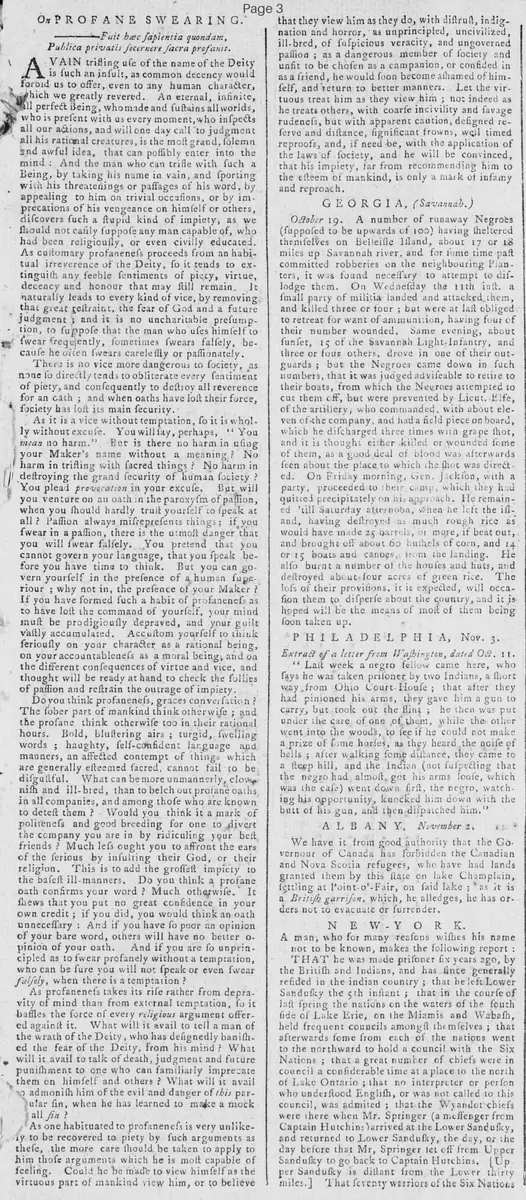
On PROFANE SWEARING.
-Fuit hæc sapientia quondam,
Publica privatis fecernere sacra profanis.
VAIN trifling use of the name of the Deity is such an insult, as common decency would forbid us to offer, even to any human character, which we greatly revered. An eternal, infinite, all perfect Being, who made and sustains all worlds, who is present with us every moment, who inspects all our actions, and will one day call to judgment all his rational creatures, is the most grand, solemn and awful idea, that can possibly enter into the mind: And the man who can trifle with such a Being, by taking his name in vain, and sporting with his threatenings or passages of his word, by appealing to him on trivial occasions, or by imprecations of his vengeance on himself or others, discovers such a stupid kind of impiety, as we should not easily suppose any man capable of, who had been religiously, or even civilly educated.
As customary profaneness proceeds from an habitual irreverence of the Deity, so it tends to extinguish any feeble sentiments of piety, virtue, decency and honour that may still remain. It naturally leads to every kind of vice, by removing that great restraint, the fear of God and a future judgment; and it is no uncharitable presumption, to suppose that the man who uses himself to swear frequently, sometimes swears falsely, because he often swears carelessly or passionately.
There is no vice more dangerous to society, as none so directly tends to obliterate every sentiment of piety, and consequently to destroy all reverence for an oath; and when oaths have lost their force, society has lost its main security.
As it is a vice without temptation, so it is wholly without excuse. You will say, perhaps, "You mean no harm." But is there no harm in using your Maker's name without a meaning? No harm in trifling with sacred things? No harm in destroying the grand security of human society?
You plead provocation in your excuse. But will you venture on an oath in the paroxysm of passion, when you should hardly trust yourself to speak at all? Passion always misrepresents things; if you swear in a passion, there is the utmost danger that you will swear falsely. You pretend that you cannot govern your language, that you speak before you have time to think. But you can govern yourself in the presence of a human superior; why not in the presence of your Maker?
If you have formed such a habit of profaneness as to have lost the command of yourself, your mind must be prodigiously depraved, and your guilt vastly accumulated. Accustom yourself to think seriously on your character as a rational being, on your accountableness as a moral being; and on the different consequences of virtue and vice, and thought will be ready at hand to check the follies of passion and restrain the outrage of impiety.
Do you think profaneness graces conversation? The sober part of mankind think otherwise: and the profane think otherwise too in their rational hours. Bold, blustering airs; turgid, swelling words; haughty, self-confident language and manners, an affected contempt of things which are generally esteemed sacred, cannot fail to be disgustful. What can be more unmannerly, clownish and ill-bred, than to belch out profane oaths in all companies, and among those who are known to detest them? Would you think it a mark of politeness and good breeding for one to divert the company you are in by ridiculing your best friends? Much less ought you to affront the ears of the serious by insulting their God, or their religion. This is to add the grossest impiety to the basest ill-manners.
Do you think a profane oath confirms your word? Much otherwise. It shows that you put no great confidence in your own credit; if you did, you would think an oath unnecessary: And if you have so poor an opinion of your bare word, others will have no better opinion of your oath. And if you are so unprincipled as to swear profanely without a temptation, who can be sure you will not speak or even swear falsely, when there is a temptation?
As profaneness takes its rise rather from depravity of mind than from external temptation, so it baffles the force of every religious argument offered against it. What will it avail to tell a man of the wrath of the Deity, who has designedly banished the fear of the Deity, from his mind? What will it avail to talk of death, judgment and future punishment to one who can familiarly imprecate them on himself and others? What will it avail admonish him of the evil and danger of this particular sin, when he has learned to make a mock of all?
As one habituated to profaneness is very unlikely to be recovered to piety by such arguments as these, the more care should be taken to apply to him those arguments which he is most capable of feeling. Could he be made to view himself as the virtuous part of mankind view him, or to believe that they view him as they do, with distrust, indignation
-Fuit hæc sapientia quondam,
Publica privatis fecernere sacra profanis.
VAIN trifling use of the name of the Deity is such an insult, as common decency would forbid us to offer, even to any human character, which we greatly revered. An eternal, infinite, all perfect Being, who made and sustains all worlds, who is present with us every moment, who inspects all our actions, and will one day call to judgment all his rational creatures, is the most grand, solemn and awful idea, that can possibly enter into the mind: And the man who can trifle with such a Being, by taking his name in vain, and sporting with his threatenings or passages of his word, by appealing to him on trivial occasions, or by imprecations of his vengeance on himself or others, discovers such a stupid kind of impiety, as we should not easily suppose any man capable of, who had been religiously, or even civilly educated.
As customary profaneness proceeds from an habitual irreverence of the Deity, so it tends to extinguish any feeble sentiments of piety, virtue, decency and honour that may still remain. It naturally leads to every kind of vice, by removing that great restraint, the fear of God and a future judgment; and it is no uncharitable presumption, to suppose that the man who uses himself to swear frequently, sometimes swears falsely, because he often swears carelessly or passionately.
There is no vice more dangerous to society, as none so directly tends to obliterate every sentiment of piety, and consequently to destroy all reverence for an oath; and when oaths have lost their force, society has lost its main security.
As it is a vice without temptation, so it is wholly without excuse. You will say, perhaps, "You mean no harm." But is there no harm in using your Maker's name without a meaning? No harm in trifling with sacred things? No harm in destroying the grand security of human society?
You plead provocation in your excuse. But will you venture on an oath in the paroxysm of passion, when you should hardly trust yourself to speak at all? Passion always misrepresents things; if you swear in a passion, there is the utmost danger that you will swear falsely. You pretend that you cannot govern your language, that you speak before you have time to think. But you can govern yourself in the presence of a human superior; why not in the presence of your Maker?
If you have formed such a habit of profaneness as to have lost the command of yourself, your mind must be prodigiously depraved, and your guilt vastly accumulated. Accustom yourself to think seriously on your character as a rational being, on your accountableness as a moral being; and on the different consequences of virtue and vice, and thought will be ready at hand to check the follies of passion and restrain the outrage of impiety.
Do you think profaneness graces conversation? The sober part of mankind think otherwise: and the profane think otherwise too in their rational hours. Bold, blustering airs; turgid, swelling words; haughty, self-confident language and manners, an affected contempt of things which are generally esteemed sacred, cannot fail to be disgustful. What can be more unmannerly, clownish and ill-bred, than to belch out profane oaths in all companies, and among those who are known to detest them? Would you think it a mark of politeness and good breeding for one to divert the company you are in by ridiculing your best friends? Much less ought you to affront the ears of the serious by insulting their God, or their religion. This is to add the grossest impiety to the basest ill-manners.
Do you think a profane oath confirms your word? Much otherwise. It shows that you put no great confidence in your own credit; if you did, you would think an oath unnecessary: And if you have so poor an opinion of your bare word, others will have no better opinion of your oath. And if you are so unprincipled as to swear profanely without a temptation, who can be sure you will not speak or even swear falsely, when there is a temptation?
As profaneness takes its rise rather from depravity of mind than from external temptation, so it baffles the force of every religious argument offered against it. What will it avail to tell a man of the wrath of the Deity, who has designedly banished the fear of the Deity, from his mind? What will it avail to talk of death, judgment and future punishment to one who can familiarly imprecate them on himself and others? What will it avail admonish him of the evil and danger of this particular sin, when he has learned to make a mock of all?
As one habituated to profaneness is very unlikely to be recovered to piety by such arguments as these, the more care should be taken to apply to him those arguments which he is most capable of feeling. Could he be made to view himself as the virtuous part of mankind view him, or to believe that they view him as they do, with distrust, indignation
What sub-type of article is it?
Moral Or Religious
Social Reform
What keywords are associated?
Profane Swearing
Impiety
Deity Insult
Moral Vice
Oath Reverence
Social Security
Self Control
What entities or persons were involved?
Deity
God
Society
Editorial Details
Primary Topic
Condemnation Of Profane Swearing
Stance / Tone
Moral Exhortation Against Impiety
Key Figures
Deity
God
Society
Key Arguments
Profane Swearing Insults The Deity And Reveals Impiety.
It Erodes Piety, Virtue, And Fear Of Judgment, Leading To Vice.
Swearing Destroys Reverence For Oaths, Undermining Societal Security.
No Excuse For Swearing; It Harms Even If Unintended.
Passion Does Not Justify False Oaths; Self Control Is Required.
Profaneness Is Ill Mannered And Disgustful In Conversation.
Oaths Do Not Confirm Word If Profane; They Indicate Lack Of Trust.
Religious Arguments Fail Against The Depraved; Use Social Perceptions Instead.