Thank you for visiting SNEWPapers!
Sign up free
Editorial
December 7, 1860
Ellsworth American
Ellsworth, Hancock County, Maine
What is this article about?
Editorial dissents from a Northern Democrat's letter sympathizing with Southern grievances, attributes sectional tensions to slavery's influence, opposes secession as unconstitutional and futile, urges treating agitators as traitors to preserve the Union.
Clipping
OCR Quality
95%
Excellent
Full Text
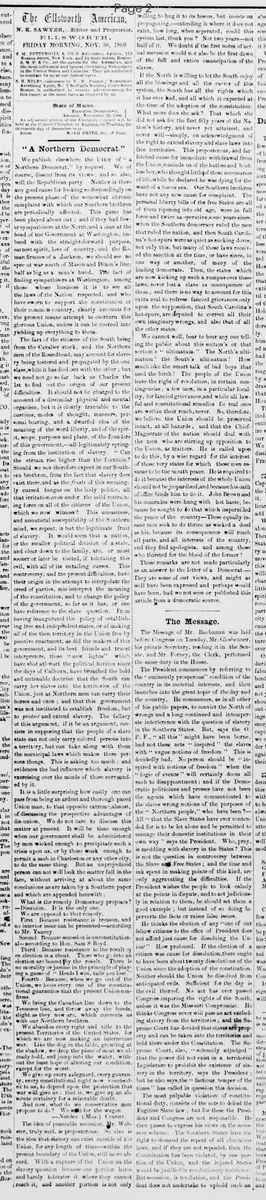
"A Northern Democrat."
We publish elsewhere the letter of "a Northern Democrat," by request. We of course, dissent from its views; and so also, will the Republican party. Neither is there any good cause for looking so despondingly on the present phase of the somewhat chronic complaint with which our Southern brethren are periodically affected. This game has been played about out; and if they had fewer sympathizers at the North, and a man at the head of the Government at Washington, imbued with the straight-forward purpose, earnest spirit, love of country, and the Roman firmness of a Jackson, we should see no speck of war south of Mason and Dixon's line, half as big as a man's hand. The fact of finding sympathizers at Washington, among those whose business it is to see all the laws of the Nation respected, and who have sworn to support the constitution of their common country, clearly accounts for the present insane attempt to overturn this glorious Union, unless it can be coerced into yielding up everything to them.
The fact of the citizens of the South being from the Cavalier stock, and the Northern men of the Roundhead, may account for slavery being fostered and propagated by the one class, while it has died out with the other; but we need not go so far back as Charles the Ist to find out the origin of our present difficulties. It should not be charged to the account of a dissimilar physical and mental organism, but it is clearly traceable to the customs, modes of thought, manners, personal bearing, and a dwarfed idea of the meaning of the word liberty, and of the spirit, scope, purposes and plans, of the founders of this government,—all legitimately springing from the institution of slavery. "Can the stream rise higher than the fountain?" Should we not therefore expect in our Southern brethren, from the fact that slavery does exist there, and as the fruits of this seemingly cursed fungus on the body politic, all that irritation, even under the mild restraining force on all of the citizens of the Union, which we now witness? This uneasiness, and unnatural susceptibility of the Southern mind, we repeat, is but the legitimate fruit of slavery. It would seem that a nation, or the smaller political division of a state, and clear down to the family, are, or must sooner or later be visited, if tolerating this evil, with all of its entailing curses. This controversy, and the present difficulties, have their origin in the attempt to interpolate the creed of parties, mis-interpret the meaning of the constitution, and to change the policy of the government, so far as it has, or can have reference to the slave question. From having inaugurated the policy of establishing free and independent states, or of making all of the then territory in the Union free by positive enactment, as did the makers of this government, and its best friends and truest interpreters, these "new lights" which have shot athwart the political horizon since the days of Calhoun, have broached the bold and untenable doctrine that the South can carry her slaves into the territories of the Union, just as Northern men can carry their horses and oxen: and that this government was not instituted to establish freedom, but to protect and extend slavery. The fallacy of this argument, if it be an argument, consists in supposing that the people of a slave state can not only carry colored persons into a territory, but can take along with them the municipal laws which makes these persons things. This is asking too much: and evidences the bad influence which slavery is exercising over the minds of those surrounded by it.
It is a little surprising how easily one can pass from being an ardent and thorough paced Union man, to that opposite extreme, almost, of discussing the prospective advantages of dis-union. We do not care to discuss this matter at present. It will be time enough when our government shall be administered by men wicked enough to precipitate such a crisis upon us, or by those weak enough to permit a mob in Charleston or any other city, to do the same thing. But an unprejudiced person can not well look the matter full in the face, without arriving at about the same conclusions as are taken by a Southern paper and which are appended herewith:
What is the remedy Democracy proposes?—Disunion. It is the only one.
We are opposed to that remedy.
First: Because resistance is treason, and no interior issue can be presented—according to Mr. Yancey.
Second: Because secession is unconstitutional—according to Hon. Sam S. Boyd.
Third: Because resistance to the result of an election is a cheat. Those who go into an election are bound by the result. There is no morality or justice in the principle of playing a game of "Heads I win, tails you lose."
Fourth: Because, when we go out of the Union, we lose every one of the constitutional guaranties that the present Union confirms.
We bring the Canadian line down to the Tennessee line, and throw away the bonds, slight as they now are, which connects us with our Northern brethren.
We abandon every right and title to the present Territories of the United States, for which we are now making an internecine war. Like the dog in the fable, growling at the shadow, we drop the piece of meat we already hold, and jump into the water, without the least hope of altering our condition except for the worst.
We give up every safeguard, every guaranty, every constitutional right now vouchsafed to us, to depend upon the protection that war will give us: that is, we give up an absolute certainty for a miserable doubt.
And now, what do we conservative men propose to do? We wait for the wagon.
—Natchez (Miss.) Courier.
The idea of peaceable secession, Mr. Webster, truly said, is preposterous. So also is the idea that slavery can exist outside of the Union, for any length of time—within the present boundary of the Union, still more absurd. With a rupture of the Union on the slavery question because one portion hates and barely tolerates it where they cannot reach it, and another portion is not only willing to hug it to its bosom, but insists on propagating,—extending it where it does not exist, how long, when separated, could this system last, think you? Not two years—not half of it. We doubt if the first notes of actual secession would not also be the first dawn of the fall and entire emancipation of the slaves.
If the North is willing to let the South enjoy all the blessings and all the curses of this system, the South has all the rights which it has ever had, and all which it expected at the time of the adoption of the constitution. What more does she ask? That which she did not ask for the first fifty years of the Nation's history, and never yet attained, and never will—simply, an acknowledgment of the right to extend slavery and slave laws into free territories. This preposterous, and far fetched cause for immediate withdrawal from the Union, reminds us of the hatless and bootless boy, who thought little of these necessaries of life, while he declared he was dying for the want of a bosom pin. Our Southern brethren have not any new cause for complaint. The personal liberty bills of the free States are all of them ripening into old age, were in full force and twice as operative, some years since, when the Southern democracy ruled the men that ruled the nation: and then South Carolina's hot-spurs were as quiet as sucking doves; not only this, but many of these laws received the sanction at the time, or have since, in one way or another, of many of the leading democrats. Then, the states which are now kicking up such a rumpus over these laws, never lost a slave in consequence of them, and there is no way to account for this extra zeal to redress fancied grievances, only upon the supposition, that South Carolina's hot-spurs, are deputed to correct all their own imaginary wrongs, and also that of all the other states.
We cannot well, bear to hear any one telling the public about this section's or that section's "ultimatum." The North's ultimatum! the South's ultimatum! How much like the smart talk of bad boys that need the birch! The people of the Union have the right of revolution, in certain contingencies; a few men, in a particular locality, for fancied grievances, and while all lawful and constitutional remedies for real ones are within their reach, never. So, therefore, we believe the Union should be preserved intact, at all hazards: and that the Chief Magistrate of the nation should deal with the men who are stirring up opposition to the Union, as traitors. He is called upon to do this, by a wise regard for the interest of those very states for which these men assume to be the mouth piece. He is required to do it because the interests of the whole Union should not be jeopardized, and because his oath of office binds him to do it. John Brown and his comrades were hung with hot haste, because he sought to do that which imperiled the peace of the country—These equally insane men seek to do thrice as wicked a deed as his, because its consequences will reach all parts, and all interests of the country, and they find apologists, and among those who thirsted for the blood of the former! These remarks are not made particularly as an answer to the letter of a Democrat.—They are some of our views, and might as well have been expressed and perhaps would have been, had we not seen or published this article from a democratic source.
We publish elsewhere the letter of "a Northern Democrat," by request. We of course, dissent from its views; and so also, will the Republican party. Neither is there any good cause for looking so despondingly on the present phase of the somewhat chronic complaint with which our Southern brethren are periodically affected. This game has been played about out; and if they had fewer sympathizers at the North, and a man at the head of the Government at Washington, imbued with the straight-forward purpose, earnest spirit, love of country, and the Roman firmness of a Jackson, we should see no speck of war south of Mason and Dixon's line, half as big as a man's hand. The fact of finding sympathizers at Washington, among those whose business it is to see all the laws of the Nation respected, and who have sworn to support the constitution of their common country, clearly accounts for the present insane attempt to overturn this glorious Union, unless it can be coerced into yielding up everything to them.
The fact of the citizens of the South being from the Cavalier stock, and the Northern men of the Roundhead, may account for slavery being fostered and propagated by the one class, while it has died out with the other; but we need not go so far back as Charles the Ist to find out the origin of our present difficulties. It should not be charged to the account of a dissimilar physical and mental organism, but it is clearly traceable to the customs, modes of thought, manners, personal bearing, and a dwarfed idea of the meaning of the word liberty, and of the spirit, scope, purposes and plans, of the founders of this government,—all legitimately springing from the institution of slavery. "Can the stream rise higher than the fountain?" Should we not therefore expect in our Southern brethren, from the fact that slavery does exist there, and as the fruits of this seemingly cursed fungus on the body politic, all that irritation, even under the mild restraining force on all of the citizens of the Union, which we now witness? This uneasiness, and unnatural susceptibility of the Southern mind, we repeat, is but the legitimate fruit of slavery. It would seem that a nation, or the smaller political division of a state, and clear down to the family, are, or must sooner or later be visited, if tolerating this evil, with all of its entailing curses. This controversy, and the present difficulties, have their origin in the attempt to interpolate the creed of parties, mis-interpret the meaning of the constitution, and to change the policy of the government, so far as it has, or can have reference to the slave question. From having inaugurated the policy of establishing free and independent states, or of making all of the then territory in the Union free by positive enactment, as did the makers of this government, and its best friends and truest interpreters, these "new lights" which have shot athwart the political horizon since the days of Calhoun, have broached the bold and untenable doctrine that the South can carry her slaves into the territories of the Union, just as Northern men can carry their horses and oxen: and that this government was not instituted to establish freedom, but to protect and extend slavery. The fallacy of this argument, if it be an argument, consists in supposing that the people of a slave state can not only carry colored persons into a territory, but can take along with them the municipal laws which makes these persons things. This is asking too much: and evidences the bad influence which slavery is exercising over the minds of those surrounded by it.
It is a little surprising how easily one can pass from being an ardent and thorough paced Union man, to that opposite extreme, almost, of discussing the prospective advantages of dis-union. We do not care to discuss this matter at present. It will be time enough when our government shall be administered by men wicked enough to precipitate such a crisis upon us, or by those weak enough to permit a mob in Charleston or any other city, to do the same thing. But an unprejudiced person can not well look the matter full in the face, without arriving at about the same conclusions as are taken by a Southern paper and which are appended herewith:
What is the remedy Democracy proposes?—Disunion. It is the only one.
We are opposed to that remedy.
First: Because resistance is treason, and no interior issue can be presented—according to Mr. Yancey.
Second: Because secession is unconstitutional—according to Hon. Sam S. Boyd.
Third: Because resistance to the result of an election is a cheat. Those who go into an election are bound by the result. There is no morality or justice in the principle of playing a game of "Heads I win, tails you lose."
Fourth: Because, when we go out of the Union, we lose every one of the constitutional guaranties that the present Union confirms.
We bring the Canadian line down to the Tennessee line, and throw away the bonds, slight as they now are, which connects us with our Northern brethren.
We abandon every right and title to the present Territories of the United States, for which we are now making an internecine war. Like the dog in the fable, growling at the shadow, we drop the piece of meat we already hold, and jump into the water, without the least hope of altering our condition except for the worst.
We give up every safeguard, every guaranty, every constitutional right now vouchsafed to us, to depend upon the protection that war will give us: that is, we give up an absolute certainty for a miserable doubt.
And now, what do we conservative men propose to do? We wait for the wagon.
—Natchez (Miss.) Courier.
The idea of peaceable secession, Mr. Webster, truly said, is preposterous. So also is the idea that slavery can exist outside of the Union, for any length of time—within the present boundary of the Union, still more absurd. With a rupture of the Union on the slavery question because one portion hates and barely tolerates it where they cannot reach it, and another portion is not only willing to hug it to its bosom, but insists on propagating,—extending it where it does not exist, how long, when separated, could this system last, think you? Not two years—not half of it. We doubt if the first notes of actual secession would not also be the first dawn of the fall and entire emancipation of the slaves.
If the North is willing to let the South enjoy all the blessings and all the curses of this system, the South has all the rights which it has ever had, and all which it expected at the time of the adoption of the constitution. What more does she ask? That which she did not ask for the first fifty years of the Nation's history, and never yet attained, and never will—simply, an acknowledgment of the right to extend slavery and slave laws into free territories. This preposterous, and far fetched cause for immediate withdrawal from the Union, reminds us of the hatless and bootless boy, who thought little of these necessaries of life, while he declared he was dying for the want of a bosom pin. Our Southern brethren have not any new cause for complaint. The personal liberty bills of the free States are all of them ripening into old age, were in full force and twice as operative, some years since, when the Southern democracy ruled the men that ruled the nation: and then South Carolina's hot-spurs were as quiet as sucking doves; not only this, but many of these laws received the sanction at the time, or have since, in one way or another, of many of the leading democrats. Then, the states which are now kicking up such a rumpus over these laws, never lost a slave in consequence of them, and there is no way to account for this extra zeal to redress fancied grievances, only upon the supposition, that South Carolina's hot-spurs, are deputed to correct all their own imaginary wrongs, and also that of all the other states.
We cannot well, bear to hear any one telling the public about this section's or that section's "ultimatum." The North's ultimatum! the South's ultimatum! How much like the smart talk of bad boys that need the birch! The people of the Union have the right of revolution, in certain contingencies; a few men, in a particular locality, for fancied grievances, and while all lawful and constitutional remedies for real ones are within their reach, never. So, therefore, we believe the Union should be preserved intact, at all hazards: and that the Chief Magistrate of the nation should deal with the men who are stirring up opposition to the Union, as traitors. He is called upon to do this, by a wise regard for the interest of those very states for which these men assume to be the mouth piece. He is required to do it because the interests of the whole Union should not be jeopardized, and because his oath of office binds him to do it. John Brown and his comrades were hung with hot haste, because he sought to do that which imperiled the peace of the country—These equally insane men seek to do thrice as wicked a deed as his, because its consequences will reach all parts, and all interests of the country, and they find apologists, and among those who thirsted for the blood of the former! These remarks are not made particularly as an answer to the letter of a Democrat.—They are some of our views, and might as well have been expressed and perhaps would have been, had we not seen or published this article from a democratic source.
What sub-type of article is it?
Slavery Abolition
Constitutional
Partisan Politics
What keywords are associated?
Secession
Slavery Extension
Union Preservation
Southern Complaints
Constitutional Rights
Personal Liberty Bills
Northern Sympathizers
Democratic Views
What entities or persons were involved?
Northern Democrat
Republican Party
Southern Brethren
Jackson
Charles I
Calhoun
Mr. Yancey
Hon. Sam S. Boyd
Natchez Courier
Mr. Webster
John Brown
South Carolina
Editorial Details
Primary Topic
Opposition To Southern Secession And Extension Of Slavery
Stance / Tone
Strongly Pro Union And Anti Slavery Extension
Key Figures
Northern Democrat
Republican Party
Southern Brethren
Jackson
Charles I
Calhoun
Mr. Yancey
Hon. Sam S. Boyd
Natchez Courier
Mr. Webster
John Brown
South Carolina
Key Arguments
Dissent From Northern Democrat's Views On Southern Complaints
Southern Secession Aided By Northern Sympathizers In Government
Slavery Causes Southern Irritation And Dwarfed Idea Of Liberty
Fallacy In Claiming Right To Carry Slaves And Slave Laws Into Territories
Secession Is Treason, Unconstitutional, And A Cheat
Secession Loses Constitutional Guarantees And Territories
Peaceable Secession Is Preposterous; Slavery Cannot Survive Outside Union
Southern Complaints Over Personal Liberty Bills Are Unfounded
Union Should Be Preserved At All Hazards; Agitators Treated As Traitors
John Brown Hanged For Less; Secessionists Find Apologists