Thank you for visiting SNEWPapers!
Sign up free
National Gazette
Philadelphia, Philadelphia County, Pennsylvania
What is this article about?
Detailed report of U.S. Congress proceedings from February 22 to 27, 1793, including readings, passages, and debates on bills related to appropriations, imports, Indian treaties, judicial courts, pensions, and other matters, with messages from the President and Senate.
Clipping
OCR Quality
Full Text
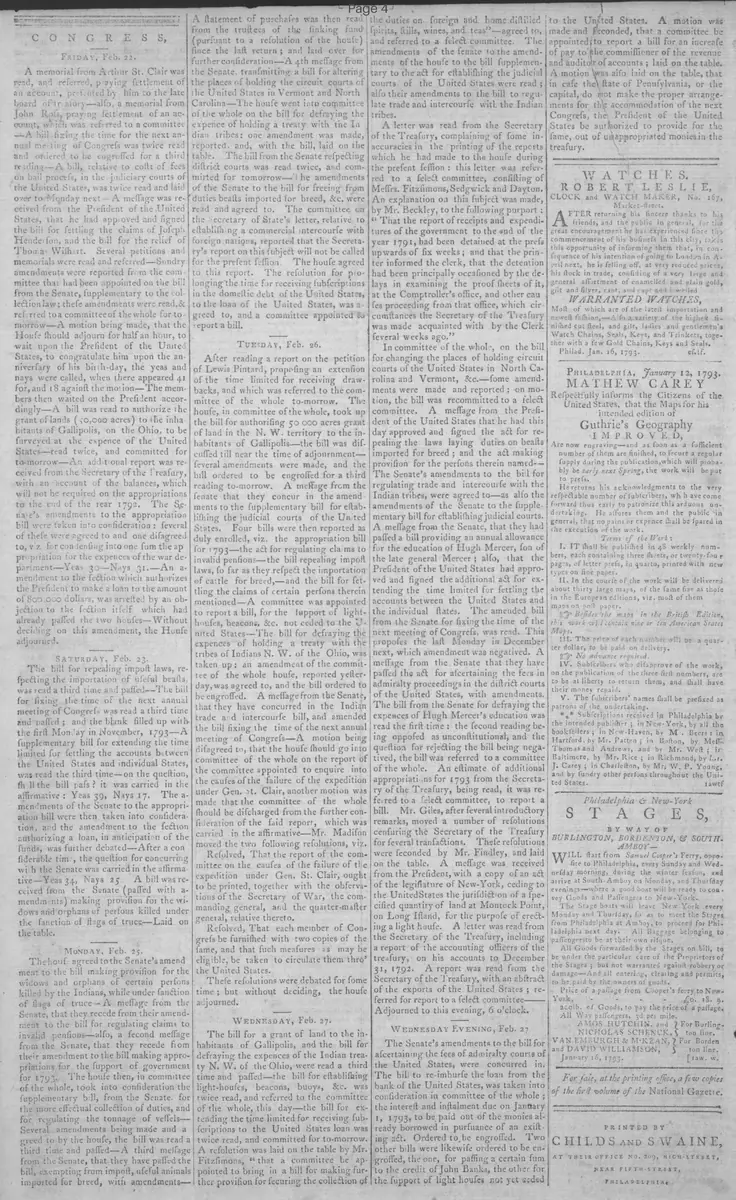
FRIDAY, Feb. 22.
A memorial from Arthur St. Clair was read, and referred, praying settlement of an account, presented by him to the late board of treasury—also, a memorial from John Ross, praying settlement of an account, which was referred to a committee.
A bill fixing the time for the next annual meeting of Congress was twice read and ordered to be engrossed for a third reading—A bill, relative to collection of fees on bail process, in the judiciary courts of the United States, was twice read and laid over to Monday next—A message was received from the President of the United States, that he had approved and signed the bill for settling the claims of Joseph Henderson, and the bill for the relief of Thomas Wither. Several petitions and memorials were read and referred—Sundry amendments were reported from the committee that had been appointed on the bill from the Senate, supplementary to the collection law; these amendments were read and referred to a committee of the whole for to-morrow—A motion being made, that the House should adjourn for half an hour, to wait upon the President of the United States, to congratulate him upon the anniversary of his birthday, the yeas and nays were called, when there appeared 41 for, and 18 against the motion—The members then waited on the President accordingly—A bill was read to authorize the grant of lands (30,000 acres) to the inhabitants of Gallipolis, on the Ohio, to be surveyed at the expense of the United States; read twice, and committed for to-morrow—An additional report was received from the Secretary of the Treasury, with an account of the balances, which will not be required on the appropriations to the end of the year 1792. The Senate's amendments to the appropriation bill were taken into consideration: several of these were agreed to and one disagreed to, viz. for condensing into one sum the appropriation for the expenses of the war department—Yea 30—Nays 31.—An amendment to the section which authorizes the President to make a loan to the amount of 800,000 dollars, was arrested by an objection to the section itself which had already passed the two houses—Without deciding on this amendment, the House adjourned.
SATURDAY, Feb. 23.
The bill for repealing impost laws, respecting the importation of useful beasts, was read a third time and passed—The bill for fixing the time of the next annual meeting of Congress was read a third time and passed; and the blank filled up with the first Monday in November, 1793—A supplementary bill for extending the time limited for settling the accounts between the United States and individual States, was read the third time—on the question, shall the bill pass? it was carried in the affirmative: Yeas 39, Nays 17. The amendments of the Senate to the appropriation bill were then taken into consideration, and the amendment to the section authorizing a loan, in anticipation of the funds, was further debated—After a considerable time, the question for concurring with the Senate was carried in the affirmative—Yea 34, Nays 25. A bill was received from the Senate (passed with amendments) making provision for the widows and orphans of persons killed under the sanction of flags of truce—Laid on the table.
MONDAY, Feb. 25.
The house agreed to the Senate's amendment to the bill making provision for the widows and orphans of certain persons killed by the Indians, while under sanction of flags of truce—A message from the Senate, that they recede from their amendment to the bill for regulating claims to invalid pensions—also, a second message from the Senate, that they recede from their amendment to the bill making appropriations for the support of government for 1793. The house then, in committee of the whole, took into consideration the supplementary bill, from the Senate, for the more effectual collection of duties, and for regulating the tonnage of vessels—Several amendments being made and agreed to by the house, the bill was read a third time and passed—A third message from the Senate, that they have passed the bill, exempting from impost, useful animals imported for breed, with amendments—
A statement of purchases was then read from the trustees of the sinking fund (pursuant to a resolution of the house) since the last return: and laid over for further consideration—A 4th message from the Senate, transmitting a bill for altering the places of holding the circuit courts of the United States in Vermont and North Carolina—The house went into committee of the whole on the bill for defraying the expense of holding a treaty with the Indian tribes: one amendment was made, reported, and, with the bill, laid on the table. The bill from the Senate respecting district courts was read twice, and committed for tomorrow—The amendments of the Senate to the bill for freeing from duties beasts imported for breed, &c. were read and agreed to. The committee on the Secretary of State's letter, relative to establishing a commercial intercourse with foreign nations, reported that the Secretary's report on this subject will not be called for the present session. The house agreed to this report. The resolution for prolonging the time for receiving subscriptions in the domestic debt of the United States, to the loan of the United States, was agreed to, and a committee appointed to report a bill.
TUESDAY, Feb. 26.
After reading a report on the petition of Lewis Pintard, proposing an extension of the time limited for receiving drawbacks, and which was referred to the committee of the whole to-morrow. The house, in committee of the whole, took up the bill for authorizing 50,000 acres grant of land in the N. W. territory to the inhabitants of Gallipolis; the bill was discussed till near the time of adjournment—several amendments were made, and the bill ordered to be engrossed for a third reading to-morrow. A message from the Senate that they concur in the amendments to the supplementary bill for establishing the judicial courts of the United States. Four bills were then reported as duly enrolled, viz. the appropriation bill for 1793—the act for regulating claims to invalid pensions—the bill repealing impost laws, so far as they respect the importation of cattle for breed,—and the bill for settling the claims of certain persons therein mentioned—A committee was appointed to report a bill, for the support of light-houses, beacons, &c. not ceded to the United States—The bill for defraying the expenses of holding a treaty with the tribes of Indians N. W. of the Ohio, was taken up: an amendment of the committee of the whole house, reported yesterday, was agreed to, and the bill ordered to be engrossed. A message from the Senate, that they have concurred in the Indian trade and intercourse bill, and amended the bill fixing the time of the next annual meeting of Congress—A motion being disagreed to, that the house should go into committee of the whole on the report of the committee appointed to enquire into the causes of the failure of the expedition under Gen. St. Clair, another motion was made that the committee of the whole should be discharged from the further consideration of the said report, which was carried in the affirmative. Mr. Madison moved the two following resolutions, viz.
Resolved, That the report of the committee on the causes of the failure of the expedition under Gen. St. Clair, ought to be printed, together with the observations of the Secretary of War, the commanding general, and the quarter-master general, relative thereto.
Resolved, That each member of Congress be furnished with two copies of the same, and that such measures as may be eligible, be taken to circulate them thro' the United States.
These resolutions were debated for some time; but without deciding, the house adjourned.
WEDNESDAY, Feb. 27.
The bill for a grant of land to the inhabitants of Gallipolis, and the bill for defraying the expenses of the Indian treaty N. W. of the Ohio, were read a third time and passed—the bill for establishing light-houses, beacons, buoys, &c. was twice read, and referred to the committee of the whole, this day—the bill for extending the time limited for receiving subscriptions to the United States loan was twice read, and committed for to-morrow. A resolution was laid on the table by Mr. Fitzsimons, "that a committee be appointed to bring in a bill for making further provision for securing the collection of the duties on foreign and home distilled spirits, stills, wines, and teas"—agreed to, and referred to a select committee. The amendments of the Senate to the amendments of the house to the bill supplementary to the act for establishing the judicial courts of the United States were read; also their amendments to the bill to regulate trade and intercourse with the Indian tribes.
A letter was read from the Secretary of the Treasury, complaining of some inaccuracies in the printing of the reports which he had made to the house during the present session: this letter was referred to a select committee, consisting of Messrs. Fitzsimons, Sedgwick and Dayton. An explanation on this subject was made, by Mr. Beckley, to the following purport: "That the report of receipts and expenditures of the government to the end of the year 1791, had been detained at the press upwards of six weeks; and that the printer informed the clerk, that the detention had been principally occasioned by the delays in examining the proof sheets of it, at the Comptroller's office, and other causes proceeding from that office, which circumstances the Secretary of the Treasury was made acquainted with by the Clerk several weeks ago."
In committee of the whole, on the bill for changing the places of holding circuit courts of the United States in North Carolina and Vermont, &c.—some amendments were made and reported: on motion, the bill was recommitted to a select committee. A message from the President of the United States that he had this day approved and signed the act for repealing the laws laying duties on beasts imported for breed; and the act making provision for the persons therein named—The Senate's amendments to the bill for regulating trade and intercourse with the Indian tribes, were agreed to—as also the amendments of the Senate to the supplementary bill for establishing judicial courts. A message from the Senate, that they had passed a bill providing an annual allowance for the education of Hugh Mercer, son of the late general Mercer; also, that the President of the United States had approved and signed the additional act for extending the time limited for settling the accounts between the United States and the individual states. The amended bill from the Senate for fixing the time of the next meeting of Congress, was read. This proposes the last Monday in December next, which amendment was negatived. A message from the Senate that they have passed the act for ascertaining the fees in admiralty proceedings in the district courts of the United States, with amendments. The bill from the Senate for defraying the expenses of Hugh Mercer's education was read the first time: the second reading being opposed as unconstitutional, and the question for rejecting the bill being negatived, the bill was referred to a committee of the whole. An estimate of additional appropriations for 1793 from the Secretary of the Treasury, being read, it was referred to a select committee, to report a bill. Mr. Giles, after several introductory remarks, moved a number of resolutions censuring the Secretary of the Treasury for several transactions. These resolutions were seconded by Mr. Findley, and laid on the table. A message was received from the President, with a copy of an act of the legislature of New-York, ceding to the United States the jurisdiction of a specified quantity of land at Montauk Point, on Long Island, for the purpose of erecting a light house. A letter was read from the Secretary of the Treasury, including a report of the accounting officers of the treasury, on his accounts to December 31, 1792. A report was read from the Secretary of the Treasury, with an abstract of the exports of the United States; referred for report to a select committee. Adjourned to this evening, 6 o'clock.
WEDNESDAY EVENING, Feb. 27.
The Senate's amendments to the bill for ascertaining the fees of admiralty courts of the United States, were concurred in. The bill to re-imburse the loan from the bank of the United States, was taken into consideration in committee of the whole: the interest and instalment due on January 1, 1793, to be paid out of the monies already borrowed in pursuance of an existing act. Ordered to be engrossed. Two other bills were likewise ordered to be engrossed, the one, for paying a certain sum to the credit of John Banks, the other for the support of light houses not yet ceded to the United States. A motion was made and seconded, that a committee be appointed to report a bill for an increase of pay to the commissioner of the revenue and auditor of accounts; laid on the table. A motion was also laid on the table, that in case the state of Pennsylvania, or the capital, do not make the proper arrangements for the accommodation of the next Congress, the President of the United States be authorized to provide for the same, out of unappropriated monies in the treasury.
What sub-type of article is it?
What keywords are associated?
What entities or persons were involved?
Domestic News Details
Event Date
February 22 27, 1793
Key Persons
Outcome
various bills passed, including appropriation bill for 1793, repealing impost laws on imported beasts, grants of land to gallipolis inhabitants, provisions for widows and orphans killed under flags of truce, and amendments to senate bills agreed upon; resolutions debated and motions carried or negatived with specified yeas and nays.
Event Details
Proceedings of the U.S. Congress over several days involved reading and passing bills on memorials, accounts settlements, annual meeting times, judicial fees, appropriations, loans, imports of beasts, accounts between states and U.S., invalid pensions, collection of duties, Indian treaties and intercourse, light-houses, circuit courts locations, trade with Indians, education allowance for Hugh Mercer, and other matters; included messages from President and Senate, committee reports, debates, and adjournments.