Thank you for visiting SNEWPapers!
Sign up free
Daily National Intelligencer
Washington, District Of Columbia
What is this article about?
Transcript of a U.S. House debate on reducing the post-War of 1812 military establishment to 6,000 men. Speakers including Calhoun argue for caution against potential British or Spanish threats; Goldsborough, Pickering, and others advocate reduction to ease taxpayer burdens, citing peace treaty and lack of immediate dangers.
Merged-components note: These components form a single continuous article reporting on the congressional debate regarding the military peace establishment, spanning multiple columns and pages with sequential reading order and coherent text flow.
Clippings
1 of 2
OCR Quality
Full Text
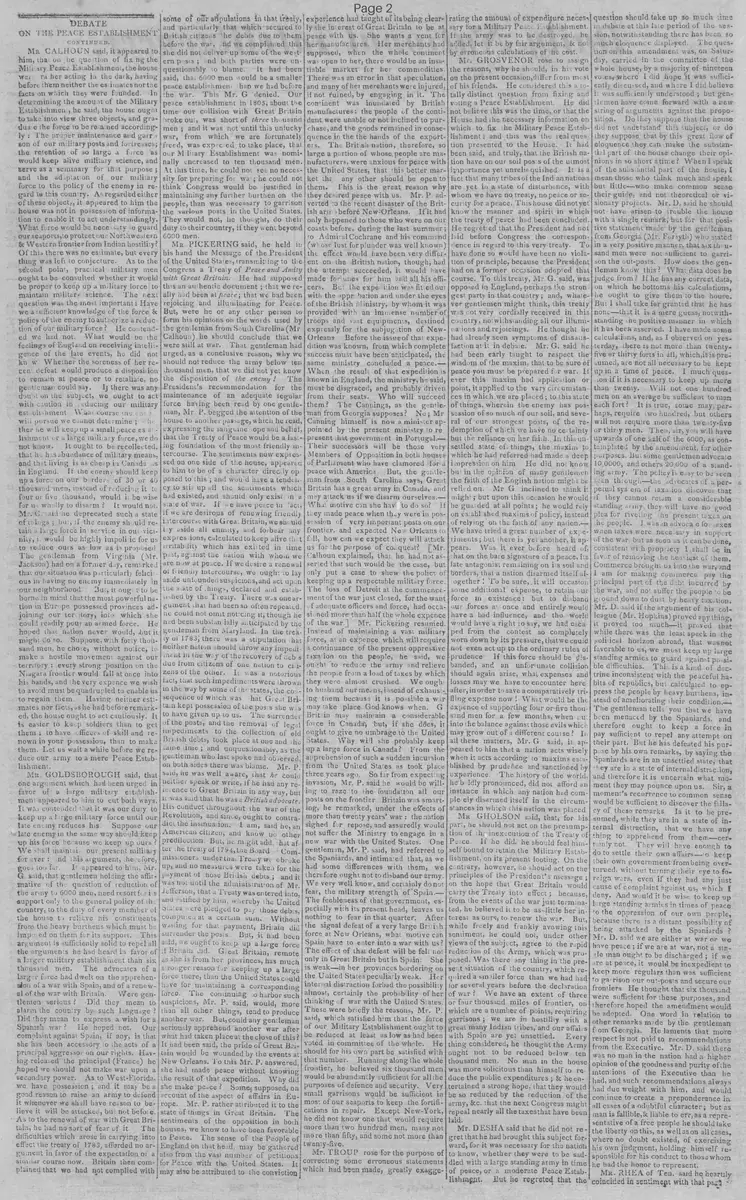
ON THE PEACE ESTABLISHMENT
CONTINUED.
Mr. CALHOUN said, it appeared to him, that on the question of fixing the Military Peace Establishment, the house were rather acting in the dark, having before them neither the estimates nor the facts on which they were founded. In determining the amount of the Military Establishment, he said, the house ought to take into view three objects, and graduate the force to be retained accordingly: The proper maintenance and garrison of our military posts and fortresses; the retention of so large a force as would keep alive military science, and serve as a seminary for that purpose; and the adaptation of our military force to the policy of the enemy in regard to this country. As regarded either of these objects, it appeared to him the house was not in possession of information to enable it to act understandingly. What force would be necessary to guard our seaports, to protect our Northwestern & Western frontier from Indian hostility? Of this there was no estimate, but every thing was left to conjecture. As to the second point, practical military men ought to be consulted whether it would be proper to keep up a military force to maintain military science. The next question was the most important: Have we a sufficient knowledge of the force & policy of the enemy to authorize a reduction of our military force? He contended we had not. What would be the feelings of England on receiving intelligence of the late events, he did not know. Whether the soreness of her recent defeat would produce a disposition to remain at peace or to retaliate, no gentleman could say. If there was any doubt on the subject, we ought to act with caution in reducing our military establishment. What course the enemy will pursue we cannot determine; whether he will keep up a small peace establishment or a large military force, we do not know. It ought to be recollected, that he has abundance of military means, and that living is as cheap in Canada as in England. If the enemy should keep up a force on our borders of 30 or 40 thousand men, instead of reducing it to four or five thousand, would it be wise for us wholly to disarm? It would not. Mr. C. said he deprecated such a state of things; but, if the enemy should retain a large force in service in our vicinity, it would be highly impolitic for us to reduce ours as low as is proposed. The gentleman from Virginia (Mr. Jackson) had on a former day, remarked that our situation was particularly felicitous in having no enemy immediately in our neighborhood. But, it ought to be borne in mind that the most powerful nation in Europe possessed provinces adjoining our territory, into which she could readily pour an armed force. He hoped that nation never would, but it might do so. Suppose, with forty thousand men, he chose, without notice, to make a hostile movement against our territory: every strong position on the Niagara frontier would fall at once into his hands, and the very expense we wish to avoid must be quadrupled to enable us to regain them. Having neither estimates nor facts, as he had before remarked, the house ought to act cautiously. It is easier to keep soldiers than to get them; to have officers of skill and renown in your possession, than to make them. Let us wait a while before we reduce our army to a mere Peace Establishment.
Mr. GOLDSBOROUGH said, that one argument which had been urged in favor of a large military establishment appeared to him to cut both ways. It was contended that it was our duty to keep up a large military force until our late enemy reduces his. Suppose our late enemy in the same way should keep up his force because we keep up ours? We shall maintain our present military forever: and this argument, therefore, goes too far. It appeared to him, Mr. G. said, that gentlemen holding the affirmative of the question of reduction of the army to 6000 men, need resort for its support only to the general policy of the country, to the duty of every member of the house to relieve his constituents from the heavy burthens which must be imposed on them for its support. This argument is sufficiently solid to repel all the arguments he had heard in favor of a larger military establishment than six thousand men. The advocates of a larger force had dwelt on the apprehension of a war with Spain, and of a renewal of the war with Britain. Were gentlemen serious? Did they mean to alarm the country by such language? Did they mean to express a wish for a Spanish war? He hoped not. Our complaint against Spain, if any, is that she has been accessory to the acts of a principal aggressor on our rights. Having released the principal (France) he hoped we should not make war upon a secondary power. As to West-Florida, we have possession; and it may be a good reason to raise an army to defend it whenever we shall have reason to believe it will be attacked, but not before. As to the renewal of war with Great Britain, he had no sort of fear of it. The difficulties which arose in carrying into effect the treaty of 1783, afforded no argument in favor of the expectation of a similar course now. Britain then complained that we had not complied with
some of our stipulations in that treaty, and particularly that which secured to British citizens the debts due to them before the war, and we complained that she did not deliver up some of the western posts; and both parties were unquestionably to blame. It had been said, that 6000 men would be a smaller peace establishment than we had before the war. This Mr. G denied. Our peace establishment in 1805, about the time our collision with Great Britain broke out, was short of three thousand men; and it was not until this unlucky war, from which we are fortunately freed, was expected to take place, that Our Military Establishment was nominally increased to ten thousand men. At this time, he could not see any necessity for preparing for war; he could not think Congress would be justified in maintaining any further burthen on the people, than was necessary to garrison the various posts in the United States. They would not, he thought, do their duty to their country, if they went beyond 6000 men.
Mr. PICKERING said, he held in his hand the Message of the President of the United States, transmitting to the Congress a Treaty of Peace and Amity with Great Britain. He had supposed this an authentic document; that we really had been at peace: that we had been rejoicing and illuminating for Peace. But, were he or any other person to form his opinions on the words used by the gentleman from South Carolina (Mr. Calhoun) he should conclude that we were still at war. That gentleman had urged, as a conclusive reason, why we should not reduce the army below ten thousand men, that we did not yet know the disposition of the enemy! The President's recommendation for the maintenance of an adequate regular force having been read by one gentleman, Mr. P. begged the attention of the house to another passage, which he read, expressing the sanguine hope and belief, that the Treaty of Peace would be a lasting foundation of the most friendly intercourse. The sentiments now expressed on one side of the house, appeared to him to be of a character directly opposed to this; and would have a tendency to stir up all the sentiments which had existed, and should only exist in a state of war. If we have peace in fact, if we are desirous of renewing friendly intercourse with Great Britain, we should lay aside all enmity, and forbear any expressions, calculated to keep alive that irritability which has existed in time past, against the nation with whom we are now at peace. If we desire a renewal of friendly intercourse, we ought to lay aside unfounded suspicions, and act upon the state of things, declared and established by the Treaty. There was one argument that had been so often repeated, he could not omit noticing it, though he had been substantially anticipated by the gentleman from Maryland. In the treaty of 1783, there was a stipulation that neither nation should throw any impediment in the way of the recovery of debts due from citizens of one nation to citizens of the other. It was a notorious fact, that such impediments were thrown in the way by some of the states, the consequence of which was that Great Britain kept possession of the posts she was to have given up to us. The surrender of the posts, and the removal of legal impediments to the collection of old British debts, took place at one and the same time; and unquestionably, as the gentleman who last spoke had observed, on both sides there was blame. Mr. P. said, he was well aware, that he could neither speak or write, if he had any reference to Great Britain in any way, but it was said that he was a British advocate. His conduct throughout the war of the Revolution, and since, ought to contradict the insinuation. I am, said he, an American citizen, and know no other predilection. But, he might add that after the treaty of 1794, the Board of Commissioners under that Treaty was broke up, and no measures were taken for the payment of those British debts; and it was not until the administration of Mr. Jefferson, that a Treaty was entered into, and ratified by him, whereby the United States were pledged to pay those debts, computed at a certain sum. Without waiting for that payment, Britain did surrender the posts. But, it had been said, we ought to keep up a large force if Britain did. Great Britain, remote as she is from her provinces, has much stronger reason for keeping up a large force there, than the United States could have for maintaining a corresponding force. The continuing to harbor such suspicions, Mr. P. said, would, more than all other things, tend to produce another war. But, could any gentleman seriously apprehend another war after what had taken place at the close of this? It had been said, the pride of Great Britain would be wounded by the events at New Orleans. To this Mr. P. answered, she had made peace without knowing the result of that expedition. Why did she make peace? Some supposed, on account of the aspect of affairs in Europe. Mr. P. rather attributed it to the state of things in Great Britain. The sentiments of the opposition in both houses, we know to have been favorable to Peace. The sense of the People of England on that head, may be gathered also from the vast number of petitions for Peace with the United States. It may also be attributed to the conviction
experience had taught of its being clearly the interest of Great Britain to be at peace with us. She wants a vent for her manufactures. Her merchants had supposed, when the whole continent was open to her, there would be an insatiable market for her commodities. There was an error in that speculation, and many of her merchants were injured, if not ruined, by engaging in it. The continent was inundated by British manufactures: the people of the continent were unable or not inclined to purchase, and the goods remained in consequence in the hands of the exporters. The British nation, therefore, so large a portion of whose people are manufacturers, were anxious for peace with the United States, that this better market than any other should be open to them. This is the great reason why they desired peace with us. Mr. P. adverted to the recent disaster of the British army before New-Orleans. If it had only happened to those who were on our coasts before, during the last summer; to Admiral Cochrane and his command (whose lust for plunder was well known) the effect would have been very different on the British nation, though, had the attempt succeeded, it would have made fortunes for him and all his officers. But the expedition was fitted out with the approbation and under the eyes of the British Ministry, by whom it was provided with an immense number of troops and vast equipments, destined expressly for the subjugation of New-Orleans. Before the issue of that expedition was known, from which complete success must have been anticipated, the same ministry concluded a peace. When the result of that expedition is known in England, the ministry, he said, must be disgraced, and probably driven from their seats. Who will succeed them? The Cannings, as the gentleman from Georgia supposes? No; Mr. Canning himself is now a minister appointed by the present ministry to represent that government in Portugal. Their successors will be those very Members of Opposition in both houses of Parliament who have clamored for a peace with America. But, the gentleman from South Carolina says, Great Britain has a great army in Canada, and may attack us if we disarm ourselves. What motive can she have to do so? If they made peace when they were in possession of very important posts on our frontier, and expected New Orleans to fall, how can we expect they will attack us for the purpose of conquest? [Mr. Calhoun explained, that he had not asserted that such would be the case, but only put a case to shew the policy of keeping up a respectable military force. The loss of Detroit at the commencement of the war just closed, for the want of adequate officers and force, had occasioned more than half the whole expense of the war.] Mr. Pickering resumed. Instead of maintaining a vast military force, at an expense which will require a continuance of the present oppressive taxation on the people, he said, we ought to reduce the army and relieve the people from a load of taxes by which they were almost crushed. We ought to husband our means, instead of exhausting them because it is possible a war may take place God knows when. Great Britain may maintain a considerable force in Canada, but, if she does, it ought to give no umbrage to the United States. Why will she probably keep up a large force in Canada? From the apprehension of such a sudden incursion from the United States as took place three years ago. So far from expecting invasion, Mr. P. said he would be willing to raze to the foundation all our posts on the frontier. Britain was smarting, he remarked, under the effects of more than twenty years' war: the nation sighed for repose, and assuredly would not suffer the Ministry to engage in a new war with the United States. One gentleman, Mr. P. said, had referred to the Spaniards, and intimated that, as we had some differences with them, we therefore ought not to disband our army. We very well know, and certainly do not fear, the military strength of Spain. The feebleness of that government, especially with its present head, leaves us nothing to fear in that quarter. After the signal defeat of a very large British force at New Orleans, what motive can Spain have to enter into a war with us? The effect of that defeat will be felt not only in Great Britain but in Spain. She is weak—in her provinces bordering on the United States peculiarly weak. Her internal distraction forbade the possibility almost, certainly the probability of her thinking of war with the United States. These were briefly the reasons, Mr. P. said, which satisfied him that the force of our Military Establishment ought to be reduced at least as low as had been voted in committee of the whole. He should for his own part be satisfied with that number. Running along the whole frontier, he believed six thousand men would be abundantly sufficient for all the purposes of defence and security. Very small garrisons would be sufficient in most of our seaports to keep the fortifications in repair. Except New-York, he did not know one that would require more than two hundred men, many not more than fifty, and some not more than twenty-five.
Mr. TROUP rose for the purpose of correcting some erroneous statements which had been made, greatly exaggerating the amount of expenditure necessary for a Military Peace Establishment.
If the army was to be destroyed, he added, let it be by fair argument, & not by erroneous calculations of the cost.
Mr. GROSVENOR rose to assign the reasons, why he should, in his vote on the present occasion, differ from most of his friends. He considered this a totally distinct question from fixing and voting a Peace Establishment. He did not believe this was the time, or that the House had the necessary information on which to fix the Military Peace Establishment: and this was the real question presented to the House. It had been said, and truly, that the British nation have on our soil possession of the utmost importance yet unrelinquished. It is a fact that many tribes of the Indian nations are yet in a state of disturbance, with whom we have no treaty, no peace or security for a peace. This house did not yet know the manner and spirit in which the treaty of peace had been concluded. He regretted that the President had not laid before Congress the correspondence in regard to this very treaty. To have done so would have been no violation of principle, because the President had on a former occasion adopted that course. To this treaty, Mr. G. said, was opposed in England, perhaps the strongest party in that country; and, whatever gentlemen might think, this treaty was not very cordially received in this country, notwithstanding all our illuminations and rejoicings. He thought he had already seen symptoms of dissatisfaction at it in debate. Mr. G. said he had been early taught to respect the wisdom of the maxim, that to be sure of peace you must be prepared for war. If ever this maxim had application or point, it applied to the very circumstances in which we are placed; to this state of things, wherein the enemy has possession of so much of our soil, and several of our strongest posts, of the redemption of which we have no certainty but the reliance on her faith. In this unsettled state of things, the maxim to which he had referred had made a deep impression on him. He did not know but in the opinion of many gentlemen the faith of the English nation might be relied on. Mr. G. inclined to think it might; but upon this occasion he would be guarded at all points; he would rely on established maxims of policy, instead of relying on the faith of any nation. We have tried a great number of experiments; but there is yet another, it appears. Was it ever before heard of, that on the bare signature of a peace, its late antagonist remaining on its soil and borders, that a nation disarmed itself altogether! To be sure, it will occasion some additional expense, to retain our force in existence: but to disband our forces at once and entirely would have a bad influence, and the World would have a right to say, we had escaped from the contest so completely worn down by its pressure, that we could not even act up to the ordinary rules of prudence. If this force should be disbanded, and an unfortunate collision should again arise, what expenses and losses may we have to encounter hereafter, in order to save a comparatively trifling expense now! What would be the expense of supporting four or five thousand men for a few months, when put into the balance against those evils which may grow out of a different course? In all these matters, Mr. G. said, it appeared to him that a nation acts wisely when it acts according to maxims established by prudence and sanctioned by experience. The history of the world, he boldly pronounced, did not afford an instance in which any nation had completely disarmed itself in the circumstances in which this nation was placed.
Mr. GHOLSON said, that, for his part, he should not act on the presumption of the inexecution of the Treaty of Peace. If he did, he should feel himself bound to retain the Military Establishment, on its present footing. On the contrary, however, he should act on the principles of the President's message; on the hope that Great Britain would carry the Treaty into effect; because, from the events of the war just terminated, he believed it to be as little her interest as ours, to renew the war. But, while freely and frankly avowing this sentiment, he could not, under other views of the subject, agree to the rapid reduction of the Army, which was proposed. Was there any thing in the present situation of the country, which required a smaller force than we had had for several years before the declaration of war? We have an extent of three or four thousand miles of frontier, on which are a number of points, requiring garrisons; we are in hostility with a great many Indian tribes, and our affairs with Spain are yet unsettled. Every thing considered, he thought the Army ought not to be reduced below ten thousand men. No man in the house was more solicitous than himself to reduce the public expenditures; & he entertained a strong hope, that they would be so reduced by the reduction of the army, &c. that the next Congress might repeal nearly all the taxes that have been laid.
Mr. DESHA said that he did not regret that he had brought this subject forward, for it was necessary for the nation to know, whether they were to be saddled with a large standing army in time of peace, or a moderate Peace Establishment. But he regretted that the
question should take up so much time in debate at this late period of the session, notwithstanding there has been so much eloquence displayed. The question on this amendment was, on Saturday, carried in the committee of the whole house, by a majority of nineteen votes, where I did hope it was sufficiently discussed, and where I did believe it was sufficiently understood; but gentlemen have come forward with a new string of arguments against the proposition. Do they suppose that the house did not understand this subject, or do they suppose that by this great flow of eloquence they can make the substantial part of the house change their opinions in so short a time? When I speak of the substantial part of the house, I mean those who think much and speak but little—who make common sense their guide, and not theoretical or visionary projects. Mr. D. said he should not have arisen to trouble the house with a single remark, but for that positive statement made by the gentleman from Georgia (Mr. Forsyth) who stated in a very positive manner, that six thousand men were not sufficient to garrison the out-posts. How does the gentleman know this? What data does he judge from? If he has any correct data, on which he bottoms his calculations, he ought to give them to the house. But I shall take for granted that he has none—that it is a mere guess, notwithstanding the positive manner in which it has been asserted. I have made some calculations, and, as I observed on yesterday, there is not more than twenty-five or thirty forts in all, which, it is presumed, are not all necessary to be kept up in a time of peace. I much question if it is necessary to keep up more than twenty. Will not one hundred men on an average be sufficient to man each fort? It is true, some may, perhaps, require two hundred, but others will not require more than twenty-five or thirty men. Then, sir, you will have upwards of one half of the 6000, as contemplated by the amendment, for other purposes. But some gentlemen advocate 10,000, and others 20,000 of a standing army. The policy is easy to be seen through—the advocates of a perpetual system of taxation discover that if they cannot retain a considerable standing army, they will have no good plea for riveting the present taxes on the people. I was an advocate for taxes when taxes were necessary in support of the war but as soon as it can be done, consistent with propriety I shall be in favor of removing the heaviest of them. Commerce brought us into the war, and I am for making commerce pay the principal part of the debt incurred by the war, and not suffer the people to be ground down to dust by heavy taxation. Mr. D. said if the argument of his colleague (Mr. Hopkins) proved any thing, it proved too much—it proved that while there was the least speck in the political horizon abroad, that was not favorable to us, we must keep up large standing armies to guard against possible difficulties. This is a kind of doctrine inconsistent with the peaceful habits of republics, but calculated to oppress the people by heavy burthens, instead of ameliorating their condition. The gentleman tells you that we have been menaced by the Spaniards, and therefore ought to keep a force in pay sufficient to repel any attempt on their part. But he has defeated his purpose by his own remarks, by saying the Spaniards are in an unsettled state, that they are in a state of internal distraction, and therefore it is uncertain what moment they may pounce upon us. Sir, a moment's recurrence to common sense would be sufficient to discover the fallacy of these remarks. Is it to be presumed, while they are in a state of internal distraction, that we have any thing to apprehend from them—certainly not. They will have enough to do to settle their own affairs—to keep their own government from being overturned, without turning their eye to foreign wars, even if they had any just cause of complaint against us, which I deny. And would it be wise to keep up large standing armies in times of peace to the oppression of our own people, because there is a distant possibility of being attacked by the Spaniards? Mr. D. said we are either at war or we have peace; if we are at war, not a single man ought to be discharged; if we are at peace, it would be inexpedient to keep more regulars than was sufficient to garrison our out-posts and secure our frontiers. He thought that six thousand were sufficient for these purposes, and therefore hoped the amendment would be adopted. One word in relation to other remarks made by the gentleman from Georgia. He laments that more respect is not paid to recommendations from the Executive. Mr. D. said there was no man in the nation had a higher opinion of the goodness and purity of the intentions of the Executive than he had, and such recommendations always had due weight with him, and would continue to create a preponderance in all cases of a doubtful character; but as man is fallible, & liable to err, as a representative of a free people he should take the liberty on this, as well as on all cases, where no doubt existed, of exercising his own judgment, holding himself responsible for his conduct to those whom he had the honor to represent.
Mr. RHEA of Tenn. said he heartily coincided in sentiment with that page.
the President's message which had been
quoted by the gentleman from Massachusetts. He meant, he said, to endeavor, as much lay in his power, to cultivate peace and friendship with Great Britain. If that nation would let us alone, he was willing to forget what had passed. He had no inclination to renew hostilities with her, and he hoped that all the members of this body corresponded with him in the feeling. But, to disarm ourselves altogether would be just as wise as, when a warm day come, to throw off all our clothes, expecting winter was over. Although the President had expressed in his message pacific purposes, he also expressed an opinion, in which Mr. R. fully concurred, adverse to a sudden or total reduction of our military force. Taking into view the present state of the world, and the probability that the calm in Europe is nothing but the precursor of a violent storm, though he sincerely desired it might be otherwise, Mr. Rhea conceived it would be highly imprudent to part with so great a proportion of our army as was proposed. The President had expressed sentiments in direct opposition to those of the gentleman from Massachusetts, who had quoted another part of the Message. Mr. Rhea here quoted the part of the Message recommending the retention of a respectable military force. This, he said, was a very plain talk, and far from coinciding with the inferences drawn from that part of the Message recommending the cultivation of friendly sentiments towards G. Britain. The best writing, even the Holy Book itself, might be distorted from its meaning and general intent, by quoting detached sentences of it. The recommendation of the Executive is, in effect, that the Military Establishment be not so reduced as that other nations may take advantage of its diminution. Mr. R. said he respected the gentleman from New York for the opinions he had just delivered; they were manly and noble; he highly approved them. Suppose the military establishment to be reduced to six, four or three thousand men: we know, said Mr. R. who have been obliged to bear the responsibility of the war, and who have disavowed any responsibility. If there should be any encroachments on us on account of our weakness, the very majority of this house would be accused of want of foresight and wisdom in disbanding the army. Mr. R said he had no inclination to subject himself to this condition. Unless there should be a correspondent reduction of force by our late enemy, he would not consent to reduce the army so greatly as was proposed. It had been said, we ought to rely wholly on militia for defence. Militia generally, he said, would do their duty, and that manfully, when called on; but we know that our late enemy have been permitted to hold on a large portion of our territory, without molestation from the militia. He would not consent to subject the United States to a continuation or repetition of that disgrace by a total disbandment of the army. TO BE CONTINUED.
What sub-type of article is it?
What themes does it cover?
What keywords are associated?
What entities or persons were involved?
Where did it happen?
Story Details
Key Persons
Location
U.S. House Of Representatives
Event Date
1815
Story Details
Congressional debate on reducing the U.S. Army from 10,000 to 6,000 men for peace establishment after War of 1812. Proponents of reduction cite economic relief and trust in peace treaty; opponents warn of British retention of forces in Canada, Spanish tensions, Indian hostilities, and need for preparedness.