Thank you for visiting SNEWPapers!
Sign up free
The Ely Miner
Ely, Saint Louis County, Minnesota
What is this article about?
USDA releases revised Farmers' Bulletin 1030-F on economical horse feeding using home-grown crops, covering nutrition, ration computation, feed preparation, and adjustments for horse conditions. Free copies available from Washington, D.C.
Clipping
OCR Quality
Full Text
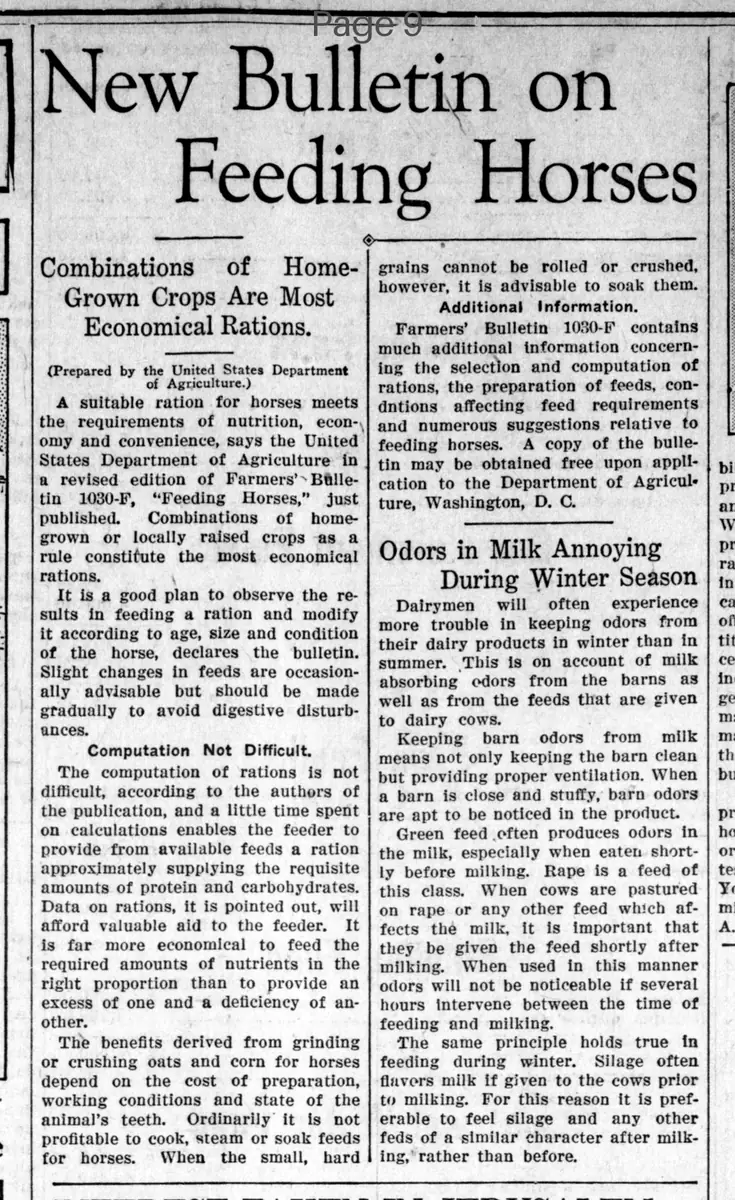
Combinations of Home-Grown Crops Are Most Economical Rations.
(Prepared by the United States Department of Agriculture.)
A suitable ration for horses meets the requirements of nutrition, economy and convenience, says the United States Department of Agriculture in a revised edition of Farmers' Bulletin 1030-F, "Feeding Horses," just published.
Combinations of home-grown or locally raised crops as a rule constitute the most economical rations.
It is a good plan to observe the results in feeding a ration and modify it according to age, size and condition of the horse, declares the bulletin.
Slight changes in feeds are occasionally advisable but should be made gradually to avoid digestive disturbances.
Computation Not Difficult.
The computation of rations is not difficult, according to the authors of the publication, and a little time spent on calculations enables the feeder to provide from available feeds a ration approximately supplying the requisite amounts of protein and carbohydrates.
Data on rations, it is pointed out, will afford valuable aid to the feeder. It is far more economical to feed the required amounts of nutrients in the right proportion than to provide an excess of one and a deficiency of another.
The benefits derived from grinding or crushing oats and corn for horses depend on the cost of preparation, working conditions and state of the animal's teeth. Ordinarily it is not profitable to cook, steam or soak feeds for horses.
When the small, hard grains cannot be rolled or crushed, however, it is advisable to soak them.
Additional Information.
Farmers' Bulletin 1030-F contains much additional information concerning the selection and computation of rations, the preparation of feeds, conditions affecting feed requirements and numerous suggestions relative to feeding horses. A copy of the bulletin may be obtained free upon application to the Department of Agriculture, Washington, D. C.
What sub-type of article is it?
What keywords are associated?
Domestic News Details
Event Details
The United States Department of Agriculture published a revised edition of Farmers' Bulletin 1030-F, 'Feeding Horses,' advising on suitable rations that meet nutrition, economy, and convenience using combinations of home-grown or locally raised crops. It recommends observing results and modifying rations based on the horse's age, size, and condition, making gradual changes to avoid digestive issues. Computation of rations is straightforward, enabling provision of required protein and carbohydrates from available feeds. Grinding or crushing grains may be beneficial depending on cost and conditions, but cooking, steaming, or soaking is generally not profitable unless grains cannot be processed otherwise. The bulletin provides additional information on ration selection, feed preparation, and feeding suggestions, available free from the Department in Washington, D.C.