Thank you for visiting SNEWPapers!
Sign up free
Laredo Weekly Times
Laredo, Webb County, Texas
What is this article about?
In the newly formed republic of Czecho-Slovakia, an absolute boycott against everything German is enforced, prohibiting dealings with German shops, professionals, music, books, theaters, and schools. This stems from centuries of German efforts to suppress Bohemian culture and nationality, which ultimately failed.
Clipping
OCR Quality
Full Text
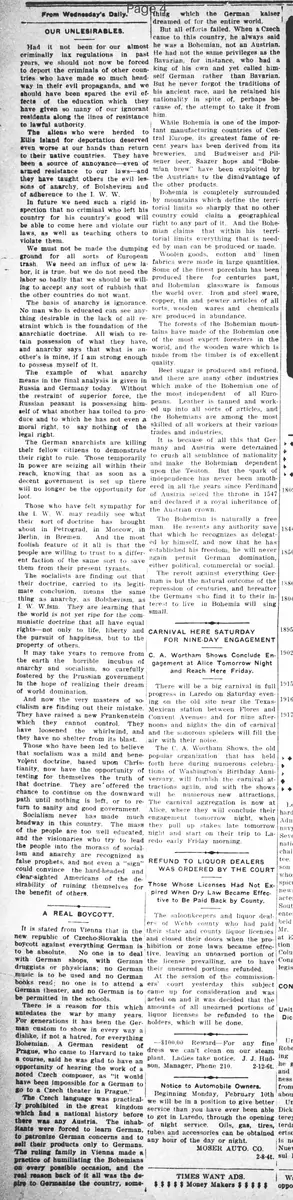
It is stated from Vienna that in the new republic of Czecho-Slovakia the boycott against everything German is to be absolute. No one is to deal with German shops, with German druggists or physicians; no German music is to be used and no German books read; no one is to attend a German theater, and no German is to be permitted in the schools.
There is a reason for this which antedates the war by many years. For generations it has been the German custom to show in every way a dislike, if not a hatred, for everything Bohemian. A German resident of Prague, who came to Harvard to take a course, said he was glad to have an opportunity of hearing the work of a noted Czech composer, as "it would have been impossible for a German to go to a Czech theater in Prague."
The Czech language was practically prohibited in the great kingdom which had a national history before there was any Austria. The inhabitants were forced to learn German, to patronize German concerns and to sell their products only to Germans.
The ruling family in Vienna made a practice of humiliating the Bohemians on every possible occasion, and the real reason back of it all was the desire to Germanize the country, something dreamed of for the entire world.
But all efforts failed. When a Czech came to this country, he always said he was a Bohemian, not an Austrian. He had not the same privileges as the Bavarian, for instance, who had a king of his own and yet called himself German rather than Bavarian.
But he never forgot the traditions of his ancient race, and he retained his nationality in spite of, perhaps because of, the attempt to take it from him.
While Bohemia is one of the important manufacturing countries of Central Europe, its greatest fame of recent years has been derived from its breweries, and Budweiser and Pilsener beer, Saazer hops and "Bohemian brew" have been exploited by the Austrians to the disadvantage of the other products.
Bohemia is completely surrounded by mountains which define the territorial limits so sharply that no other country could claim a geographical right to any part of it. And the Bohemian claims that within his territorial limits everything that is needed by man can be produced or made.
Woolen goods, cotton and linen fabrics were made in large quantities. Some of the finest porcelain has been produced there for centuries past, and Bohemian glassware is famous the world over. Iron and steel ware, copper, tin and pewter articles of all sorts, wooden wares and chemicals are produced in abundance.
The forests of the Bohemian mountains have made of the Bohemian one of the most expert foresters in the world, and the wooden ware which is made from the timber is of excellent quality.
Beet sugar is produced and refined, and there are many other industries which make of the Bohemian one of the most independent of all Europeans. Leather is tanned and worked up into all sorts of articles, and the Bohemians are among the most skilled of all workers at their various trades and industries.
It is because of all this that Germany and Austria were determined to crush all semblance of nationality and make the Bohemian dependent upon the Teuton. But the spark of independence has never been smothered in all the years since Ferdinand of Austria seized the throne in 1526 and declared it a royal inheritance of the Austrian crown.
The Bohemian is naturally a free man. He resents any authority save that which he recognizes as delegated by himself, and now that he has established his freedom, he will never again permit German domination, either political, commercial or social.
The revolt against everything German is but the natural outcome of the repression of centuries, and hereafter the Germans who find it to their interest to live in Bohemia will sing small.
What sub-type of article is it?
What keywords are associated?
What entities or persons were involved?
Where did it happen?
Foreign News Details
Primary Location
Czecho Slovakia
Key Persons
Outcome
absolute boycott against everything german implemented; historical germanization efforts failed; bohemians retain independence and establish freedom from german domination.
Event Details
In the new republic of Czecho-Slovakia, an absolute boycott against everything German is to be enforced, including no dealings with German shops, druggists, physicians, music, books, theaters, or schools. This policy arises from generations of German dislike and efforts to Germanize Bohemia, including prohibiting the Czech language, forcing patronage of German concerns, and humiliating Bohemians. Despite these attempts since 1526, Bohemians maintained their nationality. Bohemia is described as self-sufficient in manufacturing, including breweries, textiles, porcelain, glassware, metals, wood products, sugar, and leather.