Thank you for visiting SNEWPapers!
Sign up free
The Liberator
Boston, Suffolk County, Massachusetts
What is this article about?
Horace Mann replies to Wendell Phillips' attacks in The Liberator, defending his long-standing support for equal education for colored children in Massachusetts through reports, arguments, and statutes. He refutes Phillips' claims of inconsistency on slavery and constitutional oaths, accusing him of misstatements, hypocrisy in using government services while denouncing the Constitution, and overreaching in anti-slavery credit.
Merged-components note: Continuation of Horace Mann's reply to Wendell Phillips across pages; sequential reading order and direct text continuation
Clippings
1 of 2
OCR Quality
Full Text
No Union with Slaveholders.
BOSTON, APRIL 8, 1853.
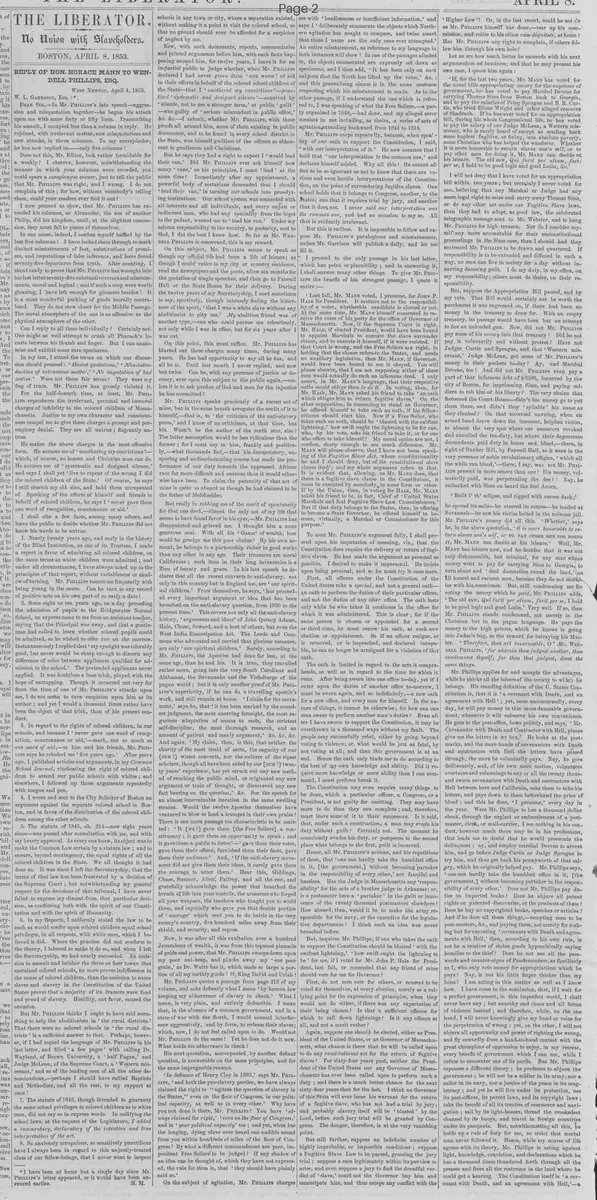
REPLY OF HON. HORACE MANN TO WENDELL PHILLIPS, ESQ.
WEST NEWTON, April 4, 1853.
W. L. GARRISON, ESQ.:
Dear SIR,—In Mr. Phillips's late speech—aggression and misquotation together—he began his attack upon me with some forty or fifty lines. Transcribing his assault, I occupied less than a column in reply. He rejoined, with irrelevant matter, new misquotations and new attacks, in three columns. To my surrejoinder, he has now replied in—only five columns!
Does not this, Mr. Editor, look rather formidable for a weekly? I observe, however, notwithstanding the manner in which your columns were crowded, you could spare a conspicuous corner, just to tell the public that Mr. Phillips was right, and I wrong. I do not complain of this; for how, without somebody's telling them, could your readers ever find it out?
I now proceed to show, that Mr. Phillips has extended his columns, as Alexander, the son of another Philip, did his kingdom, until, at the slightest concusion, they must fall to pieces of themselves.
In one sense, indeed, I confess myself baffled by the last five columns! I have looked them through to mark distinct misstatements of fact, substitutions of premises, and imputations of false inference, and have found seventy-five departures from truth. After counting, I stand ready to prove that Mr. Phillips has wrought into his last letter seventy-five substantive errors and misstatements, moral and logical; and if such a crop were worth gleaning, I have left enough for gleaners besides! It is a most wonderful packing of goods morally contraband. They do not stow closer for the Middle Passage. The moral atmosphere of the one is as offensive as the physical atmosphere of the other.
Can I reply to all these individually? Certainly not. One might as well attempt to crush all Pharaoh's locusts between his thumb and finger. But I can anatomize and exhibit some rare specimens.
In my last, I stated the terms on which our discussion should proceed: 'Honest quotations,' 'Non-introduction of extraneous matter,' 'No imputation of bad motive.' Were not these fair terms? They were my flag of truce. Mr. Phillips has grossly violated it.
For the half-dozenth time, at least, Mr. Phillips reproduces the irrelevant, personal and immoral charges of infidelity to the colored children of Massachusetts. Justice to my own character and consciousness compel me to give these charges a prompt and peremptory denial. They are all untrue; flagrantly untrue.
He makes the above charges in the most offensive form. He accuses me of 'smothering my convictions'—which, of course, no honest and Christian man can do. He accuses me of 'systematic and designed silence,' and says I shall yet 'live to repent of the wrong I did the colored children of the State.' Of course, he says I still cherish my old sins, and hold them unrepented of. Speaking of the efforts of himself and friends in behalf of colored children, he says I 'never gave them one word of recognition, countenance or aid.'
I shall cite a few facts, among many others, and leave the public to decide whether Mr. Phillips did not know his words to be untrue.
1. Nearly twenty years ago, and early in the history of the Blind Institution, as one of its Trustees, I made a report in favor of admitting all colored children, on the same terms as white children were admitted; and under all circumstances, I have always acted up to the principles of that report, without variableness or shadow of turning. Mr. Phillips taunts me frequently with being young in the cause. Can he turn to any record of positive acts on his own part of so early a date?
2. Some eight or ten years ago, on a day preceding the admission of pupils to the Bridgewater Normal School, an express came to me from an assistant teacher, saying that the Principal was away, and that a gentleman had called to learn whether colored pupils could be admitted, as he wished to offer two on the morrow. Instantaneously I replied that 'my eyesight was tolerably good, but never would be sharp enough to discern any difference of color between applicants qualified for admission to the school.' The pretended applicants never applied. It was doubtless a base trick, played with the hope of entrapping. Though it occurred not very far from the time of one of Mr. Phillips's attacks upon me, I do not mean to turn suspicion upon him as its author; and yet I would a thousand times rather have been the object of that trick, than of his present conduct.
3. In regard to the rights of colored children, in our schools, and because I 'never gave one word of recognition, countenance or aid,'—mark, not so much as one word of aid,—to him and his friends, Mr. Phillips says he rebuked me 'five years ago.' Nine years ago, I published articles and arguments, in my Common School Journal, vindicating the right of colored children to attend our public schools with whites; and elsewhere, I followed up those arguments repeatedly with tongue and pen.
4. I wrote and sent to the City Solicitor of Boston an argument against the separate colored school in Boston, and in favor of the distribution of the colored children among the other schools.
5. The statute of 1845, ch. 214—now eight years since—was passed after consultation with me, and with my hearty approval. As every one knew, its object was to make the Common Law certain by a statute law; and to ensure, beyond contingency, the equal rights of all the colored children in the State. We all thought it had done so. It was since I left the Secretaryship, that the intent of that law has been frustrated by a decision of the Supreme Court; but notwithstanding my general respect for the decisions of that tribunal, I have never failed to express my dissent from that particular decision, as conflicting both with the spirit of our Constitution and with the spirit of Humanity.
6. In my Reports, I uniformly stated the law to be such as would confer upon colored children equal school privileges, in all respects, with white ones, which I believed it did. Where the practice did not conform to the theory, I labored to make it do so, and when I left the Secretaryship, we had nearly succeeded. An omission to assault and belabor the three or four towns that sustained colored schools, no more proves indifference to the cause of colored children, than the omission to name slaves and slavery in the Constitution of the United States proves that a majority of its framers were fond and proud of slavery. Hostility, not favor, caused the omission.
But Mr. Phillips thinks I ought to have said something to help the abolitionists in 'the rural districts.' That there were no colored schools in the rural districts' is a sufficient answer to that. Perhaps, however, if I had copied the language of Mr. Phillips in his last letter, and filled 'a few pages' with calling Dr. Wayland, of Brown University, a half Pagan,' and Judge McLean, of the Supreme Court, a 'Western miscreant,' and so of the leading men of all the other denominations,—perhaps I should have rallied Baptists and Methodists, and all the rest, to my support at once!
7. The statute of 1843, though intended to guaranty the same school privileges to colored children as to white ones, did not say so in express words. In codifying the school laws, at the request of the Legislature, I added a commentary, declaratory of the intention and true interpretation of the act.
8. So anxiously scrupulous, so sensitively punctilious have I always been in regard to this unjustly-treated class of our fellow-beings, that I never went to inspect schools in any town or city, where a separation existed, without making it a point to visit the colored school, so that no ground should ever be afforded for a suspicion of neglect by me.
Now, with such documents, reports, commentaries and printed arguments before him, with such facts happening around him, for twelve years, I leave it for an impartial public to judge whether, when Mr. Phillips declared I had never given them one word' of aid in their efforts in behalf of the colored school children of the State—that I 'smothered my convictions'—practised 'systematic and designed silence'—connived by 'silence, not to use a stronger term,' at public 'guilt'—was guilty of 'serious misconduct in public office,' &c. &c. I submit, whether Mr. Phillips, with these proofs all around him, some of them existing in public documents, and to be found in every school district in the State, was himself guiltless of the offence so abhorrent to gentlemen and Christians.
But he says they had a right to expect I 'would lead their van.' Did Mr. Phillips ever ask himself how many 'vans,' on his principles, I must 'lead' at the same time? Immediately after my appointment, a powerful body of sectarians demanded that I should 'lead their van,' in turning our schools into proselyting institutions. Our school system was connected with all interests and all individuals, and every unjust or indiscreet man, who had any speciality from the bigot to the pedant, wanted me to 'lead his van.' Under my solemn responsibility to the country, to posterity, and to God, I did the best I knew how. So far as Mr. Wendell Phillips is concerned, this is my reward.
On this subject, Mr. Phillips seems to speak as though my official life had been a life of leisure; as though I could retire to my city or country residence, read the newspapers and the poets, allow six months for the gestation of single speeches, and then go to Faneuil Hall or the State House for their delivery. During the twelve years of my Secretaryship, I used sometimes to say, sportively, though intensely feeling the bitterness of the sport, 'that I was a white slave without any abolitionist to pity me.' My abolition friend was of another type,—one who could pursue me relentlessly, not only while I was in office, but for six years after I was out.
On this point, this must suffice. Mr. Phillips has blurted out these charges many times, during many years. He has had opportunity to say all he has, and all he is. Until last month I never replied, and now but twice. Can he, with any pretence of justice or decency, ever open this subject to the public again,—unless it is to ask pardon of God and man for the injustice he has committed?
Mr. Phillips speaks graciously of a recent act of mine, but in the same breath arrogates the credit of it to himself,—that is, to 'the criticism of the anti-slavery press,' and I know of no criticisms, at that time, but his. Wasn't he the author of the north star, also? The latter assumption would be less ridiculous than the former; for I must say to him, frankly and positively,—what thousands feel,—that his denunciatory, unsparing and undiscriminating course has made the performance of our duty towards the oppressed African race far more difficult and onerous than it would otherwise have been. To claim the paternity of that act of mine is quite as absurd as though he had claimed to be the father of Melchesidec.
But really in robbing me of the merit of spontaneity for that one deed,—almost the only act of my life that seems to have found favor in his eyes,—Mr. Phillips has disappointed and grieved me. I thought him a more generous soul. With all his 'Gazas' of wealth, how could he grudge me this poor obolus? By his own account, he belongs to a partnership richer in good works than any other in any age. Their treasures are moral Californias; each item in their long inventories is a Zion of beauty and grace. In his late speech he declares that all the recent converts to anti-slavery, not only in this country but in England too, are 'our spiritual children.' From themselves, he says, 'has proceeded every important argument or idea that has been broached on the anti-slavery question, from 1830 to the present time.' This covers not only all the anti-slavery history, 'arguments and ideas' of John Quincy Adams, Hale, Chase, Seward, and a host of others, but even the West India Emancipation Act. The Lords and Commons who advocated and carried that glorious measure, are only 'our spiritual children.' Surely, according to Mr. Phillips, the Apostles had done far less, at the same age, than he and his. It is true, they travelled rather more, going into the very South Carolinas and Alabamas, the Savannahs and the Vicksburgs of the pagan world; but it is only another proof of Mr. Phillips's superiority, if he can do a travelling apostle's work, and still remain at home. 'I claim for the movement,' says he, 'that it has been marked by the soundest judgment, the most unerring foresight, the most sagacious adaptation of means to ends, the strictest self-discipline, the most thorough research, and an amount of patient and manly argument,' &c. &c. &c.
And again, 'My claim, then, is this, that neither the charity of the most timid of sects, the sagacity of our [our!] wisest converts, nor the culture of the ripest scholars, though all have been aided by our [our!] twenty years' experience, has yet struck out any new method of reaching the public mind, or originated any new argument or train of thought, or discovered any new fact bearing on the question,' &c. See the speech for an almost interminable iteration in the same swelling strains. Would the twelve Apostles themselves have ventured to blow so loud a trumpet in their own praise?
There is one more passage too characteristic to be omitted: 'It [we?] gave them [the Free Soilers] a constituency; it gave them an opportunity to speak; and it gave them a public to listen'—'gave them their votes, gave them their offices, furnished them their facts, gave them their audience.' And, 'If the anti-slavery movement did not give them their ideas, it surely gave them the courage to utter them.' Hear this, Giddings, Chase, Sumner, Allen, Palfrey, and all the rest, and gratefully acknowledge the power that breathed the breath of life into your nostrils, the armorers who forged all your weapons, the teachers who taught you to wield them, and especially who gave you that double portion of 'courage' which sent you to do battle in the very enemy's country, five hundred miles away from their shield, and security, and repose.
Now, it was after all this exultation over a hundred Jerusalems of wealth, it was from this topmost pinnacle of pride and power, that Mr. Phillips swoops down upon my poor ant-heap, and plucks away my 'one poor grain,' as Dr. Watts has it, which made so large a portion of all my earthly goods! O, King David and Uriah!
Mr. Phillips quotes a passage from page 213 of my volume, and asks defiantly what I mean 'by human law keeping my abhorrence of slavery in check.' What I mean, is very plain, and entirely defensible. I mean that, in the absence of a common government, and in a state of war with the South, I would counsel interference aggressively, and by force, to redeem their slaves; which, now, I do not feel called upon to do. Would not Mr. Phillips do the same? Yet he does not do it now. What holds his abhorrence in check?
His next quotation, accompanied by another defiant question, is answerable on the same principles, and for the same impregnable reasons.
'In defiance of Henry Clay in 1839,' says Mr. Phillips, 'and both the pro-slavery parties, we have always claimed the right to "agitate the question of slavery in the States," even on the floor of Congress, in our political capacity, as well as in every other.' Why have you not done it there, Mr. Phillips? You have 'always claimed the right,' 'even on the floor of Congress,' and in 'your political capacity' too; and yet, when has the longing, dying slave ever heard one audible sound from you within hundreds of miles of the floor of Congress? By what a different commandment are poor, impenitent Free Soilers to be judged? If any shadow of an idea can be thought of, which they have not expressed, the rule for them is, that 'they should have plainly said so.'
On the subject of agitation, Mr. Phillips charges me with 'heedlessness or insufficient information,' and says I 'deliberately enumerate the objects which Northern agitation has sought to compass, and twice assert that those I name are the only ones ever attempted.' An entire misstatement, as reference to my language in both instances will show! In one of the passages alluded to, the objects enumerated are expressly set down as specimens, and I then add, 'It has been only on such subjects that the North has lifted up the voice,' &c.; and this generalizing clause is in the same sentence respecting which his misstatement is made. As to the other passage, if I understand the one which is referred to, I was speaking of what the Free Soilers,—a party organized in 1848,—had done, and my alleged error consists in not including, as theirs, a series of acts of agitation extending backward from 1844 to 1814.
Mr. Phillips carps repeatedly, because, when speaking of our oath to support the Constitution, I said, 'with our interpretation of it.' He now assumes that I hold that 'our interpretation is the common one,' and declares himself misled. Why all this? He cannot affect to be so ignorant as not to know that there are various and even hostile interpretations of the Constitution, on the point of surrendering fugitive slaves. One school holds that it belongs to Congress, another, to the States; one that it requires trial by jury, and another that it does not. I never said our interpretation was the common one, and had no occasion to say so. All that is evidently irrelevant.
But this is endless. It is impossible to follow and expose Mr. Phillips's paralogisms and misstatements, unless Mr. Garrison will publish a daily, and let me fill it.
I proceed to the only passage in his last letter, which has point or plausibility; and in answering it, I shall answer many other things. To give Mr. Phillips the benefit of his strongest passage, I quote it entire:
Last fall, Mr. Mann voted, I presume, for John P. Hale for President. It matters not to the responsibility of a voter, whether his candidate is elected or not. At the same time, Mr. Mann himself consented to receive the votes of his party for the office of Governor of Massachusetts. Now, if the Supreme Court is right, Mr. Hale, if elected President, would have been bound to appoint Marshals to execute the slave surrender clause, and to execute it himself, if it were resisted. If that Court is wrong, and the Free Soilers are right, in holding that the clause refers to the States, and needs no auxiliary legislation, then Mr. Mann, if Governor, would have been bound to see it obeyed. You will please observe, that I am not supposing either of these men would actually do such an infamous deed. I only assert, in Mr. Mann's language, that their respective oaths would oblige them to do it. In voting, then, for Mr. Hale, Mr. Mann asked his friend to take 'an oath which obliges him to return fugitive slaves.' On the other supposition, in consenting to stand as Governor, he offered himself to take such an oath, if his fellow-citizens should elect him. Now if a Free Soiler, who takes such an oath, should be 'blasted with the swiftest lightning,' how swift ought the lightning to be for one, who, by his vote, asks his friend to take it, or for one who offers to take himself? My moral optics are not, I confess, sharp enough to see much difference. Mr. Mann will please observe, that I have not been speaking of the Fugitive Slave Act, whose constitutionality he and I should deny, but of the constitutional slave clause itself; and my whole argument refers to that.
It is evident that, allowing, as Mr. Mann does, that there is a fugitive slave clause in the Constitution, it must be executed by somebody, in some form or other. If by the Union, then, in voting for Hale, Mr. MANN asked his friend to be, in fact, Chief of 'United States Marshals and foul Fugitive Slave Law Commissioners.' But if that duty belongs to the States, then, in offering to become a State Governor, he offered himself to become, virtually, a Marshal or Commissioner for this purpose.'
To meet Mr. Phillips's argument fully, I shall proceed upon his imputation of meaning, viz., that the Constitution does require the delivery or return of fugitive slaves. He has made the argument as personal as possible. I desired to make it impersonal. He insists upon being personal, and so he must try it once more.
First, all officers under the Constitution of the United States take a special, and not a general oath—an oath to perform the duties of their particular offices, and not the duties of any other office. The oath lasts only while he who takes it continues in the office for which it was administered. This is clear; for if the same person is chosen or appointed for a second or third time, he must renew his oath, at each new election or appointment. So if an officer resigns, or is removed, or is impeached, and declared incapable, he can no longer be arraigned for a violation of that oath.
The oath is limited in regard to the acts it comprehends, as well as in regard to the time for which it runs. After being sworn into one office to-day, yet if I enter upon the duties of another office to-morrow, I must be sworn again, and so indefinitely, a new oath for a new office, and every man for himself. In the nature of things, it cannot be otherwise; for how can one man swear to perform another man's duties? Even after I have sworn to support the Constitution, it may be overthrown in a thousand ways without my fault. The people may successfully rebel, either by going beyond voting to violence; or, what would be just as fatal, by not voting at all; and then this government is at an end. Hence the oath only binds me to do according to the best of my own knowledge and ability. Did it require more knowledge or more ability than I can command, I must perforce break it.
The Constitution may even require many things to be done, which a particular officer, a Congress, or a President, is not guilty for omitting. They may have more to do than they can complete; and, therefore, must leave some of it to their successors. Is it said, that, under such a construction, a man may evade his duty without guilt? Certainly not. The moment he consciously evades his duty, or postpones to the second place what belongs to the first, guilt is incurred.
Hence, all Mr. Phillips's notions, and his repetitions of them, that 'one can hardly take the humblest office in it, [the government,] without becoming partaker in the responsibility of every other,' are fanciful and baseless. Has the Judge in Massachusetts any 'responsibility' for the acts of a brother judge in Arkansas; or, is a postmaster here a 'partaker' in the guilt or innocence of the twenty thousand postmasters elsewhere? How absurd, then, would it be to make the army responsible for the navy, or the executive for the legislative departments! I think such an idea was never broached before.
But, inquires Mr. Phillips, if one who takes the oath to support the Constitution should be blasted 'with the swiftest lightning,' how swift ought the lightning to be' for me, if I voted for Mr. John P. Hale for President, last fall, or consented that any friend of mine should vote for me for Governor?
First, do not men vote for others, or consent to be voted for themselves, at every election, merely as a rallying point for the expression of principles, when they would not do either, if there was any expectation of their being chosen? Is that a sufficient offence for which to call down lightnings? Is it any offence at all, and not a merit rather?
Again, suppose one should be elected, either as President of the United States, or as Governor of Massachusetts, what chance is there that he will be called upon to do any constitutional act for the return of fugitive slaves? For sixty-four years past, neither the President of the United States nor any Governor of Massachusetts has ever been called upon to perform such a duty; and there is a much better chance for the next sixty-four years than for the last. I think no Governor of this State will ever issue his warrant for the return of a fugitive slave, who has not had a trial by jury; and probably slavery itself will be 'blasted' by the Lord, before such jury trial will be granted by Congress. The danger, therefore, is at the very vanishing point.
But still further, suppose an indefinite number of highly improbable, or impossible conditions; suppose a Fugitive Slave Law to be passed, granting the jury trial; suppose a case legitimately within its purview to arise, and even suppose a jury to find the dreadful verdict of 'slave,' could not the Governor buy him and emancipate him, and thus escape any conflict with the Higher Law'? Or, in the last resort, could he not do as Mr. Phillips himself has done,—tear up his commission, and retire to his otium cum dignitate, at home? Has Mr. Phillips any right to complain, if others follow him through his own hole?
Let us see how much better he succeeds with his next argumentum ad hominem; and that he may present his own case, I quote him again:
'If, for the last two years, Mr. Mann has voted for the usual bills appropriating money for the expenses of government, he has voted to pay Marshal Devens for carrying Thomas Sims from Boston back to Georgia, and to pay the salaries of Peleg Sprague and B. R. Curtis, who tried Elizur Wright and other alleged rescuers of Shadrach. If he has ever voted for an appropriation bill, during his whole Congressional life, he has voted to pay the salary of one Judge McLean, a Western miscreant, who is rarely heard of except as sending back some hapless fugitive, or fining, into absolute poverty, some Christian who has helped the wanderer. Whether it is more honorable to return slaves one's self, or to pay other men for doing it, Mr. Mann can decide at his leisure. The old saw, Qui facit per alium, facit per se, I hold to be good logic and good Latin,' &c.
I will not deny that I have voted for an appropriation bill within two years; but certainly I never voted for one, believing that any Marshal or Judge had any more legal right to seize and carry away Thomas Sims, or do any other act under our Fugitive Slave laws, than they had to adopt, as good law, the celebrated telegraphic message sent to Mr. Webster, and to hang Mr. Phillips for high treason. Nor do I consider myself any more accountable for their unconstitutional proceedings in the Sims case, than I should had they sentenced Mr. Phillips to be drawn and quartered. If responsibility is to be extended and diffused in such a way, no man can live in society for a day without incurring damning guilt. I do my duty, in my office, on my responsibility; others must do theirs, on their responsibility.
But, suppose the Appropriation Bill passed, and by my vote. That Bill would certainly not be worth the parchment it was engrossed on, if there had been no money in the treasury to draw for. With an empty treasury, its passage would have been but an attempt to fire an unloaded gun. Now, did not Mr. Phillips pay some of his money into that treasury? Did he not pay it voluntarily and without protest? Have not Judges Curtis and Sprague, and that 'Western miscreant,' Judge McLean, got some of Mr. Phillips's money in their pockets to-day? Ay, and Marshal Devens, too! And did not Mr. Phillips even pay a part of that infamous debt of $3500, incurred by the city of Boston, for imprisoning Sims, and paying soldiers to rob him of his liberty? The very chains that festooned the Court House——didn't his money go to put them there, and didn't they 'syllable' his name as they clanked? On that accursed morning, when an armed band drove down the innocent, helpless victim, to almost the very spot where our ancestors revoked and annulled the tea-duty, but where their degenerate descendants paid duty in bones and blood,—there, in sight of Bunker Hill, by Faneuil Hall, as it were in the very presence of noble revolutionary effigies, 'which all the while ran blood,'—there, I say, was not Mr. Phillips present in more senses than one? His money, voluntarily paid, was perpetrating the deed! Nay, he
Built i' th' eclipse, and rigged with curses dark;
he spread its sails—he steered its course—he landed at Savannah—he saw his victim bolted in the noisome jail. Mr. Phillips's money did all this. 'Whether,' says he, in the above quotation, 'it is more honorable to return slaves one's self, or TO PAY OTHER MEN FOR DOING IT, Mr. Mann can decide at his leisure.' Well, Mr. Mann has leisure now, and he decides that it was not only dishonorable, but criminal, for any man whose money went to pay for carrying Sims to Georgia, to turn about and 'deal damnation round the land,' on all honest and earnest men, because they do not moralize with his conscience. But, still condemning me for voting the money which he paid, Mr. Phillips adds, 'The old saw, Qui facit per alium, facit per se, I hold to be good logic and good Latin.' Very well. If so, then Mr. Phillips stands condemned, not merely in the Christian but in the pagan language. He pays the money to the high priests, which he knows is going into Judas's bag, as the reward for betraying his Master. Therefore, thou art inexcusable, O Mr. WENDELL PHILLIPS, 'for wherein thou judgest another, thou condemnest thyself; for thou that judgest, doest the same things.'
Mr. Phillips applies for and accepts the advantages, while he shirks all the labors of the society to which he belongs. His standing definition of the U. States Constitution is, that it is 'a covenant with Death, and an agreement with Hell'; yet, most unconcernedly, every day, he will pay money to this same damnable government, whenever it will subserve his own convenience. He goes to the post-office, bows politely, and says, 'Mr. Covenantor with Death and Contractor with Hell, please give me the letters in my box.' He looks at the post-marks, and the more hands of covenantors with Death and contractors with Hell the letters have passed through, the more he voluntarily pays. Nay, he goes deliberately, and, of his own mere motion, volunteers overtures and subornings to any or all the twenty thousand sworn covenantors with Death and contractors with Hell between here and California, asks them to take his letters, and pays down to them beforehand the price of blood; and this he does, 'I presume,' every day in the year. Were Mr. Phillips to lose a thousand dollar check, through the neglect or embezzlement of a post-master, clerk, or mail-carrier, I see nothing in his conduct, however much there may be in his professions, that leads me to doubt that he would prosecute the delinquent; ay, and employ marshal Devens to arrest him, and go before Judge Curtis or Judge Sprague to try him, and thus get back his pennyworth of that salary, which he originally helped pay. Mr. Phillips says, 'one can hardly take the humblest office in it, [the government,] without becoming partaker in the responsibility of every other.' Does not Mr. Phillips pay duties on imported books? Does he abjure all patent rights or patented discoveries, or the products of them? Does he buy no copyrighted books, speeches or articles? And if he does all these things,—tempting men to be post-masters, &c., and paying them, not merely for making but for executing 'covenants with Death and agreements with Hell,' then, according to his own rule, is not he a receiver of stolen goods hypocritically saying homilies to the thief? Does he not use all the pass-words and counter-signs of Pandemonium, as familiarly as I, who only vote money for appropriations which he pays? Nay, is not his little finger thicker than my loins? I am acting in this matter as well as I know how. I have come to the conclusion, that, if I wait for a perfect government, in this imperfect world, I shall never have any; but anarchy and chaos and all forms of violence instead; and therefore, while, on the one hand, I will never knowingly give my hand or voice for the perpetuation of wrong; yet, on the other, I will not abjure all opportunity and power of righting the wrong, and fly cowardly from a hand-to-hand contest with the great champions of oppression to enjoy, in my retreat, every benefit of government which I can use, while I refuse to encounter one of its perils. But Mr. Phillips espouses a different theory; he professes to abjure the government; he will not be a soldier in its army, nor a sailor in its navy, nor a justice of the peace in its magistracy; and yet he will live under its protection, use its post-offices, its patent laws, and its copyright laws; take the benefit of all its treaties of commerce and navigation; sail by its light-houses, thread the crookedest channel by its buoys, and travel in foreign countries under its passports. But, notwithstanding all this, he holds up a rule of duty for me, so strict that mortal man never followed it. Hence, while my course of life agrees with its theory, Mr. Phillips is acting against light, knowledge, conviction, and—declarations which he has a thousand times thundered forth through all the presses and from all the rostrums in the land where he could get a hearing. The Constitution itself is a covenant with Death, and an agreement with Hell,'—a
APRIL 8.
veritable League with the Devil, signed, sealed, acknowledged and recorded. Mr. Phillips is too wary to be a party to the original articles; but he has a way of avoiding all peril and securing all advantages, by making sub-contracts with one of the principals.
Mr. Phillips's whole theory about the nature of the official oath, the purpose for which it is taken, and the rule by which it is to be construed, seem to me untenable, and, in some points, ridiculous. If I understand him, he holds that the decisions of the Supreme Court on the Constitution become a part of the Constitution. So that whoever swears to support the former, swears to support the latter also. If so, then that Court can abolish the free agency of Congress and President, just as Judges Curtis, Sprague and Hall have abolished the prerogatives of jurors. If a judge can make a traverse jury swear to convict, under certain conditions which he himself prescribes, then it is very clear that he can make the grand jury swear to indict, under certain other conditions; and if this be so, then he can get any man indicted by the one, and convicted by the other, for any offence, while so many as twenty-four scoundrels can be found in any county or district, base enough to do his bidding; and no innocence has the possibility of escape. Now Mr. Phillips claims this extreme prerogative for the Supreme Court over both co-ordinate departments, legislative and executive. Gen. Jackson said, 'It is as much the duty of the House of Representatives, of the Senate, and of the President, to decide upon the constitutionality of any bill or resolution which may be presented to them for passage or approval, as it is of the Supreme Judges when it may be brought before them for judicial decision. The authority of the Supreme Court must not, therefore, be permitted to control the Congress or the Executive when acting in their legislative capacities,' &c. This language, Mr. Charles Sumner says, 'I adopt with entire assent.'
At the very last Congress, the two Houses overruled a decision of the Supreme Court, and the President signed the bill. What sweeping and reckless assertions are made by Mr. Phillips, to uphold his erroneous positions!
Again, as to the notion, that the official oath is a promise to support the Constitution as the 'nation' understands it; who is the nation? Mr. Phillips thinks women ought to vote. Are they a part of the nation, and to be consulted, before we decide upon our duty? Are mere majorities to govern, so that we shall give no more heed to the wisest and best men than to the weakest and worst? Shall we adopt the plurality system? Are we to be controlled by the living or the dead? Must we count by states or by individuals? Must we adopt the three-fifths rule, and allow masters to act for slaves, or not? It is utterly impossible to gather up the sense of the nation; and every sane man must see it. But, says Mr. Phillips, Go by the Supreme Court. There are a hundred vital questions on which the Supreme Court have as yet made no decision. On this great and overshadowing one, whether an alleged fugitive has a constitutional right to a jury trial, that court has never yet decided. On his own showing, then, I am not bound to deliver up an alleged fugitive, nor to do any act looking towards his being delivered up, until he has had a jury trial, or the court has decided that he is not entitled to one. Mr. Phillips is mistaken all round.
What, then, are the scope and purport of (for instance) the Congressional oath? They are, to perform the duties of that office, not of any other; during its continuance, not any longer; to ascertain the true meaning of the Constitution, in all practicable ways, and from all sources,—including the decisions of the Supreme Court, which, however, are not the law, but only evidence of the law,—and when that meaning is ascertained, to abide by it in all cases presented for action; to take up the business of the country in the order of its importance: and to execute it according to the best of one's knowledge and ability: and when the oath taker has determined what should be done, and where it should be done, then to follow the conclusions of his own judgment and conscience, whether a single other man in the nation agrees with him or not. Any other construction makes an automaton or puppet of him. Mr. Phillips's snatching at a common-place rule for governing hucksters in the market, and using its narrow basis as coextensive with the great principles that should govern a legislator's oath to God, and his duty to his own nation, to all the nations of the earth, and to posterity,—(a promise to posterity to do our duty to it, as posterity understands it !)—I say, Mr. Phillips's narrowness on this subject reminds me of what Burke said to Erskine, in the trial of Warren Hastings, that a mere nisi prius lawyer, with his technicalities and bar rules, was no more fit to decide upon the principles that should govern great questions of State, than a rabbit that breeds nine times a year was to decide upon the period necessary for the gestation of an elephant.
Though I have scarcely noticed one tenth part of the material,—illogical in argument, incorrect in statement, and calumnious in imputation,—which Mr. Phillips has furnished, yet I must desist. The very multitude of his offences must earn impunity for some of them. I will classify a few of his vices as a disputant, as exhibited in this letter, and let the rest pass,—at least till another time.
1. He misstates matters of fact enormously. This I have shown in regard to my course towards the colored school children of Massachusetts.
2. Bad motives being less capable of disproof than facts, he takes a broader license in imputing them. He attempts to fasten upon Mr. Hale and myself, and thousands of others, indeed, a guilt akin to that of perjury.
3. He enlarges the premises of his adversary, so that they may sustain some false conclusion they would not otherwise bear. Thus he reiterates the old charge that disclaimers made in my legislative capacity, and under the Constitution, were general disclaimers; and he enlarges these to take in a wider scope of action than they legitimately do.
4. He leaves out premises, in order to escape the force of conclusions, and to impute the folly of building too large a superstructure upon a given foundation.
For instance, assuming, for argument's sake, the wholly untenable ground, that my oath was a promise to follow the will of the nation, in regard to the Constitution, I said the nation, Supreme Court and all, understood in what sense I promised. To give personification to the idea, I introduced the two Speakers, Howell Cobb and Linn Boyd, who administered the oath. Mr. Phillips introduces these two names, separates them from the rest of the sentence, and, for more than a whole column, argues the question as though the soundness of my position and argument rested upon the special knowledge and understanding of Messrs. Cobb and Boyd. Taking a mere accident for the basis of the argument, who could not fasten any degree of folly upon his antagonist? Once he craftily introduced the residue or substantive part of the sentence, but immediately eclipses it with irrelevant matter about 'poor Moses Stuart' and Mr. Webster, and then occupies more than a column to disprove what no sane man ever understood me to say.
5. He fabricates both premises and conclusions. For example: In my last letter, I made a remark, on which Mr. Phillips, in his last, made a comment. I collate both for the reader's perusal:
Mr. Mann's Remark.
I had supposed that as an oath makes God a party to the transaction, it is binding in that sense in which he knows the party took it.
Mr. Phillips's Comment.
This is virtually the Jesuits' rule, that promises are binding, not as the parties understood them, but as the promisor secretly intended. That is, a man may swear one thing, and mean another, and God justifies him!
Now, in my remark, where is there any vestige or glimmer of an idea about promises not being binding as the parties understood them'; or about 'secret intentions' governing; or about a man's 'swearing one thing and meaning another'; or about 'God's justifying' men for lying or perjury? Where, I demand, is
What sub-type of article is it?
What themes does it cover?
What keywords are associated?
What entities or persons were involved?
Letter to Editor Details
Author
Hon. Horace Mann
Recipient
W. L. Garrison, Esq.
Main Argument
horace mann defends his advocacy for equal education rights for colored children through historical actions, reports, and statutes, and justifies his political participation under the constitution as consistent with anti-slavery principles, while accusing wendell phillips of numerous misstatements, hypocrisy in benefiting from the government he denounces, and overclaiming credit for the abolition movement.
Notable Details