Thank you for visiting SNEWPapers!
Sign up free
Los Angeles Herald
Los Angeles, Los Angeles County, California
What is this article about?
Southern Pacific Railway officials, led by President C.P. Huntington, visited Santa Barbara and Santa Monica by special train, engaging in receptions and discussions on local development and future railway projects amid economic challenges.
Clipping
OCR Quality
Full Text
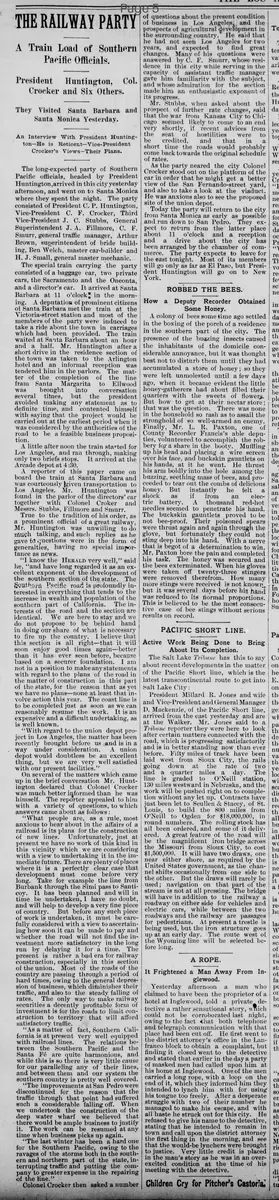
A Train Load of Southern Pacific Officials.
President Huntington, Col. Crocker and Six Others.
They Visited Santa Barbara and Santa Monica Yesterday.
An Interview With President Huntington-He is Reticent-Vice-President Crocker's Views-Their Plans.
The long-expected party of Southern Pacific officials, headed by President Huntington, arrived in this city yesterday afternoon, and went on to Santa Monica where they spent the night. The party consisted of President C. P. Huntington, Vice-President C. F. Crocker, Third Vice-President J. C. Stubbs, General Superintendent J. A. Fillmore, C. F. Smurr, general traffic manager, Arthur Brown, superintendent of bridge building, Ben Welch, master car-builder and H. J. Small, general master mechanic.
The special train carrying the party consisted of a baggage car, two private cars, the Sacramento and the Oneonta, and a director's car. It arrived at Santa Barbara at 11 o'clock in the morning. A deputation of prominent citizens of Santa Barbara met the train at the Victoria-street station and most of the members of the party were induced to take a ride about the town in carriages which had been provided. The train waited at Santa Barbara about an hour and a half. Mr. Huntington after a short drive in the residence section of the town was taken to the Arlington hotel and an informal reception was tendered him in the parlors. The matter of the completion of the line from Santa Margarita to Ellwood was brought into conversation several times, but the president avoided making any statement as to definite time, and contented himself with saying that the project would be carried out at the earliest period when it was considered by the authorities of the road to be a feasible business proposition.
A little after noon the train started for Los Angeles, and ran through, making only two brief stops. It arrived at the Arcade depot at 4:30.
A reporter of this paper came on board the train at Santa Barbara and was courteously given transportation to Los Angeles. Mr. Huntington was found in the parlor of the directors' car together with Colonel Crocker and Messrs. Stubbs, Fillmore and Smurr.
True to the tradition of his order, as a prominent official of a great railway, Mr. Huntington was unwilling to do much talking, and such replies as he gave to questions were in the form of generalities, having no special importance as news.
"I know the Herald very well," said he, "and have long regarded it as an excellent exponent of the development of the southern section of the state. The Southern Pacific road is profoundly interested in everything that tends to the increase in wealth and population of the southern part of California. The interests of the road and the section are identical. We are here to stay and we do not propose to be behind hand in doing our share of what is necessary to fire up the country. I believe that this section is all right-that it will soon enjoy good times again--better than it has ever seen before, because based on a securer foundation. I am not in a position to make any statements with regard to the plans of the road in the matter of construction in this part of the state, for the reason that as yet we have no plans-none at least that involve action this year. The coast line is to be completed just as soon as we can reasonably resume the work. It is an expensive and a difficult undertaking, as is well known.
"With regard to the union depot project in Los Angeles, the matter has been recently brought before us and is in a way under consideration. A union depot would doubtless be an excellent thing, but we are very well satisfied with our present facilities."
On several of the matters which came up in the brief conversation Mr. Huntington declared that Colonel Crocker was much better informed than he was himself. The reporter appealed to him with a variety of questions, to which answers came about as follows:
"What people are, as a rule, most anxious to hear about in the affairs of a railroad is its plans for the construction of new lines. Unfortunately, just at present we have no work of this kind in this vicinity which we are considering with a view to undertaking it in the immediate future. There are plenty of places where it is a perfectly clear case that development must come before very long. Take for example the line from Burbank through the Simi pass to Santa coy. It has been planned and will in time be undertaken, I have no doubt, and will help to develop a very fine piece of country. But before any such piece of work is undertaken, it must be carefully considered with a view to ascertaining how soon it can be made to pay and whether the road will not find the investment more satisfactory in the long run by delaying it for a time. The present is rather a bad era for railway construction, especially in this section of the union. Most of the roads of the country are passing through a period of hard times, owing to the general depression of business, which diminishes their traffic, and also to the steady falling of rates. The only way to make railway securities a decently profitable form of investment is for the roads to limit construction to territory that will afford satisfactory traffic.
"As a matter of fact, Southern California is at present very well equipped with railroad lines. The relations between the Southern Pacific and the Santa Fé are quite harmonious, and while this is so there is very little cause for our paralleling any of their lines, and between them and our system the southern country is pretty well covered.
"The improvements at San Pedro were discontinued for the reason that the traffic through that point had suffered such a considerable falling off. When we undertook the construction of the deep water wharf we believed that there would be ample business to justify it. The work can be resumed at any time when business picks up again.
"The last winter has been a hard one for the Southern Pacific, owing to the ravages of the storms both in the southern and northern part of the state, interrupting traffic and putting the company to greater expense in the repairing of the line."
Colonel Crocker then asked a number of questions about the present condition of business in Los Angeles, and the prospects of agricultural development in the surrounding country. He said that he had not seen Los Angeles for two years, and expected to find great changes. Many of his questions were answered by C. F. Smurr, whose residence in this city while serving in the capacity of assistant traffic manager gave him familiarity with the subject, and whose admiration for the section made him an enthusiastic exponent of its progress.
Mr. Stubbs, when asked about the prospect of further rate changes, said that the war from Kansas City to Chicago seemed likely to come to an end very shortly, if recent advices from the seat of hostilities were to be credited, and that in a short time the roads would probably come back towards the original schedule of rates.
As the party neared the city Colonel Crocker stood out on the platform of the car in order that he might get a better view of the San Fernando-street yard, and also to take a look at the viaduct. He was anxious also to see the proposed site of the union depot.
Today the party will return to the city from Santa Monica as early as possible and run down to San Pedro. They expect to return from the latter place about 11 o'clock and a reception and a drive about the city has been arranged by the chamber of commerce. The party expects to leave for the east tonight. Most of its members will go only as far as El Paso, but President Huntington will go on to New York.
What sub-type of article is it?
What themes does it cover?
What keywords are associated?
What entities or persons were involved?
Where did it happen?
Story Details
Key Persons
Location
Santa Barbara, Santa Monica, Los Angeles, San Pedro, Southern California
Event Date
Yesterday
Story Details
A party of Southern Pacific officials, including President Huntington and Vice-President Crocker, arrived by special train, visited Santa Barbara for a reception and drive, then proceeded to Los Angeles and Santa Monica. They discussed railway construction plans, local development, and business prospects, expressing optimism for the region's future while being reticent on specifics.