Thank you for visiting SNEWPapers!
Sign up free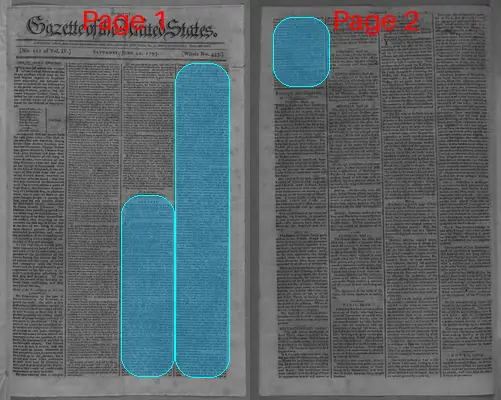
Gazette Of The United States
New York, New York County, New York
What is this article about?
In April 1793, Port-au-Prince merchants petitioned French National Civil Commissioners to avert cannonade and embargo harming colonial trade, asserting loyalty amid revolutionary tensions; attack occurred four days later.
Merged-components note: Direct textual continuation of the Port-au-Prince merchants' address across pages.
Clippings
1 of 2
OCR Quality
Full Text
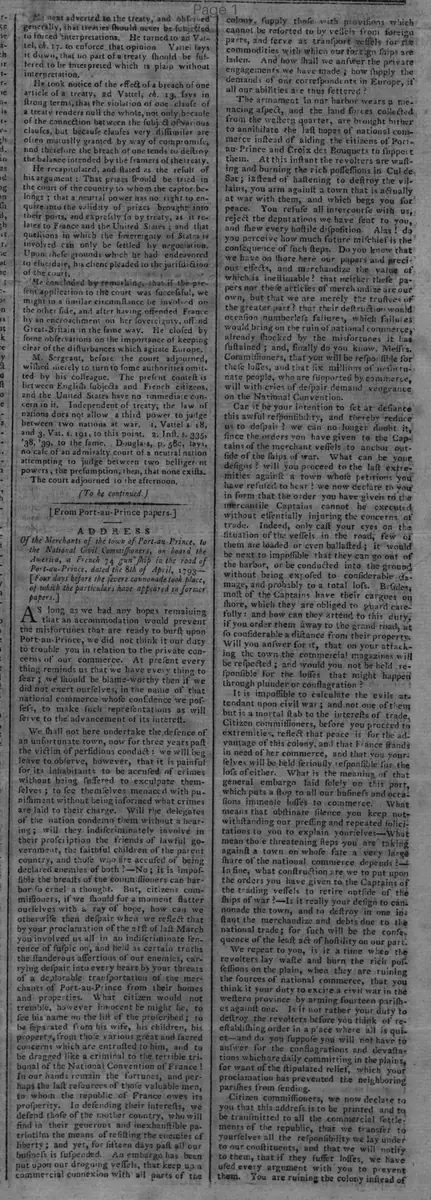
ADDRESS
Of the Merchants of the town of Port-au-Prince, to the National Civil Commissioners, on board the America, a French 74 gun ship in the road of Port-au-Prince, dated the 8th of April, 1793—
Four days before the severe cannonade took place, of which the particulars have appeared in former papers.
As long as we had any hopes remaining that an accommodation would prevent the misfortunes that are ready to burst upon Port-au-Prince, we did not think it our duty to trouble you in relation to the private concerns of our commerce. At present every thing reminds us that we have every thing to fear; we should be blame-worthy then if we did not exert ourselves, in the name of that national commerce whose confidence we possess, to make such representations as will serve to the advancement of its interest.
We shall not here undertake the defence of an unfortunate town, now for three years past the victim of perfidious conduct: we will beg leave to observe, however, that it is painful for its inhabitants to be accused of crimes without being offered to exculpate themselves; to see themselves menaced with punishment without being informed what crimes are laid to their charge. Will the delegates of the nation condemn them without a hearing; will they indiscriminately involve in their proscription the friends of lawful government, the faithful children of the parent country, and those who are accused of being declared enemies of both?—No; it is impossible the breasts of the commissioners can harbor so cruel a thought. But, citizens commissioners, if we should for a moment flatter ourselves with a ray of hope, how can we otherwise then despair when we reflect that by your proclamation of the 21st of last March you involved us all in an indiscriminate sentence of suspicion, and held as certain truths the slanderous assertions of our enemies, carrying despair into every heart by your threats of a deplorable transportation of the merchants of Port-au-Prince from their homes and properties. What citizen would not tremble, however innocent he might be, to see his name on the list of the proscribed; to be separated from his wife, his children, his property, from those various great and sacred concerns which are entrusted to him, and to be dragged like a criminal to the terrible tribunal of the National Convention of France!
In our hands remain the fortunes, and perhaps the last resources of those valuable men, to whom the republic of France owes its prosperity. In defending their interests, we defend those of the mother country, who will find in their generous and inexhaustible patriotism the means of resisting the enemies of liberty; and yet, for fifteen days past all our business is suspended. An embargo has been put upon our droguing vessels, that keep up a commercial connexion with all parts of the colony, supply those with provisions which cannot be resorted to by vessels from foreign parts, and serve as transport vessels for the commodities with which our foreign ships are laden. And how shall we answer the private engagements we have made; how supply the demands of our correspondents in Europe, if all our abilities are thus fettered?
The armament in our harbor wears a menacing aspect, and the land forces collected from the western quarter, are brought hither to annihilate the last hopes of national commerce instead of aiding the citizens of Port-au-Prince and Croix des Bouquets to support them. At this instant the revolters are wasting and burning the rich possessions in Cul de Sac; instead of hastening to destroy the villains, you arm against a town that is actually at war with them, and which begs you for peace. You refuse all intercourse with us, reject the deputations we have sent to you, and shew every hostile disposition. Alas! do you perceive how much future mischief is the consequence of such steps. Do you know that we have on shore here our papers and precious effects, and merchandise the value of which is inestimable? that neither these papers nor these articles of merchandise are our own, but that we are merely the trustees of the greater part? that their destruction would occasion numberless failures, which failures would bring on the ruin of national commerce, already shocked by the misfortunes it has sustained; and, finally do you know, Mess. Commissioners, that you will be responsible for these losses, and that six millions of unfortunate people, who are supported by commerce, will with cries of despair demand vengeance on the National Convention.
Can it be your intention to set at defiance this awful responsibility, and thereby reduce us to despair? we can no longer doubt it, since the orders you have given to the Captains of the merchant vessels to anchor outside of the ships of war. What can be your designs? will you proceed to the last extremities against a town whose petitions you have refused to hear: we now declare to you in form that the order you have given to the mercantile Captains cannot be executed without essentially injuring the concerns of trade. Indeed, only cast your eyes on the situation of the vessels in the road, few of them are loaded or even ballasted; it would be next to impossible that they can go out of the harbor, or be conducted into the ground without being exposed to considerable damage, and probably to a total loss. Besides; most of the Captains have their cargoes on shore, which they are obliged to guard carefully: and how can they attend to this duty, if you order them away to the grand road, at so considerable a distance from their property.
Will you answer for it, that on your attacking the town the commercial magazines will be respected; and would you not be held responsible for the losses that might happen through plunder or conflagration?
It is impossible to calculate the evils attendant upon civil war; and not one of them but is a mortal stab to the interests of trade.
Citizen commissioners, before you proceed to extremities, reflect that peace is for the advantage of this colony, and that France stands in need of her commerce, and that you yourselves will be held seriously responsible for the loss of either. What is the meaning of that general embargo laid solely on this port, which puts a stop to all our business and occasions immense losses to commerce. What means that obstinate silence you keep notwithstanding our pressing and repeated solicitations to you to explain yourselves—What mean those threatening steps you are taking against a town on whose fate a very large share of the national commerce depends?
In fine, what construction are we to put upon the orders you have given to the Captains of the trading vessels to retire outside of the Ships of war?—Is it really your design to cannonade the town, and to destroy in one instant the merchandise and debts due to the national trade; for such will be the consequence of the least act of hostility on our part.
We repeat to you, is it a time when the revolters lay waste and burn the rich possessions on the plain, when they are ruining the sources of national commerce, that you think it your duty to excite a civil war in the western province by arming fourteen parishes against one. Is it not rather your duty to destroy the revolters before you think of re-establishing order in a place where all is quiet—and do you suppose you will not have to answer for the conflagrations and devastations which are daily committing in the plains, for want of the stipulated relief, which your proclamation has prevented the neighboring parishes from sending.
Citizen commissioners, we now declare to you that this address is to be printed and to be transmitted to all the commercial establishments of the republic, that we transfer to yourselves all the responsibility we lay under to our constituents, and that we will notify to them, that if they suffer losses, we have used every argument with you to prevent them. You are ruining the colony instead of having it, and under pretence of avenging affronts which France has never received, you will soon plunge her into mourning and consternation. Renounce then your intended attack, give peace to the citizens of Port au Prince, and be convinced that they are worthy of the French republic, and do not merit anger or abuse. Suffer truth to shine into you, and turn not away from the mirror we hold up to you. In a short time you will no longer be able to look at it; the misfortunes we predict will fall upon your own heads presently, and you will then regret that you had not prevented them. Ye depositories of national confidence, the voice of commerce ought to have some influence on you. She has some right to a special protection, and you cannot without acting a criminal part towards your country, expose her best interests to destruction.
[The foregoing was signed by near sixty merchants, and trading companies in Port-au-Prince; the cannonade, notwithstanding, took place on the 12th (four days after the date of the above) for the reasons mentioned in the commissioner's letter.]
What sub-type of article is it?
What keywords are associated?
Where did it happen?
Foreign News Details
Primary Location
Port Au Prince
Event Date
8th Of April, 1793
Outcome
cannonade took place on the 12th (four days after the address), for reasons mentioned in the commissioner's letter.
Event Details
Merchants of Port-au-Prince addressed the National Civil Commissioners on board the French ship America, pleading against an impending attack and embargo that threatened commerce. They defended the town's loyalty, protested the suspension of business, and warned of ruin to national commerce if hostilities proceeded. The address was signed by near sixty merchants and trading companies.