Thank you for visiting SNEWPapers!
Sign up free
The Madisonian
Washington, District Of Columbia
What is this article about?
The National Convention of Young Men assembled in Baltimore on May 4, 1840, to support William Henry Harrison's presidential candidacy. Featuring a massive procession with state delegations, log cabins, and banners, it included speeches by Henry Clay, Daniel Webster, and others, ratifying the Harrison-Tyler ticket and promoting Whig reforms.
Merged-components note: These two components form a continuous report on the Harrison National Convention of Young Men, spanning multiple columns and pages with sequential reading order; merging to isolate as a single logical story unit.
Clippings
1 of 2
OCR Quality
Full Text
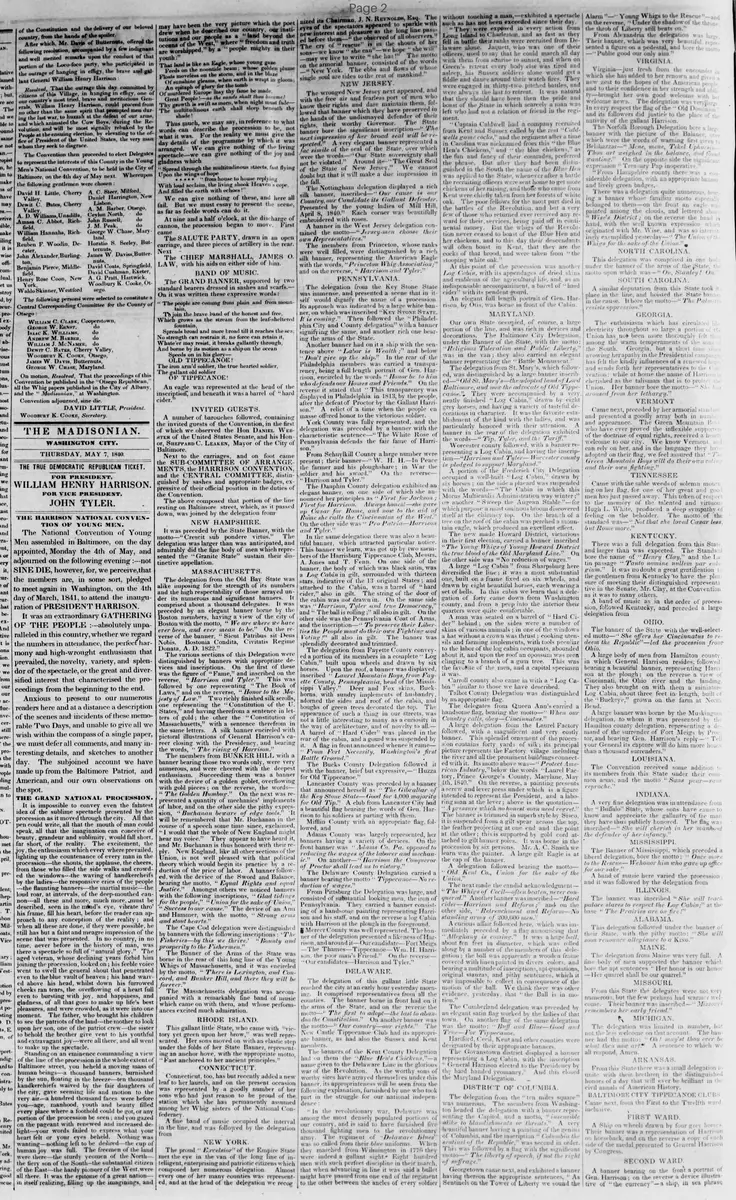
The National Convention of Young Men assembled in Baltimore, on the day appointed, Monday the 4th of May, and adjourned on the following evening—not SINE DIE, however, for, we perceive, that the members are, in some sort, pledged to meet again in Washington, on the 4th day of March, 1841, to attend the inauguration of PRESIDENT HARRISON.
It was an extraordinary GATHERING OF THE PEOPLE—absolutely unparalleled in this country, whether we regard the numbers in attendance, the perfect harmony and high-wrought enthusiasm that prevailed, the novelty, variety, and splendor of the spectacle, or the great and diversified interest that characterised the proceedings from the beginning to the end.
Anxious to present to our numerous readers here and at a distance a description of the scenes and incidents of these memorable Two Days, and unable to give all we wish within the compass of a single paper, we must defer all comments, and many interesting details, and sketches to another day. The subjoined account we have made up from the Baltimore Patriot, and American, and our own observations on the spot.
THE GRAND NATIONAL PROCESSION.
It is impossible to convey even the faintest idea of the sublime spectacle presented by the procession as it moved through the city. All that pen could write, all that the mouth of man could speak, all that the imagination can conceive of beauty, grandeur and sublimity, would fall short—far short, of the reality. The excitement, the joy, the enthusiasm which everywhere prevailed, lighting up the countenance of every man in the procession—the shouts, the applause, the cheers, from those who filled the side walks and crowded the windows—the waving of handkerchiefs by the ladies—the responsive cries of the people—the flaunting banners—the martial music—the loud roar, at intervals, of the deep-mouthed cannon—all these and more, much more, must be described, seen in the mind's eye, vibrate thro' his frame, fill his heart, before the reader can approach to any conception of the reality; and when all these are done, if they were possible, he still has but a faint and meagre impression of the scene that was presented. In no country, in no time, never before in the history of man, was there a spectacle so full of "natural glory." The aged veteran, whose declining years forbid him joining the procession, looked on; his feeble voice went to swell the general shout that penetrated even to the blue vault of heaven; his hand waved above his head, whilst down his furrowed cheeks ran tears, the overflowing of a heart full even to bursting with joy, and happiness, and gladness, of all that goes to make up life's best pleasures, and were crowded, as it were into one moment. The father, who brought his children to see the patriots of the land—the mother to look upon her son, one of the patriot crew—the sister to behold the brother give vent to his youthful and extravagant joy—were all there, and all went to make up the spectacle.
Standing on an eminence commanding a view of the line of the procession in the whole extent of Baltimore street, you beheld a moving mass of human beings—a thousand banners, burnished by the sun, floating in the breeze—ten thousand handkerchiefs waived by the fair daughters of the city, gave seeming life and motion to the very air—a hundred thousand faces were before you—age, manhood, youth and beauty filled every place where a foothold could be got, or any portion of the procession be seen; and you gazed on the pageant with renewed and increased delight—your words failed to express what your heart felt or your eyes beheld. Nothing was wanting—nothing left to be desired—the cup of human joy was full. The freemen of the land were there—the sturdy yeomen of the North—the fiery son of the South—the substantial citizen of the East—the hardy pioneer of the West, were all there. It was the epitome of a great nation—in itself realizing, filling up the imaginings, and may have been the very picture which the poet drew when he described our country, our institutions and our people as a "land beyond the oceans of the West," where "freedom and truth are worshipped," by a "people mighty in their youth:"
That land is like an Eagle, whose young gaze
Feeds on the noontide beam; whose golden plume
Floats moveless on the storm, and in the blaze
Of sunshine gleams, when earth is wrapt in gloom;
Of murdered Europe may thy fame be made,
An epitaph of glory for the tomb
Thy growth is swift as morn, when night must fade—
Great People! as the sands shalt thou become!
The multitudinous earth shall sleep beneath thy shade!
Thus much, we may say, in reference to what words can describe the procession to be, not what it was. For the reality we must give the details of the programme by which it was arranged. We can give nothing of the living spectacle—we can give nothing of the joy and gladness which
"Spread through the multitudinous streets, fast flying
Upon the wings of hope
from house to house replying
With loud acclaim, the living shook Heaven's cope,
And filled the earth with echoes!"
We can give nothing of these, and here all fail. But we must essay to present the scene, as far as feeble words can do it.
At nine and a half o'clock, at the discharge of cannon, the procession began to move. First came
The SALUTE PARTY, drawn in an open carriage, and three pieces of artillery in the rear.
Next
The CHIEF MARSHALL, JAMES O. LAW, with his aids on either side of him.
BAND OF MUSIC.
The GRAND BANNER, supported by two standard bearers dressed in sashes and scarfs.
On it was written these expressive words:
"The people are coming from plain and from mountain,
To join the brave band of the honest and free
Which grows as the stream from the leaf-sheltered fountain,
Spreads broad and more broad till it reaches the sea;
No strength can restrain it, no force can retain it.
Whate'er may resist, it breaks gallantly through
And borne by its motion as a ship on the ocean
Speeds on in his glory—
OLD TIPPECANOE!
The iron arm'd soldier, the true hearted soldier
The gallant old soldier
OF TIPPECANOE!"
An eagle was represented at the head of the inscription, and beneath it was a barrel of "hard cider."
INVITED GUESTS.
A number of barouches followed, containing the invited guests of the Convention, in the first of which we observed the Hon. Daniel Webster of the United States Senate, and his Honor, Sheppard C. Leakin, Mayor of the City of Baltimore.
Next to the carriages, and on foot came the SUB-COMMITTEE OF ARRANGEMENTS, the HARRISON CONVENTION, and the CENTRAL COMMITTEE, distinguished by sashes and appropriate badges, expressive of their official position in the duties of the Convention.
The above composed that portion of the line resting on Baltimore street, which, as it passed down, was joined by the delegation from
NEW HAMPSHIRE.
It was preceded by the State Banner, with the motto—"Crescit sub pondere virtus." The delegation was larger than was anticipated, and admirably did the fine body of men which represented the "Granite State" sustain their distinctive appellation.
MASSACHUSETTS.
The delegation from the Old Bay State was alike imposing for the strength of its numbers and the high respectability of those arrayed under its numerous and significant banners. It comprised about a thousand delegates. It was preceded by an elegant banner borne by the Boston members, having a view of the city of Boston with the motto, "We are where we have ever been, and ever mean to be." On the reverse of the banner, "Sicut Patribus sit Deus Nobis. Bostonia Condita, Civitatis Regime Donata, A. D. 1822."
The various sections of this Delegation were distinguished by banners with appropriate devices and inscriptions. On the first of these was the figure of "Fame," and inscribed on the reverse, "Harrison and Tyler." This was followed by one representing "The Book of Laws," and on the reverse, "Honor to the Majesty of Law." Two richly finished silk scrolls, one representing the "Constitution of the U. States," and having therefrom a sentence in letters of gold; the other the "Constitution of Massachusetts," with a sentence therefrom in the same letters. A silk banner encircled with pictoral illustrations of General Harrison's career closing with the Presidency, and bearing the words, "The rising of Harrison."
The members from BUNKER HILL with a banner bearing those two words only, were very numerous, and were cheered with the deepest enthusiasm. Succeeding them was a banner with the device of a golden goblet, overflowing with gold pieces; on the reverse, the words—"The Golden Humbug." On the next was represented a quantity of mechanics' implements of labor, and on the other side the pithy expression, "Buchanan beware of edge tools." It will be remembered that Mr. Buchanan in the course of a speech some time since, exclaimed, "I would that the whole of New England might hear my voice." They appear to have heard it, and Mr. Buchanan is thus honored with their reply. New England, like all other sections of the Union, is not well pleased with that political theory which would begin its practice by a reduction of the price of labor. A banner followed, with the device of the Sword and Balance, bearing the motto, "Equal Rights and equal Justice." Amongst others we noticed banners with the following inscriptions, "Glad tidings for the people," "Union for the sake of Union," "Success to our cause." The device of an Arm and Hammer, with the motto, "Strong arms and stout hearts."
The Cape Cod delegation were distinguished by banners with the following inscriptions: "The Fisheries—by this we thrive?" "Bounty and prosperity to the Fishermen."
The Banner of the Arms of the State was borne in the rear of this long line of the Young Whigs of Massachusetts, and it was encircled by the motto, "There is Lexington, and Concord, and Bunker Hill, and there they will be forever."
The Massachusetts delegation was accompanied with a remarkably fine band of music which came on with them, and whose performances excited much admiration.
RHODE ISLAND.
This gallant little State, who came with "victory yet green upon her brow," was well represented. Her sons moved on with an elastic step under the folds of her State Banner, representing an anchor hove, with the appropriate motto, "Fast anchored to her ancient principles."
CONNECTICUT.
Connecticut, too, has but recently added a new leaf to her laurels, and on the present occasion was represented by a goodly number of her sons who had just reason to be proud of the station which she has permanently assumed among her Whig sisters of the National Confederacy.
A fine band of music occupied the interval in the line, and was followed by the delegation from
NEW YORK.
The proud "Excelsior" of the Empire State met the eye in the van of the long line of intelligent, enterprising and patriotic citizens which composed her numerous delegation. Almost every one of her many counties was represented, and at the head of the delegation we recognized its Chairman, J. N. Reynolds, Esq. The eyes of the spectators appeared to sparkle with new interest and pleasure as the long line passed before them—"the observed of all observers." Sons—we know "she can"—we hope "she will"—may we live to write "she has!" The cry of "rescue" is in the shouts of her sons—we know "she can"—we hope "she will"—may we live to write "she has!" The motto on the armorial banner, consisted of the words—"New York. The ebbs and flows of whose single soul are tides to the rest of mankind."
NEW JERSEY.
The wronged New Jersey next appeared, and with the free air and fearless port of men who know their rights and dare maintain them, followed that banner which they have preserved in the hands of the undismayed defender of their rights, their worthy Governor. The State banner bore the significant inscription—"She next impression of her broad seal will be respected." A very elegant banner represented a fac simile of the seal of the State, over which were the words—"Our State sovereignty shall not be violated." Around it—"The Great Seal of the State of New Jersey." We cannot doubt but that it will make a due impression in the fall.
The Nottingham delegation displayed a rich silk banner, inscribed "Our cause is our Country, our Candidate its Gallant Defender. Presented by the young ladies of Mill Hill. April 8, 1840." Each corner was beautifully embroidered with roses.
A banner in the West Jersey delegation contained the motto—"Jersey-men choose their own Representatives."
The members from Princeton, whose ranks were well filled, were distinguished by a rich silk banner, representing the American Eagle with the words, "Princeton Whig Association;" and on the reverse, "Harrison and Tyler."
PENNSYLVANIA.
The delegation from the Key Stone State was immense, and presented a scene that in itself would dignify the name of a procession. Its approach was indicated by a large white banner, on which was inscribed "Key Stone State. It is coming." Then followed the "Philadelphia City and County delegation" with a banner signifying the same, and another rich one bearing the arms of the State.
Another banner had on it a ship with the sentence above "Labor is Wealth;" and below "Don't give up the ship." In the rear of the Philadelphia members was carried a transparency, being a full length portrait of Gen. Harrison, encircled by the words "Honor be to him who defends our Homes and Friends." On the reverse it stated that "This transparency was displayed in Philadelphia in 1813, by the people, after the defeat of Proctor by the Gallant Harrison." A relict of a time when the people en masse offered honor to the victorious soldier.
York County was fully represented, and the delegation was preceded by a banner with the characteristic sentence—"The White Rose of Pennsylvania defends the fair fame of Harrison."
From Schuylkill County a large number were present; their banner—"W. H. H.—In Peace the farmer and his ploughshare; in War the soldier and his sword."
On the reverse—"Harrison and Tyler."
The Dauphin County delegation exhibited an elegant banner, on one side of which she announced her principles as "First for Jackson; First for Harrison. Always honest—she gave up Cæsar for Rome, and now to the aid of Rome she calls the Cincinnatus of the West."
On the other side was "Pro Patria—Harrison and Tyler."
In the same delegation there was also a beautiful banner, which attracted particular notice. This banner we learn, was got up by two members of the Harrisburg Tippecanoe Club, Messrs. A. Jones and T. Fenn. On one side of the banner, the body of which was black satin, was a Log Cabin in gilt, surrounded with thirteen stars, indicative of the 13 original States; and attached to the Cabin, was a barrel of "hard cider," also in gilt. The string of the door of the cabin was not drawn in. On the same side was, "Harrison, Tyler and true Democracy," and "The ball is rolling;" all also in gilt. On the other side was the Pennsylvania Coat of Arms, and the inscription—"To preserve their Liberties the People must do their own Fighting and Voting!" all also in gilt. The banner was splendidly decorated and trimmed.
The delegation from Fayette County conveyed a portion of its members in a complete "Log Cabin," built upon wheels and drawn by six horses. Upon the roof, a banner was displayed, inscribed "Laurel Mountain Boys, from Fayette County, Pennsylvania, head of the Mississippi Valley." Deer and Fox skins, Buckhorns, with sundry implements of husbandry, adorned the sides and roof of the cabin, and boughs of green trees decorated the top. The appearance of such a thing in our streets, was not a little interesting to many as a curiosity in the way of architecture, and of novelty to all. A barrel of "Hard Cider" was placed in the rear of the cabin, and a gourd was suspended by it. A flag in front announced whence it came—"From Fort Necessity, Washington's first Battle Ground."
The Bucks County Delegation followed it with the banner, brief but expressive,—"Huzza for Old Tippecanoe."
Lancaster County was preceded by a banner that announced herself as "The Gibraltar of the Key Stone State—Good for 4,000 majority for Old Tip." A club from Lancaster City had a beautiful flag bearing the words of Gen. Harrison to his soldiers at parting with them.
Mifflin County with an appropriate flag, followed, and
Adams County was largely represented, her banners having a variety of devices. On the front banner was "Adams Co. Pa. opposed to reducing the wages of the laborer and mechanic." On another—"Harrison the Conqueror of Proctor shall lead us to victory."
The Delaware County Delegation carried a banner bearing the motto "Tippecanoe—No reduction of wages."
From Pittsburg the Delegation was large, and consisted of substantial looking men, the iron of Pennsylvania. They carried a banner consisting of a handsome painting representing Harrison and his staff, and on the reverse a log Cabin with Harrison at the plough in the foreground.
Mercer County was well represented. The banner of the delegation presented a likeness of Harrison, and around it—"Our candidate—Fort Meigs—The Thames—Tippecanoe—Wm. H. Harrison, the poor man's Friend." On the reverse—"Our candidates—Harrison and Tyler."
DELAWARE.
The delegation of this gallant little State reached the city at an early hour yesterday morning. It comprised representatives from all the counties. The banner borne in front had on it the arms of the State, and on the reverse the motto—"The first to adopt—the last to abandon the Constitution." On another banner was the motto—"Our country—our rights." The New Castle Tippecanoe Club had its appropriate banner, as had also the Sussex and Kent members.
The banners of the Kent County Delegation had on them the "Blue Hen's Chickens."—a name given to the Delaware Line in the glorious war of the Revolution. As the worthy sons of worthy sires have arrayed themselves under this banner, its appropriateness will be seen from the following explanation, furnished by one who took part in the struggle for our national independence:
"In the revolutionary war, Delaware was among the most densely populated portions of our country, and is said to have furnished five thousand fighting men to the revolutionary army. The regiment of Delaware blues was so called from their blue uniforms. When they marched from Wilmington in 1776 they were indeed a gallant sight. Eight hundred men with such perfect discipline in their march, that when advancing in line it was said a bullet might have passed from one end of the regiment to the other between the ankles of every soldier without touching a man,—exhibited a spectacle such as has not been exceeded since their day.
"They were exposed in every action from Long Island to Charleston, and as fast as they fell in battle their ranks were recruited from Delaware alone. Jaquett, who was one of their officers, used to say that he could march all day with them from sunrise to sunset, and when on Green's retreat every body else was tired and asleep, his Sussex soldiers alone would get a fiddle and dance around their watch fires. They were engaged in thirty-two pitched battles, and were always the last to retreat. It was natural that they should have been then the pride and boast of the State in which scarcely a man was left who had not a relation or friend in the regiment.
"Captain Caldwell had a company recruited from Kent and Sussex called by the rest "Caldwell's game cocks," and the regiment after a time in Carolina was nicknamed from this "the Blue Hen's Chickens," and "the blue chickens," as the fun and fancy of their comrades, preferred the phrase. But after they had been distinguished in the South the name of the Blue Hen was applied to the State, whenever after a battle the recruiting officers were sent home to get more chickens of her raising, and those who came from Kent were chiefly taken from her forests of white oak. The poor fellows for the most part died in the battles of the Revolution, and but a very few of those who returned ever received any reward for their services, being paid off in continental money. But the whigs of the Revolution never ceased to boast of the Blue Hen and her chickens, and to this day their descendants will often boast in Kent, that they are the cocks of that brood, and were taken from "the stooping white oak."
At this point of the procession was another Log Cabin, with its appendages of dried skins and emblems of the agricultural life, and, as an indispensable accompaniment, a barrel of "hard cider" with its pendent gourd.
An elegant full length portrait of Gen. Harrison, by Otis, was borne in front of the Cabin.
MARYLAND
Our own State occupied, of course, a large portion of the line, and was rich in devices and decorations. The Baltimore City Delegation under the Banner of the State, with the motto: "Religious Toleration and Public Liberty," was in the van; they also carried an elegant banner representing the "Battle Monument."
The delegation from St. Mary's, which followed, was distinguished by a large banner inscribed—"Old St. Mary's—the adopted land of Lord Baltimore, and now the advocate of Old Tippecanoe." They were accompanied by a very neatly finished "Log Cabin," drawn by eight grey horses, and having a variety of tasteful decorations in character. It was the favorite establishment of the kind with the ladies, and was particularly honored with their attention. A banner in the rear of the delegation exhibited the words—"Tip. Tyler, and the Tariff"
Worcester county followed, with a banner representing a Log Cabin, and having the inscription—"Harrison and Tyler—Worcester county is pledged to support Maryland."
A portion of the Frederick City Delegation occupied a well-built "Log Cabin," drawn by six horses; on the side a placard was suspended with the words—"The Cabin in which this Morus Multicaulis Administration may winter;" on another "Sweep the Augean Stable"—for which purpose a most ominous broom discovered itself at the chimney top. On the branch of a tree on the roof of the cabin was perched a mountain eagle, which produced an excellent effect.
The new made Howard District, victorious in their first election, carried a banner inscribed "The Young Whigs of Young Howard District the true blood of the Old Maryland Line." On the other side was "No reduction of wages."
A large "Log Cabin" from Sharpsburg here diversified the line; it was a most substantial one, built on a frame fixed on six wheels, and drawn by eight beautiful horses, each wearing a set of bells. In this cabin we learn that a delegation of forty came down from Washington county, and from a peep into the interior their quarters were quite comfortable.
A man was seated on a barrel of "Hard Cider" behind: on the sides were a number of skins of various animals: in one of the windows a hat without a crown was thrust; cooking utensils and farming implements, with tools peculiar to the labor of the log cabin occupants, abounded about it, and upon the roof an opossum was seen clinging to a branch of a gum tree. This was the favorite of the men, and a capital specimen it was.
Carroll county also came in with a "Log Cabin" similar to those we have described.
Talbot County Delegation was distinguished by an appropriate flag.
The delegates from Queen Ann's carried a handsome flag, bearing the motto—"When our Country calls, obey—Cincinnatus."
A large delegation from the Laurel Factory followed, with a magnificent and very costly banner. This splendid ornament of the procession contains forty yards of silk; its principal picture represents the Factory village including the river and all the prominent buildings connected with it. Its motto above was—"Protect American Industry," below the words "Laurel Factory, Prince George's County, Maryland, May 4th, 1840." On the reverse, a painting presents a screw and lever press under which is a figure intended to represent the President, and a laboring man at the lever; above is the quotation—"A pressure which no honest man need regret." The banner is trimmed in superb style by Sisco, it is suspended from a gilt spear across the top, the feather projecting at one end and the point at the other; this is supported by gold cord attached to gilt banner poles. It was borne in the procession by six persons. Mr. A. C. Smith we learn was the painter. A large gilt Eagle is at the cap of the banner.
A delegation followed bearing the motto—"Old Kent Co., Union for the sake of the Union."
The next made the candid acknowledgment—"The Whigs of Cecil—often beaten, never conquered." Another banner was inscribed—"Hard cider—Harrison and Reform:" and on the other side, "Retrenchment and Reform—No standing army of 200,000 men."
A curious affair followed here, which was immediately preceded by a flag announcing that "Alleghany is coming." It was a huge ball, about ten feet in diameter, which was rolled along by a number of the members of this delegation; the ball was apparently a wooden frame covered with linen painted in divers colors, and bearing a multitude of inscriptions, apt quotations, original stanzas, and pithy sentences, which it was impossible to collect in consequence of the motion of the ball. We think there was other evidence, yesterday, that "the Ball is in motion."
The Cumberland delegation was preceded by an elegant satin flag worked by the ladies of that town. On another flag of the same delegation was the motto: "Buff and Blue—Good and True—For Tippecanoe."
Hartford, Cecil, Kent and other counties were designated by their appropriate banners.
The Govanstown district displayed a banner representing a Log Cabin, with the inscription "General Harrison elected to the Presidency by the hard handed yeomanry." And this closed the Maryland Delegation.
DISTRICT OF COLUMBIA.
The delegation from the "ten miles square" was numerous. The members from Washington headed the delegation with a banner representing the Capitol, and a motto, "insensible alike to blandishments or threats." A very beautiful banner having a painting of the genius of Columbia, and the inscription "Columbia the sentinel of the Republic." was second in order.
This was followed by a flag with the significant motto—"The liberty of speech, if not the right of suffrage."
Georgetown came next, and exhibited a banner having thereon the appropriate sentences, "As Sentinels on the Tower of Liberty we sound the Alarm"—"Young Whigs to the Rescue"—and on the reverse, "Under the shadow of the throne the throb of Liberty still beats on."
From Alexandria the delegation was large. Their banner, which was very beautiful represented a figure on a pedestal, and bore the motto—"Public good our only aim."
VIRGINIA.
Virginia—just fresh from the encounter in which she has added to her renown and given a new zest to the hopes of the American people and to their confidence in her strength and ability—brought her own good welcome with her welcome news. The delegation was very large. In every respect the flag of the "Old Dominion" and its followers did justice to the place of the nativity of the gallant Harrison.
The Norfolk Borough Delegation bore a large banner with the picture of the Balance, over which were the words of warning first given to Belshazzar—"Mene, mene, Tekel Upharsin—Thou art weighed in the balance, and found wanting." On the opposite side the significant expression "Treasury Paper inoperative"
From Hampshire county there was a considerable delegation, with an appropriate banner and lively green badges.
There was a delegation quite numerous, bearing a banner whose familiar motto especially belonged to them—on the front an eagle was painted among the clouds, and lettered above "Wise's District; on the reverse the hand in hand, with the well known expression which originated with Mr. Wise, and was so interestingly exemplified yesterday—"The Union of the Whigs for the sake of the Union."
NORTH CAROLINA.
This delegation was comprised in one body under the banner of the arms of the State, the motto upon which was—"On, Stanley! On"
SOUTH CAROLINA.
A similar deputation from this State took place in the line, and hoisted the State banner in the cause. It bore the motto—"The Palmetto resists oppression."
GEORGIA.
The enthusiasm which has circulated like electricity throughout so large a portion of the Union has not been more thoroughly felt than among the warm temperaments of the sons of the South. Georgia, but a short time since avowing her apathy in the Presidential campaign, has felt the kindly influences of a renewed hope, and sends forth her representatives to the Convention: while at home the name of Harrison is cherished as the talisman that is to protect the Union. Her banner bore the motto—"She is aroused from her lethargy."
VERMONT
Came next, preceded by her armorial standard and presented a goodly array both in numbers and appearance. The Green Mountain Boys who have ever proved the inflexible supporters of the doctrine of equal rights, received a heart welcome to our city. We know Vermont always can be relied on, and in the language they have adopted on their flag, we feel assured that the Green Mountain Boys will do their own voting and their own fighting.
TENNESSEE
Came with the sable weeds of solemn mourning on her flag, for one of her great and good men has just passed away. This token of respect to the memory of the talented and virtuous Hugh L. White, produced a deep sympathy of feeling on the beholder. The motto of the standard was—"Not that she loved Caesar less, but Rome more."
KENTUCKY.
There was a full delegation from this State and larger than was expected. The Standard bore the name of "Henry Clay," and the Latin passage "Tanto nomine nullum par eulogium." It was no doubt a great gratification to the gentlemen from Kentucky to have the pleasure of meeting their distinguished representative in the Senate, Mr. Clay, at the Convention as it was to many others.
A band of music as in the order of procession, followed Kentucky, and preceded a large delegation from
OHIO.
The banner of the State with the well-selected motto—"She offers her Cincinnatus to redeem the Republic"—led the procession from Ohio.
A large body of men from Hamilton county in which General Harrison resides, followed bearing a beautiful banner, representing Harrison at the plough; on the reverse a view of Cincinnati, the Ohio river and the landing.
They also brought on with them a miniature Log Cabin, about three feet in length, built of the "Buckeye," grown on the farm at North Bend.
A large banner was borne by the Muskingum delegation, to whom it was presented by the Hamilton county delegation, representing a demand of the surrender of Fort Meigs by Proctor, and bearing Gen. Harrison's reply—"Tell your General its capture will do him more honor than a thousand surrenders."
LOUISIANA.
The Convention received some addition to its members from this State under their common arms, and the motto "Sans peur—sans reproche."
INDIANA.
A very fine delegation was in attendance from the "Buffalo" State, whose sons have cause to know and appreciate the gallantry of the man they have thus publicly honored. The flag was inscribed—"She will cherish in her manhood the defender of her infancy."
MISSISSIPPI
The Banner of Mississippi, which preceded a liberal delegation, bore the motto: "Once more to the Rescue—We honor him who gave up office for our sake."
A band of music here varied the procession and it was followed by the delegation from
ILLINOIS.
The banner was inscribed "She will teach palace slaves to respect the Log Cabin;" at the base "The Prairies are on fire!"
ALABAMA.
This delegation followed under the banner of their State, with the pithy motto: "She will soon renounce allegiance to a King."
MAINE.
The delegation from Maine was very full. A fine body of men supported the banner which bore the apt sentences "Her honor is our honor—Her quarrel shall be our quarrel."
MISSOURI.
From this State the delegates were not very numerous, but the few perhaps had warmer welcome. Their banner was inscribed—"Missouri remembers her early friend."
MICHIGAN.
The delegation was limited in number, but not the less welcome on that account. The banner had the motto: "Oh! may'st thou ever be what thou now art."
A sentence to which we all respond. Amen.
ARKANSAS.
From this State there was a small delegation to unite with their brethren in the distinguished honors of a day that will ever be brilliant in the civil annals of American History
BALTIMORE CITY TIPPECANOE CLUBS
Came next, from the First to the Twelfth ward inclusive.
FIRST WARD
A Ship on wheels drawn by four grey horses. Their banner was a representation of Harrison on horseback, and on the reverse a copy of each side of the medal presented to General Harrison by Congress,
SECOND WARD
A banner bearing on the front a portrait of Gen. Harrison; on the reverse a device illustrative of "the currency"—a ship, in sea phrase
"Lubberly sailed;" a figure at the helm to represent the President and one at the quarter-deck the Secretary of the Navy. The latter gives the word, "Hard up, Matty."
THIRD WARD.
The front banners represented a correct view of North Bend. Harrison, seated on a felled hickory tree with a sickle in his hand, is listening to the announcement of his nomination, as a friend is in the act of reading it from the Harrisburg Telegraph. The words "The Harrison nomination" are above the picture, and on either side an eagle supporting the national ensign.
Upon the reverse a Log Cabin is painted, on the door of the Cabin of which are the words, "To Let in 1841." The motto,—"We will do our own voting and our own fighting."
THE FOURTH WARD
This banner represented a beautifully painted figure of Liberty, her foot resting upon a "Sub-treasury" chest, which a snake is entwining. The sword in the hand of the figure has penetrated the reptile's head, and below it is the quotation "We have scorched the snake; not killed it;" Above "Pro Patria Nostra," on the reverse "Commerce, Arts and Manufactures." Another Banner in this Ward bore the words "No British Whigs, but real Hard Cider Boys;" on the reverse—"4th Ward Tippecanoe Club, Harrison and Reform, Spirit of '76."
THE FIFTH WARD
Displayed in the foreground of its banner a Log Cabin; in an adjoining field, Gen. Harrison by the side of his plough is attending to the information of his nomination, which a friend imparts, who points to the Capitol in the distance. The motto above, "Cincinnatus of America;" and that below, "From the Plough to the Presidency." On the reverse of the banner the inscription, "Ever Invincible 5th Ward"—"Union for the sake of the Union."
THE SIXTH WARD
This banner exhibited Harrison in command at Fort Washington; on the reverse his portrait in large, with the words "Wm. H. Harrison, President of the Union, A. D. 1841. By the will of the People."
THE GERMAN TIPPECANOE CLUB
This company which was very large, was remarkable by an elegant banner representing the armed shade of Hermann, the deliverer of Germany from the Roman sway, extending his hand from the cloud in which the figure is partly enveloped, to welcome the deliverer of America, General Harrison. A Log Cabin is in the distance and an old soldier helping himself from a barrel of "hard cider" at the door.—On the reverse of the banner the words "Deutscher Tippecanoe Club in Baltimore. For Mai 1840.—Harrison and Verbesserung."
THE SEVENTH WARD
A handsomely painted Log Cabin well finished with the usual associations. The motto "In Hoc Vincos." On the back "7th Ward Tippecanoe Club. No reduction of Wages."
THE EIGHTH WARD.
The front of the banner bore the motto "Harrison and Reform," in the upper scroll, and beneath, the favorite one of "No reduction in the price of Labor." The centre was occupied by a view of Federal Hill with a variety of craft plying in the basin. On the reverse in the foreground, a snug Log Cabin, and a barrel of "Hard Cider" at the door. The Capitol was in the perspective.
THE NINTH WARD
The advance of the banner of the 9th Ward discovered the interior of a Smith's shop, with the artisan at work. The motto,—"No reduction in the price of wages." The bodies of two serpents wind down the sides of the pictures, and the heads intertwined below are surpressed with the exclamation,—"No Sub-treasury!" On the other side a rock, wave beaten figurative of the Constitution, the American Eagle perched thereon. Inscription—"9th Ward Tippecanoe Club—Harrison and Reform."
THE TENTH WARD
The banner was adorned with a beautiful fac simile of the medal awarded to the gallant defender of his country, by a grateful country's highest legislative assembly. On the reverse of the banner the epigrammatic sentence. "The Administration say, down with the wages of the laboring men;' the laboring men say 'down with the Administration.'"
THE ELEVENTH WARD.
The banner represented the Goddess of Liberty extending a scroll to Gen. Harrison and pointing to the Capitol in the distance. Motto—"The American Cincinnatus." On the reverse "Harrison and Tyler—No reduction of Wages."
THE TWELFTH WARD
On the banner the appropriate picture of a weaver at his loom, and around the painting the quotation—"Down with the Wages, says the Administration—Down with the Administration, say the Working men."
On the back of the banner was inscribed "First Baltimore Tippecanoe Club. Harrison and Tyler."
Immediately succeeding the banner was a log cabin, built by the "cabin boys" of the ward—mounted on a wagon, and drawn by eight splendid greys—under the direction of Messrs. Whittemore and Roberts, of the ward. Close by the door of the cabin was a couple of log cabin chairs; and in the window stood a log cabin vase, filled with flowers. Suspended to the sides of the cabin were two full length portraits of General Harrison, in rustic Buckeye frames which had been presented by Mr. Taylor. Other portions of the walls of his primitive structure were hung about, with various implements of the workingman, and cooking utensils of the housewife, a gun and several coon skins, with other trophies of the hardy pioneer, in his forest excursions, decorating the exterior of the rude homestead; and on either side projected the end of a barrel of "hard cider," emblematical of the honest fare within. The string of the door latch, like that at North Bend, was evidently one that could not be pulled in. Above the log cabin, floated in the breeze, as its safeguard, the "Stars and Stripes" of the Union.
The members of the Tippecanoe Club and other friends of Harrison and Reform, followed the cabin, each with appropriate badges, the officers of the Club being in front of the column. The ward was marshalled by Gen. Medtart.
Throughout the whole line of march, the procession was welcomed and saluted, and cheered on, by loud plaudits, clapping of hands, and waiving of handkerchiefs, from the doors, the windows, the balconies, the tops of houses, and stages erected for the occasion. Flags and banners, with patriotic mottos were suspended across the streets in several places. A finely executed painting of General Harrison was exhibited in front of a house in Market street, surrounded with various embellishments and insignia.
The Canton race course was appropriated for the use of the Convention. At the entrance there had been erected a triumphant arch splendidly decorated. The different delegations, as they passed through, were greeted with the loud applause of the spectators outside. A veritable Log Cabin of the West was the first object that met the eye on entering; the next object, but at a considerable distance off, was a very good representation of a Fortress, with the dread engines of war in its port holes and the National Flag streaming above. This was Fort Meigs: and the thunder of its loudest guns was awakened, as the procession passed.
The President, Vice Presidents and Secretaries of the Convention assembled on a large platform, which surrounded the "judges stand."
The invited guests, including a number of the most distinguished members of Congress, and several eminent citizens from different sections of the Union, Revolutionary soldiers and gentlemen connected with the Whig press, were conducted to another commodious platform. The several delegations as they successively entered the enclosure, ranged themselves around these platforms while the arrival of each was greeted with peal of artillery from Fort Meigs. As considerable time elapsed between the arrival of the delegations which were at the head of the procession and those which closed, an opportunity was afforded of introducing to the vast multitude several of the most eminent strangers. Among these who presented themselves, after the repeated and enthusiastic calls of the assemblage, were Messrs. Clay, Webster, Preston, Crittenden, Merrick, White of Ind., Senators; Messrs. Graves, Corwin, Curtis, Hoffman, Monroe, Cushing, Grinnell, Carter, Fillmore, Jenifer, W. Cost Johnson, Sergeant, and Bond, Members of the House of Representatives; Mr. Halstead of New Jersey; Mr. Montgomery, of Philadelphia; Col. G. C. Washington, ex-Governor Howard, ex-Governor Veazy, ex-Governor Thomas, John P. Kennedy, &c. &c.
Mr. Ely, of Philadelphia, a highly esteemed and honored soldier of the revolution, now in the eighty-fourth year of his age, was also introduced to the assemblage. Though his head was whitened with the snows of so many winters, his heart still beat warmly and strongly with patriotic emotion. The beam of youthful fire kindled in his eye as he glanced around; and when the good right arm which had done service for his country amid scenes of danger, was raised aloft to give a hearty emphasis to his exclamation, "You are right, my boys—go ahead!" the most enthusiastic shouts of applause attested the feelings of his auditors.
The whole of the Procession having entered, and the different delegations having been marshalled into the places respectively designated for them, the Convention was called to order by John B. Thompson, Esq., of Kentucky, President of the Committee of Chairmen, and the proceedings were opened most appropriately, by an earnest and eloquent prayer from the Rev. Henry B. Bascom, of Kentucky. The spectacle presented at this moment, to those on the platform was one of memorable sublimity. The moment the reverend gentleman began his address to the Throne of Grace, the whole of the vast multitude took off their hats, and the respectful stillness and manifest attention of the immense mass were most impressive.
Mr. Thompson then announced the following nominations for officers, which had been agreed upon by the Committee of Chairmen. They were concurred in and adopted by the Convention with loud cheers.
PRESIDENT.
JOHN V. L. McMAHON, of Maryland
VICE PRESIDENTS.
W. WILLIS, of Maine
J. W. EMORY, of New Hampshire.
R. BABCOCK, Jr., of Rhode Island
J. B. ELDRIDGE, of Connecticut.
CHARLES HOPKINS, of Vermont.
THOMAS E. SAWYER, of N. Hampshire
D. P. KING, of Massachusetts.
J. N. REYNOLDS, of New York.
J. M. KEIM, of Pennsylvania.
CHARLES H. BLACK, of Delaware
WILLIAM IRICK, of New Jersey
A. WILSON, of Virginia.
T. O. EDWARDS, of Ohio.
J. H. CROZIER, of Tennessee.
G. R. CLARKE, of Missouri.
J. DILLET, of Alabama.
G. MASON GRAHAM, of Louisiana
J. H. WRIGHT, of Indiana.
J. CONSTABLE, of Illinois.
J. R. GILLIAM, of North Carolina.
THOMAS ALLEN, of District of Columbia.
F. M. ROBERTSON, of Georgia.
R. WICKLIFFE, Jr. of Kentucky.
M. GOODING, of Michigan.
HENRY PAGE, of Maryland.
EDWARD GAMAGE, of South Carolina.
SECRETARIES.
M. S. APPLETON, of Maine.
F. S. GARFIELD, Jr. of New Hampshire
B. C. HILL, of Rhode Island.
AUSTIN BALDWIN, of Connecticut
E. P. WALTON, Jr. of Vermont.
E. G. AUSTIN, of Massachusetts.
ALEXANDER KELSEY, of New York.
J. WASH. TYSON, of Pennsylvania.
J. BURTIN, of Delaware.
JOS. H. NICHOLSON, of Maryland
N. J. WINDER, of Virginia.
J. A. CORWIN, of Ohio.
C. C. NORVELL, of Tennessee
J. W. WHITE, of Missouri.
W. S. OLIVER, of Alabama.
J. WARFIELD, of Louisiana.
JOHN HUTTON, of Indiana.
C. J. RANDALL, of Illinois.
W. McPHEETERS, of North Carolina
A. C. M. PENNINGTON, of New Jersey.
GEO. DAWSON, of Michigan.
R. L. BRENT, of District of Columbia
F. COOPER, of Kentucky.
J. E. HARVEY, of South Carolina.
R. CLARKE, of Georgia.
After taking the chair, the president rose, and advancing to the front of the rostrum, addressed the convention in a speech characterized by unusual fervour, energy and eloquence; which, by means of his sonorous and forcible elocution, was heard with wonderful distinctness, throughout the whole ground, occupied by the members.
He closed with presenting the following resolutions, recommended by the committee, which were read by the chairman, and unanimously adopted:
Resolved, By the Convention of the Whig Young Men, assembled at Baltimore, the fourth day of May, 1840, that the nomination of WILLIAM HENRY HARRISON, of Ohio, for the office of President of the United States, and of JOHN TYLER, of Virginia, for the office of Vice President of the United States, by the late Whig Convention at Harrisburg is hereby cordially approved and ratified, and earnestly recommended to the support of the people of the United States
Resolved, That to sustain the said nomination, the Young Men of the Union should unite their zeal, enthusiasm and vigor to the wisdom, experience and judgment of their seniors, and to insure its triumph and success they should immediately adopt thorough and efficient organization
Resolved, That for that purpose it be recommended to Democratic Whigs everywhere, to form Democratic Tippecanoe Clubs or Harrison Associations, in the respective towns, counties and cities of the States, which shall establish and maintain an active political correspondence, and procure and circulate political information.
Resolved, That these Clubs or Associations when formed, shall select and appoint the ablest and most efficient orators to address the people on all proper occasions, as may be deemed advisable, to proclaim the truths of Republican liberty and to expose the abuses and corruptions of a spoils party which would enslave the people by an odious and insufferable Federal despotism in the form of an unchecked and unbalanced Executive, arrogantly assuming the purse, dictating laws of revenue and finance, recommending standing armies in time of peace, demolishing the co-ordinate departments of the Federal Government, proscribing individual citizens, and daringly attacking the rights and sovereignty of the States.
Resolved, That we will not yield or relax until the great work of reform and of redress of grievances be finished; and to insure perseverance to the end of this noble but arduous struggle for civil and political liberty, we will meet in our clubs at stated times, regularly; we will print and publish useful matter; we will address ourselves in every reasonable and respectful form to our fellow-countrymen; and, finally, we will immediately preceding the Presidential election in the Fall, at such times as the central clubs of the respective States may appoint, assemble in State conventions throughout the Union to consider of preparations for the coming contest.
Resolved, That to carry out these resolutions, the "Republican Committee of Seventy-six," appointed by opponents of the present Administration, at public meetings in the city of Washington, February 15, and 18, 1840, and the "Young Men's Committee of Forty-one," be and the same are hereby constituted the Central Democratic Tippecanoe Club of the Union: and the Central Whig Committee of the States respectively be and they are hereby constituted the Democratic Tippecanoe Clubs or Harrison Associations, whose duty it shall be to correspond immediately for the formation of city, town and country clubs, and to superintend all the other interests of the great and glorious cause to which we here pledge our dearest devotion and most patriotic exertions.
Resolved, That it be recommended to each delegation to raise a free contribution of one dollar from each of its members, to support the Opposition press at the city of Washington, and generally to oppose the tyrannical tax upon the officeholders of the Presidential party
Resolved, That the fund thus raised shall be placed in the hands of the Executive Committee of Seventy-six at Washington
The following resolution was then unanimously adopted:
Resolved, That the President of this Convention be requested to call on the several States through their Vice Presidents, for brief statements of their present political condition and prospects.
The president then proceeded to call, in succession, upon the vice presidents: and, before the adjournment, thirteen of these gentlemen, the elite of the youth of our far spread country, made brief addresses upon the condition of their respective States; the disastrous results upon all the laboring, commercial, and professional classes, which had flowed from the policy of the Administration—the progress of the cause of Harrison and Reform, and the determination of those whom they represented to omit no zeal or exertion in bringing about a change of rulers, and placing in the highest offices of the nation the candidates of the Harrisburg Convention.
All of these addresses were distinguished for ability and spirit; and two or three possessed an order of eloquence which has seldom been surpassed by any of the most celebrated speakers in the Union. We regret that we are unable to present even sketches of the remarks of all these gentlemen; who gave evidence that, when the great interests of their country shall be consigned, in the course of time, to their hands, they will be entrusted to men of enlightened minds and patriotic hearts. We heard the state of things in Rhode Island from Mr. Babcock. We had our great hopes of "old Connecticut" confirmed by the glowing testimony of her worthy son and representative, Mr. Eldridge. Mr. Hopkins brought us glorious tidings from the "Green Mountain Boys." Vermont, he assured us, is Whig all over. The Old Bay State will come out at the Presidential election in a manner worthy her Concord, and Lexington, and Bunker Hill. Mr. King spoke for her with the confidence he felt, and every true Whig in Massachusetts feels. Mr. J. N. Reynolds gave a glowing account of what New York will do. Her resolution is taken. If she were called upon to-morrow to give her vote, she would wake up, rub her eyes, and distinctly pronounce sentence of condemnation on her recreant son! Mr. Southard, the eminent Senator, spoke for New Jersey, in the absence of the vice president from that State. No where is there a greater determination to carry "Harrison and Tyler" triumphantly than among the Jersey Blues. The animating view of the progress of the great Whig revolution in Pennsylvania which Mr. Breese presented, was hailed with shouts of applause that showed how deeply interested was the assemblage in the course of the Keystone State. Mr. Wilson pointed, in an effective manner, to what Virginia had done in the great battle from which the people had just emerged, flushed with victory over the office-holders, the spoilsmen, and experimenters, as a guarantee of the position she will take in the great contest of the fall. The Old Dominion stands fast for the patriot and hero of North Bend, and for her other faithful and gifted son.
The speech of Mr. Humes of Tennessee, when called upon for a report from that gallant State, was most eloquent and impressive. One of the most striking incidents of the day was the manner in which the immense assemblage received his reference to the great and good Hugh L. White. He said,
Fellow Citizens: In the midst of this army of banners, borne aloft by the stout arms of freemen, there is one, robed in the sable weeds of mourning. Tennessee deplores the death, and this day, honors the memory of Hugh Lawson White.
The very moment the name of the departed patriot was mentioned, the thousands who surrounded the rostrum, simultaneously took off their hats, and bent their heads in mournful homage to his memory. The effect was instantaneous—was sublime—was electric.
Mr. Humes continued:
You, my countrymen! by your uncovered heads, at the mention of his great name, and by the holy and virtuous indignation you feel, written in legible characters, upon every face in this vast assembly, pay a just tribute to the worth of this departed patriot. He now sleeps with "the illustrious dead." His heart no longer throbs with the pulsations of freedom; his voice no longer eloquent in the councils of the nation, is hushed forever, in the unbroken silence of the grave.
In our next publication, we will endeavor to give a full report of the remarks of this gentleman, who was repeatedly interrupted by hearty cheers.
Mr. Edwards, of Ohio, Mr. Clarke, of Missouri, and Mr. Emory, of New Hampshire, severally addressed the Convention in a forcible manner.
Gov. Duncan being called upon addressed the assemblage in the following characteristic manner.
Gentlemen: I announce to you the motto on the standard of Illinois—"The Prairies are on fire." Yes, my friends, and they will burn with fervid heat so long as there is one speck of despotism left in the land.
The sun has cast its bright rays over the broad expanse of those prairies so intensely, that the Loco-foco torch light can only be seen to glimmer in their dark recesses.
The enthusiasm which has brought together, upon this occasion, thirty thousand freemen, is a true and imposing representation of what is passing in Illinois.
Misrule has done its work there as well as elsewhere. Every interest has been prostrated—every guard to our free institutions has been cut off under the hypocritical pretence of democracy and reform. Powers have been claimed for the President, and exercised by the party, now in power, which would have startled the subjects of any limited monarchy in the world.
Bold, unblushing intrigue, and daring usurpations have so perverted the laws and Constitution, as to leave us all in doubt whether we are really freemen or slaves.
Gentlemen, the thousand Harrison banners borne this day by thirty thousand freemen, announce our determination to be free—and the tens of thousands of cheering badges thrown out upon the breeze, from every window and every house-top, by the lovely and patriotic ladies of this Monumental City, announce in deep and appalling tones that the days of the hypocrite are numbered.
The hour being now late, it was thought advisable to adjourn till to-day; and for this purpose, by unanimous consent, the speeches of the other vice presidents were postponed.
From this platform the standard of New Jersey was displayed by one of her delegation, and a gentleman standing near cried out—"It is moved and seconded that New Jersey be admitted into the Union. All who are in favor of this motion say Aye!" The acclamation that responded to this appeal was immense, and many who, on account of their remote position, could not hear the words, seeing the banner of New Jersey, caught the import of what was going on, and joined in cheering. We may here remark that a most lively sympathy was exhibited on all occasions wherein the wrong done to New Jersey was alluded to. Throughout the procession her banner wherever it appeared was greeted with loud cheers, which her numerous delegation were not slow in returning—evidences both that while the Whigs of every State felt that her cause was a common cause, the stout hearts of Jerseymen were strong in the conviction that the power of righting their State's wrongs was in their own possession.
Mr. Wise, of Virginia, who was on the same platform with the officers of the Convention, was perceived by the assemblage, and loudly called for; but, owing to the state of his health, which for several months has been feeble, he was obliged to ask to be excused from speaking. He had on Saturday last exhausted himself by addressing twenty-five hundred of his fellow citizens of Delaware, and he now felt totally inadequate to the task of speaking to twenty-five thousand.
Among other incidents at this platform, we may mention the display of the banner of "Wise's district," when its distinguished representative, in obedience to repeated calls, made his appearance under the folds of the flag which his constituents had marched under to join their Whig brothers of other States and districts in convention. The banner bore the device of clasped hands, and as a motto the well known words—"The Union of the Whigs for the sake of the Union."
SPEECHES OF THE INVITED GUESTS.
It may be easily imagined that a very large number in so immense an assemblage found it impossible to approach within sound of the voices of the speakers on one platform alone on the resolutions therefore were over the members of the Convention divided pretty equally and those immediately surrounding the platform reserved for the invited guests, called upon several distinguished gentlemen to address them.
There was general sentiment among these gentlemen, and especially the eminent Whig Senators and Representatives, that their appropriate character was that of spectators and auditors; and, for some time, their determination to leave the speech-making to the many brilliant and enlightened young members of the Convention.
But the calls for them were so strong and earnest, and there was so manifest a desire on the part of a large number of the delegates to hear speeches from those who had long possessed distinction as orators and statesmen in the councils of the nation, they yielded, and, Webster, Mr. Sergeant, one after another, Mr. Clay, Mr. Preston, and Mr. Graves addressed the Convention.
At the time Mr. Clay commenced, the wind, which had been strong all the morning, blew with immense violence; and he spoke, as it were, in the very face of it. With that ease for which he is remarkable, he glided at once into a striking illustration of the voice of the people, potential and decisive, which was furnished by the strong wind of Heaven ficulty which he encountered in endeavoring to make himself heard, gave additional vigor and animation to his manner, and he seldom has produced a stronger impression by his more elaborate efforts of oratory, than he did to-day, on those immediately around him, by his fine, free, and stirring address.
Mr. Webster next appeared, and, taking a position from which he was much better heard, he held enchained the profound attention of the assemblage; while he urged them to energy, zeal, and activity in the great work to which they had devoted themselves.
Mr. Sergeant followed in a speech full of sound doctrine, strong hope, and confident spirit, delivered with a simplicity and earnestness, which carried every word home to the hearts of his hearers.
Mr. Preston, of South Carolina, then took the rostrum, and for upwards of half an hour, kept the ear of the large multitude by his peculiarly brilliant, captivating, and powerful style of speaking. The most delightful pleasantry, the keenest sarcasm, the most sparkling wit, and frequently, passages of the most fervid and commanding eloquence, gave their united effect to this admirable address; and he retired from the stand amidst the most enthusiastic plaudits, and cries of "Go on! Go on!"
Mr. Graves of Kentucky, closed the series on this platform, with a vigorous and impressive address.
The Convention was then adjourned, according to the agreement to which we have referred, and returned to the city in the same order, in which the procession had gone out.
SCENES OF THE EVENING.
After returning to the city the members of the Convention spent the afternoon in the social enjoyments of the festive board, rendered doubly refreshing by the active exercise and excitement of the previous part of the day. Besides the private dinner parties in every part of the town, there were large companies consisting of portions of the different Delegations, at each of the hotels.
A great number dined at the Eutaw House, the Head Quarters of the Committee of Reception. After the cloth was removed, Gen. McDonald, of Virginia, was called to the chair, and at his right was placed Mr. Horner, of New Jersey, who was introduced to the company as the gentleman who, at the Harrisburg Convention, last December, offered the resolution which gave birth to the Young Men's Whig Convention of the 4th of May, in Baltimore.
Upon this announcement the company all rose and received Mr. Horner with cheers. The toasts, speeches, and songs, were all good, and were worthy of being specially particularized, if the means were at hand of preserving them. Speeches were made by gentlemen from Alabama, Tennessee, New Jersey, and other States, according as delegates from abroad happened to be present—the whole affair being without previous arrangement, and most of the company being strangers personally to one another. Yet as each knew his neighbors to be good Whigs, it was not long before a cordial fellowship united all in excellent concord and good humor, so that every thing passed off in a very spirited manner.
There were no doubt similar festivals in other parts of the city, the particulars of which, if known, would tend still farther to give some adequate idea of the general state of things existing in the city during the last two days.
In the evening several of the delegations assembled at different points, and each was addressed by gentlemen of talent and influence. The Massachusetts delegation met in great force at Military Hall, North Gay street; and Mr. Webster responded to their call in a speech singularly eloquent and powerful, which will long be remembered by all who had the gratification of listening to it. The meeting was also addressed very ably and effectively by Mr. Wm. Cost Johnson, and Messrs. Cushing, Saltonstall and others.
Mr. Webster appeared to speak for himself in reply to the many calls made for him, and as soon as the acclamations, which redoubled at his rising, subsided, he entered upon a speech in which the familiar was mingled with the profound, and all imbued throughout with that eloquent spirit which characterizes the speeches of this eminent statesman. As the meeting had been called with especial reference to the Massachusetts delegation, Mr. Webster, in the beginning of his speech, addressed them particularly.
He reminded his fellow-citizens of Massachusetts that there was something like a blot tarnishing the name of the old Bay State. It was in vain to talk of Bunker Hill, of Lexington, of Concord—those glorious names were of no avail if the descendants of the men who made them illustrious should fall off from the principles for which their ancestors fought and conquered. This appeal to the citizens of Massachusetts and to the men of Middlesex by name—the county which contains within its limits the honored spots so renowned in our revolutionary history—was particularly eloquent. As each exhortation or interrogatory came from the lips of this orator, it was responded to by Massachusetts men in the crowd who gave pledges in behalf of themselves and of their fellow citizens at home, that the work of redemption should be done. Mr. Webster then addressed himself to his fellow citizens of other States—to the sons of Virginia especially—who had so recently vindicated the name of the Old Dominion, and given a signal defeat to the usurping party now in possession of the Government. He declared that Massachusetts in heart and hand was with her Whig sisters of the South. "If I were called upon," said Mr. Webster, "to name the State which I considered most likely to give twenty thousand majority for Harrison and Tyler next fall, I should name the old Bay State."
We wish that it was in our power to give the precise words with which Mr. Webster in concluding his speech referred to the Monumental City, and the noble hospitality with which the numerous visiters from abroad, on this great occasion, had been received. He said to his fellow citizens of the Massachusetts delegation, that when they returned to their homes, and spoke to their friends of what they had seen in this beautiful city—when they referred to the monument she had erected in memory of the brave men who perished in her defence during the last war, and to that other noble structure which rose in honor of him whom all voices united in calling by the sacred name of Father of his country—in speaking of these proud trophies, they would not forget to mention the agreeable acquaintances they had formed, the frankness with which they had been welcomed, and the kind hospitality which had been extended towards them
The cheering at the close of this eloquent address was immense, and the cry was next for the Mayor of Baltimore. Gen. Leakin made his appearance amid a storm of applause, and in a brief and appropriate speech replied to the complimentary allusions of the distinguished Senator. At the close of his address, the acclamations and plaudits rose to a deafening pitch, and served to indicate how hearty and enthusiastic were the feelings of good will and sympathy which bound together host and guest—the entertainers and the entertained.
Upwards of eight thousand persons assembled in and around Monument Square, and heard addresses from Mr. Clay, and Messrs. Jenifer, Graves, Hoffman, Morgan, Proffit, and other members, whose quarters were at the house of Reverdy Johnson, Esq., and from Mr. Richardson, Mr. Montgomery, of Philadelphia, Mr. Henry Clay, jr., Mr. Wickliffe, of Kentucky, Mr. Pitts, of Allegany, Mr. Sollers, of Calvert, and other gentlemen. This meeting did not disperse till after eleven o'clock, and evinced a disposition to stay all night, if they could continue to receive addresses imbued with so much talent and spirit.
THE PROCEEDINGS OF TUESDAY, MAY 5TH, IN MONUMENT SQUARE.
Pursuant to the adjournment of yesterday, thousands assembled to hear the further deliberations of the Convention.
The crowd was so great, that it was impossible for those on the outskirts to hear the speakers from the rostrum elevated in front of the Court House, and a separate rostrum being erected, several distinguished Whigs came forward at the call of the people and addressed them from it.
Mr. McMahon, the President of the Convention, announced that in furtherance of the resolution adopted yesterday, the several vice presidents, or other persons representing them from the several States, would inform them of the prospect of the Whig party in the States from whence they came; and he accordingly introduced
Mr. Dillett, Alabama.
Mr. Thompson, Delaware.
Mr. Stanly, North Carolina.
Mr. Willis, Maine.
Mr. Graham, Louisiana.
Mr. Wickliffe, Kentucky.
Mr. Allen, District of Columbia.
Mr. Robertson, Georgia.
Mr. Emory, New Hampshire.
Mr. Proffit, Indiana.
Mr. Dawson, Michigan.
Mr. Bryan, South Carolina.
Mr. Tyler, (a grandson of General Putnam,) Connecticut.
Rhode Island.
Mr. Wise, Virginia.
Mr. Stannard, Virginia.
Who addressed the Convention with great power and effect. Their speeches were responded to by repeated cheers from the assembled multitude, who presented a living mass, covering a large space of ground as far as the voice could reach, and who remained upon the ground from early in the morning until the Convention adjourned for dinner.
Among the members of Congress were HENRY CLAY and WM. C. PRESTON, of the Senate.
Both of these distinguished gentlemen spoke with that feeling of popular enthusiasm to be expected from the cheering signs and congratulations around them. Mr. CLAY was received with enthusiastic demonstrations of applause, and his stirring appeals and forcible pictures of the sad experiments brought upon the country, prompted a response in every bosom.
Mr. PRESTON, of S. C., was hardly less eloquent than on Monday, and none the less interesting to those who heard him, for many now heard him for the first time.
Mr. LEGARE, of South Carolina, we are told, also made an eloquent and spirited address. Few men in the country have more power to interest, and no one has a more brilliant imagination with which to illustrate the good or bad principles of a Government.
Mr. STANLY, of N. C., spoke eloquently also from the Court-House rostrum, and after a stirring address of an hour, the cry was "On, Stanly, on."
HENRY A. WISE, of Virginia, was also called for, and introduced to the Convention by the President. The appearance of the bold and talented Virginian was responded to by the thousands present in loud and repeated cheers. Mr. Wise, though much indisposed, spoke with great energy and power, and especially in reference to the many national peculiarities of his own District, one of the most national in the Old Dominion. There Harrison and Tyler both were born. There, too, Old Ben. Harrison, one of the Signers of the Declaration of Independence, and of Patrick Henry, the renowned champion of our National Independence, had their homes. There also was fought the last naval battle of the Revolution, and there sprung up Bacon's Rebellion. The history of the District was eventful, and it was a Whig district. The Old Dominion, God bless her, had now joined his District, and Virginia was a Whig State, ready to give her electoral vote to WM. H. Harrison and John Tyler.
Mr. Wise spoke eloquently, and with great effect. Retiring he was greeted with the hearty and unanimous applause of the Convention.
Mr. REYNOLDS, of New York City, delighted his hearers with a sensible and practical address upon the character and importance of the contest.
Mr. ROBERTSON, of Georgia, a true Southron, spoke eloquently of Georgia. His address was brief, and one of the best made in the Convention. Georgia, he said, was awake to the importance of the coming contest, and the fires kindled within her were of her own irresistible and spontaneous kindling.
Mr. PENROSE, of Penn., offered the following resolution, which was seconded by Mr. MYERS, of the same State, and unanimously adopted:-
Resolved, That the Delegations from each State represented in this Convention be, and they are hereby requested to raise by contribution of not exceeding one dollar for each person, a sum of money for the use of the bereaved family of Thomas H. Laughlin, carpenter, of the Eighth Ward of the City of Baltimore, and a member of this Convention, who was killed in the Procession of yesterday, while in the exercise of the undoubted right of freemen peaceably to assemble and deliberate upon the conduct of the officers of Government—"a right inestimable to them, and formidable to tyrants only."
Resolved, That the sum so raised be paid to the President of this Convention, to be by him applied for the relief of the widow and children of our deceased fellow member, to whom we hereby tender our condolence for his death in the glorious cause of his country.
At the close of the addresses, the Convention unanimously resolved to attend the funeral of the lamented Laughlin, at four o'clock in the afternoon.
The Convention then adjourned until five o'clock, P. M.
AFTERNOON PROCEEDINGS AND FINAL ADJOURNMENT.
At five o'clock the Convention re-assembled. The President having taken the chair, the Committee of Chairmen of the State Delegations reported the following resolution, which was seconded and advocated by Mr. Talfourd, of Ohio, and unanimously agreed to:
Resolved, That the President be directed to transmit to Gen. William H. Harrison, and John Tyler, the compliments of this Convention, together with a copy of its proceedings, signed by the President and Secretaries
The Committee of Chairmen of the State Delegations also submitted the following resolutions, which were seconded by Mr. McQueen, of Ohio, and unanimously adopted by the Convention:
Resolved, That the members of this Convention entertain the most grateful sense of the generous hospitality of the citizens of Baltimore, who have, by receiving us as guests, evinced their devotion to the cause in which we are engaged, and given to the country another evidence of their enlightened and zealous patriotism; and that we shall return to our homes cheered by their confidence, and resolved, individually, to imitate their example.
Resolved, That the generous liberality, the untiring devotion, and the judicious plans of the Baltimore Committee of Arrangements demand their most hearty acknowledgments.
The President having temporarily retired from the chair, Mr. Gill, of Ohio, on behalf of the Committee of Chairmen, offered the following resolution, which was adopted by acclamation:
Resolved, That the unanimous thanks of this Convention be and they are hereby tendered to J. V. L. McMahon, Esq., President of the Convention, for the prompt, dignified, and successful manner in which he had presided over its deliberations.
Mr. McMahon immediately appeared and expressed his acknowledgments of the great dignity which had been conferred upon him, calling him to preside over such an assemblage. He then proceeded to speak of the great objects and obligations of the Opposition, at this period, in a strain of fervid and commanding eloquence.
He concluded, by saying, that as the organ of the Convention, he had not felt at liberty hitherto to present any proposition of his own; but as they were about to separate, after two days passed in a manner which would forever be remembered, with pleasure and pride, by all the members of this Convention, and as he sincerely wished they should all be permitted to meet once more, he would submit a resolution, that when this Convention adjourns, it should adjourn to assemble in Washington on the 4th of March, 1841, to attend the inauguration of President William Henry Harrison!
We need scarcely add that this resolution was adopted amidst the most enthusiastic acclamations; and then the Convention adjourned.
But, at night, it being understood that a number of the most distinguished speakers who had addressed the Convention, were still in the city, a large concourse assembled about eight o'clock in Monument Square, and had again the gratification of listening to several gentlemen from the steps of the house of Reverdy Johnson, Esq. Among the speakers were Mr. Wickliffe, of Kentucky, Mr. Crittenden, of Kentucky, Mr. Pitts, of Balt., Mr. Wallis, of Balt., Mr. Pope, of Ky., Mr. Bell, of Tennessee, and Mr. Patterson, of New York.
Mr. Reverdy Johnson closed the evening with a most animated and eloquent address, after which the assemblage dispersed quietly to their quarters.
THE MEMBERS OF THE CONVENTION AT WASHINGTON.
We have the gratification to state that very many members of the National Convention are now on a visit to this city, where, we are sure, they will meet with the greatest attention and hospitality. A large gathering of the friends of Harrison and Reform took place yesterday at the City Hall, for the purpose of receiving in a proper manner our patriotic friends.
The meeting was opened by P. R. Fendall, Esq., Chairman of the Executive Committee of the Republican Committee of 76 of the District of Columbia, in a few appropriate observations, which he concluded by nominating Gen. Walter Jones as Chairman of the meeting.
Gen. Jones, on assuming the part assigned him, stated that he was instructed by the Republican Committee of 76 to bid a warm and hearty welcome to the very large number of the delegates to the National Convention of Young Men at Baltimore, who honored the City of Washington by their presence. He congratulated them in the name of the Committee, and in behalf of the citizens of the District of Columbia, opposed to the election of Martin Van Buren, on the union and cordiality which marked all the proceedings of the Convention, and on the auspicious assemblage of such an immense number of the most respectable and efficient citizens of the Union.
Gen. Jones enchained the attention of his audience, in a most spirited and eloquent address of about twenty minutes, in which he took a rapid survey of the course of destructive measures of the last and present Administration and concluded by cheering on the gallant young Whigs there assembled, in their patriotic determination to rescue the beloved institutions of their country from the hands of the spoilers.
Messrs. Corwin of Ohio, Graves of Kentucky Tyler of Connecticut, Briggs of Massachusetts, Morgan of New York, and Waddy Thompson of South Carolina, were successively called to the stand by the meeting, and delighted the attentive assemblage by displays of eloquence, wit, pathos and argument, seldom equalled on similar occasions.
The meeting then adjourned to re-assemble at 8 o'clock, when it was expected that additional members of Congress would have arrived.
THE NATIONAL LOCO FOCO CONVENTION
For the nomination of candidates for the Presidency and Vice Presidency, opened its session at Baltimore, on Tuesday and adjourned yesterday. It was a slim and spiritless affair, directed principally by Isaac Hill, Felix Grundy, and a few office holders and office hunters. The number of delegates did not exceed 200, and their meeting at the Assembly Rooms was swelled perhaps to four hundred and fifty, by spectators. It was chiefly distinguished for its illiberal and malignant spirit against Log Cabins and the 'Harrison party, and for its incapacity, through its own inherent discordant elements to nominate a candidate for the Vice Presidency. The several friends of Messrs. Forsyth, King and Johnson were defeated in their efforts, and did not hesitate to express openly their mortification. A letter from Colonel Johnson was read, which was remarkable for its amiable magnanimity, and its equivocal deference to the apparent wish to throw him overboard. This convention was a dead failure.
Several thousand dollars were contributed by the delegates to the Young Men's Convention for the benefit of the widow and children of the martyr Loughlin, who was murdered in the streets of Baltimore by a Loco-foco.
The Great Ball which was rolled through Baltimore in the Young Men's procession, is now rolling on its way to Philadelphia, New York, Boston, and Portland. From thence it will roll to New Orleans, and up the Mississippi, and throughout the West, and gathering as it rolls, will return to Old Alleghany in Maryland, where it started, and roll into Washington with the acclamations of the people at the inauguration of Gen. Harrison.
Lots of articles, correspondences, &c. &c, crowded out.
What sub-type of article is it?
What themes does it cover?
What keywords are associated?
What entities or persons were involved?
Where did it happen?
Story Details
Key Persons
Location
Baltimore, Maryland
Event Date
1840 05 04 To 1840 05 05
Story Details
The Young Men's National Convention in Baltimore ratified the Whig nominations of Harrison for president and Tyler for vice president, featured a grand procession with state delegations displaying banners, log cabins, and symbols of reform, included speeches by prominent Whigs criticizing the Van Buren administration, and planned future organization through Tippecanoe Clubs to ensure electoral victory.