Thank you for visiting SNEWPapers!
Sign up free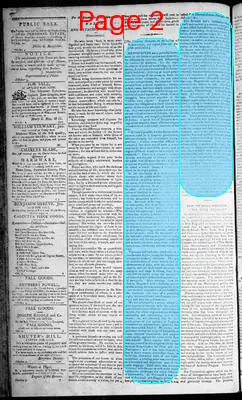
Literary
October 8, 1804
Alexandria Daily Advertiser
Alexandria, Virginia
What is this article about?
This essay praises newspapers as instruments for spreading political knowledge and influencing conduct, crediting them for American independence and Irish deliverance. It discusses press freedom as a check on power, critiques corruption in journalism and theater criticism, and traces the history of newspapers from ancient Rome to 18th-century England, noting their economic impact and governmental tensions.
Clipping
OCR Quality
98%
Excellent
Full Text
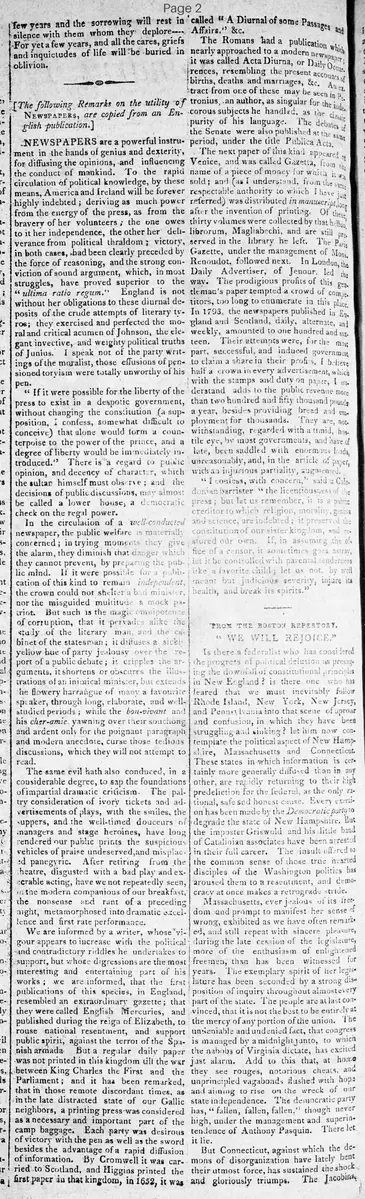
[The following Remarks on the utility of NewsPapers, are copied from an English publication.]
NEWSPAPERS are a powerful instrument in the hands of genius and dexterity, for diffusing the opinions, and influencing the conduct of mankind. To the rapid circulation of political knowledge, by these means, America and Ireland will be forever highly indebted; deriving as much power from the energy of the press, as from the bravery of her volunteers; the one owes to it her independence, the other her deliverance from political thraldom; victory, in both cases, had been clearly preceded by the force of reasoning, and the strong conviction of sound argument, which, in most struggles, have proved superior to the "ultima ratio regum." England is not without her obligations to these diurnal deposits of the crude attempts of literary tyros; they exercised and perfected the moral and critical acumen of Johnson, the elegant invective, and weighty political truths of Junius. I speak not of the party writings of the moralist, those effusions of pensioned toryism were totally unworthy of his pen.
"If it were possible for the liberty of the press to exist in a despotic government, without changing the constitution (a supposition, I confess, somewhat difficult to conceive) that alone would form a counterpoise to the power of the prince, and a degree of liberty would be immediately introduced." There is "a regard to public opinion, and decency of character, which the sultan himself must observe; and the decisions of public discussions, may almost be called a lower house, a democratic check on the regal power.
In the circulation of a well-conducted newspaper, the public welfare is materially concerned; in trying moments they give the alarm, they diminish that danger which they cannot prevent, by preparing the public mind. If it were possible for a publication of this kind to remain independent, the crown could not shelter a bad minister, nor the misguided multitude a mock patriot. But such is the magic omnipotence of corruption, that it pervades alike the study of the literary man, and the cabinet of the statesman; it diffuses a sickly yellow hue of party jealousy over the report of a public debate; it cripples the arguments, it shortens or obscures the illustrations of an inimical minister, but extends the flowery harangue of many a favourite speaker, through long, elaborate, and well-studied periods; while the bon-vivant and his cher-amie, yawning over their souchong and ardent only for the poignant paragraph and modern anecdote, curse those tedious discussions, which they will not attempt to read.
The same evil hath also conduced, in a considerable degree, to sap the foundations of impartial dramatic criticism. The paltry consideration of ivory tickets and advertisements of plays, with the smiles, the suppers, and the well-timed douceurs of managers and stage heroines, have long rendered our public prints the suspicious vehicles of praise undeserved, and misplaced panegyric. After retiring from the theatre, disgusted with a bad play and execrable acting, have we not repeatedly seen, in the modern companions of our breakfast, the nonsense and rant of a preceding night, metamorphosed into dramatic excellence and first rate performance.
We are informed by a writer, whose vigour appears to increase with the political and contradictory riddles he undertakes to support, but whose digressions are the most interesting and entertaining part of his works; we are informed, that the first publications of this species, in England, resembled an extraordinary gazette; that they were called English Mercuries, and published during the reign of Elizabeth, to rouse national resentment, and support public spirit, against the terror of the Spanish armada. But a regular daily paper was not printed in this kingdom till the war between King Charles the First and the Parliament; and it has been remarked, that in those remote discordant times, as in the late distracted state of our Gallic neighbors, a printing press was considered as a necessary and important part of the camp baggage. Each party was desirous of victory with the pen as well as the sword besides the advantage of a rapid diffusion of information. By Cromwell it was carried to Scotland, and Higgins printed the first paper in that kingdom, in 1652, it was called "A Diurnal of some Passages and Affairs." &c.
The Romans had a publication which it nearly approached to Diurna, a modern or Daily Occurrences, resembling the present accounts of births, deaths and &c. An extract from one of these may be seen in Petronius an author as singular for the curious subjects he handled, as the classic purity of his language.
The debates of the Senate were also published at the same period, under the title Publica Acta.
The next paper of this kind appeared at Venice, and was called Gazetta, from the name of a piece of money for which it was sold and as I understand from the same respectable authority to which I have just referred) was distributed in manuscript, long after the invention of printing.
Of these thirty volumes were collected by that helluo librorum, Magliabechi, and are still preserved in the library he left. The Paris Gazette, under the management of Mons. Renoudot, followed next. In London, the Daily Advertiser, of Jenour, led the way. The prodigious profits of this gentleman's paper tempted a crowd of competitors, too long to enumerate in this place
In 1793, the newspapers published in England and Scotland, daily, alternate, and weekly, amounted to one hundred and sixteen. Their attempts were, for the most part, successful, and induced government to claim a share in their profits, I believe half a crown in every advertisement, which with the stamps and duty on paper, I understand adds to the public revenue more than two hundred and fifty thousand pounds a year, besides providing bread and employment for thousands. They are, notwithstanding, regarded with a timid, hostile eye, by most governments, and have of late, been saddled with enormous loads unreasonably, and, in the article of paper, with an injurious partiality, augmented.
"I confess, with concern," said a Caledonian barrister "the licentiousness of the press; but let us remember, it is a public creditor to which religion, morality, genealogy and science, are indebted; it preserved the constitution of our sister kingdom, and restored our own. If, in assuming the office of a censor, it sometimes goes astray, let it be controlled with parental tenderness like a favorite child; let us not, by well meant but judicious severity, injure its health, and break its spirits."
NEWSPAPERS are a powerful instrument in the hands of genius and dexterity, for diffusing the opinions, and influencing the conduct of mankind. To the rapid circulation of political knowledge, by these means, America and Ireland will be forever highly indebted; deriving as much power from the energy of the press, as from the bravery of her volunteers; the one owes to it her independence, the other her deliverance from political thraldom; victory, in both cases, had been clearly preceded by the force of reasoning, and the strong conviction of sound argument, which, in most struggles, have proved superior to the "ultima ratio regum." England is not without her obligations to these diurnal deposits of the crude attempts of literary tyros; they exercised and perfected the moral and critical acumen of Johnson, the elegant invective, and weighty political truths of Junius. I speak not of the party writings of the moralist, those effusions of pensioned toryism were totally unworthy of his pen.
"If it were possible for the liberty of the press to exist in a despotic government, without changing the constitution (a supposition, I confess, somewhat difficult to conceive) that alone would form a counterpoise to the power of the prince, and a degree of liberty would be immediately introduced." There is "a regard to public opinion, and decency of character, which the sultan himself must observe; and the decisions of public discussions, may almost be called a lower house, a democratic check on the regal power.
In the circulation of a well-conducted newspaper, the public welfare is materially concerned; in trying moments they give the alarm, they diminish that danger which they cannot prevent, by preparing the public mind. If it were possible for a publication of this kind to remain independent, the crown could not shelter a bad minister, nor the misguided multitude a mock patriot. But such is the magic omnipotence of corruption, that it pervades alike the study of the literary man, and the cabinet of the statesman; it diffuses a sickly yellow hue of party jealousy over the report of a public debate; it cripples the arguments, it shortens or obscures the illustrations of an inimical minister, but extends the flowery harangue of many a favourite speaker, through long, elaborate, and well-studied periods; while the bon-vivant and his cher-amie, yawning over their souchong and ardent only for the poignant paragraph and modern anecdote, curse those tedious discussions, which they will not attempt to read.
The same evil hath also conduced, in a considerable degree, to sap the foundations of impartial dramatic criticism. The paltry consideration of ivory tickets and advertisements of plays, with the smiles, the suppers, and the well-timed douceurs of managers and stage heroines, have long rendered our public prints the suspicious vehicles of praise undeserved, and misplaced panegyric. After retiring from the theatre, disgusted with a bad play and execrable acting, have we not repeatedly seen, in the modern companions of our breakfast, the nonsense and rant of a preceding night, metamorphosed into dramatic excellence and first rate performance.
We are informed by a writer, whose vigour appears to increase with the political and contradictory riddles he undertakes to support, but whose digressions are the most interesting and entertaining part of his works; we are informed, that the first publications of this species, in England, resembled an extraordinary gazette; that they were called English Mercuries, and published during the reign of Elizabeth, to rouse national resentment, and support public spirit, against the terror of the Spanish armada. But a regular daily paper was not printed in this kingdom till the war between King Charles the First and the Parliament; and it has been remarked, that in those remote discordant times, as in the late distracted state of our Gallic neighbors, a printing press was considered as a necessary and important part of the camp baggage. Each party was desirous of victory with the pen as well as the sword besides the advantage of a rapid diffusion of information. By Cromwell it was carried to Scotland, and Higgins printed the first paper in that kingdom, in 1652, it was called "A Diurnal of some Passages and Affairs." &c.
The Romans had a publication which it nearly approached to Diurna, a modern or Daily Occurrences, resembling the present accounts of births, deaths and &c. An extract from one of these may be seen in Petronius an author as singular for the curious subjects he handled, as the classic purity of his language.
The debates of the Senate were also published at the same period, under the title Publica Acta.
The next paper of this kind appeared at Venice, and was called Gazetta, from the name of a piece of money for which it was sold and as I understand from the same respectable authority to which I have just referred) was distributed in manuscript, long after the invention of printing.
Of these thirty volumes were collected by that helluo librorum, Magliabechi, and are still preserved in the library he left. The Paris Gazette, under the management of Mons. Renoudot, followed next. In London, the Daily Advertiser, of Jenour, led the way. The prodigious profits of this gentleman's paper tempted a crowd of competitors, too long to enumerate in this place
In 1793, the newspapers published in England and Scotland, daily, alternate, and weekly, amounted to one hundred and sixteen. Their attempts were, for the most part, successful, and induced government to claim a share in their profits, I believe half a crown in every advertisement, which with the stamps and duty on paper, I understand adds to the public revenue more than two hundred and fifty thousand pounds a year, besides providing bread and employment for thousands. They are, notwithstanding, regarded with a timid, hostile eye, by most governments, and have of late, been saddled with enormous loads unreasonably, and, in the article of paper, with an injurious partiality, augmented.
"I confess, with concern," said a Caledonian barrister "the licentiousness of the press; but let us remember, it is a public creditor to which religion, morality, genealogy and science, are indebted; it preserved the constitution of our sister kingdom, and restored our own. If, in assuming the office of a censor, it sometimes goes astray, let it be controlled with parental tenderness like a favorite child; let us not, by well meant but judicious severity, injure its health, and break its spirits."
What sub-type of article is it?
Essay
What themes does it cover?
Political
Liberty Freedom
What keywords are associated?
Newspapers
Press Freedom
Political Influence
History Of Press
Corruption In Media
Liberty Of Press
Literary Details
Title
Remarks On The Utility Of Newspapers
Subject
On The Utility Of Newspapers And The Liberty Of The Press
Key Lines
Newspapers Are A Powerful Instrument In The Hands Of Genius And Dexterity, For Diffusing The Opinions, And Influencing The Conduct Of Mankind.
If It Were Possible For The Liberty Of The Press To Exist In A Despotic Government, Without Changing The Constitution... That Alone Would Form A Counterpoise To The Power Of The Prince, And A Degree Of Liberty Would Be Immediately Introduced.
In The Circulation Of A Well Conducted Newspaper, The Public Welfare Is Materially Concerned; In Trying Moments They Give The Alarm, They Diminish That Danger Which They Cannot Prevent, By Preparing The Public Mind.
I Confess, With Concern, The Licentiousness Of The Press; But Let Us Remember, It Is A Public Creditor To Which Religion, Morality, Genealogy And Science, Are Indebted; It Preserved The Constitution Of Our Sister Kingdom, And Restored Our Own.