Thank you for visiting SNEWPapers!
Sign up free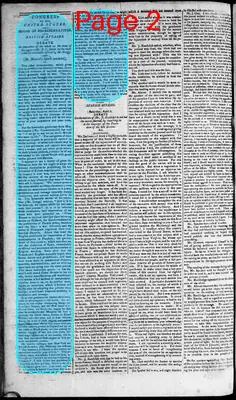
Story
April 11, 1806
Alexandria Daily Advertiser
Alexandria, Virginia
What is this article about?
In the US House of Representatives, a speaker opposes Dr. Gregg's resolution to prohibit British imports, arguing it would provoke British retaliation, devastate American commerce worth nearly $100 million, lead to economic distress, direct taxation, and potential war with Britain's superior naval power.
Clipping
OCR Quality
95%
Excellent
Full Text
CONGRESS
OF THE
UNITED STATES.
HOUSE OF REPRESENTATIVES.
BRITISH AFFAIRS.
DEBATE
In committee of the whole on the state of the union—Mr. F. C. Smith in the chair—on the resolution offered by Dr. Gregg.
[Mr. Masters's Speech concluded.]
The other circumstance, which gives rise to prohibitions between nations, arises from the violence of national animosity; which generally ends in war. This circumstance has brought this resolution into existence, the preamble speaks warlike language, and the whole taken together is a prelude to war with a nation who has two hundred ships of the line, four hundred frigates, besides gun brigs and other armed vessels, whose revenue is between forty and fifty millions sterling, who can go to war with us without any additional expense to themselves, who will sweep the ocean of American commerce, amounting to nearly one hundred million of dollars. What then will be the situation of your carrying trade? what then will be the situation of your commerce and your country?
But the honorable gentleman from Massachusetts (Mr. Crowninshield) has told us "if we go to war we can do G. Britain the most injury." The navigation of their merchant vessels is principally carried on under convoy, or some individuals may fit out a few privateers and capture now and then a vessel, and put some prize money in their private pockets, it cannot be of any advantage to the nation which will groan under poverty and distress.
It appears to me a matter of great deliberation how far we ought to adopt the present resolution by prohibiting the importation of British manufactures; in every country it ever was, and always must be the interest of the great body of the people to buy whatever they want of those who sell it cheapest. We cannot procure the same articles so cheap elsewhere; even should the measure not involve us in a war, prohibitions and revenge naturally dictate retaliation, and nations seldom fail to do it. The honorable mover of the resolution (Mr. Gregg) asks us, "how it is to be inferred we cannot abide by and execute this system." It is to be inferred from retaliation, and observation of nations who have preceded us. When France in the year 1667 laid discriminating duties on Holland, the Dutch retaliated by the prohibition of French wines, brandies and the like: a war followed, and the peace of Nimeguen regulated their commercial disputes. About that time the English prohibited the importation of lace manufactured in Flanders; the government of that country, which was then under the dominion of Spain, immediately retaliated and prohibited all importation of English woolens. Soon after this the French and English mutually began their heavy duties and prohibitions, and have ever since been in commercial disputes, quarrels, and hostilities; and we with our eyes open are going into the same system.
The same honorable gentleman has also said it will attack Great Britain in her vitals, in her manufactories and warehouses; it seems a bad method of compensating injuries done to us, to do another worse injury to ourselves, which I believe will be the case by adopting the present resolution; it will have a natural tendency to retaliation and revenge.
It is very problematical whether the carrying trade is advantageous to this nation. Our merchants in that employ transporting foreign produce from Batavia and the West Indies to the United States, and storing the cargoes for some time in warehouses and reshipping the same to Holland, the Hanse towns, Antwerp to France, Flanders and other ports; and in one instance taking the avails of those cargoes and proceeding to China, from whence they return with teas; in other instances proceed to England and lay out the avails in British goods, and then making circuitous voyages of two and three years, with those large capitals out of our country, and before they can realize those cargoes so as to purchase our domestic produce.
My worthy colleague from New York who has just sat down, (Mr. Williams) has observed, "that commerce is essential to this country and agriculture naturally goes with it." This proposition taken abstractedly I shall not deny, and he asks us "where is the revenue to support government." I will answer that gentleman, by asking him the same question, Where is the revenue to support government when nearly one half of that revenue is derived from Great Britain and her dependencies? I would ask that gentleman where is to be the market for 21,000,000 weight of cotton annually exported, (it is not to be presumed they will not retaliate in every particular) where is to be the market for your tobacco, pot ashes, flaxseed, provisions and other domestic produce, exported from this country to Great Britain, the British East or West Indies, and Newfoundland to the annual value of between 20 and 30,000,000—rely on it if you adopt this measure, you will embarrass all the operations of government, all the operations of the community, and must have recourse to direct taxation on the farmer, who will be unable to pay, for the want of a price for his produce; your merchants become bankrupts and you distress the agriculturalists.
The same hon. gentleman from Pennsylvania, has further observed "it will be such a shock upon G. Britain, he will not be able to endure it." Let that gentleman reflect on the wealth and maritime power of that country. Ever since my memory, the approaching ruin of G. Britain has been frequently foretold, after all the anxiety, after all the vain attempts, they yet regulate the commerce of the world. I must confess, I have but little faith in undertaking commercial regulations with that nation, and I believe we shall show a very pretty figure in the attempt, and be obliged to recede with disgrace, and I cannot vote for the present resolution.
To be continued.
OF THE
UNITED STATES.
HOUSE OF REPRESENTATIVES.
BRITISH AFFAIRS.
DEBATE
In committee of the whole on the state of the union—Mr. F. C. Smith in the chair—on the resolution offered by Dr. Gregg.
[Mr. Masters's Speech concluded.]
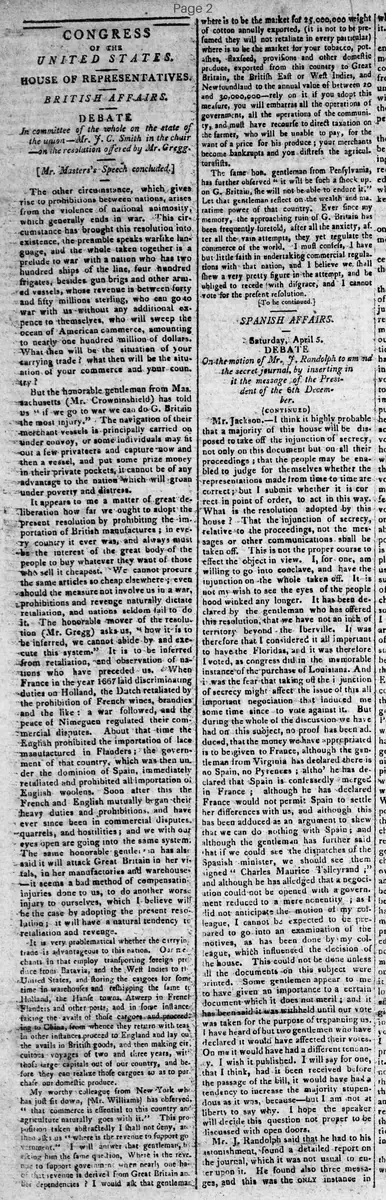
The other circumstance, which gives rise to prohibitions between nations, arises from the violence of national animosity; which generally ends in war. This circumstance has brought this resolution into existence, the preamble speaks warlike language, and the whole taken together is a prelude to war with a nation who has two hundred ships of the line, four hundred frigates, besides gun brigs and other armed vessels, whose revenue is between forty and fifty millions sterling, who can go to war with us without any additional expense to themselves, who will sweep the ocean of American commerce, amounting to nearly one hundred million of dollars. What then will be the situation of your carrying trade? what then will be the situation of your commerce and your country?
But the honorable gentleman from Massachusetts (Mr. Crowninshield) has told us "if we go to war we can do G. Britain the most injury." The navigation of their merchant vessels is principally carried on under convoy, or some individuals may fit out a few privateers and capture now and then a vessel, and put some prize money in their private pockets, it cannot be of any advantage to the nation which will groan under poverty and distress.
It appears to me a matter of great deliberation how far we ought to adopt the present resolution by prohibiting the importation of British manufactures; in every country it ever was, and always must be the interest of the great body of the people to buy whatever they want of those who sell it cheapest. We cannot procure the same articles so cheap elsewhere; even should the measure not involve us in a war, prohibitions and revenge naturally dictate retaliation, and nations seldom fail to do it. The honorable mover of the resolution (Mr. Gregg) asks us, "how it is to be inferred we cannot abide by and execute this system." It is to be inferred from retaliation, and observation of nations who have preceded us. When France in the year 1667 laid discriminating duties on Holland, the Dutch retaliated by the prohibition of French wines, brandies and the like: a war followed, and the peace of Nimeguen regulated their commercial disputes. About that time the English prohibited the importation of lace manufactured in Flanders; the government of that country, which was then under the dominion of Spain, immediately retaliated and prohibited all importation of English woolens. Soon after this the French and English mutually began their heavy duties and prohibitions, and have ever since been in commercial disputes, quarrels, and hostilities; and we with our eyes open are going into the same system.
The same honorable gentleman has also said it will attack Great Britain in her vitals, in her manufactories and warehouses; it seems a bad method of compensating injuries done to us, to do another worse injury to ourselves, which I believe will be the case by adopting the present resolution; it will have a natural tendency to retaliation and revenge.
It is very problematical whether the carrying trade is advantageous to this nation. Our merchants in that employ transporting foreign produce from Batavia and the West Indies to the United States, and storing the cargoes for some time in warehouses and reshipping the same to Holland, the Hanse towns, Antwerp to France, Flanders and other ports; and in one instance taking the avails of those cargoes and proceeding to China, from whence they return with teas; in other instances proceed to England and lay out the avails in British goods, and then making circuitous voyages of two and three years, with those large capitals out of our country, and before they can realize those cargoes so as to purchase our domestic produce.
My worthy colleague from New York who has just sat down, (Mr. Williams) has observed, "that commerce is essential to this country and agriculture naturally goes with it." This proposition taken abstractedly I shall not deny, and he asks us "where is the revenue to support government." I will answer that gentleman, by asking him the same question, Where is the revenue to support government when nearly one half of that revenue is derived from Great Britain and her dependencies? I would ask that gentleman where is to be the market for 21,000,000 weight of cotton annually exported, (it is not to be presumed they will not retaliate in every particular) where is to be the market for your tobacco, pot ashes, flaxseed, provisions and other domestic produce, exported from this country to Great Britain, the British East or West Indies, and Newfoundland to the annual value of between 20 and 30,000,000—rely on it if you adopt this measure, you will embarrass all the operations of government, all the operations of the community, and must have recourse to direct taxation on the farmer, who will be unable to pay, for the want of a price for his produce; your merchants become bankrupts and you distress the agriculturalists.
The same hon. gentleman from Pennsylvania, has further observed "it will be such a shock upon G. Britain, he will not be able to endure it." Let that gentleman reflect on the wealth and maritime power of that country. Ever since my memory, the approaching ruin of G. Britain has been frequently foretold, after all the anxiety, after all the vain attempts, they yet regulate the commerce of the world. I must confess, I have but little faith in undertaking commercial regulations with that nation, and I believe we shall show a very pretty figure in the attempt, and be obliged to recede with disgrace, and I cannot vote for the present resolution.
To be continued.
What sub-type of article is it?
Historical Event
What themes does it cover?
Misfortune
Justice
What keywords are associated?
British Trade Prohibition
Economic Retaliation
War Prelude
Us Congress Debate
Commercial Policy
Naval Power
Agricultural Distress
What entities or persons were involved?
Mr. F. C. Smith
Dr. Gregg
Mr. Masters
Mr. Crowninshield
Mr. Williams
Where did it happen?
United States House Of Representatives
Story Details
Key Persons
Mr. F. C. Smith
Dr. Gregg
Mr. Masters
Mr. Crowninshield
Mr. Williams
Location
United States House Of Representatives
Story Details
A congressional speaker argues against prohibiting British imports, citing historical retaliations, potential war with Britain's naval superiority, loss of commerce and revenue, market for US exports like cotton and tobacco, leading to economic distress and direct taxation.