Thank you for visiting SNEWPapers!
Sign up free
Literary
January 20, 1829
Constitutional Whig
Richmond, Virginia
What is this article about?
An essay advocating the application of Adam Smith's division of labor to agriculture in Virginia. It proposes diversifying crops and assigning specialized tasks to laborers, including slaves, to increase efficiency, ensure steady income, and utilize all workforce, contrasting with the current tobacco monoculture's drawbacks.
Clipping
OCR Quality
95%
Excellent
Full Text
For The Richmond Whig.
To Messrs. White, Rives of Campbell, and Nelson.
No. V.
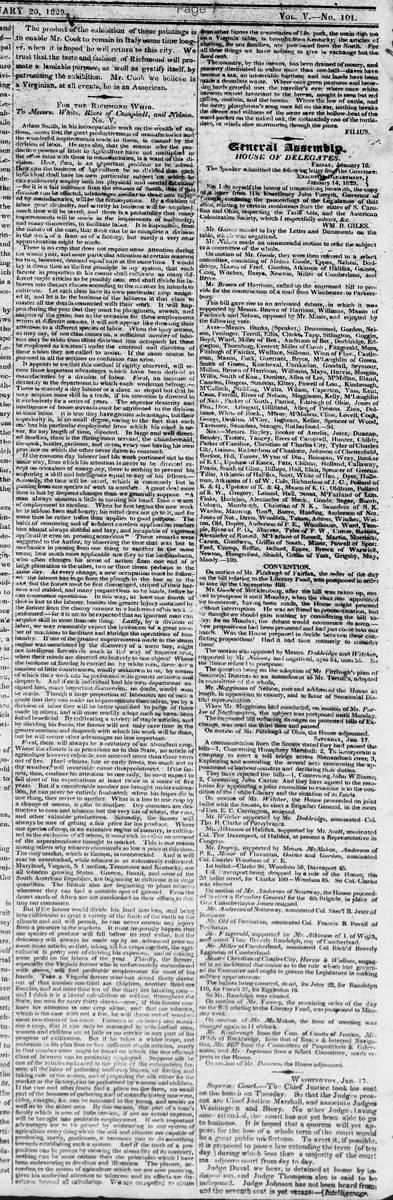
Adam Smith, in his incomparable work on the wealth of nations, shows that the great productiveness of manufactories and the wonderful improvements made in them, is caused by the division of labor. He says also, that the reason why the productive powers of labor in Agriculture have not multiplied in the same ratio with those in manufactories, is a want of this division. Here, then, is an important problem to be solved. How can the business of Agriculture be so divided that each individual shall have his own particular subject on which he can exclusively employ both his physical and mental faculties—for it is a fair inference from the reasons of Smith, that if this division can be effected, advantages similar to those now enjoyed by manufactories, will be the Consequence. By a division of labor, great dexterity, and activity in business will be acquired: much time will be saved; and there is a probability that many improvements will be made in the implements of husbandry, and many discoveries, to facilitate labor. It is impossible, from the nature of the case, that there can be as complete a division in the works of a farm as of a factory; but surely a very near approximation might be made.
There is no crop that does not require some attention during the whole year, and more particular attention at certain seasons; no two, however, demand equal care at the same time. I would lay it down then as the first principle in any system, that each farmer in proportion to his means shall cultivate as many different staple articles as he possibly can; and shall divide his laborers into distinct classes according to the number he intends to cultivate. Let each class have its own particular crop assigned it; and let it be the business of the laborers in that class to master all the details connected with their work. It will happen during the year that they must be ploughmen, sowers, and reapers of the grain; but as the occasion of these employments return at different seasons, it will not appear like directing their attention to a different species of labor. When the busy season, as they say, of one class comes on, a sufficient number of laborers may be taken from other divisions less occupied; let these be employed as assistants under the control and direction of those whom they are called to assist. If the same course be pursued in all the sections no confusion can arise.
It appears to me that this method if rigidly observed, will secure those important advantages which have been derived to manufactories by a division of labor. First, an increase of dexterity in the department to which each workman belongs. There is scarcely a day laborer or a slave so stupid but that he may acquire some skill in a trade, if his attention is directed to it exclusively for a series of years. The superior dexterity and intelligence of house servants must be attributed to the division in their labor. it is true they have greater advantages, but their superiority is, in no small degree, owing to the fact that each one has his particular employment from which his mind is never, for any length of time, diverted. In large and well directed families, there is the dining-room servant, the chambermaid, the cook, hostler, gardener, and so on; every one having his own province on which the other never dares to encroach.
If the common day laborer had his work portioned out in the same way, from which his attention is never to be diverted except on occasions of emergency, there is nothing to prevent his acquiring a skill and intelligence equal to any of his fellows. Secondly, the time will be saved, which is commonly lost in passing from one species of work to another. A great deal more time is lost by frequent changes than we generally suppose. "A man always saunters a little in turning his hand from one sort of employment to another. When he first begins the new work he is seldom keen and hearty; his mind does not go to it, and for some time he rather trifles than applies to good purpose. The habit of sauntering and of indolent careless application renders him almost always slothful and lazy, and incapable of vigorous application even on pressing occasions." These remarks were suggested to the Author, by observing the time that was lost to mechanics in passing from one thing to another in the same room; how much more applicable are they to the husbandman, who often changes his scene of action from one end of a large plantation to the other, two or three times perhaps in the same day. At every change, a new occupation must be followed. the laborer has to go from the plough to the hoe or to the axe, but the horses must be first disengaged, stripped of their harness and stabled, and many preparations to be made, before he can commence operations.
In this way, at least one fourth of time is lost to the laborer; besides the greater injury sustained by the farmer from the clumsy manner in which most of his work is performed;—or it is not to be expected that an ignorant man can acquire skill in more than one thing. Lastly, by a division of labor, we may reasonably expect the invention of a great number of machines to facilitate and abridge the operations of husbandry. If one of the greatest improvements made in the steam engine was occasioned by the discovery of a mere boy, might not intelligent farmers do much in the way of improvement, when their minds are directed exclusively to one object? Where the business of farming is carried on by white men, there are a number of little contrivances, wholly unknown to us, by means of which their work can be performed with greater neatness and despatch. And if each individual had his own department assigned him, many important discoveries, no doubt, would soon be made. Though a large proportion of labourers are of such a grade that they can make no improvements themselves, yet by a division of labor they will be better qualified to judge of those made by others, and will more readily adopt such as have been found beneficial. By cultivating a variety of staple articles, and by dividing his forces, the farmer will not only save time in the greater neatness and despatch with which his work will be done, but he will secure other advantages no less important.
First, there will always be a certainty of an abundant crop. Where the climate is so precarious as in this State, no article of agriculture however valuable, can succeed more than three years out of five. Hard winters, late or early frosts, too much wet or dry weather, will invariably cause disappointment. If the farmer, then, confines his attention to one only, he must expect to fall short of his expectations at least twice in a series of five years. But if a considerable number are brought under cultivation, he can never be entirely frustrated; when his hopes die in one thing, they revive in another. What is a loss to one crop by a change of season, is gain to another. Dry summers are destructive to corn and tobacco; but the very life of wheat, the vine, and other valuable productions. Secondly, the farmer will always be sure of getting a fair price for his produce. Where one species of crop, in an extensive region of country, is cultivated to the exclusion of all others, it must sink in value on account of the superabundance brought to market. This is one reason among others why tobacco commands so low a price at this time. The only market, which is Europe, is overstocked. And it will ever be overstocked, while tobacco is so extensively cultivated. Maryland, Virginia, N. Carolina, Tennessee and Kentucky, are all tobacco growing States. Greece, Brazil, and some of the South American Republics, are beginning to cultivate it in large quantities. The British also are beginning to plant tobacco wherever they can find a suitable spot of ground. Even the desert sands of Africa are not overlooked in their efforts to destroy our commerce.
But if the farmer would divide his land into lots, and bring into cultivation as great a variety of the fruits of the earth as the climate and soil will permit, he can never sustain any injury from a pressure in the markets. it must frequently happen that one species of produce will fall below its real value, but the deficiency will always be made up by an advanced price on some other article; so that, taking all his crops together, the agriculturist is pretty sure of clearing his expenses, and of making some profit on the labors of the year. Thirdly, the farmer, especially the Virginia farmer who is unfortunately encumbered with slaves, will find profitable employment for most of his hands. Take a Virginia farmer who has about thirty slaves out of that number one-third are children, another third are females, and not more than ten of the thirty are laboring men—and I think it is a liberal calculation to reckon, throughout the State, ten men for every thirty slaves now, if this farmer confines his attention to one crop alone, and that one tobacco, which is the case with not a few, he will throw out of employment two-thirds of his force. Tobacco is so heavy and laborious a crop, that it can only be managed by able-bodied men; women and children are of little or no service in any part of the progress of cultivation. But if he takes a wider scope, and embraces in his plan four or five different staple articles, surely in that number some might be found on which the less efficient class of laborers can be profitably employed. Suppose silk be one of the articles embraced in the plan of the enterprising farmer; all the labor of gathering mulberry leaves, of feeding and taking care of the worms, and of preparing the silk either for the market or the factory, can be performed by women and children. If the vine and other fruits find a place on the farm, no small part of the business of gathering and of manufacturing into wine, cider, vinegar, &c. can be entrusted to the young and tender as well as to the ablest men. By this means, that part of a man's family which is now of little service, if not an actual expense, will be brought into profitable employment. If such important advantages are to be gained by embracing in our system of agriculture every thing which the soil and climate are capable of producing, surely, gentlemen, it becomes you to do something towards establishing such a system. And if the truth of a proposition can be proven by showing the absurdity of its contrary, nothing can be more certain than the principles which I have been endeavoring to develope and illustrate. The planter, according to the system of agriculture which we are now pursuing, gives his undivided attention to tobacco: and its effects are disastrous beyond all calculation. We are compelled to obtain from other States the necessaries of life: pork, the main dish too on a Virginia table, is brought from Kentucky; the articles of clothing, for our families, are purchased from the North. For all these things we have nothing to give in exchange but the hard cash.
The country, by this means, has been drained of money, and property diminished in value more than one-half—slaves have become a tax, an intolerable burthen; and our lands have been made a desolate waste. Where once green pastures and browsing herds grateful met the traveller's eye; where once white harvests waved luxuriant to the breeze, nought is seen but red gullies, mullein, and the broom. Where the low of cattle, and the merry ploughman's song once fell on the ear, nothing breaks the silence and stillness of the scene save the hollow-beat of the wood-pecker on the naked oak, the melancholy coo of the turtle-dove, or wind's slow murmuring through the pines.
FILUS.
To Messrs. White, Rives of Campbell, and Nelson.
No. V.
Adam Smith, in his incomparable work on the wealth of nations, shows that the great productiveness of manufactories and the wonderful improvements made in them, is caused by the division of labor. He says also, that the reason why the productive powers of labor in Agriculture have not multiplied in the same ratio with those in manufactories, is a want of this division. Here, then, is an important problem to be solved. How can the business of Agriculture be so divided that each individual shall have his own particular subject on which he can exclusively employ both his physical and mental faculties—for it is a fair inference from the reasons of Smith, that if this division can be effected, advantages similar to those now enjoyed by manufactories, will be the Consequence. By a division of labor, great dexterity, and activity in business will be acquired: much time will be saved; and there is a probability that many improvements will be made in the implements of husbandry, and many discoveries, to facilitate labor. It is impossible, from the nature of the case, that there can be as complete a division in the works of a farm as of a factory; but surely a very near approximation might be made.
There is no crop that does not require some attention during the whole year, and more particular attention at certain seasons; no two, however, demand equal care at the same time. I would lay it down then as the first principle in any system, that each farmer in proportion to his means shall cultivate as many different staple articles as he possibly can; and shall divide his laborers into distinct classes according to the number he intends to cultivate. Let each class have its own particular crop assigned it; and let it be the business of the laborers in that class to master all the details connected with their work. It will happen during the year that they must be ploughmen, sowers, and reapers of the grain; but as the occasion of these employments return at different seasons, it will not appear like directing their attention to a different species of labor. When the busy season, as they say, of one class comes on, a sufficient number of laborers may be taken from other divisions less occupied; let these be employed as assistants under the control and direction of those whom they are called to assist. If the same course be pursued in all the sections no confusion can arise.
It appears to me that this method if rigidly observed, will secure those important advantages which have been derived to manufactories by a division of labor. First, an increase of dexterity in the department to which each workman belongs. There is scarcely a day laborer or a slave so stupid but that he may acquire some skill in a trade, if his attention is directed to it exclusively for a series of years. The superior dexterity and intelligence of house servants must be attributed to the division in their labor. it is true they have greater advantages, but their superiority is, in no small degree, owing to the fact that each one has his particular employment from which his mind is never, for any length of time, diverted. In large and well directed families, there is the dining-room servant, the chambermaid, the cook, hostler, gardener, and so on; every one having his own province on which the other never dares to encroach.
If the common day laborer had his work portioned out in the same way, from which his attention is never to be diverted except on occasions of emergency, there is nothing to prevent his acquiring a skill and intelligence equal to any of his fellows. Secondly, the time will be saved, which is commonly lost in passing from one species of work to another. A great deal more time is lost by frequent changes than we generally suppose. "A man always saunters a little in turning his hand from one sort of employment to another. When he first begins the new work he is seldom keen and hearty; his mind does not go to it, and for some time he rather trifles than applies to good purpose. The habit of sauntering and of indolent careless application renders him almost always slothful and lazy, and incapable of vigorous application even on pressing occasions." These remarks were suggested to the Author, by observing the time that was lost to mechanics in passing from one thing to another in the same room; how much more applicable are they to the husbandman, who often changes his scene of action from one end of a large plantation to the other, two or three times perhaps in the same day. At every change, a new occupation must be followed. the laborer has to go from the plough to the hoe or to the axe, but the horses must be first disengaged, stripped of their harness and stabled, and many preparations to be made, before he can commence operations.
In this way, at least one fourth of time is lost to the laborer; besides the greater injury sustained by the farmer from the clumsy manner in which most of his work is performed;—or it is not to be expected that an ignorant man can acquire skill in more than one thing. Lastly, by a division of labor, we may reasonably expect the invention of a great number of machines to facilitate and abridge the operations of husbandry. If one of the greatest improvements made in the steam engine was occasioned by the discovery of a mere boy, might not intelligent farmers do much in the way of improvement, when their minds are directed exclusively to one object? Where the business of farming is carried on by white men, there are a number of little contrivances, wholly unknown to us, by means of which their work can be performed with greater neatness and despatch. And if each individual had his own department assigned him, many important discoveries, no doubt, would soon be made. Though a large proportion of labourers are of such a grade that they can make no improvements themselves, yet by a division of labor they will be better qualified to judge of those made by others, and will more readily adopt such as have been found beneficial. By cultivating a variety of staple articles, and by dividing his forces, the farmer will not only save time in the greater neatness and despatch with which his work will be done, but he will secure other advantages no less important.
First, there will always be a certainty of an abundant crop. Where the climate is so precarious as in this State, no article of agriculture however valuable, can succeed more than three years out of five. Hard winters, late or early frosts, too much wet or dry weather, will invariably cause disappointment. If the farmer, then, confines his attention to one only, he must expect to fall short of his expectations at least twice in a series of five years. But if a considerable number are brought under cultivation, he can never be entirely frustrated; when his hopes die in one thing, they revive in another. What is a loss to one crop by a change of season, is gain to another. Dry summers are destructive to corn and tobacco; but the very life of wheat, the vine, and other valuable productions. Secondly, the farmer will always be sure of getting a fair price for his produce. Where one species of crop, in an extensive region of country, is cultivated to the exclusion of all others, it must sink in value on account of the superabundance brought to market. This is one reason among others why tobacco commands so low a price at this time. The only market, which is Europe, is overstocked. And it will ever be overstocked, while tobacco is so extensively cultivated. Maryland, Virginia, N. Carolina, Tennessee and Kentucky, are all tobacco growing States. Greece, Brazil, and some of the South American Republics, are beginning to cultivate it in large quantities. The British also are beginning to plant tobacco wherever they can find a suitable spot of ground. Even the desert sands of Africa are not overlooked in their efforts to destroy our commerce.
But if the farmer would divide his land into lots, and bring into cultivation as great a variety of the fruits of the earth as the climate and soil will permit, he can never sustain any injury from a pressure in the markets. it must frequently happen that one species of produce will fall below its real value, but the deficiency will always be made up by an advanced price on some other article; so that, taking all his crops together, the agriculturist is pretty sure of clearing his expenses, and of making some profit on the labors of the year. Thirdly, the farmer, especially the Virginia farmer who is unfortunately encumbered with slaves, will find profitable employment for most of his hands. Take a Virginia farmer who has about thirty slaves out of that number one-third are children, another third are females, and not more than ten of the thirty are laboring men—and I think it is a liberal calculation to reckon, throughout the State, ten men for every thirty slaves now, if this farmer confines his attention to one crop alone, and that one tobacco, which is the case with not a few, he will throw out of employment two-thirds of his force. Tobacco is so heavy and laborious a crop, that it can only be managed by able-bodied men; women and children are of little or no service in any part of the progress of cultivation. But if he takes a wider scope, and embraces in his plan four or five different staple articles, surely in that number some might be found on which the less efficient class of laborers can be profitably employed. Suppose silk be one of the articles embraced in the plan of the enterprising farmer; all the labor of gathering mulberry leaves, of feeding and taking care of the worms, and of preparing the silk either for the market or the factory, can be performed by women and children. If the vine and other fruits find a place on the farm, no small part of the business of gathering and of manufacturing into wine, cider, vinegar, &c. can be entrusted to the young and tender as well as to the ablest men. By this means, that part of a man's family which is now of little service, if not an actual expense, will be brought into profitable employment. If such important advantages are to be gained by embracing in our system of agriculture every thing which the soil and climate are capable of producing, surely, gentlemen, it becomes you to do something towards establishing such a system. And if the truth of a proposition can be proven by showing the absurdity of its contrary, nothing can be more certain than the principles which I have been endeavoring to develope and illustrate. The planter, according to the system of agriculture which we are now pursuing, gives his undivided attention to tobacco: and its effects are disastrous beyond all calculation. We are compelled to obtain from other States the necessaries of life: pork, the main dish too on a Virginia table, is brought from Kentucky; the articles of clothing, for our families, are purchased from the North. For all these things we have nothing to give in exchange but the hard cash.
The country, by this means, has been drained of money, and property diminished in value more than one-half—slaves have become a tax, an intolerable burthen; and our lands have been made a desolate waste. Where once green pastures and browsing herds grateful met the traveller's eye; where once white harvests waved luxuriant to the breeze, nought is seen but red gullies, mullein, and the broom. Where the low of cattle, and the merry ploughman's song once fell on the ear, nothing breaks the silence and stillness of the scene save the hollow-beat of the wood-pecker on the naked oak, the melancholy coo of the turtle-dove, or wind's slow murmuring through the pines.
FILUS.
What sub-type of article is it?
Essay
What themes does it cover?
Agriculture Rural
Commerce Trade
What keywords are associated?
Division Of Labor
Agriculture
Adam Smith
Virginia Farming
Tobacco Monoculture
Crop Diversification
Slave Labor
Economic Reform
What entities or persons were involved?
Filus.
Literary Details
Title
No. V.
Author
Filus.
Subject
Applying Division Of Labor To Agriculture In Virginia
Key Lines
Adam Smith, In His Incomparable Work On The Wealth Of Nations, Shows That The Great Productiveness Of Manufactories And The Wonderful Improvements Made In Them, Is Caused By The Division Of Labor.
I Would Lay It Down Then As The First Principle In Any System, That Each Farmer In Proportion To His Means Shall Cultivate As Many Different Staple Articles As He Possibly Can; And Shall Divide His Laborers Into Distinct Classes According To The Number He Intends To Cultivate.
"A Man Always Saunters A Little In Turning His Hand From One Sort Of Employment To Another. When He First Begins The New Work He Is Seldom Keen And Hearty; His Mind Does Not Go To It, And For Some Time He Rather Trifles Than Applies To Good Purpose."
By Cultivating A Variety Of Staple Articles, And By Dividing His Forces, The Farmer Will Not Only Save Time In The Greater Neatness And Despatch With Which His Work Will Be Done, But He Will Secure Other Advantages No Less Important.
The Country, By This Means, Has Been Drained Of Money, And Property Diminished In Value More Than One Half—Slaves Have Become A Tax, An Intolerable Burthen; And Our Lands Have Been Made A Desolate Waste.