Thank you for visiting SNEWPapers!
Sign up free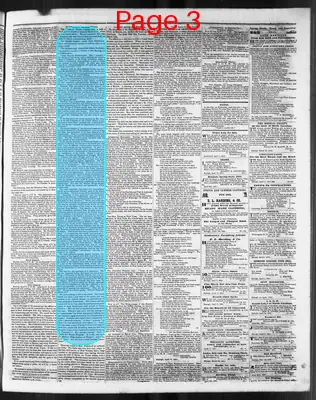
Story
April 12, 1851
North Carolina Standard
Raleigh, Wake County, North Carolina
What is this article about?
Article criticizes Wayne County Whigs' resolutions praising Edward Stanly's congressional actions, the Compromise of 1850, and the fugitive slave law, arguing they betray Southern interests on slavery and rights.
Clipping

OCR Quality
98%
Excellent
Full Text
SUBMISSION, RESOLUTIONS.
The Whigs of Wayne County recently held a Meeting and adopted a series of Resolutions, which will be found below. We are surprised that such sentiments and views should have emanated from any body of men in a slaveholding State.
The Raleigh Register copies these Resolutions but it very prudently declines to endorse them in so many words.
The Goldsborough Republican makes the following excellent remarks in relation to this Meeting and its Resolutions:
"The Wayne Resolutions. The "handfull" of Whigs of this county held a meeting last week to appoint delegates to the Whig Convention when a series of resolutions were adopted, a part of which we propose to notice briefly. In order that there may be no misapprehensions, we give the four following resolutions in full:
Resolved, That the Hon. Edward Stanly has merited the approbation of his constituents, for the patriotic and conservative course pursued by him, in the late Congress of the United States.
Resolved, That the series of measures lately passed by Congress, and commonly known as the "Compromise," are Constitutional in their nature, beneficial in their operation, and absolutely necessary to the South, to secure to her the free exercise of her rights.
Resolved, That the repeal of the law passed, for the purpose of securing the delivery of fugitive slaves to the proper owners, or the modification thereof, in any of its essential provisions, would be an act of injustice to the South, and would be well calculated to disturb the tranquility, which that law was intended to effect, and which it has, in no inconsiderable degree, effected.
Resolved, That no gentleman opposed to the spirit and operation of said law, will truly represent the feelings and sentiments of the Whigs of Wayne County.
The Whigs of Wayne county have thus defined, accurately and with commendable boldness, the precise position which they occupy. They have made known the principles upon which they intend to enter upon the campaign, and we take them at their word.
In the first place the course pursued by Mr. Stanly in the late Congress of the United States, is pronounced to have been "patriotic and conservative," and that he has "merited the approbation of his constituents."
We cannot imagine a "patriotic and conservative" course on the part of a Representative, to be any thing else than one promotive of the best interest of his constituents. Duty to a constituency, and patriotism and conservatism, can never be inconsistent with each other. Has Mr. Stanly's course accorded with the best interest of his constituents?
In the contest between the North and South on the subject of Slavery, the friends of the South saw that little could be effected without entire unanimity of action and purpose among themselves. It was believed and rightly believed, that a union of Southern men would secure a settlement of the controversy to the satisfaction of the South. Hence it was that Messrs. Toombs and Stephens of Georgia, Hilliard of Alabama, and other Whigs, threw off the ties of party for a time, and united hand to hand with those who were struggling against aggression. Did Mr. Stanly unite with those Whigs, and help to beat back the tide of abolitionism? No! On the contrary, he sneered at the South, ridiculed the excitement here, avowed that he would stick to the Union whatever might be done, and thus encouraged the abolitionists to continue their aggressions. Is that the patriotism and conservatism for which he merits the approbation of his constituents? But not satisfied with favoring Northern views on the slavery question, he also desired an increase of the tariff to protect Northern manufactures, thus imposing a higher tax on his own constituents. For this, the Wayne Whigs declare that Mr. Stanly has merited the approbation of his constituents.
The next resolution lays down two propositions which we are astonished that any party at the South should affirm. The first is that the Compromise Acts are "beneficial in their operation," and the second declares that they are "absolutely necessary to the South to secure to her the free exercise of her rights."
Beneficial in their operation! Those acts were the result of the Anti-slavery agitation and were nothing less than an absolute cession to the North by the South of all the rights of the latter in the territory acquired from Mexico. The benefits to the South were a complete exclusion from the gold mines of California, and all the territory of the United States. But in addition, it is declared that they were "absolutely necessary to the South to secure to her the free exercise of her rights." Absolutely necessary implies, if we understand it, that no other mode of settlement would have been so efficient to secure the rights of the South, as the compromise acts. The Whigs of Wayne must have forgotten that the majority of the Southern members in Congress desired the Missouri Compromise line extended to the Pacific Ocean. That would have been a settlement "beneficial" in its operation, and would have secured to the South her rights; but now, the South has no rights in California or the territories: she is directly or virtually excluded. No citizen of the South can carry his slaves to California, nor will he run the risk of carrying them to Utah or New Mexico. The South, according to the compromise acts, has no rights whatever in any territory of the United States, yet the resolution under consideration declares that their operation is "beneficial," and secures "the free exercise of her rights."
The third resolution quoted, simply declares that the repeal of the fugitive slave law, would be an act of injustice, well calculated to disturb the tranquility of the South. And is that all? We shall consider the repeal of the fugitive slave law as an abrogation of a part of the Constitution itself, which will be such conclusive evidence of the hostility of the North, that the dissolution of the Union should immediately follow.
The last is a rare specimen of a resolution. We had not supposed before, that there was any person, Whig or Democrat, in the 8th District who was opposed to the spirit and operation of the fugitive slave law; but the passage of this resolution by the Whigs of Wayne, leads us to suppose that there must be some person or persons among the Whigs, aspirants for a seat in Congress too, who are "opposed to the spirit and operation of said law." Else, why the necessity of passing this resolution? Who can he be? We are at a loss to guess. Will the Telegraph inform us?"
We have nothing to add to the above. Our friend Gulick has taken a just view of the matter, and has exposed in the clearest manner the unsoundness of these submission Resolutions. Sad, dreary, and dark indeed will be the day when the sentiments and principles of these Resolutions shall prevail in North Carolina. May the God of the free and fearless avert that day! Southern men exult over the passage of a "compromise" by which they gained nothing, but lost important rights as members of a Confederacy of equals! Southern men declare this "compromise" to be "absolutely necessary" to them "to secure" to them "the free exercise of their rights"!! Southern men make a merit of being in favor of the fugitive slave law, which law is nothing more nor less than the plain words of the Constitution carried out by act of Congress!!! But enough—enough. Such is Stanly and Wayne Whigism. Is it true that there are Abolition Whig Quakers in Wayne? And if so, how many! Did they have a hand in these Resolutions?
The Whigs of Wayne County recently held a Meeting and adopted a series of Resolutions, which will be found below. We are surprised that such sentiments and views should have emanated from any body of men in a slaveholding State.
The Raleigh Register copies these Resolutions but it very prudently declines to endorse them in so many words.
The Goldsborough Republican makes the following excellent remarks in relation to this Meeting and its Resolutions:
"The Wayne Resolutions. The "handfull" of Whigs of this county held a meeting last week to appoint delegates to the Whig Convention when a series of resolutions were adopted, a part of which we propose to notice briefly. In order that there may be no misapprehensions, we give the four following resolutions in full:
Resolved, That the Hon. Edward Stanly has merited the approbation of his constituents, for the patriotic and conservative course pursued by him, in the late Congress of the United States.
Resolved, That the series of measures lately passed by Congress, and commonly known as the "Compromise," are Constitutional in their nature, beneficial in their operation, and absolutely necessary to the South, to secure to her the free exercise of her rights.
Resolved, That the repeal of the law passed, for the purpose of securing the delivery of fugitive slaves to the proper owners, or the modification thereof, in any of its essential provisions, would be an act of injustice to the South, and would be well calculated to disturb the tranquility, which that law was intended to effect, and which it has, in no inconsiderable degree, effected.
Resolved, That no gentleman opposed to the spirit and operation of said law, will truly represent the feelings and sentiments of the Whigs of Wayne County.
The Whigs of Wayne county have thus defined, accurately and with commendable boldness, the precise position which they occupy. They have made known the principles upon which they intend to enter upon the campaign, and we take them at their word.
In the first place the course pursued by Mr. Stanly in the late Congress of the United States, is pronounced to have been "patriotic and conservative," and that he has "merited the approbation of his constituents."
We cannot imagine a "patriotic and conservative" course on the part of a Representative, to be any thing else than one promotive of the best interest of his constituents. Duty to a constituency, and patriotism and conservatism, can never be inconsistent with each other. Has Mr. Stanly's course accorded with the best interest of his constituents?
In the contest between the North and South on the subject of Slavery, the friends of the South saw that little could be effected without entire unanimity of action and purpose among themselves. It was believed and rightly believed, that a union of Southern men would secure a settlement of the controversy to the satisfaction of the South. Hence it was that Messrs. Toombs and Stephens of Georgia, Hilliard of Alabama, and other Whigs, threw off the ties of party for a time, and united hand to hand with those who were struggling against aggression. Did Mr. Stanly unite with those Whigs, and help to beat back the tide of abolitionism? No! On the contrary, he sneered at the South, ridiculed the excitement here, avowed that he would stick to the Union whatever might be done, and thus encouraged the abolitionists to continue their aggressions. Is that the patriotism and conservatism for which he merits the approbation of his constituents? But not satisfied with favoring Northern views on the slavery question, he also desired an increase of the tariff to protect Northern manufactures, thus imposing a higher tax on his own constituents. For this, the Wayne Whigs declare that Mr. Stanly has merited the approbation of his constituents.
The next resolution lays down two propositions which we are astonished that any party at the South should affirm. The first is that the Compromise Acts are "beneficial in their operation," and the second declares that they are "absolutely necessary to the South to secure to her the free exercise of her rights."
Beneficial in their operation! Those acts were the result of the Anti-slavery agitation and were nothing less than an absolute cession to the North by the South of all the rights of the latter in the territory acquired from Mexico. The benefits to the South were a complete exclusion from the gold mines of California, and all the territory of the United States. But in addition, it is declared that they were "absolutely necessary to the South to secure to her the free exercise of her rights." Absolutely necessary implies, if we understand it, that no other mode of settlement would have been so efficient to secure the rights of the South, as the compromise acts. The Whigs of Wayne must have forgotten that the majority of the Southern members in Congress desired the Missouri Compromise line extended to the Pacific Ocean. That would have been a settlement "beneficial" in its operation, and would have secured to the South her rights; but now, the South has no rights in California or the territories: she is directly or virtually excluded. No citizen of the South can carry his slaves to California, nor will he run the risk of carrying them to Utah or New Mexico. The South, according to the compromise acts, has no rights whatever in any territory of the United States, yet the resolution under consideration declares that their operation is "beneficial," and secures "the free exercise of her rights."
The third resolution quoted, simply declares that the repeal of the fugitive slave law, would be an act of injustice, well calculated to disturb the tranquility of the South. And is that all? We shall consider the repeal of the fugitive slave law as an abrogation of a part of the Constitution itself, which will be such conclusive evidence of the hostility of the North, that the dissolution of the Union should immediately follow.
The last is a rare specimen of a resolution. We had not supposed before, that there was any person, Whig or Democrat, in the 8th District who was opposed to the spirit and operation of the fugitive slave law; but the passage of this resolution by the Whigs of Wayne, leads us to suppose that there must be some person or persons among the Whigs, aspirants for a seat in Congress too, who are "opposed to the spirit and operation of said law." Else, why the necessity of passing this resolution? Who can he be? We are at a loss to guess. Will the Telegraph inform us?"
We have nothing to add to the above. Our friend Gulick has taken a just view of the matter, and has exposed in the clearest manner the unsoundness of these submission Resolutions. Sad, dreary, and dark indeed will be the day when the sentiments and principles of these Resolutions shall prevail in North Carolina. May the God of the free and fearless avert that day! Southern men exult over the passage of a "compromise" by which they gained nothing, but lost important rights as members of a Confederacy of equals! Southern men declare this "compromise" to be "absolutely necessary" to them "to secure" to them "the free exercise of their rights"!! Southern men make a merit of being in favor of the fugitive slave law, which law is nothing more nor less than the plain words of the Constitution carried out by act of Congress!!! But enough—enough. Such is Stanly and Wayne Whigism. Is it true that there are Abolition Whig Quakers in Wayne? And if so, how many! Did they have a hand in these Resolutions?
What sub-type of article is it?
Historical Event
What themes does it cover?
Justice
Betrayal
What keywords are associated?
Wayne County Whigs
Compromise Of 1850
Fugitive Slave Law
Edward Stanly
Southern Rights
Political Resolutions
What entities or persons were involved?
Edward Stanly
Toombs
Stephens
Hilliard
Gulick
Where did it happen?
Wayne County, North Carolina
Story Details
Key Persons
Edward Stanly
Toombs
Stephens
Hilliard
Gulick
Location
Wayne County, North Carolina
Event Date
Recently
Story Details
Wayne County Whigs adopt resolutions praising Edward Stanly's congressional course, the Compromise measures, and the fugitive slave law; criticized as submissive and detrimental to Southern rights on slavery and territory.