Thank you for visiting SNEWPapers!
Sign up free
Muscatine Weekly Journal
Muscatine, Muscatine County, Iowa
What is this article about?
Adjutant-General Thomas's report criticizes Gen. Fremont's management of the Western Department in Missouri, highlighting irregularities in quartermaster and paymaster operations, excessive expenditures on barracks and a pontoon bridge, irregular appointments, and defiance of presidential orders on emancipation proclamation.
Clipping
OCR Quality
Full Text
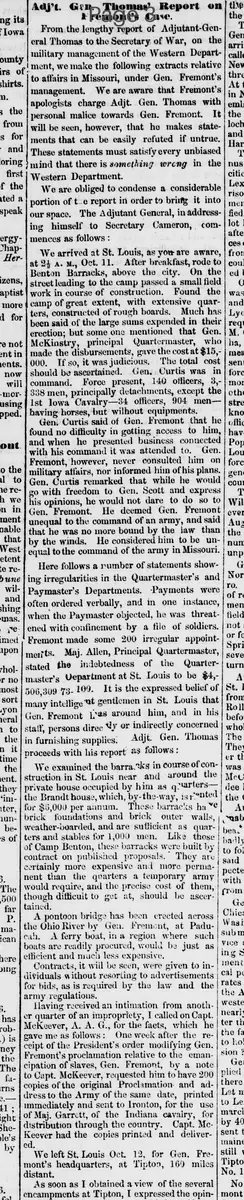
We are obliged to condense a considerable portion of the report in order to bring it into our space. The Adjutant General, in addressing himself to Secretary Cameron, commences as follows:
We arrived at St. Louis, as you are aware, at 2 A. M. Oct. 11. After breakfast, rode to Benton Barracks, above the city. On the street leading to the camp passed a small field work in course of construction. Found the camp of great extent, with extensive quarters, constructed of rough boards. Much has been said of the large sums expended in their erection; but some one mentioned that Gen. McKinstry, principal Quartermaster, who made the disbursements, gave the cost at $15,000. If so, it was judicious. The total cost should be ascertained. Gen. Curtis was in command. Force present, 140 officers, 3,338 men, principally detachments, except the 1st Iowa Cavalry-34 officers, 904 men-having horses, but without equipments.
Gen. Curtis said of Gen. Fremont that he found no difficulty in getting access to him, and when he presented business connected with his command it was attended to. Gen. Fremont, however, never consulted him on military affairs, nor informed him of his plans. Gen. Curtis remarked that while he would go with freedom to Gen. Scott and express his opinions, he would not dare to do so to Gen. Fremont. He deemed Gen. Fremont unequal to the command of an army, and said that he was no more bound by the law than by the winds. He considered him to be unequal to the command of the army in Missouri.
Here follows a number of statements showing irregularities in the Quartermaster's and Paymaster's Departments. Payments were often ordered verbally, and in one instance, when the Paymaster objected, he was threatened with confinement by a file of soldiers. Fremont made some 200 irregular appointments. Maj. Allen, Principal Quartermaster, stated the indebtedness of the Quartermaster's Department at St. Louis to be $4,506,309.73. It is the expressed belief of many intelligent gentlemen in St. Louis that Gen. Fremont has around him, and in his staff, persons directly or indirectly concerned in furnishing supplies. Adjt. Gen. Thomas proceeds with his report as follows:
We examined the barracks in course of construction in St. Louis near and around the private house occupied by him as quarters-the Brandt house, which, by-the-way, is rented for $6,000 per annum. These barracks have brick foundations and brick outer walls, weather-boarded, and are sufficient as quarters and stables for 1,000 men. Like those of Camp Benton, these barracks were built by contract on published proposals. They are certainly more expensive and more permanent than the quarters a temporary army would require, and the precise cost of them, though difficult to get at, should be ascertained.
A pontoon bridge has been erected across the Ohio River by Gen. Fremont, at Paducah. A ferry boat, in a region where such boats are readily procured, would be just as efficient and much less expensive.
Contracts, it will be seen, were given to individuals without resorting to advertisements for bids, as is required by the law and the army regulations.
Having received an intimation from another quarter of an impropriety, I called on Capt. McKeever, A. A. G., for the facts, which he gave me as follows: One week after the receipt of the President's order modifying Gen. Fremont's proclamation relative to the emancipation of slaves, Gen. Fremont, by a note to Capt. McKeever, requested him to have 200 copies of the original Proclamation and address to the Army of the same date, printed immediately and sent to Ironton, for the use of Maj. Garrett, of the Indiana cavalry, for distribution through the country. Capt. McKeever had the copies printed and delivered.
We left St. Louis Oct. 12, for Gen. Fremont's headquarters, at Tipton, 160 miles distant.
What sub-type of article is it?
What themes does it cover?
What keywords are associated?
What entities or persons were involved?
Where did it happen?
Story Details
Key Persons
Location
Missouri, St. Louis, Benton Barracks, Tipton, Paducah
Event Date
Oct. 11, Oct. 12
Story Details
Adjutant-General Thomas reports on irregularities in Gen. Fremont's management of the Western Department, including excessive costs for barracks and a pontoon bridge, verbal payment orders, irregular appointments, high departmental debt, potential conflicts of interest in supply contracts, and Fremont's circumvention of presidential orders on emancipation by distributing original proclamation copies.