Thank you for visiting SNEWPapers!
Sign up free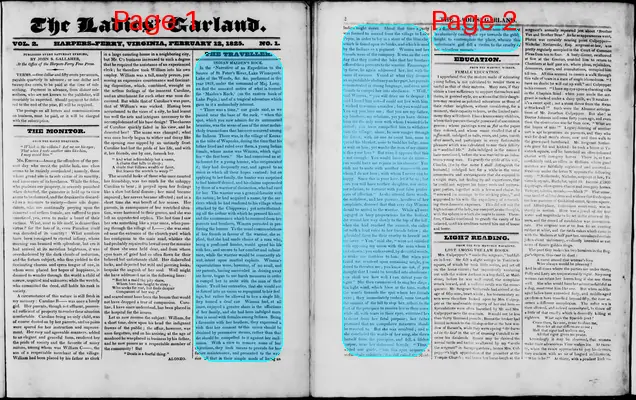
The Ladies' Garland
Harpers Ferry, Jefferson County, West Virginia
What is this article about?
During Maj. Long's 1823 expedition, a guide recounts the legend of Winona, a Sioux maiden who, forced by her family to marry a warrior instead of her chosen hunter, leaps to her death from Maiden's Rock on Lake Pepin to defy them.
Merged-components note: Continuation of the 'Indian Maiden's Rock' narrative across pages; original label was 'story' on first part, but overall fits 'literary' as a serialized narrative from a book
Clippings
1 of 2
OCR Quality
Full Text
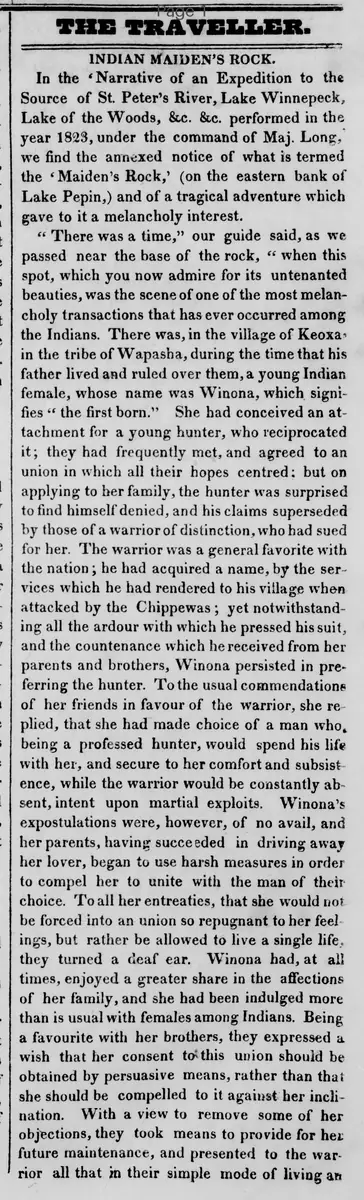
INDIAN MAIDEN'S ROCK.
In the 'Narrative of an Expedition to the Source of St. Peter's River, Lake Winnepeck, Lake of the Woods, &c. &c. performed in the year 1823, under the command of Maj. Long, we find the annexed notice of what is termed the Maiden's Rock,' (on the eastern bank of Lake Pepin,) and of a tragical adventure which gave to it a melancholy interest.
"There was a time," our guide said, as we passed near the base of the rock, "when this spot, which you now admire for its untenanted beauties, was the scene of one of the most melancholy transactions that has ever occurred among the Indians. There was, in the village of Keoxa, in the tribe of Wapasha, during the time that his father lived and ruled over them, a young Indian female, whose name was Winona, which signifies "the first born." She had conceived an attachment for a young hunter, who reciprocated it; they had frequently met, and agreed to an union in which all their hopes centred: but on applying to her family, the hunter was surprised to find himself denied, and his claims superseded by those of a warrior of distinction, who had sued for her. The warrior was a general favorite with the nation; he had acquired a name, by the services which he had rendered to his village when attacked by the Chippewas; yet notwithstanding all the ardour with which he pressed his suit, and the countenance which he received from her parents and brothers, Winona persisted in preferring the hunter. To the usual commendations of her friends in favour of the warrior, she replied, that she had made choice of a man who, being a professed hunter, would spend his life with her, and secure to her comfort and subsistence, while the warrior would be constantly absent, intent upon martial exploits. Winona's expostulations were, however, of no avail, and her parents, having succeeded in driving away her lover, began to use harsh measures in order to compel her to unite with the man of their choice. To all her entreaties, that she would not be forced into an union so repugnant to her feelings, but rather be allowed to live a single life, they turned a deaf ear. Winona had, at all times, enjoyed a greater share in the affections of her family, and she had been indulged more than is usual with females among Indians. Being a favourite with her brothers, they expressed a wish that her consent to this union should be obtained by persuasive means, rather than that she should be compelled to it against her inclination. With a view to remove some of her objections, they took means to provide for her future maintenance, and presented to the warrior all that in their simple mode of living an
Indian might covet. About that time a party was formed to ascend from the village to Lake Pepin, in order to lay in a store of the blue clay which is found upon its banks, and which is used by the Indians as a pigment. Winona and her friends were of the company. It was on the very day that they visited the lake that her brothers offered their presents to the warrior. Encouraged by these, he again addressed her, but with the same ill success. Vexed at what they deemed an unjustifiable obstinacy on her part, her parents remonstrated in strong language, and even used threats to compel her into obedience. "Well," said Winona, "you will drive me to despair: I said I loved him not—I could not live with him. I wished to remain a maiden; but you would not. You say you love me; that you are my father, my brothers, my relations, yet you have driven from me the only man with whom I wished to be united: you have compelled him to withdraw from the village; alone, he now ranges through the forest, with no one to assist him, none to spread his blanket, none to build his lodge, none to wait on him; yet was he the man of my choice. Is this your love? But even it appears that this is not enough: You would have me do more—you would have me rejoice in his absence! You wish me to unite with another man—with one whom I do not love; with whom I never can be happy. Since this is your love, let it be so; but soon you will have neither daughter, nor sister, nor relation, to torment with your false professions of affection." As she uttered these words, she withdrew, and her parents, heedless of her complaints, decreed that that very day Winona should be united to the warrior. While all were engaged in busy preparations for the festival, she wound her way slowly to the top of the hill; when she had reached the summit, she called out with a loud voice to her friends below; she upbraided them for their cruelty to herself and her lover. "You," said she, "were not satisfied with opposing my union with the man whom I had chosen; you endeavored, by deceitful words, to make me faithless to him: But when you found me resolved upon remaining single, you dared to threaten me; you knew me not, if you thought that I could be terrified into obedience; you shall see how well I can defeat your designs." She then commenced to sing her dirge; the light wind, which blew at the time, wafted the words towards the spot where her friends were; they immediately rushed, some towards the summit of the hill to stop her, others to the foot of the precipice to receive her in their arms, while all, with tears in their eyes, entreated her to desist from her fatal purpose; her father promised that no compulsive measures should be resorted to. But she was resolved; and as she concluded the words of her song, she threw herself from the precipice, and fell, a lifeless corpse, near her distressed friends. "Thus," added our guide, "has this spot acquired a melancholy celebrity; it is still called the Maiden's Rock, and no Indian passes near it, without involuntarily casting his eye towards the giddy height, to contemplate the place, whence this unfortunate girl fell a victim to the cruelty of her relentless parents."
What sub-type of article is it?
What themes does it cover?
What keywords are associated?
What entities or persons were involved?
Literary Details
Title
Indian Maiden's Rock
Author
From Narrative Of An Expedition... Maj. Long
Subject
Legend Of Winona's Suicide At Maiden's Rock
Form / Style
Narrative Legend In Prose
Key Lines