Thank you for visiting SNEWPapers!
Sign up free
Story
August 17, 1911
The Monmouth Inquirer
Freehold, Monmouth County, New Jersey
What is this article about?
Article advises farmers to select fertilizers based on soil deficiencies to build land fertility, rather than crop-specific mixes promoted by manufacturers. Recommends crop rotation with legumes for nitrogen and humus.
Clipping
OCR Quality
98%
Excellent
Full Text
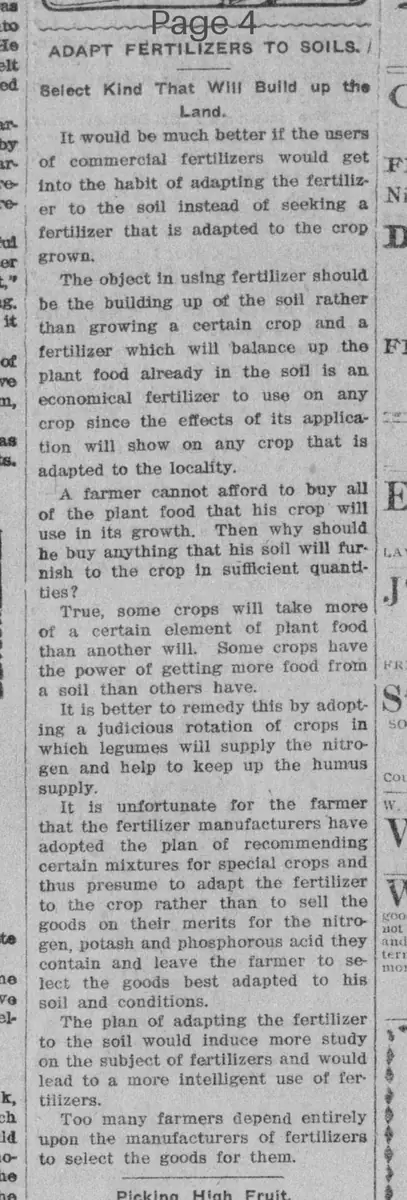
(How to) Adapt Fertilizers to Soils.
Select Kind That Will Build up the land.
It would be much better if the users of commercial fertilizers would get into the habit of adapting the fertilizer to the soil instead of seeking a fertilizer that is adapted to the crop grown.
The object in using fertilizer should be the building up of the soil rather than growing a certain crop and a fertilizer which will balance up the plant food already in the soil is an economical fertilizer to use on any crop since the effects of its application will show on any crop that is adapted to the locality.
A farmer cannot afford to buy all of the plant food that his crop will use in its growth. Then why should he buy anything that his soil will furnish to the crop in sufficient quantities?
True, some crops will take more of a certain element of plant food than another will. Some crops have the power of getting more food from a soil than others have.
It is better to remedy this by adopting a judicious rotation of crops in which legumes will supply the nitrogen and help to keep up the humus supply.
It is unfortunate for the farmer that the fertilizer manufacturers have adopted the plan of recommending certain mixtures for special crops and thus presume to adapt the fertilizer to the crop rather than to sell the goods on their merits for the nitrogen, potash and phosphoric acid they contain and leave the farmer to select the goods best adapted to his soil and conditions.
The plan of adapting the fertilizer to the soil would induce more study on the subject of fertilizers and would lead to a more intelligent use of fertilizers.
Too many farmers depend entirely upon the manufacturers of fertilizers to select the goods for them.
Select Kind That Will Build up the land.
It would be much better if the users of commercial fertilizers would get into the habit of adapting the fertilizer to the soil instead of seeking a fertilizer that is adapted to the crop grown.
The object in using fertilizer should be the building up of the soil rather than growing a certain crop and a fertilizer which will balance up the plant food already in the soil is an economical fertilizer to use on any crop since the effects of its application will show on any crop that is adapted to the locality.
A farmer cannot afford to buy all of the plant food that his crop will use in its growth. Then why should he buy anything that his soil will furnish to the crop in sufficient quantities?
True, some crops will take more of a certain element of plant food than another will. Some crops have the power of getting more food from a soil than others have.
It is better to remedy this by adopting a judicious rotation of crops in which legumes will supply the nitrogen and help to keep up the humus supply.
It is unfortunate for the farmer that the fertilizer manufacturers have adopted the plan of recommending certain mixtures for special crops and thus presume to adapt the fertilizer to the crop rather than to sell the goods on their merits for the nitrogen, potash and phosphoric acid they contain and leave the farmer to select the goods best adapted to his soil and conditions.
The plan of adapting the fertilizer to the soil would induce more study on the subject of fertilizers and would lead to a more intelligent use of fertilizers.
Too many farmers depend entirely upon the manufacturers of fertilizers to select the goods for them.
What sub-type of article is it?
Agricultural Advice
Farming Guide
What keywords are associated?
Fertilizers
Soil Adaptation
Crop Rotation
Plant Food
Legumes
Nitrogen
Potash
Phosphoric Acid
Story Details
Story Details
Advice on adapting fertilizers to soil needs rather than specific crops to build up land fertility, using crop rotation with legumes for nitrogen, and criticizing manufacturers for crop-specific recommendations.