Thank you for visiting SNEWPapers!
Sign up free
Story
November 29, 1895
Wheeling Register
Wheeling, Ohio County, West Virginia
What is this article about?
Report of Rev. Schwarm's sermon at English Lutheran Church urging thanks to God for material blessings including bountiful 1890s harvests, industrial progress, and 19th-century inventions like stoves, cotton goods, and railways, contrasting with ancestors' lacks.
Clipping
OCR Quality
75%
Good
Full Text
ENGLISH LUTHERAN CHURCH
An Able Sermon Preached by Rev. Schwarm, the Pastor.
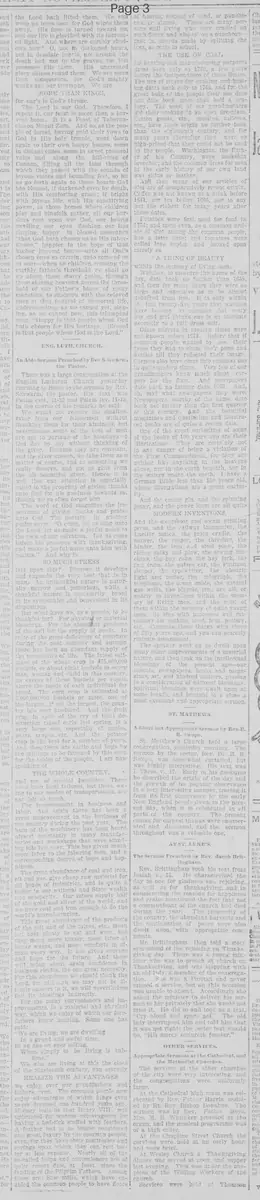
There was a large congregation at the English Lutheran Church yesterday morning to listen to the sermon by Rev. Schwarm, the pastor. His text was Psalm cviii. 31-32 and Psalm lxv. 11-13. In the course of his remarks he said: We would not receive the smallest favor from our fellowmen without thanking them for their kindnesses, but nevertheless some of the best of men are apt to partake of the blessings of God day by day without thinking of the giver. Because they are constant, and the giver unseen, we take them as a matter of course, and as something we really deserve, and not as gifts from the all bountiful giver. Hence it is well that our attention is especially called to the propriety of giving thanks unto God for his goodness towards us, though we so often forget him. The word of God magnifies the importance of giving thanks and praise unto God. The psalms in another psalm says: "O come, let us sing unto the Lord: let us make a joyful noise to the rock of our salvation. Let us come before his presence with thanksgiving, and make a joyful noise unto him with psalms." And why is SO MUCH STRESS laid upon this? Because it develops and expands the very best that is in man. An unthankful nature is naturally narrow and penurious, while a thankful nature is necessarily broad in its sympathies and benevolent in its disposition.
But what have we, as a people, to be thankful for? For physical or material blessings. For the abundant products of the soil for the supply of need. In spite of the great deficiency of moisture during the past summer and autumn there has been an abundant supply of the necessities of life. The latest estimate of the wheat crop is 475,000,000 bushels, or about eight bushels to every man, woman and child in this country, an excess of three bushels per capita above the needs of each individual for bread. The corn crop is estimated at 2,000,000,000 bushels or more, one of the largest if not the largest the country has ever produced. And the fruit crop, in spite of the cry of total destruction raised early last spring, is a very large one, especially of apples, pears, grapes etc. And the potato crop is the best for a number of years. And there are cattle and hogs by the millions to be fattened by this corn for the tables of the people. I am now speaking of THE WHOLE COUNTRY, and not of special localities. There have been local failures, but these, owing to our modes of transportation, are not felt so much.
For Improvement In business and labor. And again there has been a great improvement in the business of the country during the past year. The hum of the machinery has been heard almost constantly in many manufactories and workshops that were standing idle last year. This has given much more labor to the laboring men, and a corresponding degree of hope and happiness. The great abundance of coal and iron, oil and gas, give cheap raw material for all kinds of industries, and is quite a factor in our national and State wealth and prosperity. Our mines supply half of the gold and silver of the world, and we have coal and iron enough to do the world's manufacturing. This great abundance of the products of the soil and of the mines, etc. mean not only plenty to eat and wear, but they mean more money, more labor at better wages, and more comforts in almost every way. It has given courage and hope for the future. And these will bring about again confidence in business circles, the one great necessity.
For this abundance we should thank the Lord, for although we may not be directly sharers in it, we will nevertheless feel its blessings indirectly.
For the many conveniences and improvements in a material and physical way, which we enjoy of which our forefathers knew nothing. Some one has said: We are living, we are dwelling In a grand and awful time. In an age on ages telling. When simply to be living is sublime. We who are living at this the close of the nineteenth century, can scarcely REALIZE THE ADVANTAGES we enjoy over our grandfathers and fathers, even. The common people now enjoy advantages of which kings even never dreamed one hundred years ago. History tells us that Henry VIII. was upbraided for wanton extravagance for having a bed-tick stuffed with feathers. A feather bed is no longer considered any great luxury by the common people, even, for they have their mattresses and springs upon which they can rest better at less expense.
Nearly all of the so-called helps and conveniences are quite recent date, at least since the landing of the Pilgrim Fathers. Among these are: Saw mills, which have enabled the common people to have floors of boards, instead of sand, or puncheons, or stones. There are many persons still living who were cradled on such floors, and who sat on a puncheon- that is, boards made by splitting the log, as etc. in school.
THE USE OF COAL for heating and manufacturing purposes dates back only to 1770, a few years before the independence of these States. The use of stoves for cooking and heating dates back only to 1746, and for the great bulk of the people their use does not date back more than half a century. The most of our grandmothers did their cooking in an open fire-place.
Cotton goods, viz. muslins, calicoes, etc., have their origin no farther back than the eighteenth century, and for many years thereafter they were so high-priced that they could not be used by the people. Washington, the Father of his Country, wore buckskin breeches; and the common dress for men in the early history of our own land was skins or leather.
And then many of our articles of diet are of comparatively recent origin. Coffee was not known as a drink before 1641, nor tea before 1660s, nor to any but the richest for many years after those dates. Potatoes were first used for food in 1751; and meat even, as a common article of diet among the common people, has a later date; and tomatoes were called love apples and looked upon merely as A THING OF BEAUTY within the memory of living men.
Watches, to measure the hours of the day, date back no farther than 1658, and then for many years they were so large and expensive as to be almost debarred from use. It is only within the last twenty-five years that watches have become so common that every boy and girl thinks one is an absolute necessity to a full dress suit.
Glass mirrors in modern times were not known before 1673. Before that if common people wanted to see their faces they had to shine their pans and kettles till they reflected their image.
Carpets also have come into common use in quite modern times. Very few of our grandmothers knew much about carpets for the floor.
And newspapers date back no farther than 1690. And, oh my! what newspapers they were. Newspapers, worthy of the name, date back not farther than the first quarter of this century. And the beautiful magazines and quarterlies and illustrated books are of quite a recent date. One of the great curiosities of some of the books of 100 years ago are their illustrations. They are certainly not in any danger of being a violation of the First Commandment, for they are neither like anything in the heavens above, nor in the earth beneath, nor in the waters under the earth. I have a German Bible less than 150 years old, whose illustrations are a great curiosity.
And the cotton gin, and the spinning jenny, and the power loom are all quite MODERN INVENTIONS. And the steamboat and steam printing press, and the railway locomotive, the lucifer match, the grain cradle, the mower, the reaper, the thresher, the binder, the iron and steel plow, the riding sulky and plow, the sewing machine, the hay rake, the hay fork, the fast train, the palace car, the Pullman sleeper, the typewriter, the electric light and motor, the telegraph, the telephone, the ocean cable, the natural gas wells, the bicycle, etc., are all, or nearly so inventions within the memory of living men, and the most of them within the memory of quite young men.
So also with processes and machinery for making steel, iron, pottery, etc. Compare these things with those of fifty years ago, and you can scarcely restrain amazement.
The speaker went on to dwell upon many other improvements of a material nature, and then took up the intellectual blessings of the present age—our schools, newspapers, books and magazines, art, and kindred matters, passing to a consideration of national blessings. Spiritual blessings were dwelt upon at some length, and brought to a close a most excellent and appropriate sermon.
An Able Sermon Preached by Rev. Schwarm, the Pastor.
There was a large congregation at the English Lutheran Church yesterday morning to listen to the sermon by Rev. Schwarm, the pastor. His text was Psalm cviii. 31-32 and Psalm lxv. 11-13. In the course of his remarks he said: We would not receive the smallest favor from our fellowmen without thanking them for their kindnesses, but nevertheless some of the best of men are apt to partake of the blessings of God day by day without thinking of the giver. Because they are constant, and the giver unseen, we take them as a matter of course, and as something we really deserve, and not as gifts from the all bountiful giver. Hence it is well that our attention is especially called to the propriety of giving thanks unto God for his goodness towards us, though we so often forget him. The word of God magnifies the importance of giving thanks and praise unto God. The psalms in another psalm says: "O come, let us sing unto the Lord: let us make a joyful noise to the rock of our salvation. Let us come before his presence with thanksgiving, and make a joyful noise unto him with psalms." And why is SO MUCH STRESS laid upon this? Because it develops and expands the very best that is in man. An unthankful nature is naturally narrow and penurious, while a thankful nature is necessarily broad in its sympathies and benevolent in its disposition.
But what have we, as a people, to be thankful for? For physical or material blessings. For the abundant products of the soil for the supply of need. In spite of the great deficiency of moisture during the past summer and autumn there has been an abundant supply of the necessities of life. The latest estimate of the wheat crop is 475,000,000 bushels, or about eight bushels to every man, woman and child in this country, an excess of three bushels per capita above the needs of each individual for bread. The corn crop is estimated at 2,000,000,000 bushels or more, one of the largest if not the largest the country has ever produced. And the fruit crop, in spite of the cry of total destruction raised early last spring, is a very large one, especially of apples, pears, grapes etc. And the potato crop is the best for a number of years. And there are cattle and hogs by the millions to be fattened by this corn for the tables of the people. I am now speaking of THE WHOLE COUNTRY, and not of special localities. There have been local failures, but these, owing to our modes of transportation, are not felt so much.
For Improvement In business and labor. And again there has been a great improvement in the business of the country during the past year. The hum of the machinery has been heard almost constantly in many manufactories and workshops that were standing idle last year. This has given much more labor to the laboring men, and a corresponding degree of hope and happiness. The great abundance of coal and iron, oil and gas, give cheap raw material for all kinds of industries, and is quite a factor in our national and State wealth and prosperity. Our mines supply half of the gold and silver of the world, and we have coal and iron enough to do the world's manufacturing. This great abundance of the products of the soil and of the mines, etc. mean not only plenty to eat and wear, but they mean more money, more labor at better wages, and more comforts in almost every way. It has given courage and hope for the future. And these will bring about again confidence in business circles, the one great necessity.
For this abundance we should thank the Lord, for although we may not be directly sharers in it, we will nevertheless feel its blessings indirectly.
For the many conveniences and improvements in a material and physical way, which we enjoy of which our forefathers knew nothing. Some one has said: We are living, we are dwelling In a grand and awful time. In an age on ages telling. When simply to be living is sublime. We who are living at this the close of the nineteenth century, can scarcely REALIZE THE ADVANTAGES we enjoy over our grandfathers and fathers, even. The common people now enjoy advantages of which kings even never dreamed one hundred years ago. History tells us that Henry VIII. was upbraided for wanton extravagance for having a bed-tick stuffed with feathers. A feather bed is no longer considered any great luxury by the common people, even, for they have their mattresses and springs upon which they can rest better at less expense.
Nearly all of the so-called helps and conveniences are quite recent date, at least since the landing of the Pilgrim Fathers. Among these are: Saw mills, which have enabled the common people to have floors of boards, instead of sand, or puncheons, or stones. There are many persons still living who were cradled on such floors, and who sat on a puncheon- that is, boards made by splitting the log, as etc. in school.
THE USE OF COAL for heating and manufacturing purposes dates back only to 1770, a few years before the independence of these States. The use of stoves for cooking and heating dates back only to 1746, and for the great bulk of the people their use does not date back more than half a century. The most of our grandmothers did their cooking in an open fire-place.
Cotton goods, viz. muslins, calicoes, etc., have their origin no farther back than the eighteenth century, and for many years thereafter they were so high-priced that they could not be used by the people. Washington, the Father of his Country, wore buckskin breeches; and the common dress for men in the early history of our own land was skins or leather.
And then many of our articles of diet are of comparatively recent origin. Coffee was not known as a drink before 1641, nor tea before 1660s, nor to any but the richest for many years after those dates. Potatoes were first used for food in 1751; and meat even, as a common article of diet among the common people, has a later date; and tomatoes were called love apples and looked upon merely as A THING OF BEAUTY within the memory of living men.
Watches, to measure the hours of the day, date back no farther than 1658, and then for many years they were so large and expensive as to be almost debarred from use. It is only within the last twenty-five years that watches have become so common that every boy and girl thinks one is an absolute necessity to a full dress suit.
Glass mirrors in modern times were not known before 1673. Before that if common people wanted to see their faces they had to shine their pans and kettles till they reflected their image.
Carpets also have come into common use in quite modern times. Very few of our grandmothers knew much about carpets for the floor.
And newspapers date back no farther than 1690. And, oh my! what newspapers they were. Newspapers, worthy of the name, date back not farther than the first quarter of this century. And the beautiful magazines and quarterlies and illustrated books are of quite a recent date. One of the great curiosities of some of the books of 100 years ago are their illustrations. They are certainly not in any danger of being a violation of the First Commandment, for they are neither like anything in the heavens above, nor in the earth beneath, nor in the waters under the earth. I have a German Bible less than 150 years old, whose illustrations are a great curiosity.
And the cotton gin, and the spinning jenny, and the power loom are all quite MODERN INVENTIONS. And the steamboat and steam printing press, and the railway locomotive, the lucifer match, the grain cradle, the mower, the reaper, the thresher, the binder, the iron and steel plow, the riding sulky and plow, the sewing machine, the hay rake, the hay fork, the fast train, the palace car, the Pullman sleeper, the typewriter, the electric light and motor, the telegraph, the telephone, the ocean cable, the natural gas wells, the bicycle, etc., are all, or nearly so inventions within the memory of living men, and the most of them within the memory of quite young men.
So also with processes and machinery for making steel, iron, pottery, etc. Compare these things with those of fifty years ago, and you can scarcely restrain amazement.
The speaker went on to dwell upon many other improvements of a material nature, and then took up the intellectual blessings of the present age—our schools, newspapers, books and magazines, art, and kindred matters, passing to a consideration of national blessings. Spiritual blessings were dwelt upon at some length, and brought to a close a most excellent and appropriate sermon.
What sub-type of article is it?
Historical Event
Curiosity
What themes does it cover?
Moral Virtue
Providence Divine
Triumph
What keywords are associated?
Thanksgiving Sermon
Abundant Crops
Business Improvement
Historical Inventions
Modern Conveniences
What entities or persons were involved?
Rev. Schwarm
Where did it happen?
English Lutheran Church
Story Details
Key Persons
Rev. Schwarm
Location
English Lutheran Church
Event Date
Yesterday Morning
Story Details
Rev. Schwarm preaches on giving thanks to God for constant blessings like abundant crops despite dry weather, business improvements, natural resources, and modern conveniences and inventions unknown to forefathers, highlighting moral growth through gratitude.