Thank you for visiting SNEWPapers!
Sign up free
Letter to Editor
March 15, 1849
Virginia Free Press
Charles Town, Jefferson County, West Virginia
What is this article about?
A letter critiques a Virginia legislative report on fugitive slaves by comparing New England's economic success through manufacturing and commerce to Virginia's reliance on slavery, urging Virginians to invest in machinery and reduce slave labor for economic improvement.
Clipping
OCR Quality
78%
Good
Full Text
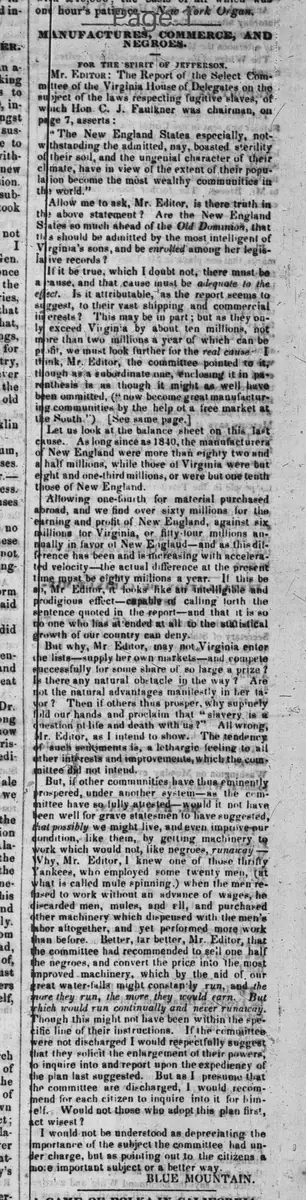
MANUFACTURES, COMMERCE, AND
NEGROES
FOR THE SPIRIT OF JEFFERSON.
Mr. Editor: The Report of the Select Committee of the Virginia House of Delegates on the
subject of the laws respecting fugitive slaves, of
which Hon. C. J. Faulkner was chairman, on
page 7, asserts:
The New England States especially, notwithstanding the admitted, nay, boasted sterility
of their soil, and the ungenial character of their
climate, have in view of the extent of their population become the most wealthy communities in
the world."
Allow me to ask, Mr. Editor, is there truth in
the above statement? Are the New England
States so much ahead of the Old Dominion, that
it should be admitted by the most intelligent of
Virginia's sons, and be enrolled among her legislative records?
If it be true, which I doubt not, there must be
cause, and that cause must be adequate to the
effect. Is it attributable, as the report seems to
suggest, to their vast shipping and commercial
interests? This may be in part; but as they only
exceed Virginia by about ten millions, not
more than two millions a year of which can be
net, we must look further for the real cause—Is it
not, Mr. Editor, the committee pointed to it,
though as a subordinate one, enclosing it in pa
renthesis as though it might as well have
been omitted, ("now become great manufacturing
communities by the help of a free market at
the South.") [See same page.]
Let us look at the balance sheet on this last
cause. As long since as 1840, the manufacturers
of New England were more than eighty two and
half millions, while those of Virginia were but
eight and one-third millions, or were but one tenth
those of New England.
Allowing one-fourth for material purchased
abroad, and we find over sixty millions for the
earning and profit of New England, against six
millions for Virginia, or fifty-four millions annually in favor of New England—and as this difference has been and is increasing with accelerated velocity—the actual difference at the present
time must be eighty millions a year. If this be
so, Mr Editor, it looks like an intelligible and
prodigious effect—capable of calling forth the
sentence quoted in the report—and that it is so
no one who has attended at all to the statistical
growth of our country can deny.
But why, Mr Editor, may not Virginia enter
the lists—supply her own markets—and compete
successfully for some share of so large a prize?
Is there any natural obstacle in the way? Are
not the natural advantages manifestly in her fa-
v or? Then if others thus prosper, why supinely
fold our hands and proclaim that "slavery is
a question of life and death with us?" All wrong,
Mr. Editor, as I intend to show. The tendency
of such sentiments is, a lethargic feeling to all
other interests and improvements, which the com-
mittee did not intend.
But, if other communities have thus eminently
prospered, under another system—as the com-
mittee have so fully attested—would it not have
been well for grave statesmen to have suggested,
that possibly we might live, and even improve—our
condition, like them, by getting machinery to
work which would not, like negroes, run away?
Why, Mr. Editor, I knew one of those thrifty
Yankees, who employed some twenty men, (at
what is called mule spinning.) when the men re-
fused to work without an advance of wages, he
discarded men, mules, and all, and purchased
other machinery which dispensed with the men's
labor altogether, and yet performed more work
than before. Better, far better, Mr. Editor, that
the committee had recommended to sell one half
the negroes, and convert the price into the most
improved machinery, which by the aid of our
great water-falls might constantly run, and the
more they run, the more they would earn. But
which would run continually and never run away.
Though this might not have been within the spe-
cific line of their instructions. If the committee
were not discharged I would respectfully suggest
that they solicit the enlargement of their powers,
to inquire into and report upon the expediency of
the plan last suggested. But as I presume that
the committee are discharged, I would recom-
mend for each citizen to inquire into it for him-
self. Would not those who adopt this plan first,
act wisest?
I would not be understood as depreciating the
importance of the subject the committee had un-
der charge, but as pointing out to the citizens a
more important subject or a better way.
BLUE MOUNTAIN.
NEGROES
FOR THE SPIRIT OF JEFFERSON.
Mr. Editor: The Report of the Select Committee of the Virginia House of Delegates on the
subject of the laws respecting fugitive slaves, of
which Hon. C. J. Faulkner was chairman, on
page 7, asserts:
The New England States especially, notwithstanding the admitted, nay, boasted sterility
of their soil, and the ungenial character of their
climate, have in view of the extent of their population become the most wealthy communities in
the world."
Allow me to ask, Mr. Editor, is there truth in
the above statement? Are the New England
States so much ahead of the Old Dominion, that
it should be admitted by the most intelligent of
Virginia's sons, and be enrolled among her legislative records?
If it be true, which I doubt not, there must be
cause, and that cause must be adequate to the
effect. Is it attributable, as the report seems to
suggest, to their vast shipping and commercial
interests? This may be in part; but as they only
exceed Virginia by about ten millions, not
more than two millions a year of which can be
net, we must look further for the real cause—Is it
not, Mr. Editor, the committee pointed to it,
though as a subordinate one, enclosing it in pa
renthesis as though it might as well have
been omitted, ("now become great manufacturing
communities by the help of a free market at
the South.") [See same page.]
Let us look at the balance sheet on this last
cause. As long since as 1840, the manufacturers
of New England were more than eighty two and
half millions, while those of Virginia were but
eight and one-third millions, or were but one tenth
those of New England.
Allowing one-fourth for material purchased
abroad, and we find over sixty millions for the
earning and profit of New England, against six
millions for Virginia, or fifty-four millions annually in favor of New England—and as this difference has been and is increasing with accelerated velocity—the actual difference at the present
time must be eighty millions a year. If this be
so, Mr Editor, it looks like an intelligible and
prodigious effect—capable of calling forth the
sentence quoted in the report—and that it is so
no one who has attended at all to the statistical
growth of our country can deny.
But why, Mr Editor, may not Virginia enter
the lists—supply her own markets—and compete
successfully for some share of so large a prize?
Is there any natural obstacle in the way? Are
not the natural advantages manifestly in her fa-
v or? Then if others thus prosper, why supinely
fold our hands and proclaim that "slavery is
a question of life and death with us?" All wrong,
Mr. Editor, as I intend to show. The tendency
of such sentiments is, a lethargic feeling to all
other interests and improvements, which the com-
mittee did not intend.
But, if other communities have thus eminently
prospered, under another system—as the com-
mittee have so fully attested—would it not have
been well for grave statesmen to have suggested,
that possibly we might live, and even improve—our
condition, like them, by getting machinery to
work which would not, like negroes, run away?
Why, Mr. Editor, I knew one of those thrifty
Yankees, who employed some twenty men, (at
what is called mule spinning.) when the men re-
fused to work without an advance of wages, he
discarded men, mules, and all, and purchased
other machinery which dispensed with the men's
labor altogether, and yet performed more work
than before. Better, far better, Mr. Editor, that
the committee had recommended to sell one half
the negroes, and convert the price into the most
improved machinery, which by the aid of our
great water-falls might constantly run, and the
more they run, the more they would earn. But
which would run continually and never run away.
Though this might not have been within the spe-
cific line of their instructions. If the committee
were not discharged I would respectfully suggest
that they solicit the enlargement of their powers,
to inquire into and report upon the expediency of
the plan last suggested. But as I presume that
the committee are discharged, I would recom-
mend for each citizen to inquire into it for him-
self. Would not those who adopt this plan first,
act wisest?
I would not be understood as depreciating the
importance of the subject the committee had un-
der charge, but as pointing out to the citizens a
more important subject or a better way.
BLUE MOUNTAIN.
What sub-type of article is it?
Persuasive
Political
Informative
What themes does it cover?
Commerce Trade
Economic Policy
Slavery Abolition
What keywords are associated?
New England Economy
Virginia Manufacturing
Slavery Reliance
Machinery Investment
Fugitive Slaves
Commercial Interests
What entities or persons were involved?
Blue Mountain.
Mr. Editor
Letter to Editor Details
Author
Blue Mountain.
Recipient
Mr. Editor
Main Argument
new england's wealth stems from manufacturing enabled by southern markets, not just commerce; virginia should develop its own manufacturing using machinery instead of relying on slaves, potentially by selling some to fund it, to improve economically without abolishing slavery entirely.
Notable Details
References Virginia House Report Chaired By Hon. C. J. Faulkner On Fugitive Slaves
1840 Manufacturing Values: New England Over $82.5m, Virginia $8.33m
Anecdote Of Yankee Replacing Workers With Machinery
Suggests Selling Half The Negroes For Machinery