Thank you for visiting SNEWPapers!
Sign up free
Republican Herald
Providence, Providence County, Rhode Island
What is this article about?
President Andrew Jackson issues an official opinion disapproving the Court of Inquiry's findings on delays in the 1836 campaign against hostile Creek Indians in Georgia and Alabama, remitting proceedings back for further review, focusing on Major Gen. Scott's actions.
Merged-components note: These two components form the complete 'Opinion of the President' on the Court of Inquiry proceedings, continuing directly in text and adjacent spatially.
Clipping
OCR Quality
Full Text
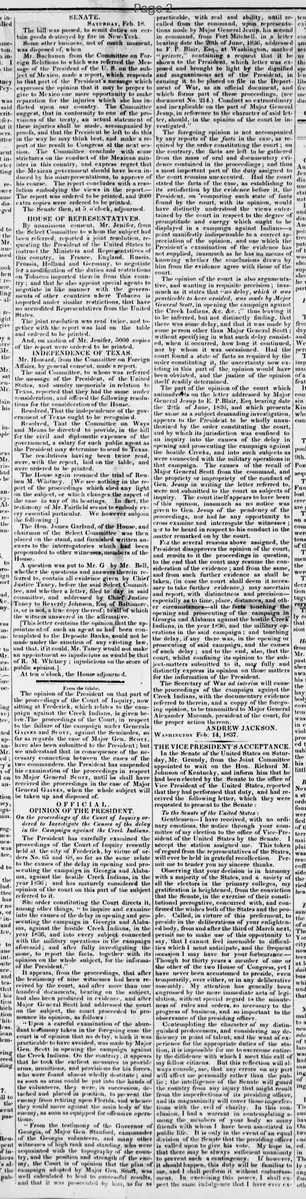
The opinion of the President on that part of the proceedings of the Court of Inquiry, now sitting at Frederick, which relates to the campaign against the Creek Indians, is given below. The proceedings of the Court, in respect to the failure of the campaign under Generals Gaines and Scott, against the Seminoles, so far as regards the case of Major Gen. Scott, have also been submitted to the President; but we understand that in consequence of the necessary connection between the cases of the two commanders, the President has suspended his examination of the proceedings in respect to Major General Scott, until he shall have received the proceedings in the case of Major General Gaines, when the whole subject will be taken up and disposed of.
OFFICIAL.
OPINION OF THE PRESIDENT.
On the proceedings of the Court of Inquiry ordered to Investigate the Causes of the delay in the Campaign against the Creek Indians.
The President has carefully examined the proceedings of the Court of Inquiry recently held at the city of Frederick, by virtue of orders No. 65 and 68, so far as the same relate to the causes of the delay in opening and prosecuting the campaign in Georgia and Alabama, against the hostile Creek Indians, in the year 1836; and has maturely considered the opinion of the court on this part of the subject referred to it.
The order constituting the Court directs it, among other things, "to inquire and examine into the causes of the delay in opening and prosecuting the campaign in Georgia and Alabama, against the hostile Creek Indians, in the year 1836, and into every subject connected with the military operations in the campaign aforesaid; and after fully investigating the same, to report the facts, together with its opinion on the whole subject, for the information of the President."
It appears, from the proceedings, that after the testimony of nine witnesses had been received by the court, and after more than one hundred documents, bearing on the subject, had also been produced in evidence, and after Major General Scott had addressed the court on the subject, the court proceeded to pronounce its opinion, as follows:
"Upon a careful examination of the abundant testimony taken in the foregoing case the court is of opinion that no delay, which it was practicable to have avoided, was made by Major Gen. Scott in opening the campaign against the Creek Indians. On the contrary, it appears that he took the earliest measures to provide arms, munitions, and provisions for his forces, who were found almost wholly destitute; and as soon as arms could be put into the hands of the volunteers, they were, in succession, detached and placed in position, to prevent the enemy from retiring upon Florida, and whence they could move against the main body of the enemy, as soon as equipped for offensive operations.
From the testimony of the Governor of Georgia, of Major Gen. Stanford, commander of the Georgia volunteers, and many other witnesses of high rank and standing, who were acquainted with the topography of the country, and the position and strength of the enemy, the Court is of opinion that the plan of campaign adopted by Major Gen. Scott, was well calculated to lead to successful results, and that it was prosecuted by him, as far as practicable, with zeal and ability, until recalled from the command, upon representations made by Major General Jesup, his second in command, from Fort Mitchell, in a letter bearing date the 20th of June, 1836, addressed to F. P. Blair, Esq., at Washington, marked "private," containing a request that it be shown to the President, which letter was exposed and brought to light by the dignified and magnanimous act of the President, in causing it to be placed on file in the Department of War, as an official document, and which forms part of these proceedings, (see document No. 214.) Conduct so extraordinary and inexplicable on the part of Major General Jesup, in reference to the character of said letter, should, in the opinion of the court be investigated."
The foregoing opinion is not accompanied by any reports of the facts in the case, as required by the order constituting the court; on the contrary, the facts are left to be gathered from the mass of oral and documentary evidence contained in the proceedings; and thus a most important part of the duty assigned to the court remains unexecuted. Had the court stated the facts of the case, as established to its satisfaction by the evidence before it, the President, on comparing such state of facts found by the court, with its opinion, would have distinctly understood the views entertained by the court in respect to the degree of promptitude and energy which ought to be displayed in a campaign against Indians—a point manifestly indispensable to a correct appreciation of the opinion, and one which the President's examination of the evidence has not supplied, inasmuch as he has no means of knowing whether the conclusions drawn by him from the evidence agree with those of the court.
The opinion of the court is also argumentative, and wanting in requisite precision; inasmuch as it states that "no delay, which it was practicable to have avoided, was made by Major General Scott, in opening the campaign against the Creek Indians, &c. &c. ;" thus leaving it to be inferred, but not distinctly finding, that there was some delay, and that it was made by some person other than Major General Scott; without specifying in what such delay consisted, when it occurred, how long it continued, nor by whom it was occasioned. Had the court found a state of facts as required by the order constituting it, the uncertainty now existing in this part of the opinion would have been obviated, and the justice of the opinion itself readily determined.
The part of the opinion of the court which animadverts on the letter addressed by Major General Jesup to E. P. Blair, Esq. bearing date the 20th of June, 1836, and which presents the same as a subject demanding investigation, appears to the President to be wholly unauthorized by the order constituting the court, and by which its jurisdiction was confined to an inquiry into the causes of the delay in opening and prosecuting the campaign against the hostile Creeks, and into such subjects as were connected with the military operations in that campaign. The causes of the recall of Major General Scott from the command, and the propriety or impropriety of the conduct of Gen. Jesup in writing the letter referred to, were not submitted to the court as subjects of inquiry. The court itself appears to have been of this opinion, inasmuch as no notice was given to Gen. Jesup of the pendency of the proceedings, nor had he any opportunity to cross examine and interrogate the witnesses; nor to be heard in respect to his conduct in the matter remarked on by the court.
For the several reasons above assigned, the President disapproves the opinion of the court, and remits to it the proceedings in question, to the end that the court may resume the consideration of the evidence; and from the same, and from such further evidence as shall be taken, (in case the court shall deem it necessary to take further evidence,) may ascertain and report, with distinctness and precision—especially as to time, place, distances, and other circumstances—all the facts touching the opening and prosecuting of the campaign in Georgia and Alabama against the hostile Creek Indians, in the year 1836, and the military operations in the said campaign; and touching the delay, if any there was, in the opening or prosecuting of said campaign, and the causes of such delay; and to the end, also, that the court, whilst confining its opinion to the subject-matters submitted to it, may fully and distinctly express its opinion on those matters for the information of the President.
The Secretary of War ad interim will cause the proceedings of the campaign against the Creek Indians, with the documentary evidence referred to therein, and a copy of the foregoing opinion, to be transmitted to Major General Alexander Macomb, president of the court, for the proper action thereon.
ANDREW JACKSON.
Washington Feb. 14, 1837.
What sub-type of article is it?
What keywords are associated?
What entities or persons were involved?
Where did it happen?
Domestic News Details
Primary Location
Washington
Event Date
Feb. 14, 1837
Key Persons
Outcome
president disapproves the court's opinion and remits proceedings for further review and reporting of facts with precision.
Event Details
President examines proceedings of Court of Inquiry at Frederick on delays in 1836 campaign against Creek Indians in Georgia and Alabama; court opined no avoidable delay by Major Gen. Scott and criticized Jesup's letter; President finds opinion lacking facts, precision, and overstepping jurisdiction, thus disapproves and orders resumption.