Thank you for visiting SNEWPapers!
Sign up free
Bismarck Daily Tribune
Bismarck, Burleigh County, North Dakota
What is this article about?
The Commercial Club in Bismarck convenes a large meeting to recommend civic improvements to the city council, including a cattle impounding ordinance, removal of slaughterhouses, support for a brass band, militia armory funding, hitching posts, watering troughs, and abolishing private sewers. They also plan a farmers' institute and report on new members and publicity efforts.
Clipping
OCR Quality
Full Text
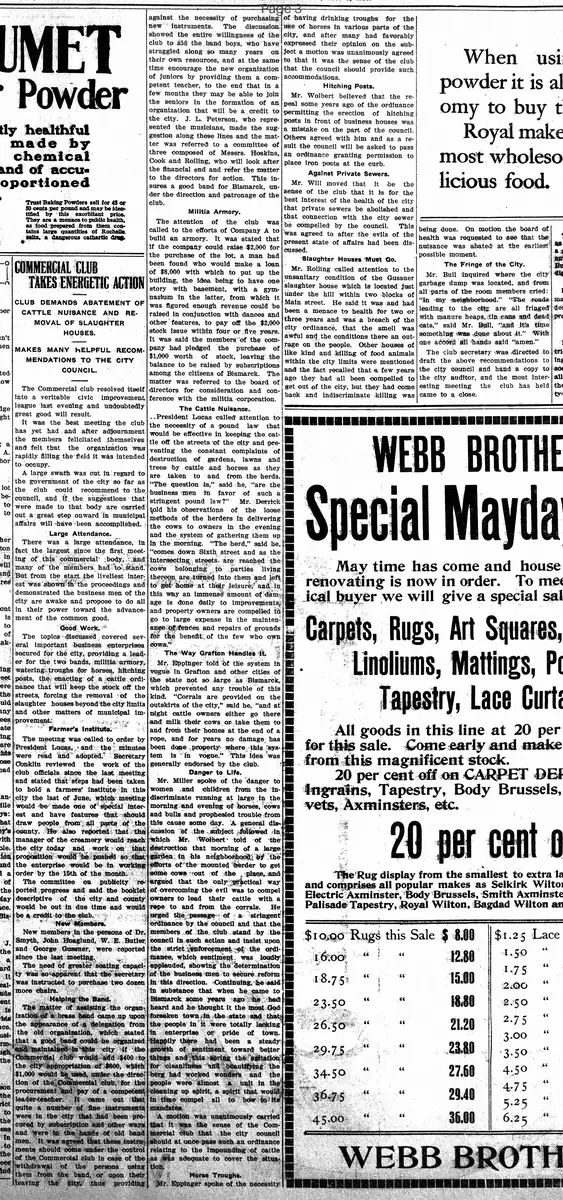
TAKES ENERGETIC ACTION
CLUB DEMANDS ABATEMENT OF
CATTLE NUISANCE AND RE-
MOVAL OF SLAUGHTER
HOUSES.
MAKES MANY HELPFUL RECOM-
MENDATIONS TO THE CITY
COUNCIL.
The Commercial club resolved itself
into a veritable civic improvement
league last evening and undoubtedly
great good will result.
It was the best meeting the club
has yet had and after adjournment
the members felicitated themselves
and felt that the organization was
rapidly filling the field it was intended
to occupy.
A large swath was cut in regard to
the government of the city so far as
the club could recommend to the
council, and if the suggestions that
were made to that body are carried
out a great step onward in municipal
affairs will have been accomplished.
Large Attendance.
There was a large attendance, in
fact the largest since the first meet-
ing of this commercial body, and
many of the members had to stand.
But from the start the liveliest inter-
est was shown in the proceedings and
demonstrated the business men of the
city are awake and propose to do all
in their power toward the advance-
ment of the common good.
Good Work.
The topics discussed covered sev-
eral important business enterprises
secured for the city, providing a leader
for the two bands, militia armory,
watering troughs for horses, hitching
posts, the enacting of a cattle ordi-
nance that will keep the stock off the
streets, forcing the removal of the
slaughter houses beyond the city limits
and other matters of municipal im-
provement.
Farmer's Institute.
The meeting was called to order by
President Lucas, and the minutes
were read and adopted. Secretary
Conklin reviewed the work of the
club officials since the last meeting
and stated that steps had been taken
to hold a farmers' institute in this
city the last of June, which meeting
would be made one of special inter-
est and have features that should
draw people from all parts of the
county. He also reported that the
manager of the creamery would reach
the city today and work on that
proposition would be pushed so that
the enterprise would be in working
order by the 15th of the month.
The committee on publicity
re-
ported progress and said the booklet
descriptive of the city and county
would be out in due time and would
be a credit to the club.
New Members.
New members in the persons of Dr.
Smyth, John Hoaglund, W. E. Butler
and George Gussner, were reported
since the last meeting.
The need of greater seating capacity
was so apparent that the secretary
was instructed to purchase two dozen
more chairs.
Helping the Band.
The matter of assisting the organ-
ization of a brass band came up upon
the appearance of a delegation from
the old organization which stated
that a good band could be organized
and maintained in this city if the
Commercial club would add $400 to
the city appropriation of $600, which
$1,000 would be used under the direc-
tion of the commercial club for the
procurement and pay of a competent
leader-teacher. It came out that
quite a number of fine instruments
were in the city that had been pro-
cured by subscription and other ways
and were in the hands of old band
men. It was agreed that these instru-
ments should come under the control
of the Commercial club in case of the
withdrawal of the persons using
them from the band or upon their
leaving the city, thus guarding
against the necessity of purchasing
new instruments. The discussion
showed the entire willingness of the
club to aid the band boys who have
struggled along so many years on
their own resources, and at the same
time encourage the new organization
of juniors by providing them a com-
petent teacher, to the end that in a
few months they may be able to join
the seniors in the formation of an
organization that will be a credit to
the city. J. L. Peterson, who repre-
sented the musicians, made the sug-
gestion along these lines and the mat-
ter was referred to a committee of
three composed of Messrs. Hoskins,
Cook and Rolling, who will look after
the financial end and refer the matter
to the directors for action. This in-
sures a good band for Bismarck, un-
der the direction and patronage of the
club.
Militia Armory.
The attention of the club
was
called to the efforts of Company A to
build an armory. It was stated that
if the company could raise $2,000 for
the purchase of the lot a man had
been found who would make a loan
of $8,000 with which to put up the
building, the idea being to have one
story with basement, with a gym-
nasium in the latter, from which it
was figured enough revenue could be
raised in conjunction with dances and
other features, to pay off the $2,000
stock issue within four or five years.
It was said the members of the com-
pany had pledged the purchase of
$1,000 worth of stock, leaving the
balance to be raised by subscriptions
among the citizens of Bismarck. The
matter was referred to the board of
directors for consideration and con-
ference with the militia corporation.
The Cattle Nuisance.
President Lucas called attention to
the necessity of a pound law that
would be effective in keeping the cat-
tle off the streets of the city and pre-
venting the constant complaints of
destruction of gardens, lawns and
trees by cattle and horses as they
are taken to and from the herds.
"The question is," said he, "are the
business men in favor of such a
stringent pound law?" Mr. Derrick
told his observations of the loose
methods of the herders in delivering
the cows to owners in the evening
and the system of gathering them up
in the morning. "The herd," said he,
"comes down Sixth street and as the
intersecting streets are reached the
cows belonging to parties living
thereon are turned into them and left
to get home at their leisure, and in
this way an immense amount of dam-
age is done daily to improvements,
and property owners are compelled to
go to large expense in the mainten-
ance of fences and repairs of grounds
for the benefit of the few who own
cows.
The Way Grafton Handles It.
Mr. Eppinger told of the system in
vogue in Grafton and other cities of
the state not so large as Bismarck
which prevented any trouble of this
kind. "Corrals are provided on the
outskirts of the city," said he, "and at
night cattle owners either go there
and milk their cows or take them to
and from their homes at the end of a
rope, and for years no damage has
been done property where this sys-
tem is in vogue." This idea was
generally endorsed by the club.
Danger to Life.
Mr. Miller spoke of the danger to
women and children from the in-
discriminate running at large in the
morning and evening of horses, cows
and bulls and prophesied trouble from
this cause some day. A general dis-
cussion of the subject followed in
which Mr. Wolbert told of the
destruction that morning of a large
garden in his neighborhood by the
efforts of the mounted herder to get
some cows out of the place, and
argued that the only practical way
of overcoming the evil was to compel
owners to lead their cattle with a
rope to and from the corrals. He
urged the passage of a stringent
ordinance by the council and that the
members of the club stand by the
council in such action and insist upon
the strict enforcement of the ordi-
nance, which sentiment was loudly
applauded, showing the determination
of the business men to secure reform
in this direction. Continuing, he said
in substance that when he came to
Bismarck some years ago he had
heard and he thought it the most God
forsaken town in the state and that
the people in it were totally lacking
in enterprise or pride of town.
Happily there had been a steady
growth of sentiment toward better
things and this spring the agitation
for cleanliness and beautifying the
berg had worked wonders and the
people were almost a unit in the
cleaning up spirit, a spirit that would
in time compel all to bow to its
mandates.
A motion was unanimously carried
that it was the sense of the Com-
mercial club that the city council
should at once pass such an ordinance
relating to the impounding of cattle
as was adequate to cover the situa-
Jot
of having drinking troughs for the
use of horses in various parts of the
city, and after many had favorably
expressed their opinion on the sub-
ject a motion was unanimously agreed
to that it was the sense of the club
that the council should provide such
accommodations.
Hitching Posts.
Mr. Wolbert believed that the re-
peal some years ago of the ordinance
permitting the erection of hitching
posts in front of business houses was
a mistake on the part of the council.
Others agreed with him and as a re-
sult the council will be asked to pass
an ordinance granting permission to
place iron posts at the curb.
Against Private Sewers.
Mr. Will moved that it be the
sense of the club that it is for the
best interest of the health of the city
that private sewers be abolished and
that connection with the city sewer
be compelled by the council. This
was agreed to after the evils of the
present state of affairs had been dis-
cussed.
Slaughter Houses Must Go.
Mr. Rolling called attention to the
unsanitary condition of the Gussner
slaughter house which is located just
under the hill within two blocks of
Main street. He said it was and had
been a menace to health for two or
three years and was a breach of the
city ordinance, that the smell was
awful and the conditions there an out-
rage on the people. Other houses of
like kind and killing of food animals
within the city limits were mentioned
and the fact recalled that a few years
ago they had all been compelled to
get out of the city, but they had come
back and indiscriminate killing was
being done. On motion the board of
health was requested to see that the
nuisance was abated at the earliest
possible moment.
The Fringe of the City.
Mr. Bull inquired where the city
garbage dump was located, and from
all parts of the room members cried:
"In my neighborhood." "The roads
leading to the city are all fringed
with manure heaps, tin cans and dead
cats," said Mr. Bull, "and its time
something was done about it." With
one accord all hands said "amen."
The club secretary was directed to
draft the above recommendations to
the city council and hand a copy to
the city auditor, and the most inter-
esting meeting the club has held
came to a close.
What sub-type of article is it?
What themes does it cover?
What keywords are associated?
What entities or persons were involved?
Where did it happen?
Story Details
Key Persons
Location
Bismarck
Event Date
Last Evening
Story Details
The Commercial Club meeting discusses and resolves to recommend to the city council measures for civic improvement, including enacting a stringent cattle impounding ordinance, removing slaughterhouses beyond city limits, providing watering troughs and hitching posts, abolishing private sewers, supporting a brass band with funding for a leader, aiding militia armory construction, planning a farmers' institute, and addressing garbage dumps.