Thank you for visiting SNEWPapers!
Sign up free
Literary
April 1, 1859
The Bedford Gazette
Bedford, Bedford County, Pennsylvania
What is this article about?
A note references a legend in Scott's 'Rokeby' about Darrell of Littlecote and recounts a similar Edinburgh tale from Sir Walter Scott's childhood: a blindfolded clergyman prays for a dying lady post-childbirth, hears a pistol shot, receives gold in silence, and later learns of a fire killing the lady; years later, an apparition appears in a new fire at the site.
Clipping
OCR Quality
95%
Excellent
Full Text
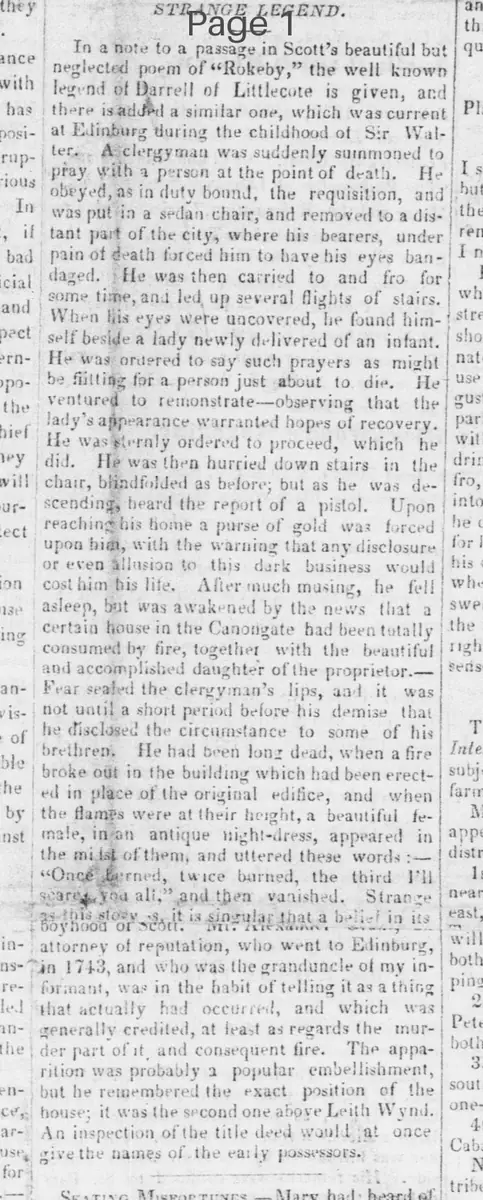
In a note to a passage in Scott's beautiful but neglected poem of "Rokeby," the well known legend of Darrell of Littlecote is given, and there is added a similar one, which was current at Edinburgh during the childhood of Sir Walter. A clergyman was suddenly summoned to pray with a person at the point of death. He obeyed, as in duty bound, the requisition, and was put in a sedan chair, and removed to a distant part of the city, where his bearers, under pain of death forced him to have his eyes bandaged. He was then carried to and fro for some time, and led up several flights of stairs. When his eyes were uncovered, he found himself beside a lady newly delivered of an infant. He was ordered to say such prayers as might be fitting for a person just about to die. He ventured to remonstrate--observing that the lady's appearance warranted hopes of recovery. He was sternly ordered to proceed, which he did. He was then hurried down stairs in the chair, blindfolded as before; but as he was descending, heard the report of a pistol. Upon reaching his home a purse of gold was forced upon him, with the warning that any disclosure or even allusion to this dark business would cost him his life. After much musing, he fell asleep, but was awakened by the news that a certain house in the Canongate had been totally consumed by fire, together with the beautiful and accomplished daughter of the proprietor. Fear sealed the clergyman's lips, and it was not until a short period before his demise that he disclosed the circumstance to some of his brethren. He had been long dead, when a fire broke out in the building which had been erected in place of the original edifice, and when the flames were at their height, a beautiful female, in an antique night-dress, appeared in the midst of them, and uttered these words: "Once burned, twice burned, the third I'll scare, and all," and then vanished. Strange as this story is, it is singular that a belief in its truth was current in the boyhood of Scott. Mr. Hiram attorney of reputation, who went to Edinburgh, in 1743, and who was the granduncle of my informant, was in the habit of telling it as a thing that actually had occurred, and which was generally credited, at least as regards the murder part of it and consequent fire. The apparition was probably a popular embellishment, but he remembered the exact position of the house; it was the second one above Leith Wynd. An inspection of the title deed would at once give the names of the early possessors.
What sub-type of article is it?
Prose Fiction
What themes does it cover?
Death Mortality
What keywords are associated?
Edinburgh Legend
Scott Childhood
Infanticide Murder
Apparition Fire
Clergyman Witness
Literary Details
Form / Style
Anecdotal Legend In Prose
Key Lines
"Once Burned, Twice Burned, The Third I'll Scare, And All,"