Thank you for visiting SNEWPapers!
Sign up free
Portland Gazette, And Maine Advertiser
Portland, Cumberland County, Maine
What is this article about?
Historical agricultural advice on efficient Indian Corn cultivation in cooler climates, advocating less ground with intensive manuring, specific planting in drills, seed sprouting, and thorough hoeing to boost yields up to 120 bushels per acre.
Merged-components note: Continuation of the article on the cultivation of Indian Corn across page 2 and 3; text flows directly from one to the next.
Clippings
1 of 2
OCR Quality
Full Text
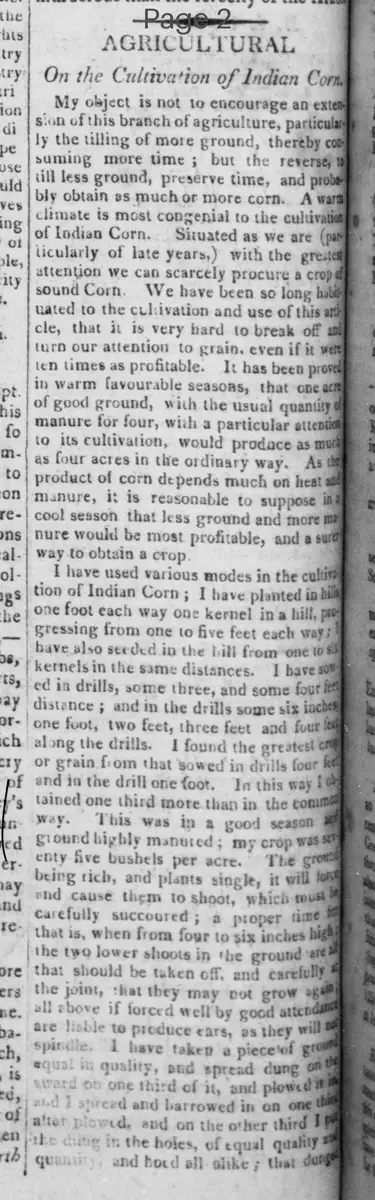
On the Cultivation of Indian Corn.
My object is not to encourage an extension of this branch of agriculture, particularly the tilling of more ground, thereby consuming more time; but the reverse, to till less ground, preserve time, and probably obtain as much or more corn. A warm climate is most congenial to the cultivation of Indian Corn. Situated as we are (particularly of late years,) with the greatest attention we can scarcely procure a crop of sound Corn. We have been so long habituated to the cultivation and use of this article, that it is very hard to break off and turn our attention to grain, even if it were ten times as profitable. It has been proved in warm favourable seasons, that one acre of good ground, with the usual quantity of manure for four, with a particular attention to its cultivation, would produce as much as our acres in the ordinary way. As the product of corn depends much on heat and manure, it is reasonable to suppose in a cool season that less ground and more manure would be most profitable, and a surer way to obtain a crop.
I have used various modes in the cultivation of Indian Corn; I have planted in hills one foot each way one kernel in a hill, progressing from one to five feet each way; have also seeded in the hill from one to five kernels in the same distances. I have sowed in drills, some three, and some four feet distance; and in the drills some six inches one foot, two feet, three feet and four feet along the drills. I found the greatest crop or grain from that sowed in drills four feet and in the drill one foot. In this way I obtained one third more than in the common way. This was in a good season ground highly manured; my crop was seventy five bushels per acre. The ground being rich, and plants single, it will force and cause them to shoot, which must be carefully succoured; a proper time that is, when from four to six inches high the two lower shoots in the ground are that should be taken off, and carefully at the joint, that they may not grow again all above if forced well by good attendance are liable to produce ears, as they will not da spindle. I have taken a piece of ground equal in quality, and spread dung on the sward on one third of it and plowed it and I spread and harrowed in on one third after plowed, and on the other third I put the dung in the holes, of equal quality quantity and hoed all alike; that dunged
in the holes and that spread on top and harrowed in produced a similar crop; that spread on the sward and plowed in produced much the best Corn. This ground was warm loam. I tried the same experiment on moist ground and the result was the reverse.
Under all circumstances I recommend planting but little ground and that warm and highly manured, and to procure the earliest seed. The early seed is generally smaller in its growth: though to be planted in distances proportionate to its size. I would recommend planting early, as there are many advantages resulting herefrom. Corn grows more stocky and shoots lower, and will give more ears, is more forward, heavier, sounder, and generally produces a better crop.
It is best to sprout corn before planting; it will not only prove your seed, but will preserve it from rotting, and cause it to come up much sooner and better. Corn may be sufficiently sprouted in twelve hours. Soak it in warm water above blood heat about two hours, drain off the water, cover it with wet cloths in a cistern set in an oven of the same heat and continue it that period of time. This method of sprouting corn will apply to all seeds, and is generally very necessary, especially to vine seeds.
Corn should be hoed early and kept free from weeds; by neglecting it when small, it becomes slim and feeble, and will not recover the whole season. It is wrong to scrape up all loose dirt between the hills, it leaves the ground hard and bare, and exposes it to the power of the sun, and attracts the moisture from the ground, whereas if kept covered with a few inches of pulverised earth it will prevent that attraction, and as the fibres pass through every part of the ground the corn will be better fed in its last growth, and will cause it to fill much better.
The growth of Indian Corn depends more on a particular attention to its cultivation than any other grain, or perhaps vegetable. Grain will produce a crop without hoeing but much greater with hoeing or stirring the ground; but corn sowed in the broad cast way, on the best and highest cultivated ground not hoed will not produce either stock or kernel.
Take two acres of the best ground, highly manured, equal in quality, cultivate one with the best attention, and it will produce 120 bushels; whereas the other slightly cultivated, will not produce a kernel.
What sub-type of article is it?
What keywords are associated?
Story Details
Story Details
Author describes experiments and recommendations for cultivating Indian Corn efficiently in cool climates, including planting in wide drills with spacing, intensive manuring on less ground, removing shoots, early planting of sprouted seeds, and thorough hoeing to achieve yields of 75-120 bushels per acre.