Thank you for visiting SNEWPapers!
Sign up free
Alexandria Daily Gazette, Commercial & Political
Alexandria, Virginia
What is this article about?
Federalist editorial critiques the concept of 'constitutional resistance' as promoted in the 1798 Virginia Resolutions, quoting resolutions on state interposition against federal overreach during the Quasi-War with France, and Madison's justifying report, portraying them as seditious and anti-federal.
Merged-components note: Continuation of the editorial article 'What is Constitutional Resistance?' from the North American, spanning across pages 2 and 3 based on text flow and sequential reading order.
Clippings
1 of 2
OCR Quality
Full Text
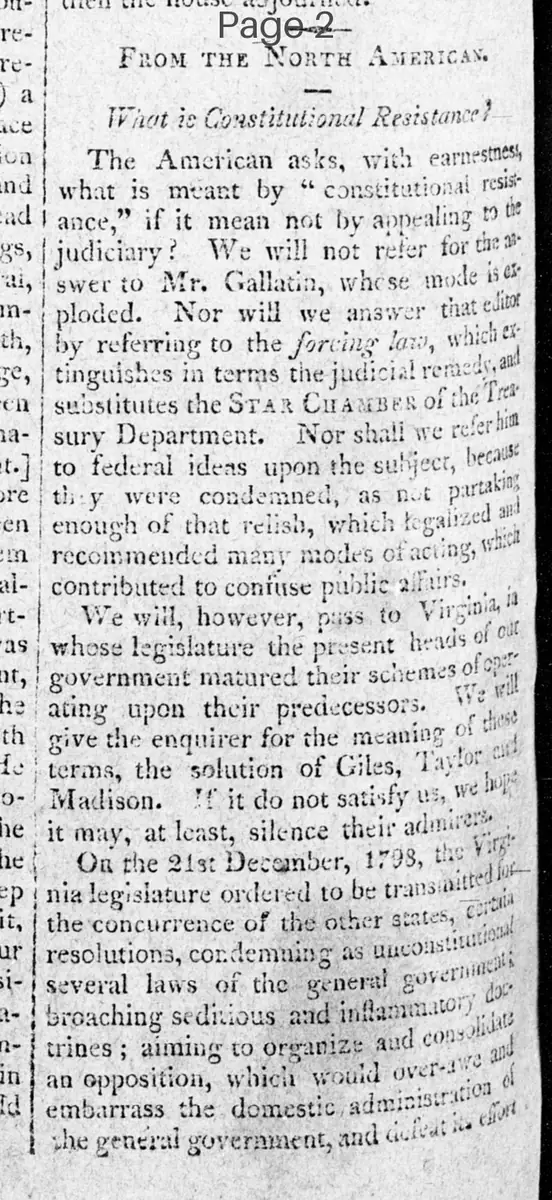
What is Constitutional Resistance?
The American asks, with earnestness, what is meant by "constitutional resistance," if it mean not by appealing to the judiciary? We will not refer for the answer to Mr. Gallatin, whose mode is exploded. Nor will we answer that editor by referring to the forcing law, which constitutes the STAR CHAMBER of the Treasury Department. It distinguishes in terms the judicial remedy, and that they were condemned, as not partaking of federal ideas upon the subject, because Nor shall we refer him to the Virginia Resolutions, recommended many modes of acting, which enough of that relish, which legalized and contributed to confuse public affairs.
We will, however, pass to Virginia in whose legislature the present heads of government matured their schemes of opposition, which would over-awe and embarrass the general government, and eat We will give the enquirer for the meaning of these ating upon their predecessors.
We will the solution of Giles, Taylor and Madison. If it do not satisfy us, we hope it may, at least, silence their admirers.
nia legislature led to be a On the 21st December, 1798, the Virginia resolutions, condemning as unconstitutional the concurrence of the other states, Certain several laws of the general government; trines; aiming to organize and consolidate broaching seditious and inflammatory doctrine an opposition, which would to bring an honorable conclusion a war then actually raging with France.
Various, for a moment—
Let us listen to the doctrines of these patriots, to which the states are parties. Are no further government, as resulting from the compact
Resol. 3d. "The powers of the federal government are those only which are enumerated in that compact; that in case a deliberate, palpable and dangerous exercise of other powers, the states, who are parties thereto, are bound to interpose, for maintaining within their respective limits, the authorities, rights and liberties appertaining to them."
Does his exposition satisfy our democrats? If it does not, we will enforce it a little further, by quoting another resolution, by way of showing that the demagogues of the day were so far sincere and earnest, as
by the states against the general government: into the case which called for resistance to bring the then condition of their country
ment.
follows on the principles of these demagogues, that the states were then bound to interpose in those cases, which were in reality
alarming infractions of the constitution." Hence it
The fifth resolution declares two acts of Congress "to be palpable and
gagues, that the states were then bound to
all plain emanations from the constitution.
of confusion; these republican citizens so
But the labors of these worthy artificers
extremely attached to the constitution and the welfare of their country; so devoutly
inclined to support it in the raging war;
did not stop here. As before observed,
their disorganizing resolutions were sent
out for the approbation of the states, accom-
panied by an inflammatory address, which
we shall publish on another day. By many of the Legislatures they were disapproved,
and by some treated with contempt
and indignity. In short their reception was
not such as had been hoped. The answers
were afterwards referred by the Legislature
of Virginia to a committee, of whom Mr.
Madison was one and generally admitted
to be that one, who drafted the report.—
This the committee presented to the House
in a large pamphlet, and in it they revised
and justified the resolutions, "solemnly ad-
hering to them, as true constitutional and
salutary." An edition of this pamphlet
was published at Philadelphia by way of
disseminating even there, the pernicious
and anti-federal doctrines it recommended.
In the language of an able and learned writer, now no more, it appeared to be "the
work of an ingenious mind uncandidly en-
deavoring to persuade others to believe
what it believes not itself."
What sub-type of article is it?
What keywords are associated?
What entities or persons were involved?
Editorial Details
Primary Topic
Critique Of Virginia Resolutions On Constitutional Resistance
Stance / Tone
Strongly Anti Democratic Republican, Pro Federalist Critique
Key Figures
Key Arguments