Thank you for visiting SNEWPapers!
Sign up free
Editorial
January 30, 1806
The Enquirer
Richmond, Henrico County, Virginia
What is this article about?
This editorial, Number II from Richmond on January 30, critiques British doctrine subjecting neutral trade not open in peacetime to capture in wartime. It analyzes historical evidence, treaties, and British practices, arguing the principle is an innovation for commercial gain, harming neutral nations like the US. It defends neutral rights and exposes inconsistencies in British policy and courts.
Clipping
OCR Quality
95%
Excellent
Full Text
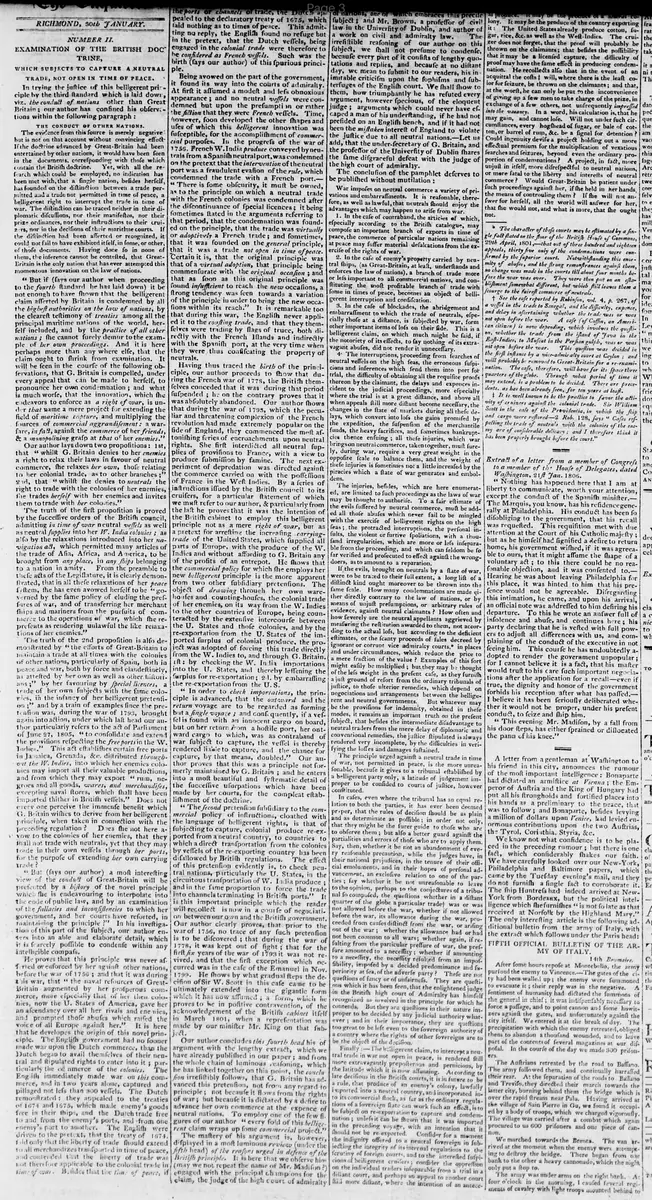
RICHMOND, 30th JANUARY.
NUMBER II.
EXAMINATION OF THE BRITISH DOCTRINE,
WHICH SUBJECTS TO CAPTURE A NEUTRAL
TRADE, NOT OPEN IN TIME OF PEACE.
In trying the justice of this belligerent principle by the third standard which is laid down, viz. the conduct of nations other than Great Britain: our author has confined his observations within the following paragraph:
THE CONDUCT OF OTHER NATIONS.
The evidence from this source is merely negative but is not on that account without convincing effect. If the doctrine advanced by Great-Britain had been entertained by other nations, it would have been seen in the documents, corresponding with those which contain the British doctrine. Yet, with all the research which could be employed, no indication has been met with, that a single nation, besides herself has founded on the distinction between a trade permitted and a trade not permitted in time of peace, a belligerent right to interrupt the trade in time of war. The distinction can be traced neither in their diplomatic discussions, nor their manifestos, nor their prize ordinances, nor their instructions to their cruisers, nor in the decisions of their maritime courts. If the distinction had been asserted or recognized, it could not fail to have exhibited itself, in some, or other. of those documents. Having done so in none of them, the inference cannot be contested, that Great-Britain is the only nation that has ever attempted this momentous innovation on the Law of nations.
"But if (says our author when proceeding to the fourth standard he has laid down) it be not enough to have shown that the belligerent claim asserted by Britain is condemned by all the highest authorities on the law of nations, by the clearest testimony of treaties among all the principal maritime nations of the world, herself included, and by the practice of all other nations; she cannot surely demur to the example of her own proceedings. And it is here perhaps more than any where else, that the claim ought to shrink from examination. It will be seen in the course of the following observations, that G. Britain is compelled, under every appeal that can be made to herself, to pronounce her own condemnation; and what is much worse, that the innovation, which she endeavors to enforce as a right of war, is under that name a mere project for extending the field of maritime capture, and multiplying the sources of commercial aggrandizement: a warfare, in fact, against the commerce of her friends, & a monopolizing grasp at that of her enemies."
Our author lays down two propositions: 1st, that "whilst G. Britain denies to her enemies a right to relax their laws in favour of neutral commerce, she relaxes her own, those relating to her colonial trade, as to other branches;" 2nd, that "whilst she denies to neutrals the right to trade with the colonies of her enemies, she trades herself with her enemies and invites them to trade with her colonies."
The truth of the first proposition is proved by the successive orders of the British council, admitting in time of war neutral vessels as well as neutral supplies into her W. India colonies; as also by the relaxations introduced into her navigation act, which permitted many articles of the trade of Asia, Africa, and America, to be brought from any place, in any ships belonging to a nation in amity.
From the preamble to these acts of the Legislature, it is clearly demonstrated, that in all these relaxations of her peace system, she has even avowed herself to be "governed by the same policy of eluding the pressures of war, and of transferring her merchant ships and mariners from the pursuits of commerce to the operations of war, which she represents as rendering unlawful the like relaxations of her enemies.'
The truth of the 2nd proposition is also demonstrated by "the efforts of Great-Britain to maintain a trade at all times with the colonies of other nations, particularly of Spain, both in peace and war, both by force and clandestinely, as attested by her own as well as other historians;" by her favouring by special licences, a trade of her own subjects with the same colonies, in the infancy of her belligerent pretensions;" and by a train of examples since the pretension was, during the war of 1793, brought again into action, under which last head our author particularly refers to the act of Parliament of June 27, 1805, "to consolidate and extend the provisions respecting the free ports in the W. Indies." This act establishes certain free ports in Jamaica, Grenada, &c. distributed throughout the W. Indies, into which her enemies colonies may import all their valuable productions, and from which they may export "rum, negroes and all goods, wares, and merchandises, excepting naval stores, which shall have been imported thither in British vessels." Does not every one perceive the immense benefit which G. Britain wishes to derive from her belligerent principle, when taken in connection with the preceding regulation? Does she not here avow to the colonies of her enemies, that they shall not trade with neutrals, yet that they may trade in their own vessels through her ports, for the purpose of extending her own carrying trade?
"But (says our author) a most interesting view of the conduct of Great-Britain will be presented by a history of the novel principle which she is endeavouring to interpolate into the code of public law, and by an examination of the fallacies and inconsistencies to which her government, and her courts have resorted, in maintaining the principle?" In his investigation of this part of the subject, our author enters into an able and elaborate detail, which it is scarcely possible to condense within any intelligible compass.
He proves that this principle was never exercised or enforced by her against other nations, before the war of 1756; and that it was during this war, that "the naval resources of Great-Britain augmented by her prosperous commerce, more especially that of her then colonies, now the U. States of America, gave her an ascendancy over all her rivals and enemies, and prompted those abuses which raised the voice of all Europe against her." It is here that he develops the origin of this novel principle. The English government had no sooner made war upon the Dutch commerce, than the Dutch began to avail themselves of their neutral and stipulated rights to enter into it; particularly the commerce of the colonies. The English immediately made war on this commerce, and in two years alone, captured and pillaged not less than 500 vessels. The Dutch remonstrated: they appealed to the treaties of 1674 and 1675, which made enemy's goods free in their ship, and the Dutch trade free to and from the enemy's ports, and from one enemy's port to another. The English were driven to the pretext, that the treaty of 1674. did only that the liberty of trade should extend to all merchandizes transported in time of peace, and contended that the liberty of trade was not therefore applicable to the colonial trade in time of war. Besides that the time of peace, if the ports or channels of trade, the Dutch appealed to the declaratory treaty of 1675, which said nothing as to times of peace. This admitting no reply, the English found no refuge but in the pretext, that the Dutch vessels, being engaged in the colonial trade were therefore to be considered as French vessels. Such was the birth (says our author) of this spurious principle.
Being avowed on the part of the government, it found its way into the courts of admiralty. At first it assumed a modest and less obnoxious appearance; and no neutral vessels were condemned but upon the presumption or rather the fiction that they were French vessels. Time, however, soon developed the other shapes and uses of which this belligerent innovation was susceptible, for the accomplishment of commercial purposes. In the progress of the war of 1755, French W. India produce conveyed by neutrals from a Spanish neutral port, was condemned on the pretext that the intervention of the neutral port was a fraudulent evasion of the rule, which condemned the trade with a French port.
"There is some obscurity, it must be owned, as to the principle on which a neutral trade with the French colonies was condemned after the discontinuance of special licences; it being sometimes stated in the arguments referring to that period, that the condemnation was founded on the principle, that the trade was virtually or adoptively a French trade; and sometimes, that it was founded on the general principle, that it was a trade not open in time of peace. Certain it is, that the original principle was that of a virtual adoption, that principle being commensurate with the original occasion; and that as soon as this original principle was found insufficient to reach the new occasions, a strong tendency was seen towards a variation of the principle in order to bring the new occasions within its reach." It is remarkable too that during this war, the English never applied it to the coasting trade, and that they themselves were trading by flags of truce, both directly with the French Islands and indirectly with the Spanish port, at the very time when they were thus confiscating the property of neutrals.
Having thus traced the birth of the principle, our author proceeds to show that during the French war of 1778, the British themselves conceded that it was during that period suspended; he on the contrary proves that it was absolutely abandoned. Our author shows that during the war of 1793, which the peculiar and threatening complexion of the French revolution had made extremely popular on the side of England, they commenced the most astonishing series of encroachments upon neutral rights. She first interdicted all neutral supplies of provisions to France, with a view to produce submission by famine. The next experiment of depredation was directed against the commerce carried on with the possessions of France in the West Indies. By a series of instructions issued by the British council to its cruisers, for a particular statement of which we must refer to our author, & particularly from the last he proves that it was the intention of the British cabinet to employ this belligerent principle not as a mere right of war, but as a pretext for arresting the increasing carrying trade of the United States, which supplied all parts of Europe, with the produce of the W. Indies and without affording to G. Britain any of the profits of an entrepot. He shows that the commercial policy for which she employs her new belligerent principle is the more apparent from two other subsidiary pretensions. The object of drawing through her own warehouses and counting-houses, the colonial trade of her enemies, on its way from the W. Indies to the other countries of Europe, being counteracted by the extensive intercourse between the U. States and those colonies, and by the re-exportation from the U. States of the imported surplus of colonial produce, the project was adopted of forcing this trade directly from the W. Indies to, and through G. Britain. 1st: by checking the W. India importations into the U. States, and thereby lessening the surplus for re-exportation; 2d. by embarrassing the re-exportation from the U.S.
"In order to check importations, the principle is advanced, that the outward and the return voyage are to be regarded as forming but a single voyage; and consequently, if a vessel is found with an innocent cargo on board, but on her return from a hostile port, her outward cargo to which, was as contraband of war subject to capture, the vessel is thereby rendered liable to capture, and the chance for capture, by that means, doubled." Our author proves that this was a principle not formerly maintained by G. Britain; and he enters into a most beautiful and systematic detail of the successive usurpations which have been made by her courts, for the complete establishment of the doctrine.
"The second pretension subsidiary to the commercial policy of instructions, clothed with the language of belligerent rights, is that of subjecting to capture, colonial produce re-exported from a neutral country, to countries to which a direct transportation from the colonies by vessels of the re-exporting country has been disallowed by British regulations. The effect of this pretension evidently is, to check neutral nations, particularly the U. States, in the circuitous transportation of W. India produce; and in the same proportion to force the trade into channels terminating in British ports." It is this important principle which the reader will recollect is now in a course of negotiation between our own and the British government.
Our author clearly proves, that prior to the war of 1756, no trace of any such pretension is to be discovered; that during the war of 1778, it was kept out of sight; that for the first six years of the war of 1793 it was not revived, and that the first exception which occurred was in the case of the Emanuel in Nov. 1799. He shows by what gradual steps the decision of Sir W. Scott in this case came to be ultimately extended into the gigantic form which it has now assumed; a form, which he proves to be in positive contravention, of the acknowledgement of the British cabinet itself in March 1801, when a representation was made by our minister Mr. King on that subject.
Our author concludes this fourth head of argument with the lengthy extract, which we have already published in our paper; and from the whole chain of luminous reasoning, which he has linked together on this point, the conclusion irresistibly follows, that G. Britain has advanced this pretension, not from any regard to principle; not because it flows from the rights of war; but because it is dictated by a desire to advance her own commerce at the expense of neutral nations. To employ one of the few figures of our author "every fold of this belligerent claim wraps up some commercial project."
The mastery of his argument is, however, displayed in a most luminous review (under the fifth head) of the reasons urged in defence of the British principle. It is here that we observe him (may we not repeat the name of Mr. Madison?) engaged with the principal champions for the claim, the judge of the high court of admiralty one or which embraces this precise subject; and Mr. Brown, a professor of civil law in the University of Dublin, and author of a work on civil and admiralty law.
The irresistible reasoning of our author on this subject, we shall not presume to condense, because every part of it consists of lengthy quotations and replies, and because at no distant day, we mean to submit to our readers, his incomparable criticism upon the opinions and subterfuges of the English court. We shall show to them, how triumphantly he has refuted every argument, however specious, of the eloquent judge; arguments which could never have escaped a man of his understanding, if he had not presided on an English bench, and if it had not been the mistaken interest of England to violate the justice due to all neutral nations. Let us add, that the under-secretary of G. Britain, and the professor of the University of Dublin shares the same disgraceful defeat with the judge of the high court of admiralty.
The conclusion of the pamphlet deserves to be published without mutilation:
War imposes on neutral commerce a variety of privations and embarrassments. It is reasonable, therefore, as well as lawful, that neutrals should enjoy the advantages which may happen to arise from war.
1. In the case of contraband, the articles of which, especially according to the British catalogue, may compose an important branch of exports in time of peace, the commerce of particular nations remaining at peace may suffer material defalcations from the exercise of the rights of war.
2. In the case of enemy's property carried by neutral ships, (as Great-Britain, at least, understands and enforces the law of nations), a branch of trade more or less important to all commercial nations, and constituting the most profitable branch of trade with some in times of peace, becomes an object of belligerent interruption and confiscation.
3. In the case of blockades, the abridgement and embarrassment to which the trade of neutrals, especially those at a distance, is subjected by war, form other important items of loss on their side. This is a belligerent claim, on which much might be said, if the notoriety of its effects, to say nothing of its extravagant abuses, did not render it unnecessary.
4. The interruptions, proceeding from searches of neutral vessels on the high seas, the erroneous suspicions and inferences which send them into port for trial, the difficulty of obtaining all the requisite proofs thereon by the claimant, the delays and expenses incident to the judicial proceedings, more especially where the trial is at a great distance, and above all when appeals still more distant become necessary, the changes in the state of markets during all these delays, which convert into loss the gains promised by the expedition, the suspension of the mercantile funds, the heavy sacrifices, and sometimes bankruptcies thence ensuing; all these injuries, which war brings on neutral commerce, taken together, must surely, during war, require a very great weight in the opposite scale to balance them, and the weight of these injuries is sometimes not a little increased by the piracies which a state of war generates and emboldens.
The injuries, besides, which are here enumerated, are limited to such proceedings as the laws of war may be thought to authorize. To a fair estimate of the evils suffered by neutral commerce, must be added all those abuses which never fail to be mingled with the exercise of belligerent rights on the high seas; the protracted interruptions, the personal insults, the violent or furtive spoliations, with a thousand irregularities, which are more or less inseparable from the proceeding, and which can seldom be so far verified and prosecuted to effect against the wrongdoers, as to amount to a reparation.
If the evils, brought on neutrals by a state of war, were to be traced to their full extent, a long list of a distinct kind ought moreover to be thrown into the same scale. How many condemnations are made either directly contrary to the law of nations, or by means of unjust presumptions, or arbitrary rules of evidence, against neutral claimants? How often and how severely are the neutral appellants aggrieved by measuring the restitution awarded to them, not according to the actual loss, but according to the deficient estimates, or the scanty proceeds of sales decreed by ignorant or corrupt vice admiralty courts, in places and under circumstances, which reduce the price to a mere fraction of the value? Examples of this sort might easily be multiplied; but they may be thought of the less weight in the present case, as they furnish a just ground of resort from the ordinary tribunals of justice, to those ulterior remedies, which depend on negotiations and arrangements between the belligerent and neutral governments.
But whatever may be the provisions for indemnity, obtained in these modes, it remains an important truth on the present subject, that besides the intermediate disadvantage to neutral traders from the mere delay of diplomatic and conventional remedies, the justice stipulated is always rendered very incomplete, by the difficulties in verifying the losses and damages sustained.
The principle urged against a neutral trade in time of war, not permitted in peace, is the more unreasonable, because it gives to a tribunal established by a belligerent party only, a latitude of judgment improper to be confided to courts of justice, however constituted.
In cases, even where the tribunal has an equal relation to both the parties, it has ever been deemed proper, that the rules of decision should be as plain and as determinate as possible; in order not only, that they might be the surer guide to those who are to observe them; but also a better guard against the partialities and errors of those who are to apply them.
Say, then, whether it be not an abandonment of every reasonable precaution, while the judges have, in their national prejudices, in the tenure of their official emoluments, and in their hopes of personal advancement, an exclusive relation to one of the parties; say whether it be not unreasonable to leave to the opinion, perhaps to the conjectures of a tribunal so composed, the questions whether in a distant quarter of the globe a particular trade was or was not allowed before the war, whether if not allowed before the war, its allowance during the war, proceeded from causes distinct from the war, or arising out of the war; whether the allowance had or had not been common to all wars; whether again, if resulting from the particular pressure of war, the pressure amounted to a necessity; whether if amounting to a necessity, the necessity resulted from an impossibility, imposed by a decided predominance and superiority at sea, of the adverse party? These are not questions of fancy or of unfairness. They are questions which it has been seen, that the enlightened judge in the British high court of Admiralty has himself recognized as involved in the principle for which he contends. But they are questions in their nature improper to be decided by any judicial authority whatever; and in their importance, they are questions too great to be left even to the sovereign authority of a country where the rights of other sovereigns are to be the object of the decision.
Finally:—The belligerent claim, to intercept a neutral trade in war not open in peace, is rendered still more extravagantly preposterous and pernicious, by the latitude which it is now assuming. According to late decisions in the British courts, it is in future to be a rule, that produce of an enemy's colony, lawfully imported into a neutral country, and incorporated into its commercial stock, as far as the ordinary regulations of a sovereign State can work such an effect, is to be subject on re-exportation to capture and condemnation; unless it can be shown that it was imported in the preceding voyage, with an intention that it should not be re-exported. Consider for a moment the indignity offered to a neutral sovereign in subjecting the integrity of its internal regulations to the scrutiny of foreign courts, and to the interested suspicions of belligerent cruisers; consider the oppression on the individual traders inseparable from a trial in a distant court, and perhaps an appeal to another court still more distant, where the intention of an antecedent voyage is to come under consideration.
Colony. It may be the produce of the country exporting it: The United States already produce cotton, sugar, rice, &c. as well as the West-Indies. The cruiser does not forget, that the proof will probably be thrown on the claimants; that besides the possibility that it may be a licensed capture, the difficulty of proof may have the same effect in producing condemnation. He recollects also that in the event of an acquittal the costs will, where there is the least color for seizure, be thrown on the claimants; and that, at the worst, he can only be put to the inconvenience of giving up a few men to take charge of the prize, in exchange of a few others, not unfrequently impressed into the vacancy. In a word, his calculation is, that he may gain, and cannot lose. Will not under such circumstances, every hogshead of sugar, or bale of cotton, or barrel of rum, &c. be a signal for detention?
Could ingenuity devise a project holding out a more effectual premium for the multiplication of vexatious searches and seizures, beyond even the ordinary proportion of condemnations? A project, in fact, more unjust in itself, more disrespectful to neutral nations, or more fatal to the liberty and interests of neutral commerce? Would Great-Britain be patient under such proceedings against her, if she held in her hands the means of controlling them? If she will not answer for herself, all the world will answer for her. that she would not, and what is more, that she ought not.
The character of these courts may be estimated by a single fact stated on the floor of the British House of Commons 29th April, 1801, that out of three hundred and eighteen appeals, thirty five only of the condemnations were confirmed by the superior court. Notwithstanding this enormity of abuses, and the strong remonstrances against them, no change was made in the courts till about four months before the war was over. They were then put on an establishment somewhat different, but which still leaves them a scourge to the fairest commerce of neutrals.
See the case reported by Robinson, vol. 4, p. 267, of a vessel in the trade to Senegal, and the difficulty, expense, and delay in ascertaining whether the trade was or was not open before the war. A case (of Coffin, an American citizen) is now depending, which involves the question, whether the trade from the island of Java in the East-Indies, to Muscat in the Persian gulf, was or was not open before the war. This question was decided in the first instance by a vice-admiralty court at Ceylon; and will probably be removed to Great-Britain for a re-examination. The case, therefore, will have for its space three quarters of the globe. Through what period of time it may extend, is a problem to be decided. There are precedents, as has been already seen, for ten years at least.
It is well known to be the practice to favor the activity of cruisers against the colonial trade. Sir William Scott in the case of the Providentia, in which the ship and cargo were restored—2 Rob. 128, says "Cases respecting the trade of neutrals with the colonies of the enemy are of considerable delicacy; and I therefore think it has been properly brought before the court."
NUMBER II.
EXAMINATION OF THE BRITISH DOCTRINE,
WHICH SUBJECTS TO CAPTURE A NEUTRAL
TRADE, NOT OPEN IN TIME OF PEACE.
In trying the justice of this belligerent principle by the third standard which is laid down, viz. the conduct of nations other than Great Britain: our author has confined his observations within the following paragraph:
THE CONDUCT OF OTHER NATIONS.
The evidence from this source is merely negative but is not on that account without convincing effect. If the doctrine advanced by Great-Britain had been entertained by other nations, it would have been seen in the documents, corresponding with those which contain the British doctrine. Yet, with all the research which could be employed, no indication has been met with, that a single nation, besides herself has founded on the distinction between a trade permitted and a trade not permitted in time of peace, a belligerent right to interrupt the trade in time of war. The distinction can be traced neither in their diplomatic discussions, nor their manifestos, nor their prize ordinances, nor their instructions to their cruisers, nor in the decisions of their maritime courts. If the distinction had been asserted or recognized, it could not fail to have exhibited itself, in some, or other. of those documents. Having done so in none of them, the inference cannot be contested, that Great-Britain is the only nation that has ever attempted this momentous innovation on the Law of nations.
"But if (says our author when proceeding to the fourth standard he has laid down) it be not enough to have shown that the belligerent claim asserted by Britain is condemned by all the highest authorities on the law of nations, by the clearest testimony of treaties among all the principal maritime nations of the world, herself included, and by the practice of all other nations; she cannot surely demur to the example of her own proceedings. And it is here perhaps more than any where else, that the claim ought to shrink from examination. It will be seen in the course of the following observations, that G. Britain is compelled, under every appeal that can be made to herself, to pronounce her own condemnation; and what is much worse, that the innovation, which she endeavors to enforce as a right of war, is under that name a mere project for extending the field of maritime capture, and multiplying the sources of commercial aggrandizement: a warfare, in fact, against the commerce of her friends, & a monopolizing grasp at that of her enemies."
Our author lays down two propositions: 1st, that "whilst G. Britain denies to her enemies a right to relax their laws in favour of neutral commerce, she relaxes her own, those relating to her colonial trade, as to other branches;" 2nd, that "whilst she denies to neutrals the right to trade with the colonies of her enemies, she trades herself with her enemies and invites them to trade with her colonies."
The truth of the first proposition is proved by the successive orders of the British council, admitting in time of war neutral vessels as well as neutral supplies into her W. India colonies; as also by the relaxations introduced into her navigation act, which permitted many articles of the trade of Asia, Africa, and America, to be brought from any place, in any ships belonging to a nation in amity.
From the preamble to these acts of the Legislature, it is clearly demonstrated, that in all these relaxations of her peace system, she has even avowed herself to be "governed by the same policy of eluding the pressures of war, and of transferring her merchant ships and mariners from the pursuits of commerce to the operations of war, which she represents as rendering unlawful the like relaxations of her enemies.'
The truth of the 2nd proposition is also demonstrated by "the efforts of Great-Britain to maintain a trade at all times with the colonies of other nations, particularly of Spain, both in peace and war, both by force and clandestinely, as attested by her own as well as other historians;" by her favouring by special licences, a trade of her own subjects with the same colonies, in the infancy of her belligerent pretensions;" and by a train of examples since the pretension was, during the war of 1793, brought again into action, under which last head our author particularly refers to the act of Parliament of June 27, 1805, "to consolidate and extend the provisions respecting the free ports in the W. Indies." This act establishes certain free ports in Jamaica, Grenada, &c. distributed throughout the W. Indies, into which her enemies colonies may import all their valuable productions, and from which they may export "rum, negroes and all goods, wares, and merchandises, excepting naval stores, which shall have been imported thither in British vessels." Does not every one perceive the immense benefit which G. Britain wishes to derive from her belligerent principle, when taken in connection with the preceding regulation? Does she not here avow to the colonies of her enemies, that they shall not trade with neutrals, yet that they may trade in their own vessels through her ports, for the purpose of extending her own carrying trade?
"But (says our author) a most interesting view of the conduct of Great-Britain will be presented by a history of the novel principle which she is endeavouring to interpolate into the code of public law, and by an examination of the fallacies and inconsistencies to which her government, and her courts have resorted, in maintaining the principle?" In his investigation of this part of the subject, our author enters into an able and elaborate detail, which it is scarcely possible to condense within any intelligible compass.
He proves that this principle was never exercised or enforced by her against other nations, before the war of 1756; and that it was during this war, that "the naval resources of Great-Britain augmented by her prosperous commerce, more especially that of her then colonies, now the U. States of America, gave her an ascendancy over all her rivals and enemies, and prompted those abuses which raised the voice of all Europe against her." It is here that he develops the origin of this novel principle. The English government had no sooner made war upon the Dutch commerce, than the Dutch began to avail themselves of their neutral and stipulated rights to enter into it; particularly the commerce of the colonies. The English immediately made war on this commerce, and in two years alone, captured and pillaged not less than 500 vessels. The Dutch remonstrated: they appealed to the treaties of 1674 and 1675, which made enemy's goods free in their ship, and the Dutch trade free to and from the enemy's ports, and from one enemy's port to another. The English were driven to the pretext, that the treaty of 1674. did only that the liberty of trade should extend to all merchandizes transported in time of peace, and contended that the liberty of trade was not therefore applicable to the colonial trade in time of war. Besides that the time of peace, if the ports or channels of trade, the Dutch appealed to the declaratory treaty of 1675, which said nothing as to times of peace. This admitting no reply, the English found no refuge but in the pretext, that the Dutch vessels, being engaged in the colonial trade were therefore to be considered as French vessels. Such was the birth (says our author) of this spurious principle.
Being avowed on the part of the government, it found its way into the courts of admiralty. At first it assumed a modest and less obnoxious appearance; and no neutral vessels were condemned but upon the presumption or rather the fiction that they were French vessels. Time, however, soon developed the other shapes and uses of which this belligerent innovation was susceptible, for the accomplishment of commercial purposes. In the progress of the war of 1755, French W. India produce conveyed by neutrals from a Spanish neutral port, was condemned on the pretext that the intervention of the neutral port was a fraudulent evasion of the rule, which condemned the trade with a French port.
"There is some obscurity, it must be owned, as to the principle on which a neutral trade with the French colonies was condemned after the discontinuance of special licences; it being sometimes stated in the arguments referring to that period, that the condemnation was founded on the principle, that the trade was virtually or adoptively a French trade; and sometimes, that it was founded on the general principle, that it was a trade not open in time of peace. Certain it is, that the original principle was that of a virtual adoption, that principle being commensurate with the original occasion; and that as soon as this original principle was found insufficient to reach the new occasions, a strong tendency was seen towards a variation of the principle in order to bring the new occasions within its reach." It is remarkable too that during this war, the English never applied it to the coasting trade, and that they themselves were trading by flags of truce, both directly with the French Islands and indirectly with the Spanish port, at the very time when they were thus confiscating the property of neutrals.
Having thus traced the birth of the principle, our author proceeds to show that during the French war of 1778, the British themselves conceded that it was during that period suspended; he on the contrary proves that it was absolutely abandoned. Our author shows that during the war of 1793, which the peculiar and threatening complexion of the French revolution had made extremely popular on the side of England, they commenced the most astonishing series of encroachments upon neutral rights. She first interdicted all neutral supplies of provisions to France, with a view to produce submission by famine. The next experiment of depredation was directed against the commerce carried on with the possessions of France in the West Indies. By a series of instructions issued by the British council to its cruisers, for a particular statement of which we must refer to our author, & particularly from the last he proves that it was the intention of the British cabinet to employ this belligerent principle not as a mere right of war, but as a pretext for arresting the increasing carrying trade of the United States, which supplied all parts of Europe, with the produce of the W. Indies and without affording to G. Britain any of the profits of an entrepot. He shows that the commercial policy for which she employs her new belligerent principle is the more apparent from two other subsidiary pretensions. The object of drawing through her own warehouses and counting-houses, the colonial trade of her enemies, on its way from the W. Indies to the other countries of Europe, being counteracted by the extensive intercourse between the U. States and those colonies, and by the re-exportation from the U. States of the imported surplus of colonial produce, the project was adopted of forcing this trade directly from the W. Indies to, and through G. Britain. 1st: by checking the W. India importations into the U. States, and thereby lessening the surplus for re-exportation; 2d. by embarrassing the re-exportation from the U.S.
"In order to check importations, the principle is advanced, that the outward and the return voyage are to be regarded as forming but a single voyage; and consequently, if a vessel is found with an innocent cargo on board, but on her return from a hostile port, her outward cargo to which, was as contraband of war subject to capture, the vessel is thereby rendered liable to capture, and the chance for capture, by that means, doubled." Our author proves that this was a principle not formerly maintained by G. Britain; and he enters into a most beautiful and systematic detail of the successive usurpations which have been made by her courts, for the complete establishment of the doctrine.
"The second pretension subsidiary to the commercial policy of instructions, clothed with the language of belligerent rights, is that of subjecting to capture, colonial produce re-exported from a neutral country, to countries to which a direct transportation from the colonies by vessels of the re-exporting country has been disallowed by British regulations. The effect of this pretension evidently is, to check neutral nations, particularly the U. States, in the circuitous transportation of W. India produce; and in the same proportion to force the trade into channels terminating in British ports." It is this important principle which the reader will recollect is now in a course of negotiation between our own and the British government.
Our author clearly proves, that prior to the war of 1756, no trace of any such pretension is to be discovered; that during the war of 1778, it was kept out of sight; that for the first six years of the war of 1793 it was not revived, and that the first exception which occurred was in the case of the Emanuel in Nov. 1799. He shows by what gradual steps the decision of Sir W. Scott in this case came to be ultimately extended into the gigantic form which it has now assumed; a form, which he proves to be in positive contravention, of the acknowledgement of the British cabinet itself in March 1801, when a representation was made by our minister Mr. King on that subject.
Our author concludes this fourth head of argument with the lengthy extract, which we have already published in our paper; and from the whole chain of luminous reasoning, which he has linked together on this point, the conclusion irresistibly follows, that G. Britain has advanced this pretension, not from any regard to principle; not because it flows from the rights of war; but because it is dictated by a desire to advance her own commerce at the expense of neutral nations. To employ one of the few figures of our author "every fold of this belligerent claim wraps up some commercial project."
The mastery of his argument is, however, displayed in a most luminous review (under the fifth head) of the reasons urged in defence of the British principle. It is here that we observe him (may we not repeat the name of Mr. Madison?) engaged with the principal champions for the claim, the judge of the high court of admiralty one or which embraces this precise subject; and Mr. Brown, a professor of civil law in the University of Dublin, and author of a work on civil and admiralty law.
The irresistible reasoning of our author on this subject, we shall not presume to condense, because every part of it consists of lengthy quotations and replies, and because at no distant day, we mean to submit to our readers, his incomparable criticism upon the opinions and subterfuges of the English court. We shall show to them, how triumphantly he has refuted every argument, however specious, of the eloquent judge; arguments which could never have escaped a man of his understanding, if he had not presided on an English bench, and if it had not been the mistaken interest of England to violate the justice due to all neutral nations. Let us add, that the under-secretary of G. Britain, and the professor of the University of Dublin shares the same disgraceful defeat with the judge of the high court of admiralty.
The conclusion of the pamphlet deserves to be published without mutilation:
War imposes on neutral commerce a variety of privations and embarrassments. It is reasonable, therefore, as well as lawful, that neutrals should enjoy the advantages which may happen to arise from war.
1. In the case of contraband, the articles of which, especially according to the British catalogue, may compose an important branch of exports in time of peace, the commerce of particular nations remaining at peace may suffer material defalcations from the exercise of the rights of war.
2. In the case of enemy's property carried by neutral ships, (as Great-Britain, at least, understands and enforces the law of nations), a branch of trade more or less important to all commercial nations, and constituting the most profitable branch of trade with some in times of peace, becomes an object of belligerent interruption and confiscation.
3. In the case of blockades, the abridgement and embarrassment to which the trade of neutrals, especially those at a distance, is subjected by war, form other important items of loss on their side. This is a belligerent claim, on which much might be said, if the notoriety of its effects, to say nothing of its extravagant abuses, did not render it unnecessary.
4. The interruptions, proceeding from searches of neutral vessels on the high seas, the erroneous suspicions and inferences which send them into port for trial, the difficulty of obtaining all the requisite proofs thereon by the claimant, the delays and expenses incident to the judicial proceedings, more especially where the trial is at a great distance, and above all when appeals still more distant become necessary, the changes in the state of markets during all these delays, which convert into loss the gains promised by the expedition, the suspension of the mercantile funds, the heavy sacrifices, and sometimes bankruptcies thence ensuing; all these injuries, which war brings on neutral commerce, taken together, must surely, during war, require a very great weight in the opposite scale to balance them, and the weight of these injuries is sometimes not a little increased by the piracies which a state of war generates and emboldens.
The injuries, besides, which are here enumerated, are limited to such proceedings as the laws of war may be thought to authorize. To a fair estimate of the evils suffered by neutral commerce, must be added all those abuses which never fail to be mingled with the exercise of belligerent rights on the high seas; the protracted interruptions, the personal insults, the violent or furtive spoliations, with a thousand irregularities, which are more or less inseparable from the proceeding, and which can seldom be so far verified and prosecuted to effect against the wrongdoers, as to amount to a reparation.
If the evils, brought on neutrals by a state of war, were to be traced to their full extent, a long list of a distinct kind ought moreover to be thrown into the same scale. How many condemnations are made either directly contrary to the law of nations, or by means of unjust presumptions, or arbitrary rules of evidence, against neutral claimants? How often and how severely are the neutral appellants aggrieved by measuring the restitution awarded to them, not according to the actual loss, but according to the deficient estimates, or the scanty proceeds of sales decreed by ignorant or corrupt vice admiralty courts, in places and under circumstances, which reduce the price to a mere fraction of the value? Examples of this sort might easily be multiplied; but they may be thought of the less weight in the present case, as they furnish a just ground of resort from the ordinary tribunals of justice, to those ulterior remedies, which depend on negotiations and arrangements between the belligerent and neutral governments.
But whatever may be the provisions for indemnity, obtained in these modes, it remains an important truth on the present subject, that besides the intermediate disadvantage to neutral traders from the mere delay of diplomatic and conventional remedies, the justice stipulated is always rendered very incomplete, by the difficulties in verifying the losses and damages sustained.
The principle urged against a neutral trade in time of war, not permitted in peace, is the more unreasonable, because it gives to a tribunal established by a belligerent party only, a latitude of judgment improper to be confided to courts of justice, however constituted.
In cases, even where the tribunal has an equal relation to both the parties, it has ever been deemed proper, that the rules of decision should be as plain and as determinate as possible; in order not only, that they might be the surer guide to those who are to observe them; but also a better guard against the partialities and errors of those who are to apply them.
Say, then, whether it be not an abandonment of every reasonable precaution, while the judges have, in their national prejudices, in the tenure of their official emoluments, and in their hopes of personal advancement, an exclusive relation to one of the parties; say whether it be not unreasonable to leave to the opinion, perhaps to the conjectures of a tribunal so composed, the questions whether in a distant quarter of the globe a particular trade was or was not allowed before the war, whether if not allowed before the war, its allowance during the war, proceeded from causes distinct from the war, or arising out of the war; whether the allowance had or had not been common to all wars; whether again, if resulting from the particular pressure of war, the pressure amounted to a necessity; whether if amounting to a necessity, the necessity resulted from an impossibility, imposed by a decided predominance and superiority at sea, of the adverse party? These are not questions of fancy or of unfairness. They are questions which it has been seen, that the enlightened judge in the British high court of Admiralty has himself recognized as involved in the principle for which he contends. But they are questions in their nature improper to be decided by any judicial authority whatever; and in their importance, they are questions too great to be left even to the sovereign authority of a country where the rights of other sovereigns are to be the object of the decision.
Finally:—The belligerent claim, to intercept a neutral trade in war not open in peace, is rendered still more extravagantly preposterous and pernicious, by the latitude which it is now assuming. According to late decisions in the British courts, it is in future to be a rule, that produce of an enemy's colony, lawfully imported into a neutral country, and incorporated into its commercial stock, as far as the ordinary regulations of a sovereign State can work such an effect, is to be subject on re-exportation to capture and condemnation; unless it can be shown that it was imported in the preceding voyage, with an intention that it should not be re-exported. Consider for a moment the indignity offered to a neutral sovereign in subjecting the integrity of its internal regulations to the scrutiny of foreign courts, and to the interested suspicions of belligerent cruisers; consider the oppression on the individual traders inseparable from a trial in a distant court, and perhaps an appeal to another court still more distant, where the intention of an antecedent voyage is to come under consideration.
Colony. It may be the produce of the country exporting it: The United States already produce cotton, sugar, rice, &c. as well as the West-Indies. The cruiser does not forget, that the proof will probably be thrown on the claimants; that besides the possibility that it may be a licensed capture, the difficulty of proof may have the same effect in producing condemnation. He recollects also that in the event of an acquittal the costs will, where there is the least color for seizure, be thrown on the claimants; and that, at the worst, he can only be put to the inconvenience of giving up a few men to take charge of the prize, in exchange of a few others, not unfrequently impressed into the vacancy. In a word, his calculation is, that he may gain, and cannot lose. Will not under such circumstances, every hogshead of sugar, or bale of cotton, or barrel of rum, &c. be a signal for detention?
Could ingenuity devise a project holding out a more effectual premium for the multiplication of vexatious searches and seizures, beyond even the ordinary proportion of condemnations? A project, in fact, more unjust in itself, more disrespectful to neutral nations, or more fatal to the liberty and interests of neutral commerce? Would Great-Britain be patient under such proceedings against her, if she held in her hands the means of controlling them? If she will not answer for herself, all the world will answer for her. that she would not, and what is more, that she ought not.
The character of these courts may be estimated by a single fact stated on the floor of the British House of Commons 29th April, 1801, that out of three hundred and eighteen appeals, thirty five only of the condemnations were confirmed by the superior court. Notwithstanding this enormity of abuses, and the strong remonstrances against them, no change was made in the courts till about four months before the war was over. They were then put on an establishment somewhat different, but which still leaves them a scourge to the fairest commerce of neutrals.
See the case reported by Robinson, vol. 4, p. 267, of a vessel in the trade to Senegal, and the difficulty, expense, and delay in ascertaining whether the trade was or was not open before the war. A case (of Coffin, an American citizen) is now depending, which involves the question, whether the trade from the island of Java in the East-Indies, to Muscat in the Persian gulf, was or was not open before the war. This question was decided in the first instance by a vice-admiralty court at Ceylon; and will probably be removed to Great-Britain for a re-examination. The case, therefore, will have for its space three quarters of the globe. Through what period of time it may extend, is a problem to be decided. There are precedents, as has been already seen, for ten years at least.
It is well known to be the practice to favor the activity of cruisers against the colonial trade. Sir William Scott in the case of the Providentia, in which the ship and cargo were restored—2 Rob. 128, says "Cases respecting the trade of neutrals with the colonies of the enemy are of considerable delicacy; and I therefore think it has been properly brought before the court."
What sub-type of article is it?
Foreign Affairs
Trade Or Commerce
War Or Peace
What keywords are associated?
Neutral Trade
Belligerent Rights
Colonial Commerce
British Doctrine
War Of 1756
Us Carrying Trade
Admiralty Courts
Maritime Law
What entities or persons were involved?
Great Britain
Mr. Madison
Sir William Scott
United States
Dutch
French Colonies
British Courts Of Admiralty
Mr. Brown
Editorial Details
Primary Topic
Examination Of British Doctrine On Capturing Neutral Trade Not Open In Peacetime
Stance / Tone
Strongly Critical Of British Policy, Defending Neutral Rights
Key Figures
Great Britain
Mr. Madison
Sir William Scott
United States
Dutch
French Colonies
British Courts Of Admiralty
Mr. Brown
Key Arguments
No Other Nation Has Adopted The British Doctrine On Neutral Trade Distinctions
British Practices Contradict Their Claims By Relaxing Own Laws For Neutrals
The Principle Originated As A Pretext During The 1756 War Against Dutch Commerce
British Policy Aims To Monopolize Enemy Colonial Trade Through Free Ports And Captures
Subsidiary Pretensions Check Us Re Exports To Force Trade Through Britain
The Doctrine Leads To Unjust Captures And Abuses By Biased Tribunals
Neutrals Deserve War Advantages To Balance Imposed Privations
Recent Court Decisions Expand The Principle Oppressively On Re Exports