Thank you for visiting SNEWPapers!
Sign up free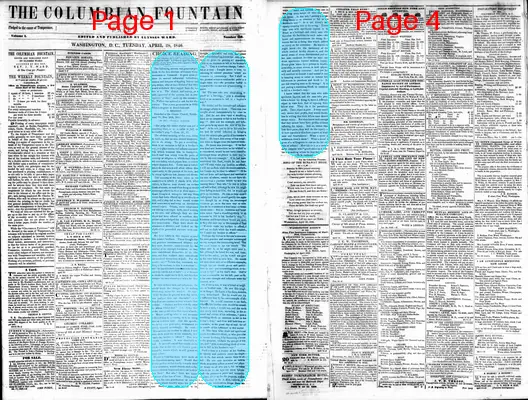
The Columbian Fountain
Washington, District Of Columbia
What is this article about?
A sermon by Rev. Charles Walker, based on Romans 14:13, argues against using or selling intoxicating liquors as they tempt others to moral and physical ruin, akin to placing a stumbling block in a brother's path. Preached in Brattleboro, VT, on Dec. 28, 1845, before a county election, sparking local controversy.
Merged-components note: Merging continuation of the temperance sermon 'A SERMON' by Rev. Charles Walker across pages 1 and 4; original label of the final segment changed from 'editorial' to 'literary' to match the essay/sermon style.
Clippings
1 of 2
OCR Quality
Full Text
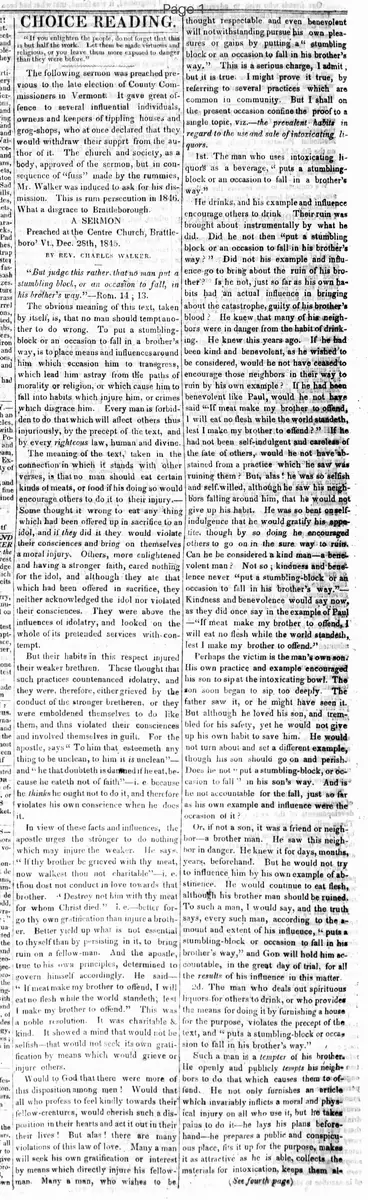
"If you enlighten the people, do not forget that this is but half the work. Let them be made virtuous and religious, or you leave them more exposed to danger than they were before."
The following sermon was preached previous to the late election of County Commissioners in Vermont. It gave great offence to several influential individuals—owners and keepers of tippling houses and grog-shops, who at once declared that they would withdraw their support from the author of it. The church and society, as a body, approved of the sermon, but in consequence of "fuss" made by the rummies, Mr. Walker was induced to ask for his dismissal. This is rum persecution in 1846. What a disgrace to Brattleborough
A SERMON
Preached at the Centre Church, Brattleboro' Vt., Dec. 28th, 1845.
BY REV. CHARLES WALKER.
"But judge this rather, that no man put a stumbling block, or an occasion to fall, in his brother's way." -Rom. 14:13.
The obvious meaning of this text, taken by itself, is, that no man should tempt another to do wrong. To put a stumbling-block or an occasion to fall in a brother's way, is to place means and influences around him which occasion him to transgress, which lead him astray from the paths of morality or religion, or which cause him to fall into habits which injure him, or crimes which disgrace him. Every man is forbidden to do that which will affect others thus injuriously, by the precept of the text, and by every righteous law, human and divine.
The meaning of the text, taken in the connection in which it stands with other verses, is that no man should eat certain kinds of meats, or food if his doing so would encourage others to do it to their injury.—Some thought it wrong to eat any thing which had been offered up in sacrifice to an idol, and if they did it they would violate their consciences and bring on themselves a moral injury. Others, more enlightened and having a stronger faith, cared nothing for the idol, and although they ate that which had been offered in sacrifice, they neither acknowledged the idol nor violated their consciences. They were above the influences of idolatry, and looked on the whole of its pretended services with contempt.
But their habits in this respect injured their weaker brethren. These thought that such practices countenanced idolatry, and they were, therefore, either grieved by the conduct of the stronger brethren, or they were emboldened themselves to do like them, and thus violated their consciences and involved themselves in guilt. For the apostle, says "To him that esteemeth any thing to be unclean, to him it is unclean" and "he that doubteth is damned if he eat, because he eateth not of faith"--i. e. because he thinks he ought not to do it, and therefore violates his own conscience when he does it.
In view of these facts and influences, the apostle urges the stronger to do nothing which may injure the weaker. He says, "If thy brother be grieved with thy meat, now walkest thou not charitably" i. e. thou dost not conduct in love towards that brother. "Destroy not him with thy meat for whom Christ died." i. e.--better forego thy own gratification than injure a brother. Better yield up what is not essential to thyself than by persisting in it, to bring ruin on a fellow-man. And the apostle, true to his own principles, determined to govern himself accordingly. He said-- "If meat make my brother to offend, I will eat no flesh while the world standeth; lest I make my brother to offend." This was a noble resolution. It was charitable & kind. It showed a mind that would not be selfish-that would not seek its own gratification by means which would grieve or injure others.
Would to God that there were more of this disposition among men! Would that all who profess to feel kindly towards their fellow-creatures, would cherish such a disposition in their hearts and act it out in their lives! But alas! there are many violations of this law of love. Many a man will seek his own gratification or interest by means which directly injure his fellow-man. Many a man, who wishes to be thought respectable and even benevolent will notwithstanding pursue his own pleasures or gains by putting a stumbling block or an occasion to fall in his brother's way." This is a serious charge, I admit but it is true. I might prove it true, by referring to several practices which are common in community. But I shall on the present occasion confine the proof to a single topic, viz.--the prevalent habits in regard to the use and sale of intoxicating liquors.
1st. The man who uses intoxicating liquors as a beverage, "puts a stumbling-block or an occasion to fall - in a brother's way"
He drinks, and his example and influence encourage others to drink Their ruin was brought about instrumentally by what he did. Did he not then "put a stumbling block or an occasion to fall in his brother's way?". Did not his example and influence go to bring about the ruin of his brother'? Is he not, just so far as his own habits had an actual influence in bringing about the catastrophe, guilty of his brother's blood? "He knew, that many of his neighbors were in danger from the habit of drinking. He knew this years ago. If he had been kind and benevolent, as he wished to be considered, would he not have ceased to encourage those neighbors in their way to ruin by his own example? If he had been benevolent like Paul, would he not have said "-If meat make my brother to offend I will eat no flesh while the world standeth, lest I make my brother to offend??" If he had not been self-indulgent and careless of the fate of others, would he not have abstained from a practice which he saw was ruining them? But, alas! he was so selfish and self-willed, although he saw his neighbors falling around him, that he would not give up his habit. He was so bent on self indulgence that he would gratify his appetite, though by so doing he encouraged others to go on in the sure way to ruin.
Can he be considered a kind man-a benevolent man? Not so; kindness and benevolence never "put a stumbling-block or an occasion to fall in his brother's way."
Kindness and benevolence would say now. as they did once say in the example of Paul —"If meat make my brother to offend, I will eat no flesh while the world standeth, lest I make my brother to offend."
Perhaps the victim is the man's own son? His own practice and example encouraged his son to sip at the intoxicating bowl. The son soon began to sip, too deeply. "The father saw it, or he might have seen it. But although he loved his son, and trembled for his safety, yet he would not give up his own habit to save him. He would not turn about and set a different example, though his son should go on and perish. Does he not "put a stumbling-block, or occasion to fall " in his son's way. And is he not accountable for the fall, just so far as his own example and influence were the occasion of it?
Or, if not a son, it was a friend or neighbor-a brother man. He saw this neighbor in danger. He knew it for days, months, years, beforehand. But he would not try to influence him by his own example of abstinence. He would continue to eat flesh, although his brother man should be ruined. To such a man, I would say, and the truth says, every such man, according to the amount and extent of his influence, "puts a stumbling-block or occasion to fall in his brother's way," and God will hold him accountable, in the great day of trial, for all the results of his influence in this matter.
2d. The man who deals out spirituous liquors for others to drink, or who provides the means for doing it by furnishing a house for the purpose, violates the precept of the text, and "puts a stumbling-block or occasion to fall in his brother's way."
Such a man is a tempter of his brother He openly and publicly tempts his neighbors to do that which causes them to offend. He not only furnishes an article which invariably inflicts a moral and physical injury on all who use it, but he takes pains to do it—he lays his plans beforehand—he prepares a public and conspicuous place, fits it up for the purpose, makes it as attractive as he is able, collects the materials for intoxication, keeps them ready. ways on hand, and spreads them out in tempting array before all who may enter his house. Is this not "putting a stumbling-block or an occasion to fall in his brother's way?" Is it not directly and openly tempting him to do wrong? Every man who sells spirituous liquors to be drunk as a beverage, and every man who furnishes the facilities for such sales—the house and appurtenances for doing it—knows that he is doing that which inflicts an injury on the consumer. He knows or might know—for the testimony of the whole medical faculty shows it, and the moral sense of every disinterested and sober man confirms it—that no man can drink spirituous liquors without injury. Every glass taken by a person in health, invariably, to some extent, is both physically and morally injurious. And yet he will continue to furnish it and spread it out in tempting array in order to induce his fellow-man to purchase and drink it. Is not this tempting men to do wrong? Is it not putting a stumbling-block or occasion to fall in a brother's way?
I know indeed that the man who sells spirituous liquors, and the man who provides a house for doing it, have a different object in view from that of injuring their fellow men. They do it for pecuniary profit. Their object is gain. If they could only secure their profits, they would doubtless be willing that their fellow men should escape injury. But they know well enough that they cannot have their profits without inflicting the injury. And so, rather than lose their gains, they will do the injury.—O how opposite is this from a spirit of kindness and benevolence! What a spirit of selfishness does it show! What a proof it gives of a willingness to rise on the fall and ruin of others! How like is it to a certain other tempter who "goeth about as a roaring lion seeking whom he may devour!"
(To be continued.)
What sub-type of article is it?
What themes does it cover?
What keywords are associated?
What entities or persons were involved?
Literary Details
Title
A Sermon
Author
By Rev. Charles Walker.
Subject
Preached Previous To The Late Election Of County Commissioners In Vermont; On The Use And Sale Of Intoxicating Liquors
Key Lines