Thank you for visiting SNEWPapers!
Sign up free
Gazette Of The United States, & Philadelphia Daily Advertiser
Philadelphia, Philadelphia County, Pennsylvania
What is this article about?
U.S. House of Representatives proceedings on March 16: petitions for compensation referred; reports on post-offices and Indian maintenance noted; extensive debate and passage of naval armament appropriation bill with amendments totaling over $279,000; resolution on naval materials adopted; debt relief bill amended and recommitted; enrolled bills reported.
Clipping
OCR Quality
Full Text
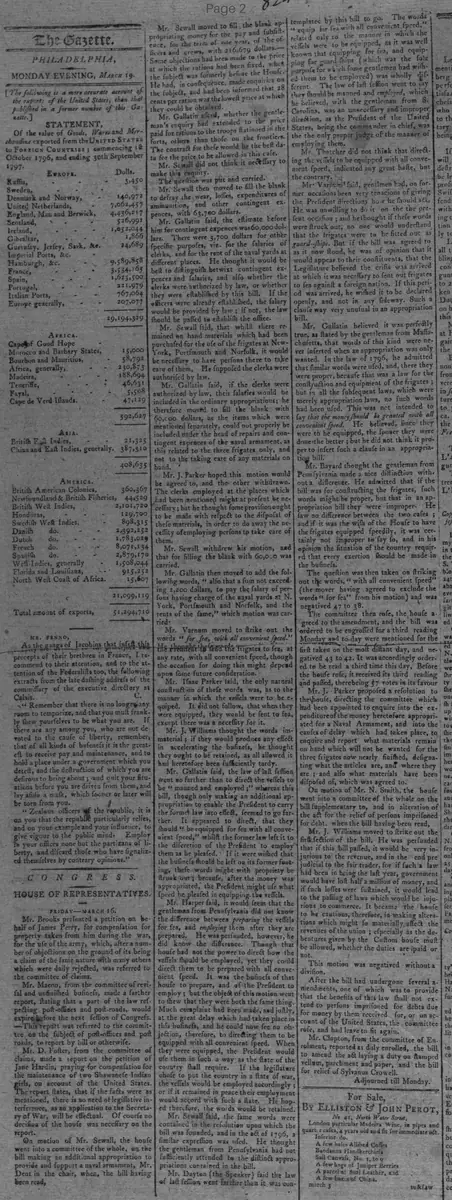
HOUSE OF REPRESENTATIVES.
FRIDAY—MARCH 16.
Mr. Brooks presented a petition on behalf of James Perry, for compensation for property taken from him during the war, for the use of the army, which, after a number of objections on the ground of its being a claim of the same nature with many others which were daily rejected, was referred to the committee of claims.
Mr. Macon, from the committee of revisal and unfinished business, made a farther report, stating that a part of the law respecting post-offices and post-roads, would expire before the next session of Congress.—This report was referred to the committee on the subject of post-offices and post roads, to report by bill or otherwise.
Mr. D. Foster, from the committee of claims, made a report on the petition of Jane Hardin, praying for compensation for the maintenance of two Shawanee Indian girls, on account of the United States. The report states, that if the facts were as mentioned, there is no need of legislative interference, as an application to the Secretary of War, will be effectual. Of course no decision of the house was necessary on the report.
On motion of Mr. Sewall, the house went into a committee of the whole, on the bill making an additional appropriation to provide and support a naval armament, Mr. Dent in the chair, when, the bill having been read,
Mr. Sewall moved to fill the blank appropriating money for the pay and subsistence, for the term of one year, of the officers and crews, with 216,679 dollars.—
Some objections had been made to the price at which the rations had been fixed, when the subject was formerly before the House. He had, in consequence, made enquiries on the subject, and had been informed that 28 cents per ration was the lowest price at which they could be obtained. Mr. Gallatin asked, whether the gentleman's enquiry had extended to the price paid for rations to the troops stationed in the forts, others than those on the frontiers. The contract for these would be the best data for the price to be allowed in this case. Mr. Sewall did not think it necessary to make this enquiry. The question was put and carried.
Mr. Sewall then moved to fill the blank to defray the wear, loss, expenditures of ammunition, and other contingent expenses, with 63,700 dollars.
Mr. Gallatin said, the estimate before him for contingent expenses was 60,000 dollars. There were 3,700 dollars for other specific purposes, viz. for the salaries of clerks, and for the rent of the naval yards at different places. He thought it would be best to distinguish betwixt contingent expenses and salaries, and also whether the clerks were authorized by law, or whether they were established by this bill. If the officers were already established, the salary would be provided by law; if not, the law should be passed to establish the office.
Mr. Sewall said, that whilst there remained on hand materials which had been purchased for the use of the frigates at New-York, Portsmouth and Norfolk, it would be necessary to have persons there to take care of them, He supposed the clerks were authorised by law.
Mr. Gallatin said, if the clerks were authorized by law, their salaries would be included in the ordinary appropriations; he therefore moved to fill the blank with 60,000 dollars, as the items which were mentioned separately, could not properly be included under the head of repairs and contingent expenses of the naval armament, as this related to the three frigates only, and not to the taking care of any materials on hand.
Mr. J. Parker hoped this motion would be agreed to, and the other withdrawn. The clerks employed at the places which had been mentioned might at present be necessary; but he thought some provision ought to be made with respect to the disposal of these materials, in order to do away the necessity of employing persons to take care of them.
Mr. Sewall withdrew his motion, and that for filling the blank with 60,000 was carried.
Mr. Gallatin then moved to add the following words, "also that a sum not exceeding 2,700 dollars, to pay the salary of persons having charge of the naval yards at N. York, Portsmouth and Norfolk, and the rents of the same," which motion was carried—
Mr. Varnum moved to strike out the words "for sea, with all convenient speed."
He thought these words the President to send the frigates to sea, at any rate, with all convenient speed, though the occasion for doing this might depend upon some future consideration.
Mr. Isaac Parker said, the only natural construction of these words was, as to the manner in which the vessels were to be equipped. It did not follow, that when they were equipped, they would be sent to sea, except there was a necessity for it.
Mr. I. Williams thought the words immaterial; if they would produce any effect in accelerating the business, he thought they ought to be retained, as all allowed it had heretofore been sufficiently tardy.
Mr. Gallatin said, the law of last session went no farther than to direct the vessels to be "manned and employed;" whereas this bill, though only making an additional appropriation to enable the President to carry the former law into effect, seemed to go farther. It appeared to direct, that they should "be equipped for sea with all convenient speed," whilst the former law left it to the discretion of the President to employ them as he pleased. If it were wished that the business should be left on its former footing, these words might with propriety be struck out; because, after the money was appropriated, the President might use what speed he pleased in equipping the vessels.
Mr. Harper said, it would seem that the gentleman from Pennsylvania did not know the difference between preparing the vessels for sea, and employing them after they are prepared. He was persuaded, however, he did know the difference. Though that house had not the power to direct how the vessels should be employed, yet they could direct them to be prepared with all convenient speed. It was the business of that house to prepare, and of the President to employ; but the object of this motion went to shew that they were both the same thing. Much complaint had been made, and justly, at the great delay which had taken place in this business, and he could now see no objection, therefore, to directing them to be equipped with all convenient speed. When they were equipped, the President would use them in such a way as the state of the country shall require. If the legislature chose to put the country in a state of war, the vessels would be employed accordingly; or if it remained in peace their employment would accord with such a state. He hoped therefore, the words would be retained.
Mr. Sewall said, the same words were contained in the resolution upon which the bill was founded, and in the act of 1796, a similar expression was used. He thought the gentleman from Pennsylvania had not sufficiently attended to the distinct appropriations contained in the bill.
Mr. Dayton (the Speaker) said the law of last session went farther than it was contemplated by this bill to go. The words "equip for sea with all convenient speed," related only to the manner in which the vessels were to be equipped, as it was well known that equipping for sea, and equipping for guard-ships (which was the sole purpose for which some gentlemen had wished them to be employed) was wholly different. The law of last session went to say they should be manned and employed, which he believed, with the gentleman from S. Carolina, was an unnecessary and improper direction, as the President of the United States, being the commander in chief, was the only proper judge of the manner of employing them.
Mr. Thatcher did not think that directing the vessels to be equipped with all convenient speed, indicated any great haste, but the contrary:
Mr. Varnum said, gentlemen had, on former occasions been very tenacious of giving the President directions how he should act, He was unwilling to do it on the present occasion; and he thought if these words were struck out, no one would understand that the frigates were to be fitted out as guard-ships. But if the bill was agreed to as it now stood, he was of opinion that it would appear to their constituents, that the Legislature believed the crisis was arrived at which it was necessary to send out frigates to sea against a foreign nation. If this period was arrived, he wished it to be declared openly, and not in any sideway. Such a clause was very unusual in an appropriation bill.
Mr. Gallatin believed it was perfectly true, as stated by the gentleman from Massachusetts, that words of this kind were never inserted when an appropriation was only wanted. In the law of 1796, he admitted that similar words were used, and, there they were proper, because that was a law for the construction and equipment of the frigates; but in all the subsequent laws, which were merely appropriation laws, no such words had been used. This was not intended to say that the money should be granted with all convenient speed. He believed, since they were to be equipped, the sooner they were done the better; but he did not think it proper to insert such a clause in an appropriation bill.
Mr. Bayard thought the gentleman from Pennsylvania made a nice distinction without a difference. He admitted that if the bill was for constructing the frigates, such words might be proper, but that in an appropriation bill they were improper. He saw no difference between the two cases; and if it was the wish of the House to have the frigates equipped speedily, it was certainly not improper to say so, and in his opinion the situation of the country required that every exertion should be made in the business.
The question was then taken on striking out the words, "with all convenient speed" (the mover having agreed to exclude the words "for sea" from his motion) and was negatived 47 to 38.
The committee then rose, the house agreed to the amendment, and the bill was ordered to be engrossed for a third reading
Monday and to-day were mentioned for the first taken on the most distant day, and negatived 43 to 42. It was accordingly ordered to be read a third time this day, Before the house rose, it received its third reading and passed, there being 57 votes in its favour
Mr. J. Parker proposed a resolution to the house, directing the committee which had been appointed to enquire into the expenditure of the money heretofore appropriated for a Naval Armament, and into the causes of delay which had taken place, to enquire and report what materials remain on hand which will not be wanted for the three frigates now nearly finished, designating what the articles are, and where they are; and also what materials have been disposed of, which was agreed to.
On motion of Mr. N. Smith, the house went into a committee of the whole on the bill supplementary to, and in alteration of the act for the relief of persons imprisoned for debt. when the bill having been read,
Mr. J. Williams moved to strike out the first section of the bill, He was persuaded that if this bill passed, it would be very injurious to the revenue, and in the end prejudicial to the fair trader, for if such a law had been in being the last year, government would have lost half a million of money, and if such loss were sustained, it would lead to the passing of laws which would be injurious to commerce. It became the house to be cautious, therefore, in making alterations which might so materially affect the revenues of the union; especially as the debentures given by the Custom house must be allowed, whether the duties are paid or not.
This motion was negatived without a division.
After the bill had undergone several amendments, one of which was to provide that the benefits of this law shall not extend to persons imprisoned for debts due for money by them received for, or on account of the United States, the committee rose, and had leave to sit again.
Mr. Clopton, from the committee of Enrolment, reported as duly enrolled, the bill to amend the act laying a duty on stamped vellum, parchment and paper, and the bill for relief of Sylvanus Crowell.
Adjourned till Monday.
What sub-type of article is it?
What keywords are associated?
What entities or persons were involved?
Domestic News Details
Event Date
Friday—March 16
Key Persons
Outcome
the naval appropriation bill passed with amendments, including $216,679 for pay and subsistence and $60,000 for contingent expenses plus $2,700 for salaries and rents. the debt relief bill underwent amendments and was recommitted. other reports and petitions were referred or noted without further action.
Event Details
The House considered petitions for compensation, reports on post-offices, maintenance of Shawanee Indian girls, and debated and amended a bill for additional naval appropriation, passing it. A resolution was agreed to inquire into naval materials. The supplementary bill for relief of imprisoned debtors was debated and amended. Enrolled bills were reported.