Thank you for visiting SNEWPapers!
Sign up free
Story
October 17, 1922
The North Platte Semi Weekly Tribune
North Platte, Lincoln County, Nebraska
What is this article about?
Nebraska mechanic Noel Bullock wins the 1922 Pike's Peak auto race in a $400 junk-assembled flivver, defeating elite drivers and fancy cars on the treacherous 12.5-mile course with 147 curves up to 14,109 feet.
Clipping
OCR Quality
95%
Excellent
Full Text
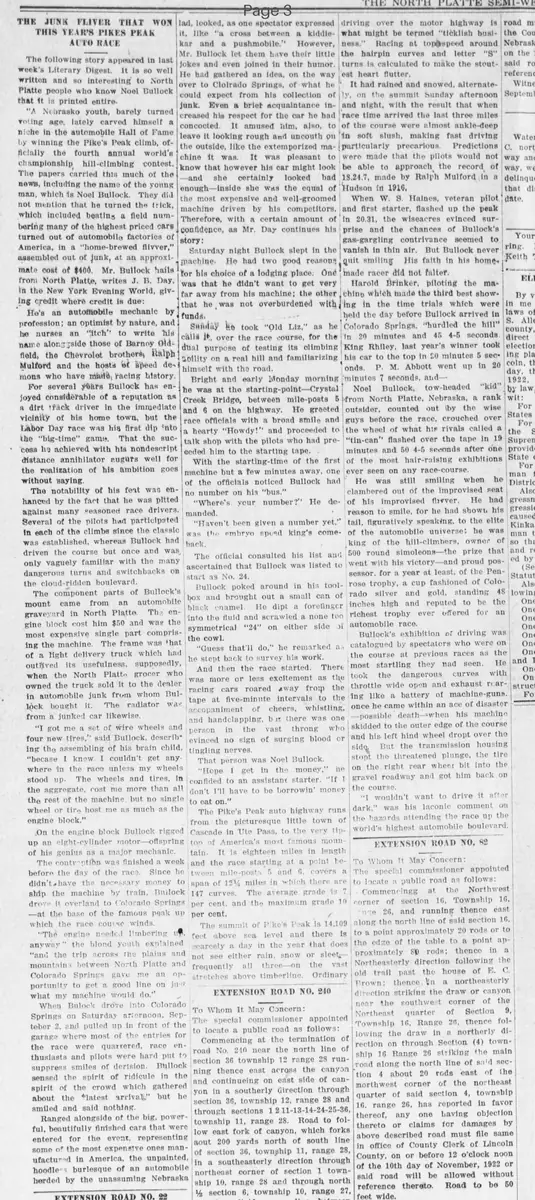
THE JUNK FLIVVER THAT WON
THIS YEAR'S PIKES PEAK AUTO RACE
The following story appeared in last week's Literary Digest. It is so well written and so interesting to North Platte people who know Noel Bullock that it is printed entire.
"A Nebraska youth, barely turned voting age, lately carved himself a niche in the automobile Hall of Fame by winning the Pike's Peak climb, officially the fourth annual world's championship hill-climbing contest.
The papers carried this much of the news, including the name of the young man, which is Noel Bullock. They did not mention that he turned the trick, which included beating a field numbering many of the highest priced cars turned out of automobile factories of America, in a "home-brewed flivver," assembled out of junk, at an approximate cost of $400. Mr. Bullock hails from North Platte, writes J. B. Day in the New York Evening World, giving credit where credit is due:
He's an automobile mechanic by profession; an optimist by nature, and he nurses an itch to write his name alongside those of Barney Oldfield, the Chevrolet brothers, Ralph Mulford and the hosts of speed demons who have made racing history.
For several years Bullock has enjoyed considerable of a reputation as a dirt track driver in the immediate vicinity of his home town, but the Labor Day race was his first dip into the "big-time" game. That the success he achieved with his nondescript distance annihilator augurs well for the realization of his ambition goes without saying.
The notability of his feat was enhanced by the fact that he was pitted against many seasoned race drivers. Several of the pilots had participated in each of the climbs since the classic was established, whereas Bullock had driven the course but once and was only vaguely familiar with the many dangerous turns and switchbacks on the cloud-ridden boulevard.
The component parts of Bullock's mount came from an automobile graveyard in North Platte. The engine block cost him $50 and was the most expensive single part comprising the machine. The frame was that of a light delivery truck which had outlived its usefulness, supposedly, when the North Platte grocer who owned the truck sold it to the dealer in automobile junk from whom Bullock bought it. The radiator was from a junked car likewise.
"I got me a set of wire wheels and four new tires," said Bullock, describing the assembling of his brain child. "because I know I couldn't get anywhere in the race unless my wheels stood up. The wheels and tires, in the aggregate, cost me more than all the rest of the machine, but no single wheel or tire cost me as much as the engine block."
On the engine block Bullock rigged up an eight-cylinder motor-offspring of his genius as a major mechanic. The contraption was finished a week before the day of the race. Since he didn't have the necessary money to ship the machine by train, Bullock drove it overland to Colorado Springs—at the base of the famous peak up which the race course winds.
"The engine needed limbering up anyway," the blond youth explained, "and the trip across the plains and mountains between North Platte and Colorado Springs gave me an opportunity to get a good line on just what my machine would do."
When Bullock drove into Colorado Springs on Saturday afternoon, September 2, and pulled up in front of the garage where most of the entries for the race were quartered, race enthusiasts and pilots were hard put to suppress smiles of derision. Bullock sensed the spirit of ridicule in the spirit of the crowd which gathered about the "latest arrival," but he smiled and said nothing.
Ranged alongside of the big, powerful, beautifully finished cars that were entered for the event, representing some of the most expensive ones manufactured in America, the unpainted, hoodless burlesque of an automobile herded by the unassuming Nebraska lad, looked, as one spectator expressed it, like "a cross between a kiddie-kar and a pushmobile." However, Mr. Bullock let them have their little jokes and even joined in their humor.
He had gathered an idea, on the way over to Colorado Springs, of what he could expect from his collection of junk. Even a brief acquaintance increased his respect for the car he had concocted. It amused him, also, to leave it looking rough and uncouth on the outside, like the extemporized machine it was.
It was pleasant to know that however his car might look—and she certainly looked bad enough—inside she was the equal of the most expensive and well-groomed machine driven by his competitors.
Therefore, with a certain amount of confidence, as Mr. Day continues his story:
Saturday night Bullock slept in the machine. He had two good reasons for his choice of a lodging place. One was that he didn't want to get very far away from his machine; the other that he was not overburdened with funds.
Sunday he took "Old Liz," as he calls it, over the race course, for the dual purpose of testing its climbing ability on a real hill and familiarizing himself with the road.
Bright and early Monday morning he was at the starting-point—Crystal Creek Bridge, between mile-posts 5 and 6 on the highway. He greeted race officials with a broad smile and a hearty "Howdy!" and proceeded to talk shop with the pilots who had preceded him to the starting tape.
With the starting-time of the first machine but a few minutes away, one of the officials noticed Bullock had no number on his "bus."
"Where's your number?" he demanded.
"Haven't been given a number yet," was the embryo speed king's come-back.
The official consulted his list and ascertained that Bullock was listed to start as No. 24.
Bullock poked around in his tool-box and brought out a small can of black enamel. He dipped a forefinger into the fluid and scrawled a none too symmetrical "24" on either side of the cowl.
"Guess that'll do," he remarked as he stepped back to survey his work.
And then the race started. There was more or less excitement as the racing cars roared away from the tape at five-minute intervals to the accompaniment of cheers, whistling and handclapping. But there was one person in the vast throng who evinced no sign of surging blood or tingling nerves.
That person was Noel Bullock.
"Hope I get in the money," he confided to an assistant starter. "If I don't I'll have to be borrowin' money to eat on."
The Pike's Peak auto highway runs from the picturesque little town of Cascade in Ute Pass, to the very tip-top of America's most famous mountain. It is eighteen miles in length and the race starting at a point between mile-posts 5 and 6, covers a span of 12½ miles in which there are 147 curves. The average grade is 7 per cent. and the maximum grade 10 per cent.
The summit of Pike's Peak is 14,109 feet above sea level and there is scarcely a day in the year that does not see either rain, snow or sleet—frequently all three—on the vast stretches above timberline. Ordinary driving over the motor highway is what might be termed "ticklish business."
Racing at top speed around the hairpin curves and letter "S" turns is calculated to make the stoutest heart flutter.
It had rained and snowed, alternately, on the summit Sunday afternoon and night, with the result that when race time arrived the last three miles of the course were almost ankle-deep in soft slush, making fast driving particularly precarious.
Predictions were made that the pilots would not be able to approach the record of 18:24.7, made by Ralph Mulford in a Hudson in 1916.
When W. S. Haines, veteran pilot and first starter, flashed up the peak in 20:31, the wiseacres evinced surprise and the chances of Bullock's gas-gargling contrivance seemed to vanish in thin air. But Bullock never quit smiling. His faith in his home-made racer did not falter.
Harold Brinker, piloting the machine which made the third best showing in the time trials which were held the day before Bullock arrived in Colorado Springs, "hurdled the hill" in 20 minutes and 45 4-5 seconds.
King Riley, last year's winner took his car to the top in 20 minutes 5 seconds. P. M. Abbott went up in 20 minutes 7 seconds. And Noel Bullock, tow-headed "kid" from North Platte, Nebraska, a rank outsider, counted out by the wise guys before the race, crouched over the wheel of what his rivals called a "tin-can" flashed over the tape in 19 minutes and 50 4-5 seconds after one of the most hair-raising exhibitions ever seen on any race-course.
He was still smiling when he clambered out of the improvised seat of his improvised flivver.
He had reason to smile, for he had shown his tail, figuratively speaking, to the elite of the automobile universe: he was king of the hill-climbers, owner of 500 round simoleons—the prize that went with his victory—and proud possessor, for a year at least, of the Penrose trophy, a cup fashioned of Colorado silver and gold, standing 48 inches high and reputed to be the richest trophy ever offered for an automobile race.
Bullock's exhibition of driving was catalogued by spectators who were on the course at previous races as the most startling they had seen.
He took the dangerous curves with throttle wide open and exhaust roaring like a battery of machine-guns.
Once he came within an ace of disaster—possible death—when his machine skidded to the outer edge of the course and his left hind wheel dropped over the side.
But the transmission housing stopped the threatened plunge, the tire on the right rear wheel bit into the gravel roadway and got him back on the course.
"I wouldn't want to drive it after dark," was his laconic comment on the hazards attending the race up the world's highest automobile boulevard.
THIS YEAR'S PIKES PEAK AUTO RACE
The following story appeared in last week's Literary Digest. It is so well written and so interesting to North Platte people who know Noel Bullock that it is printed entire.
"A Nebraska youth, barely turned voting age, lately carved himself a niche in the automobile Hall of Fame by winning the Pike's Peak climb, officially the fourth annual world's championship hill-climbing contest.
The papers carried this much of the news, including the name of the young man, which is Noel Bullock. They did not mention that he turned the trick, which included beating a field numbering many of the highest priced cars turned out of automobile factories of America, in a "home-brewed flivver," assembled out of junk, at an approximate cost of $400. Mr. Bullock hails from North Platte, writes J. B. Day in the New York Evening World, giving credit where credit is due:
He's an automobile mechanic by profession; an optimist by nature, and he nurses an itch to write his name alongside those of Barney Oldfield, the Chevrolet brothers, Ralph Mulford and the hosts of speed demons who have made racing history.
For several years Bullock has enjoyed considerable of a reputation as a dirt track driver in the immediate vicinity of his home town, but the Labor Day race was his first dip into the "big-time" game. That the success he achieved with his nondescript distance annihilator augurs well for the realization of his ambition goes without saying.
The notability of his feat was enhanced by the fact that he was pitted against many seasoned race drivers. Several of the pilots had participated in each of the climbs since the classic was established, whereas Bullock had driven the course but once and was only vaguely familiar with the many dangerous turns and switchbacks on the cloud-ridden boulevard.
The component parts of Bullock's mount came from an automobile graveyard in North Platte. The engine block cost him $50 and was the most expensive single part comprising the machine. The frame was that of a light delivery truck which had outlived its usefulness, supposedly, when the North Platte grocer who owned the truck sold it to the dealer in automobile junk from whom Bullock bought it. The radiator was from a junked car likewise.
"I got me a set of wire wheels and four new tires," said Bullock, describing the assembling of his brain child. "because I know I couldn't get anywhere in the race unless my wheels stood up. The wheels and tires, in the aggregate, cost me more than all the rest of the machine, but no single wheel or tire cost me as much as the engine block."
On the engine block Bullock rigged up an eight-cylinder motor-offspring of his genius as a major mechanic. The contraption was finished a week before the day of the race. Since he didn't have the necessary money to ship the machine by train, Bullock drove it overland to Colorado Springs—at the base of the famous peak up which the race course winds.
"The engine needed limbering up anyway," the blond youth explained, "and the trip across the plains and mountains between North Platte and Colorado Springs gave me an opportunity to get a good line on just what my machine would do."
When Bullock drove into Colorado Springs on Saturday afternoon, September 2, and pulled up in front of the garage where most of the entries for the race were quartered, race enthusiasts and pilots were hard put to suppress smiles of derision. Bullock sensed the spirit of ridicule in the spirit of the crowd which gathered about the "latest arrival," but he smiled and said nothing.
Ranged alongside of the big, powerful, beautifully finished cars that were entered for the event, representing some of the most expensive ones manufactured in America, the unpainted, hoodless burlesque of an automobile herded by the unassuming Nebraska lad, looked, as one spectator expressed it, like "a cross between a kiddie-kar and a pushmobile." However, Mr. Bullock let them have their little jokes and even joined in their humor.
He had gathered an idea, on the way over to Colorado Springs, of what he could expect from his collection of junk. Even a brief acquaintance increased his respect for the car he had concocted. It amused him, also, to leave it looking rough and uncouth on the outside, like the extemporized machine it was.
It was pleasant to know that however his car might look—and she certainly looked bad enough—inside she was the equal of the most expensive and well-groomed machine driven by his competitors.
Therefore, with a certain amount of confidence, as Mr. Day continues his story:
Saturday night Bullock slept in the machine. He had two good reasons for his choice of a lodging place. One was that he didn't want to get very far away from his machine; the other that he was not overburdened with funds.
Sunday he took "Old Liz," as he calls it, over the race course, for the dual purpose of testing its climbing ability on a real hill and familiarizing himself with the road.
Bright and early Monday morning he was at the starting-point—Crystal Creek Bridge, between mile-posts 5 and 6 on the highway. He greeted race officials with a broad smile and a hearty "Howdy!" and proceeded to talk shop with the pilots who had preceded him to the starting tape.
With the starting-time of the first machine but a few minutes away, one of the officials noticed Bullock had no number on his "bus."
"Where's your number?" he demanded.
"Haven't been given a number yet," was the embryo speed king's come-back.
The official consulted his list and ascertained that Bullock was listed to start as No. 24.
Bullock poked around in his tool-box and brought out a small can of black enamel. He dipped a forefinger into the fluid and scrawled a none too symmetrical "24" on either side of the cowl.
"Guess that'll do," he remarked as he stepped back to survey his work.
And then the race started. There was more or less excitement as the racing cars roared away from the tape at five-minute intervals to the accompaniment of cheers, whistling and handclapping. But there was one person in the vast throng who evinced no sign of surging blood or tingling nerves.
That person was Noel Bullock.
"Hope I get in the money," he confided to an assistant starter. "If I don't I'll have to be borrowin' money to eat on."
The Pike's Peak auto highway runs from the picturesque little town of Cascade in Ute Pass, to the very tip-top of America's most famous mountain. It is eighteen miles in length and the race starting at a point between mile-posts 5 and 6, covers a span of 12½ miles in which there are 147 curves. The average grade is 7 per cent. and the maximum grade 10 per cent.
The summit of Pike's Peak is 14,109 feet above sea level and there is scarcely a day in the year that does not see either rain, snow or sleet—frequently all three—on the vast stretches above timberline. Ordinary driving over the motor highway is what might be termed "ticklish business."
Racing at top speed around the hairpin curves and letter "S" turns is calculated to make the stoutest heart flutter.
It had rained and snowed, alternately, on the summit Sunday afternoon and night, with the result that when race time arrived the last three miles of the course were almost ankle-deep in soft slush, making fast driving particularly precarious.
Predictions were made that the pilots would not be able to approach the record of 18:24.7, made by Ralph Mulford in a Hudson in 1916.
When W. S. Haines, veteran pilot and first starter, flashed up the peak in 20:31, the wiseacres evinced surprise and the chances of Bullock's gas-gargling contrivance seemed to vanish in thin air. But Bullock never quit smiling. His faith in his home-made racer did not falter.
Harold Brinker, piloting the machine which made the third best showing in the time trials which were held the day before Bullock arrived in Colorado Springs, "hurdled the hill" in 20 minutes and 45 4-5 seconds.
King Riley, last year's winner took his car to the top in 20 minutes 5 seconds. P. M. Abbott went up in 20 minutes 7 seconds. And Noel Bullock, tow-headed "kid" from North Platte, Nebraska, a rank outsider, counted out by the wise guys before the race, crouched over the wheel of what his rivals called a "tin-can" flashed over the tape in 19 minutes and 50 4-5 seconds after one of the most hair-raising exhibitions ever seen on any race-course.
He was still smiling when he clambered out of the improvised seat of his improvised flivver.
He had reason to smile, for he had shown his tail, figuratively speaking, to the elite of the automobile universe: he was king of the hill-climbers, owner of 500 round simoleons—the prize that went with his victory—and proud possessor, for a year at least, of the Penrose trophy, a cup fashioned of Colorado silver and gold, standing 48 inches high and reputed to be the richest trophy ever offered for an automobile race.
Bullock's exhibition of driving was catalogued by spectators who were on the course at previous races as the most startling they had seen.
He took the dangerous curves with throttle wide open and exhaust roaring like a battery of machine-guns.
Once he came within an ace of disaster—possible death—when his machine skidded to the outer edge of the course and his left hind wheel dropped over the side.
But the transmission housing stopped the threatened plunge, the tire on the right rear wheel bit into the gravel roadway and got him back on the course.
"I wouldn't want to drive it after dark," was his laconic comment on the hazards attending the race up the world's highest automobile boulevard.
What sub-type of article is it?
Personal Triumph
Adventure
What themes does it cover?
Triumph
Bravery Heroism
What keywords are associated?
Pikes Peak Race
Noel Bullock
Junk Flivver
Hill Climb Victory
Automobile Race
What entities or persons were involved?
Noel Bullock
Where did it happen?
Pike's Peak, Colorado Springs, North Platte, Nebraska
Story Details
Key Persons
Noel Bullock
Location
Pike's Peak, Colorado Springs, North Platte, Nebraska
Event Date
September 4, 1922 (Race On Monday Following Saturday September 2)
Story Details
Nebraska youth Noel Bullock wins the fourth annual Pike's Peak hill-climbing race in a homemade flivver assembled from junk parts costing about $400, beating high-priced cars driven by experienced racers.