Thank you for visiting SNEWPapers!
Sign up free
Alexandria Daily Advertiser
Alexandria, Virginia
What is this article about?
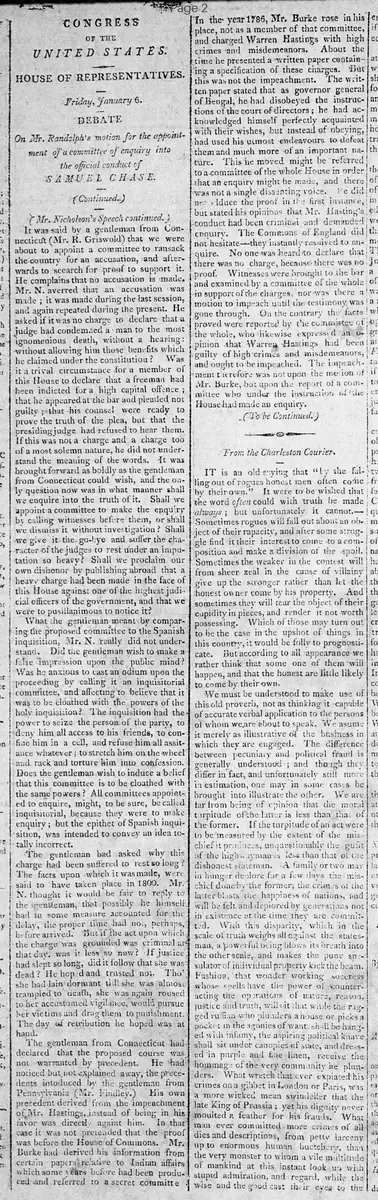
In the U.S. House of Representatives on January 6, Mr. Nicholson continues his speech defending a motion to appoint a committee investigating Judge Samuel Chase's alleged misconduct in denying a defendant a fair hearing in a capital case. He refutes claims of no accusation or improper precedent, emphasizing the need for justice.
Clipping
OCR Quality
Full Text
OF THE
UNITED STATES.
HOUSE OF REPRESENTATIVES.
Friday, January 6.
DEBATE
On Mr. Randolph's motion for the appointment of a committee of enquiry into
the official conduct of
SAMUEL CHASE.
(Continued.)
Mr. Nicholson's Speech continued.
It was said by a gentleman from Connecticut (Mr. R. Griswold) that we were
about to appoint a committee to ransack
the country for an accusation, and afterwards to search for proof to support it.
He complains that no accusation is made.
Mr. N. averred that an accusation was
made; it was made during the last session,
and again repeated during the present. He
asked if it was no charge to declare that a
judge had condemned a man to the most
ignominious death, without a hearing:
without allowing him those benefits which
he claimed under the constitution? Was
it a trivial circumstance for a member of
this House to declare that a freeman had
been indicted for a high capital offence;
that he appeared at the bar and pleaded not
guilty; that his counsel were ready to
prove the truth of the plea, but that the
presiding judge had refused to hear them.
If this was not a charge and a charge too
of a most solemn nature, he did not understand the meaning of the words. It was
brought forward as boldly as the gentleman
from Connecticut could wish, and the only question now was in what manner shall
we enquire into the truth of it. Shall we
appoint a committee to make the enquiry
by calling witnesses before them, or shall
we dismiss it without investigation? Shall
we give it the go-by and suffer the cha-
racter of the judges to rest under an impu-
tation so heavy? Shall we proclaim our
own dishonor by publishing abroad that a
heavy charge had been made in the face of
this House against one of the highest judi-
cial officers of the government, and that we
were too pusillanimous to notice it?
What the gentleman meant by compar-
ing the proposed committee to the Spanish
inquisition, Mr. N. really did not under-
stand. Did the gentleman wish to make a
false impression upon the public mind?
Was he anxious to cast an odium upon the
proceeding by calling it an inquisitorial
committee, and affecting to believe that it
was to be clothed with the powers of the
holy inquisition? The inquisition had the
power to seize the person of the party, to
deny him all access to his friends, to con-
fine him in a cell, and refuse him all assit-
ance whatever; to stretch him on the wheel
and rack and torture him into confession.
Does the gentleman wish to induce a belief
that this committee is to be clothed with
the same powers? All committees appoint-
ed to enquire, might, to be sure, be called
inquisitorial, because they were to make
enquiry; but the epithet of Spanish inqui-
sition, was intended to convey an idea to-
tally incorrect.
The gentleman had asked why this
charge had been suffered to rest so long?
The facts upon which it was made, were
said to have taken place in 1800. Mr.
N. thought it would be fair to reply to
the gentleman, that possibly he himself
had in some measure accounted for the
delay, the proper time had not, perhaps,
be fore arrived. But if the act upon which.
the charge was grounded was criminal at
that day, was it less so now? If justice
had slept so long, did it follow that she was
dead? He hoped and trusted not. Though
she had lain dormant till she was almost
trampled to death, she was again roused
to her accustomed vigilance, would pursue
her victims and drag them to punishment.
The day of retribution he hoped was at
hand.
The gentleman from Connecticut had.
declared that the proposed course was
not warranted by precedent. He had
noticed but not explained away, the prece-
dents introduced by the gentleman from
Pennsylvania (Mr. Findley.) His own
precedent derived from the impeachment
of Mr. Hastings, instead of being in his
favor was directly against him. In that
case it was not pretended that the proof
was before the House of Commons. Mr.
Burke had derived his information from
certain papers relative to Indian affairs
which some years before had been produ-
ced and referred to a secret committee
What sub-type of article is it?
What themes does it cover?
What keywords are associated?
What entities or persons were involved?
Where did it happen?
Story Details
Key Persons
Location
House Of Representatives, United States Congress
Event Date
Friday, January 6
Story Details
Mr. Nicholson defends the motion to investigate Judge Samuel Chase for allegedly denying a defendant a fair hearing in a capital trial in 1800, refuting claims of no accusation, improper methods, and lack of precedent, urging the House to appoint a committee for inquiry.