Thank you for visiting SNEWPapers!
Sign up free
Imperial Valley Press
El Centro, Imperial County, California
What is this article about?
Gen. John J. Pershing, from Walter Reed Hospital, urges Congress on Sept. 13 to increase the U.S. Army to full peacetime strength, endorsing President Roosevelt's order for 104,000 more troops and criticizing current forces as a 'skeleton' of 1920 levels.
Clipping
OCR Quality
Full Text
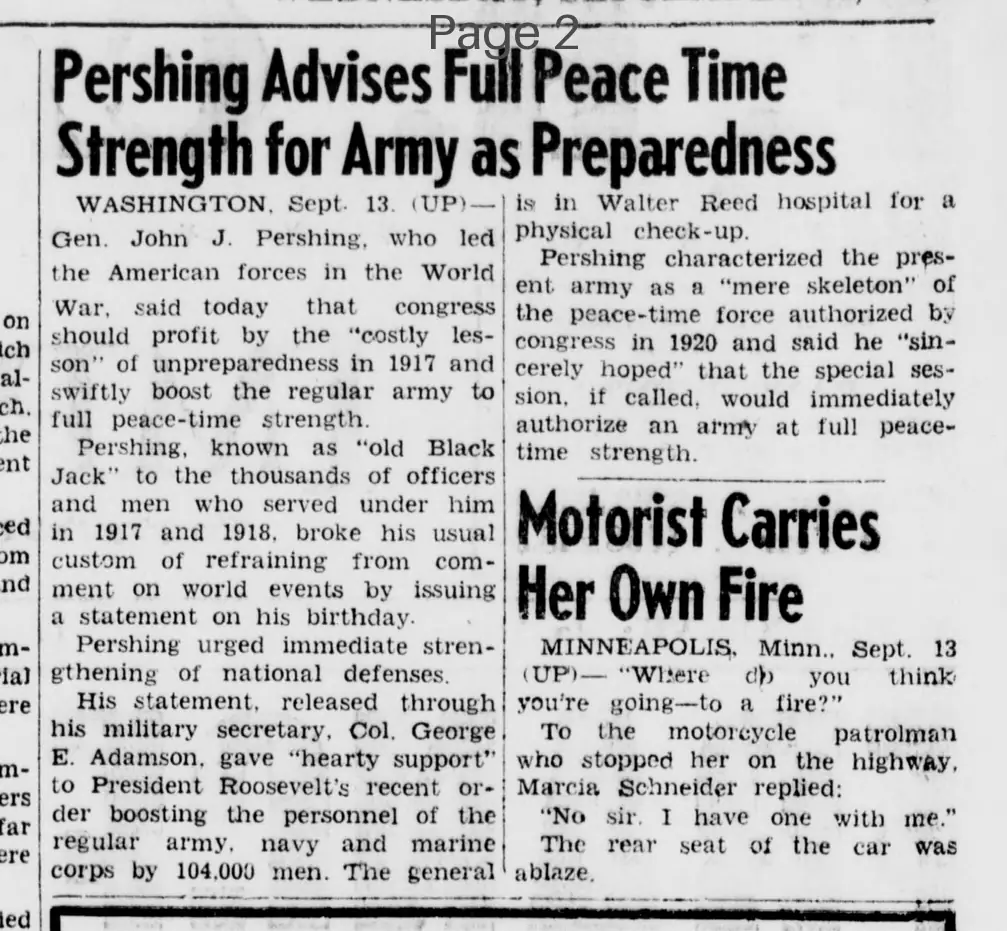
WASHINGTON, Sept. 13 (UP).—Gen. John J. Pershing, who led the American forces in the World War, said today that congress should profit by the 'costly lesson' of unpreparedness in 1917 and swiftly boost the regular army to full peace-time strength.
Pershing, known as 'old Black Jack' to the thousands of officers and men who served under him in 1917 and 1918, broke his usual custom of refraining from comment on world events by issuing a statement on his birthday.
Pershing urged immediate strengthening of national defenses. His statement, released through his military secretary, Col. George E. Adamson, gave 'hearty support' to President Roosevelt's recent order boosting the personnel of the regular army, navy and marine corps by 104,000 men.
The general is in Walter Reed hospital for a physical check-up.
Pershing characterized the present army as a 'mere skeleton' of the peace-time force authorized by congress in 1920 and said he 'sincerely hoped' that the special session, if called, would immediately authorize an army at full peace-time strength.
What sub-type of article is it?
What keywords are associated?
What entities or persons were involved?
Where did it happen?
Domestic News Details
Primary Location
Washington
Event Date
Sept. 13
Key Persons
Outcome
supports boosting army, navy, and marine corps by 104,000 men; hopes for special session to authorize full peace-time strength.
Event Details
Gen. John J. Pershing issued a statement urging Congress to boost the regular army to full peace-time strength, citing the lesson of unpreparedness in 1917. He supported President Roosevelt's order increasing personnel by 104,000 and described the current army as a 'mere skeleton' of the 1920 authorized force. The statement was released through his military secretary on his birthday while he was in Walter Reed hospital for a check-up.