Thank you for visiting SNEWPapers!
Sign up free
Gazette Of The United States
Philadelphia, Philadelphia County, Pennsylvania
What is this article about?
Extract of a letter from Boston, August 5, 1795, to a Philadelphia merchant defends the Jay Treaty against Jacobin opposition, describing Boston town meeting protests as manipulated, praising the treaty's benefits for peace, commerce, and boundaries, and warning against French revolutionary influences endangering U.S. government.
Clipping
OCR Quality
Full Text
PHILADELPHIA, August 15.
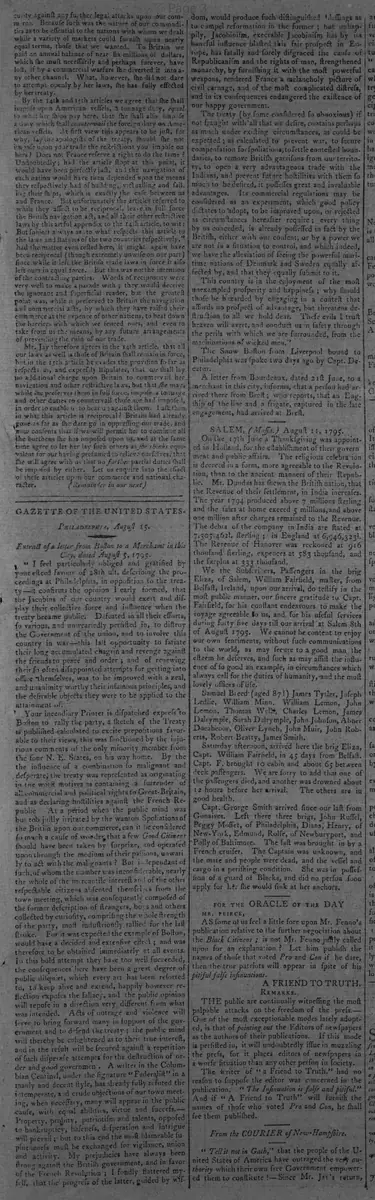
Extract of a letter from Boston to a Merchant in this City, dated August 5, 1795.
"I feel particularly obliged and gratified by your esteemed favour of 8th ult. describing the proceedings at Philadelphia, in opposition to the treaty—it confirms the opinion I early formed, that the Jacobins of our country would exert and display their collective force and influence when the treaty became public. Defeated in all their efforts, so various, and unweariedly persisted in, to destroy the Government of the union, and to involve this country in war—this last opportunity to satiate their long accumulated chagrin and revenge against the friends to peace and order; and of renewing their often disappointed attempts for getting into office themselves, was to be improved with a zeal, and unanimity worthy their infamous principles, and the desirable objects they were to be applied to the attainment of.
Your incendiary Printer is dispatched express to Boston to rally the party, a sketch of the Treaty is published calculated to excite prepossessions favorable to their views, this was sanctioned by the injurious comments of the only minority member from the eastern N. E. States, on his way home. By the influence of a combination of malignant and desperate; the treaty was represented as originating in the worst motives as containing a surrender of all commercial and political rights to Great-Britain, and as declaring hostilities against the French Republic. At a period when the public mind was but too justly irritated by the wanton Spoliations of the British upon our commerce, can it be considered so much a cause of wonder that a few good Citizens should have been taken by surprise, and operated upon through the medium of their passions, unwarily to act with the malignants? But independent of such, of whom the number was inconsiderable, nearly the whole of the mercantile interest and of the other respectable citizens absented themselves from the town meeting, which was consequently composed of the former description of strangers, boys and others collected by curiosity, comprising the whole strength of the party, most industriously rallied for the last stroke. For it was expected the example of Boston would have a decided and extensive effect; and was therefore to be obtained immediately at all events.
In this bold attempt they have too well succeeded, the consequences here have been a great degree of public disquiet, which every art has been resorted to, to keep alive and extend, happily however reflection exposes the fallacy, and the public opinion will repose in a direction very different from what was intended. Acts of outrage and violence will serve to bring forward many in support of the government and to defend the treaty; the public mind will thereby be enlightened as to their true interest, and in the result will be secured against a repetition of such desperate attempts for the destruction of order and good government. A writer in the Columbian Centinel, under the signature "Federalist" in a manly and decent style, has already fully refuted the intemperate, and crude objections of our town meeting, when necessary, many will appear in the public cause, with equal abilities, virtue and success.
Property, probity, patriotism and talents, opposed to bankruptcy, baseness, desperation and intrigue will prevail; but to this end the most blameable supineness must be exchanged for vigilance, union and activity. My prejudices have always been strong against the British government, and in favor of the French Revolution: I fondly flattered myself, that the progress of the latter, guided by wi-
dom, would produce such distinguished beings as to compel reformation in the former; but unhappily, Jacobinism, execrable Jacobinism has by its baneful influence blasted this fair prospect in Europe, has fatally and hourly disgraced the cause of Republicanism and the rights of man, strengthened monarchy, by furnishing it with the most powerful weapons, rendered France a melancholy picture of civil carnage, and of the most complicated distress, and in its consequences endangered the existence of our happy government.
The treaty (by some considered so obnoxious) if not fraught with all that we desire, contains perhaps as much under existing circumstances, as could be expected; as calculated to prevent war, to secure compensation for spoliations, to settle contested boundaries, to remove British garrisons from our territory, to open a very advantageous trade with the Indians, and prevent future hostilities with them so much to be desired, it possesses great and invaluable advantages. Its commercial regulations may be considered as an experiment, which good policy dictates to adopt, to be improved upon, or rejected as circumstances hereafter require; every thing by us conceded, is already possessed in fact by the British, either with our consent, or by a power we are not in a situation to control, and which indeed, we have the alleviation of seeing the powerful maritime nations of Denmark and Sweden equally affected by, and that they equally submit to it.
This country is in the enjoyment of the most unexampled prosperity and happiness; why should those be hazarded by engaging in a contest that affords no prospect of advantage, but threatens destruction to all we hold dear. These evils I trust heaven will avert, and conduct us in safety through the perils with which we are surrounded, from the machinations of wicked men."
What sub-type of article is it?
What themes does it cover?
What keywords are associated?
What entities or persons were involved?
Letter to Editor Details
Recipient
A Merchant In This City
Main Argument
the jay treaty provides essential benefits like preventing war, securing compensation, settling boundaries, and opening trade, despite opposition from jacobins who seek to destroy the government; public opinion will ultimately support it over the malignants' intrigue.
Notable Details