Thank you for visiting SNEWPapers!
Sign up free
Story
January 20, 1817
Alexandria Gazette, Commercial And Political
Alexandria, Virginia
What is this article about?
Reports from Washington on House debates over repealing the congressional compensation law amid public backlash. Speakers like Hulbert, Calhoun, and Wheaton defend the law, emphasizing legislative independence. Motion to revert to $6/day fails 81-91. Brief mention of militia organization bill.
Clipping
OCR Quality
95%
Excellent
Full Text
MONDAY, JANUARY 20.
FROM OUR CORRESPONDENT
AT WASHINGTON.
January 17.
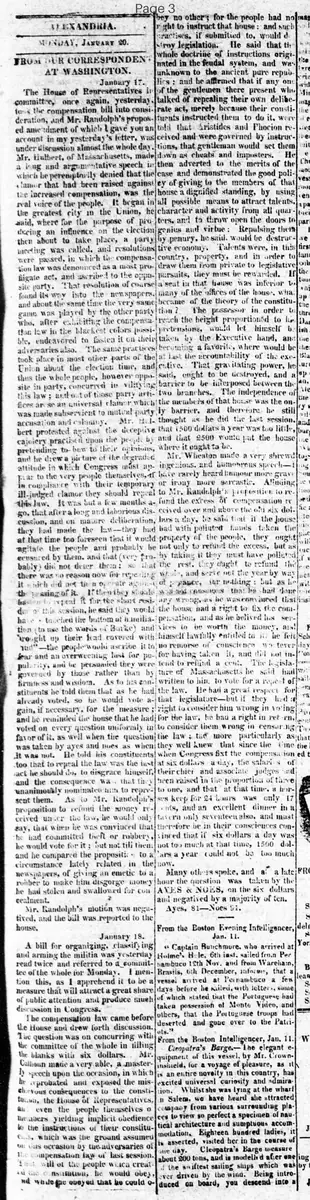
The House of Representatives in committee, once again, yesterday took the compensation bill into consideration, and Mr. Randolph's proposed amendment of which I gave you an account in my yesterday's letter, was under discussion almost the whole day. Mr. Hulbert, of Massachusetts, made a long and argumentative speech in which he peremptorily denied that the clamor that had been raised against the increased compensation, was the real voice of the people. It began in the greatest city in the Union, he said, where for the purpose of producing an influence on the election then about to take place, a party meeting was called, and resolutions were passed, in which the compensation law was denounced as a most profligate act, and ascribed to the opposite party. That resolution of course found its way into the newspapers. And about the same time the very same game was played by the other party who, after exhibiting the compensation law in the blackest colors possible, endeavored to fasten it on their adversaries also. The same practices took place in most other parts of the Union about the election time, and thus the whole people, however opposite in party, concurred in vilifying this law; and out of those party artifices arose an universal clamor which was made subservient to mutual party accusation and calumny. Mr. Hulbert protested against the deceptive cajolery practiced upon the people by pretending to bow to their opinions, and he drew a picture of the degraded attitude in which Congress was about to place itself to the very people themselves, if in compliance with their temporary ill-judged clamor they should repeal this law. It was but a few months ago, that after a long and laborious discussion, and on mature deliberation, they had made the law—they had at that time too foreseen that it would agitate the people and probably be censured by them, and that very probably did not deter them: So that there was no reason now for rejecting it which did not exist at the time of passing it. If then they should hasten to repeal it for the short residue of this session, he said they would have touched the bottom of humiliation (to use the words of Burke) and brought up their lead covered with mud—the people would ascribe it to fear and an overweening lust for popularity, and be persuaded they were governed by those rather than by firmness and wisdom. As to his constituents he told them that as he had already voted, so he would vote again, if necessary, for the measure; and he reminded the house that he had voted on every question uniformly in favor of it, as well when the question was taken by ayes and noes as when it was not. He told his constituents too that to repeal the law was the last act he should do, to disgrace himself, and the consequence was, that they unanimously nominated him to represent them. As to Mr. Randolph's proposition to refund the money received under the law, he would only say, that when he was convinced that he had committed theft or robbery, he would vote for it; but not till then: and he compared the proposition to a circumstance lately related, in the newspapers, of giving an emetic to a robber to make him disgorge money he had stolen and swallowed for concealment.
Mr. Randolph's motion was negatived, and the bill was reported to the house.
January 18.
A bill for organizing, classifying and arming the militia was yesterday read twice and referred to a committee of the whole for Monday. I mention this, as I apprehend it to be a measure that will attract a great share of public attention and produce such discussion in Congress.
The compensation law came before the House and drew forth discussion. The question was on concurring with the committee of the whole in filling the blanks with six dollars. Mr. Calhoun made a very able, a masterly speech upon the occasion, in which he probated and exposed the mischievous consequences to the constitution, the House of Representatives, and even the people themselves of members yielding implicit obedience to the instructions of their constituents, which was the ground assumed on this occasion by the adversaries of the compensation law of last session. If it will not the people which created the constitution, he would obey, and while one obey he that he could obey no other; for the people had no right to instruct that house: and such practices, if submitted to, would destroy legislation. He said that the whole doctrine of instructions originated in the feudal system, and was unknown to the ancient pure republics: and he affirmed that if any one of the gentlemen there present who talked of repealing their own deliberate act, merely because their constituents instructed them to do it, were told that Aristides and Phocion received and were governed by instructions, that gentleman would set them down as cheats and imposters. He then adverted to the merits of the case and demonstrated the good policy of giving to the members of that house a dignified standing, by using all possible means to attract talents, character and activity from all quarters, and to throw open the doors to genius and virtue: Repulsing them by penury, he said, would be destructive economy. Talents were, in this country, property, and in order to draw them from private to legislative pursuits, they must be rewarded. If a seat in that house was inferior in many of the offices of the house, what became of the theory of the constitution? The possessor in order to reach the height proportioned to his pretensions, would let himself be taken by the Executive hand, and becoming a favorite, where would be at last the accountability of the executive. That gravitating power, he said, ought to be destroyed, and a barrier to be interposed between the two branches. The independence of the members of that house was the only barrier, and therefore he still thought as he did the last session, that 600 dollars a year was too little, and that 900 would put the house where it ought to be.
Mr. Wheaton made a very shrewd, ingenious, and humorous speech—I have rarely heard humour more grave or irony more sarcastic. Alluding to Mr. Randolph's proposition to refund the excess of compensation received over and above the old six dollars a day, he said that if the house had with polluted hands taken the property of the people, they ought not only to refund the excess, but as in taking it they must have polluted the rest, they ought to refund the whole, and serve out the year by way of penance, for nothing: but as he was not conscious that he had done any wrong, as he was convinced that the house had a right to fix the compensation, and as he believed his services to be worth the money, and himself lawfully entitled to it, he felt no remorse of conscience whatever for having taken it, and did not intend to refund a cent. The legislature of Massachusetts he said had written to him, to vote for a repeal of the law. He had a great respect for that legislature but if they had a right to consider him wrong in voting for the law, he had a right in return, to consider them wrong in censoring the law; the more particularly as they well knew that since the time when Congress fixed the compensation at six dollars a day, the salaries of their chief and associate judges had been raised in the proportion of three to one, and that at that time, a horse's keep for 24 hours was only 17 cents, and an excellent dinner in a tavern only seventeen also, and must therefore be in their consciences convinced that if six dollars a day was not too much at that time, 1500 dollars a year could not be too much now.
Many others spoke, and at a late hour the question was taken by the AYES & NOES, on the six dollars and negatived by a majority of ten.
Ayes, 81—Noes 91.
FROM OUR CORRESPONDENT
AT WASHINGTON.
January 17.
The House of Representatives in committee, once again, yesterday took the compensation bill into consideration, and Mr. Randolph's proposed amendment of which I gave you an account in my yesterday's letter, was under discussion almost the whole day. Mr. Hulbert, of Massachusetts, made a long and argumentative speech in which he peremptorily denied that the clamor that had been raised against the increased compensation, was the real voice of the people. It began in the greatest city in the Union, he said, where for the purpose of producing an influence on the election then about to take place, a party meeting was called, and resolutions were passed, in which the compensation law was denounced as a most profligate act, and ascribed to the opposite party. That resolution of course found its way into the newspapers. And about the same time the very same game was played by the other party who, after exhibiting the compensation law in the blackest colors possible, endeavored to fasten it on their adversaries also. The same practices took place in most other parts of the Union about the election time, and thus the whole people, however opposite in party, concurred in vilifying this law; and out of those party artifices arose an universal clamor which was made subservient to mutual party accusation and calumny. Mr. Hulbert protested against the deceptive cajolery practiced upon the people by pretending to bow to their opinions, and he drew a picture of the degraded attitude in which Congress was about to place itself to the very people themselves, if in compliance with their temporary ill-judged clamor they should repeal this law. It was but a few months ago, that after a long and laborious discussion, and on mature deliberation, they had made the law—they had at that time too foreseen that it would agitate the people and probably be censured by them, and that very probably did not deter them: So that there was no reason now for rejecting it which did not exist at the time of passing it. If then they should hasten to repeal it for the short residue of this session, he said they would have touched the bottom of humiliation (to use the words of Burke) and brought up their lead covered with mud—the people would ascribe it to fear and an overweening lust for popularity, and be persuaded they were governed by those rather than by firmness and wisdom. As to his constituents he told them that as he had already voted, so he would vote again, if necessary, for the measure; and he reminded the house that he had voted on every question uniformly in favor of it, as well when the question was taken by ayes and noes as when it was not. He told his constituents too that to repeal the law was the last act he should do, to disgrace himself, and the consequence was, that they unanimously nominated him to represent them. As to Mr. Randolph's proposition to refund the money received under the law, he would only say, that when he was convinced that he had committed theft or robbery, he would vote for it; but not till then: and he compared the proposition to a circumstance lately related, in the newspapers, of giving an emetic to a robber to make him disgorge money he had stolen and swallowed for concealment.
Mr. Randolph's motion was negatived, and the bill was reported to the house.
January 18.
A bill for organizing, classifying and arming the militia was yesterday read twice and referred to a committee of the whole for Monday. I mention this, as I apprehend it to be a measure that will attract a great share of public attention and produce such discussion in Congress.
The compensation law came before the House and drew forth discussion. The question was on concurring with the committee of the whole in filling the blanks with six dollars. Mr. Calhoun made a very able, a masterly speech upon the occasion, in which he probated and exposed the mischievous consequences to the constitution, the House of Representatives, and even the people themselves of members yielding implicit obedience to the instructions of their constituents, which was the ground assumed on this occasion by the adversaries of the compensation law of last session. If it will not the people which created the constitution, he would obey, and while one obey he that he could obey no other; for the people had no right to instruct that house: and such practices, if submitted to, would destroy legislation. He said that the whole doctrine of instructions originated in the feudal system, and was unknown to the ancient pure republics: and he affirmed that if any one of the gentlemen there present who talked of repealing their own deliberate act, merely because their constituents instructed them to do it, were told that Aristides and Phocion received and were governed by instructions, that gentleman would set them down as cheats and imposters. He then adverted to the merits of the case and demonstrated the good policy of giving to the members of that house a dignified standing, by using all possible means to attract talents, character and activity from all quarters, and to throw open the doors to genius and virtue: Repulsing them by penury, he said, would be destructive economy. Talents were, in this country, property, and in order to draw them from private to legislative pursuits, they must be rewarded. If a seat in that house was inferior in many of the offices of the house, what became of the theory of the constitution? The possessor in order to reach the height proportioned to his pretensions, would let himself be taken by the Executive hand, and becoming a favorite, where would be at last the accountability of the executive. That gravitating power, he said, ought to be destroyed, and a barrier to be interposed between the two branches. The independence of the members of that house was the only barrier, and therefore he still thought as he did the last session, that 600 dollars a year was too little, and that 900 would put the house where it ought to be.
Mr. Wheaton made a very shrewd, ingenious, and humorous speech—I have rarely heard humour more grave or irony more sarcastic. Alluding to Mr. Randolph's proposition to refund the excess of compensation received over and above the old six dollars a day, he said that if the house had with polluted hands taken the property of the people, they ought not only to refund the excess, but as in taking it they must have polluted the rest, they ought to refund the whole, and serve out the year by way of penance, for nothing: but as he was not conscious that he had done any wrong, as he was convinced that the house had a right to fix the compensation, and as he believed his services to be worth the money, and himself lawfully entitled to it, he felt no remorse of conscience whatever for having taken it, and did not intend to refund a cent. The legislature of Massachusetts he said had written to him, to vote for a repeal of the law. He had a great respect for that legislature but if they had a right to consider him wrong in voting for the law, he had a right in return, to consider them wrong in censoring the law; the more particularly as they well knew that since the time when Congress fixed the compensation at six dollars a day, the salaries of their chief and associate judges had been raised in the proportion of three to one, and that at that time, a horse's keep for 24 hours was only 17 cents, and an excellent dinner in a tavern only seventeen also, and must therefore be in their consciences convinced that if six dollars a day was not too much at that time, 1500 dollars a year could not be too much now.
Many others spoke, and at a late hour the question was taken by the AYES & NOES, on the six dollars and negatived by a majority of ten.
Ayes, 81—Noes 91.
What sub-type of article is it?
Historical Event
What themes does it cover?
Moral Virtue
Justice
What keywords are associated?
Compensation Bill
House Debate
Legislative Independence
Public Clamor
Congressional Pay
What entities or persons were involved?
Mr. Randolph
Mr. Hulbert
Mr. Calhoun
Mr. Wheaton
Where did it happen?
Washington
Story Details
Key Persons
Mr. Randolph
Mr. Hulbert
Mr. Calhoun
Mr. Wheaton
Location
Washington
Event Date
January 17 And 18
Story Details
Debate in the House on repealing the compensation law; speeches defend the increase against public clamor and constituent instructions, emphasizing legislative independence; motion to revert to six dollars fails 81-91. Militia bill introduced.