Thank you for visiting SNEWPapers!
Sign up free
Dayton Daily Empire
Dayton, Montgomery County, Ohio
What is this article about?
An editorial discusses a letter from John Adams, Jr., reporting Southern leaders' weariness of the Civil War and willingness to accept peace terms preserving slavery under state laws, urging President Lincoln to offer magnanimous reconciliation to restore the Union, criticizing extremists and calling for Democratic leadership to end the conflict.
Merged-components note: Editorial introduction and full text of letter on 'Public Opinion at the South'.
Clipping
OCR Quality
Full Text
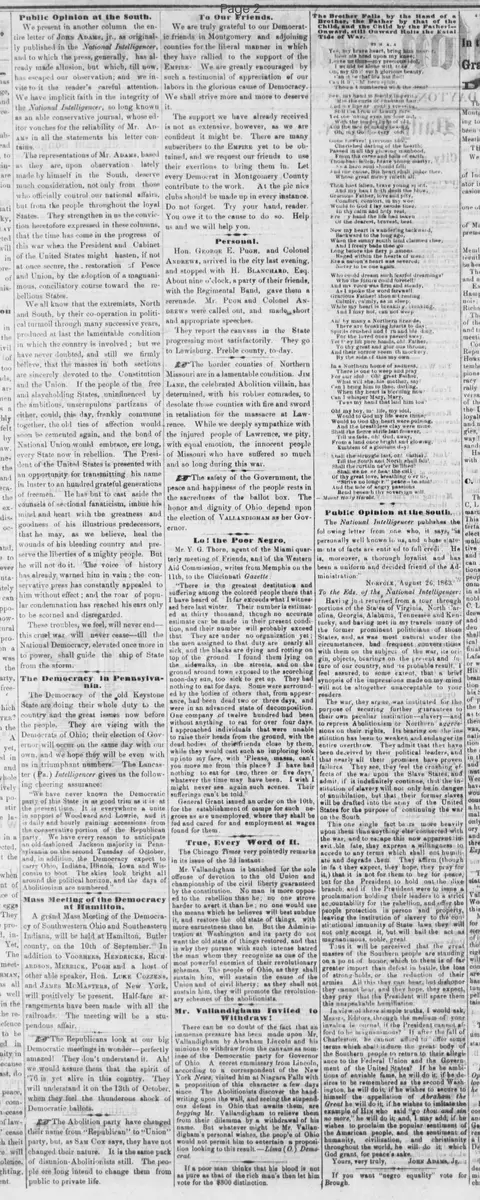
We present in another column the entire letter of John Adams, Jr., as originally published in the National Intelligencer, and to which the press, generally, has already made allusion, but which, till now, has escaped our observation; and we invite to it the reader's careful attention.
We have implicit faith in the integrity of the National Intelligencer, so long known as an able conservative journal, whose editor vouches for the reliability of Mr. Adams in all the statements his letter contains.
The representations of Mr. Adams, based as they are upon observation lately made by himself in the South, deserve much consideration, not only from those who officially control our national affairs, but from the people throughout the loyal States. They strengthen in us the conviction heretofore expressed in these columns, that the time has come in the progress of this war when the President and Cabinet of the United States might hasten, if not at once secure, the restoration of Peace and Union, by the adoption of a magnanimous, conciliatory course toward the rebellious States.
We all know that the extremists, North and South, by their co-operation in political turmoil through many successive years, produced at last the lamentable condition in which the country is involved; but we have never doubted, and still we firmly believe, that the masses in both sections are sincerely devoted to the Constitution and the Union. If the people of the free and slaveholding States, uninfluenced by the ambitious, unscrupulous partisans of either, could this day frankly commune together, the old ties of affection would soon be cemented again, and the bond of National Union would embrace, ere long, every State now in rebellion. The President of the United States is presented with an opportunity for transmitting his name in luster to a hundred grateful generations of freemen. He has but to cast aside the counsels of sectional fanaticism, imbue his mind and heart with the greatness and goodness of his illustrious predecessors, that he may, as we believe, heal the wounds of his bleeding country and preserve the liberties of a mighty people. But he will not do it. The voice of history has already warned him in vain; the conservative press has constantly appealed to him without effect; and the roar of popular condemnation has reached his ears only to be scorned and disregarded.
These troubles, we feel, will never end—this cruel war will never cease—till the National Democracy, elevated once more into power, shall guide the ship of State from the storm.
Public Opinion at the South.
The National Intelligencer publishes the following letter from one who, it says, "is personally well known to us, and whose statements of facts are entitled to full credit. He is, moreover, a thorough loyalist and has been a uniform and decided friend of the Administration:"
NORFOLK, August 26, 1863.
To the Eds. of the National Intelligencer:
Having just returned from a tour through portions of the States of Virginia, North Carolina, Georgia, Alabama, Tennessee and Kentucky, and having met in my travels many of the former prominent politicians of those States, and, as was most natural under the circumstances, had frequent conversations with them on the subject of the war, its origin, objects, bearings on the present and future of our country, and its probable result, I feel assured, to some extent, that a brief synopsis of the impressions made on my mind will not be altogether unacceptable to your readers.
The war, they argue, was instituted for the purpose of securing further guarantees to their own peculiar institution—slavery—and to repress Abolitionism or Northern aggressions on their rights. Its bearing on the constitution has been to weaken and endanger its entire overthrow. They admit that they have been deceived by their political leaders, and that nearly all their promises have proven failures. They see, they feel the crushing effects of the war upon the Slave States, and admit, if it indefinitely continue, that the institution of slavery will not only be in danger of annihilation, but that their former slaves will be drafted into the army of the United States for the purpose of continuing the war on the South.
This one single fact bears more heavily upon them than anything else connected with the war, and to escape this now apparent inevitable fate, they express a willingness to accede to any terms which shall not humiliate and degrade them. They affirm (though in fact they expect, they hope, they pray for it,) that it is not for them to beg for peace, but for the President to hold out the olive branch, and if the President were to issue a proclamation holding their leaders to a strict accountability for the rebellion, and offer the people protection in person and property, leaving the institution of slavery to the constitutional immunity of State laws, they will not only accept it, but will hail the act as magnanimous, noble, great.
Thus it will be perceived that the great masses of the Southern people are standing on a point of honor, which to them is of far greater import than defeat in battle, the loss of strong-holds, or the reduction of their armies. All this they can bear, but dishonor they cannot bear, and they hope, they expect, they pray that the President will spare them this unspeakable humiliation.
In view of these simple truths, I would ask, Messrs. Editors, through the medium of your invaluable journal, if the President cannot afford to be magnanimous? If after the fall of Charleston, he cannot afford to offer some terms which shall induce the great body of the Southern people to return to their allegiance to the Federal Union and the Government of the United States? If he be ambitious of enviable fame, he will do it; if he desires to be remembered as the second Washington, he will do it; if he wishes to secure to himself the appellation of Abraham the Great he will do it; if he wishes to imitate the example of Him who said "go thou and sin no more," he will do it; and, I may add, if he wishes to proclaim the popular sentiment of the American people, and the sentiment of humanity, civilization, and Christianity throughout the world, he will do it; which God grant, for peace's sake.
Yours, very truly,
JOHN ADAMS, JR.
If you want "negro equality" vote for Brough.
What sub-type of article is it?
What keywords are associated?
What entities or persons were involved?
Editorial Details
Primary Topic
Advocating Magnanimous Peace Terms To Reconcile The South And Restore The Union
Stance / Tone
Conciliatory And Urgent Call For Presidential Initiative Toward Peace, Critical Of Extremists And Current Administration Inaction
Key Figures
Key Arguments