Thank you for visiting SNEWPapers!
Sign up free
Literary
May 30, 1817
The Rhode Island American, And General Advertiser
Providence, Providence County, Rhode Island
What is this article about?
Extract from Dr. Chalmers' discourse praising Sir Isaac Newton's philosophical modesty, emphasizing his reliance on evidence in science and theology, rejecting unproven ideas, and defending his biblical commentary against Voltaire's criticism.
Clipping
OCR Quality
95%
Excellent
Full Text
SIR ISAAC NEWTON
The following admirable portrait of this Prince of Philosophers is extracted from a discourse entitled "The modesty of true Science," by Dr. Chalmers, a most learned and eloquent Scotch divine, reckoned not improperly perhaps "the Massillon of the age." A neat and elegant edition of Dr. Chalmers' celebrated discourses have just been published in New-York:
There are perhaps no two sets of human beings who comprehend less the movements, and enter less into the cares and concerns of each other, than the wide and busy publick on the one hand; and on the other, those men of close and studious retirement, whom the world never hears of, save when, from their thoughtful solitude, there issues forth some splendid discovery, to set the world on a gaze of admiration. Then will the brilliancy of a superior genius draw every eye towards it—and the homage paid to intellectual superiority, will place its idol on a loftier eminence than all wealth or than all titles can bestow—and the name of the successful philosopher will circulate, in his own age, over the whole extent of civilized society, and be borne down to posterity in the characters of ever-during remembrance—and thus it is, that, when we look back on the days of Newton, we annex a kind of mysterious greatness to him, who, by the pure force of his understanding, rose to such a gigantick elevation above the level of ordinary men—and the kings and warriors of other days sink into insignificance around him; and he, at this moment, stands forth to the publick eye, in a prouder array of glory than circles the memory of all the men of former generations, and while all the vulgar grandeur of other days is mouldering in forgetfulness, the achievements of our great astronomer are still fresh in the veneration of his countrymen, and they carry him forward on the stream of time with a reputation ever gathering, and the triumphs of a distinction that will never die.
Now, the point that I want to impress upon you is, that the same publick, who are so dazed and overborne by the lustre of all this superiority, are utterly in the dark as to what that is which confers its chief merit on the philosophy of Newton. They see the result of his labours, but they know not how to appreciate the difficulty or the extent of them. They look on the stately edifice he has reared, but they know not what he had to do in settling the foundation which gives to it all its stability—nor are they aware what painful encounters he had to make, both with the natural predilections of his own heart, and with the prejudices of others, when employed on the work of laying together its unperishing materials. They have never heard of the controversies which this man, of peaceful unambitious modesty, had to sustain, with all that was proud, and all that was intolerant in the philosophy of the age. They have never, in thought, entered that closet which was the scene of his patient and profound exercises—nor have they gone along with him, as he gave his silent hours to the labours of the midnight oil, and plied that unwearied task, to which the charm of lofty contemplation had allured him, nor have they accompanied him through all the workings of that wonderful mind, from which, as from the recesses of a laboratory, there came forth such gleams, and processes of thought as shed an effulgency over the whole amplitude of nature. All this, the publick have not done; for of this the great majority, even of the reading and cultivated publick, are utterly incapable; and therefore is it that they need to be told what that is, in which the main distinction of his philosophy lies; that, when labouring in other fields of investigation, they may know how to borrow from his safe example, and how to profit by that superior wisdom which marked the whole conduct of his understanding.
Let it be understood, then, that they are the positive discoveries of Newton, which in the eye of a superficial publick, confer upon him all his reputation. He discovered the mechanism of the planetary system. He discovered the composition of light. He discovered the cause of those alternate movements which take place on the waters of the ocean. These form his actual and his visible achievements. These are what the world look at as the monuments of his greatness. These are doctrines by which he has enriched the fields of philosophy; and thus it is that the whole of his merit is supposed to lie in having had the sagacity to perceive, and the vigour to lay hold of the proofs, which conferred upon these doctrines all the establishment of a most rigid and conclusive demonstration.
But while he gets all his credit, and all his admiration for those articles of science which he has added to the creed of philosophers, he deserves as much credit and admiration for those articles which he kept out of the creed, as for those which he introduced into it. It was the property of his mind, that it kept a tenacious hold of every one position which had proof to substantiate it—but it forms a property equally characteristick, and which, in fact, gives its leading peculiarity to the whole spirit and style of his investigations, that he put a most determined exclusion on every one position that was destitute of such proof. He would not admit the astronomical theories of those who went before him, because they had no proof. He would not give into their notions about the planets wheeling their rounds in whirlpools of ether—for he did not see this ether—he had no proof of its existence—and, besides, even supposing it to exist, it would not have impressed, on the heavenly bodies, such movements as met his observation. He would not submit his judgment to the reigning systems of the day—for, though they had authority to recommend them, they had no proof; and, thus it is, that he evinced the strength and soundness of his philosophy, as much by his decisions upon those doctrines of science which he rejected, as by his demonstration of those doctrines of science which he was the first to propose, and which now stand out to the eye of posterity as the only monuments to the force and superiority of his understanding.
He wanted no other recommendation for any one article of science, than the recommendation of evidence—and, with this recommendation, he opened to it the chamber of his mind, though authority scowled upon it, and taste was disgusted by it, and fashion was ashamed of it, and all the beauteous speculation of former days was cruelly broken up by this new announcement of the better philosophy, and scattered like the fragments of an aerial vision, over which the past generations of the world had been slumbering their profound and their pleasing reverie. But, on the other hand, should the article of science want the recommendation of evidence, he shut against it all the avenues of his understanding—aye, and though all antiquity lent their suffrages to it, and all eloquence had thrown around it the most attractive brilliancy, and all habit had incorporated it with every system of every seminary in Europe, and all fancy had arrayed it in graces of the most tempting solicitations;—yet was the steady and inflexible mind of Newton proof against this whole weight of authority and allurement, and, casting his cold and unwelcome look at the specious plausibility, he rebuked it from his presence. The strength of his philosophy lay as much in refusing admittance to that which wanted evidence, as in giving a place and an occupancy to that which possessed it. In that march of intellect, which led him onwards through the rich and magnificent field of his discoveries, he pondered every step; and, while he advanced with a firm and assured movement, wherever the light of evidence carried him, he never suffered any glare of imagination or of prejudice to seduce him from his path.
Sure I am, that in the prosecution of his wonderful career, he found himself on a way beset with temptation upon every side of him. It was not merely that he had the reigning taste and philosophy of the times to contend with; but, he expatiated on a lofty region, where, in all the giddiness of success, he might have met with much to solicit his fancy, and tempt him to some devious speculation. Had he been like the majority of other men, he would have broken free from the fetters of a sober and chastised understanding, and, giving wing to his imagination, had done what philosophers have done after him—been carried away by some meteor of their own forming, or found their amusement in some of their own intellectual pictures, or palmed some loose and confident plausibilities of their own upon the world. But Newton stood true to his principle, that he would take up with nothing which wanted evidence, and he kept by his demonstrations, and his measurements, and his proofs; and if it be true that he who ruleth his own spirit is greater than he who taketh a city, there was won, in the solitude of his chamber, many a repeated victory over himself, which should give a brighter lustre to his name than all the conquests he has made on the field of discovery, or than all the splendour of his positive achievements."
"If you have gone along with me in the preceding observations, you will perceive how they are calculated to disarm of all its point, and of all its energy, that flippancy of Voltaire; when, in the examples he gives of the dotage of the human understanding, he tells us of Bacon having believed in witchcraft, and Sir Isaac Newton having written a Commentary on the Book of Revelation. The former instance we shall not undertake to vindicate; but in the latter instance, we perceive what this brilliant and specious, but withal superficial, apostle of infidelity, either did not see, or refused to acknowledge. We see in this intellectual labour of our great philosopher, the work of the very same principles which carried him through the profoundest and the most successful of his investigations; and how he kept most sacredly and most consistently by those very maxims, the authority of which he, even in the full vigour and manhood of his faculties, ever recognized. We see in the theology of Newton, the very spirit and principle which gave all its stability, and all its sureness, to the philosophy of Newton. We see the same tenacious adherence to every one doctrine, that had such valid proof to uphold it, as could be gathered from the field of human experience; and we see the same firm resistance of every one argument, that had nothing to recommend it, but such plausibilities as could easily be devised by the genius of man, when he expatiated abroad on those fields of creation which the eye never witnessed, and from which no messenger ever came to us with any credible information. Now, it was on these two principles that Newton clung so determinedly to his Bible, as the record of an actual annunciation from God to the inhabitants of this world. When he turned his attention to this book, he came to it with a mind tutored to the philosophy of facts—and, when he looked at its credentials, he saw the stamp and the impress of this philosophy on every one of them. He saw the act of Christ being a messenger from heaven, in the audible language by which it was conveyed from heaven's canopy to human ears. He saw the fact of his being an approved ambassador of God, in those miracles which carried their own resistless evidence along with them to human eyes. He saw the truth of this whole history brought home to his own conviction, by a sound and substantial vehicle of human testimony—He saw the reality of that supernatural light, which "inspired the prophecies he himself illustrated, by such an agreement with the events of a various and distant futurity as could be taken cognizance of, by human observation. He saw the wisdom of God pervading the whole substance of the written message, in such manifold adaptations to the circumstances of man, and to the whole secrecy of his thoughts, and his affections, and his spiritual wants, and his moral sensibilities, as even in the mind of an ordinary and unlettered peasant, can be attested by human consciousness. These formed the solid materials of the basis on which our experimental philosopher stood; and there was nothing in the whole compass of his own astronomy to dazzle him away from it : and he was too well aware of the limit between what he knew, and what he did not know, to be seduced from the ground he had taken, by any of those brilliancies which have since led so many of his humbler successors into the track of Infidelity.
Without the testimony of an authentick messenger from heaven, I know nothing of heaven's counsels. I never heard of any moral telescope that can bring to my observation the doings or deliberations which are taking place in the sanctuary of the Eternal. I may put into the registers of my belief, all that comes home to me through the senses of the outer man. But neither the one nor the other can tell me of the purposes of God; can tell me of the transactions or the designs of his sublime monarchy; can tell me of the goings forth of Him who is from everlasting unto everlasting; can tell me of the march and the movements of that great administration which embraces all worlds, and takes into its wide and comprehensive survey the mighty roll of innumerable ages. It is true that my fancy may break its impetuous way into this lofty and inaccessible field; and through the devices of my heart, which are many, the visions of an ever-shifting theology may take their alternate sway over me; but the counsel of the Lord, it shall stand. And I repeat it, that if true to the leading principle of that philosophy, which has poured such a flood of light over the mysteries of nature, we shall dismiss every self-formed conception of our own, and wait in all the humility of conscious ignorance, till the Lord himself shall break his silence, and make his counsel known, by an act of communication. And now, that a professed communication is before me, and that it has all the solidity of the experimental evidence on its side, and nothing but the reveries of a daring speculation to oppose it, what is the consistent, what is the rational; what is the philosophical use that should be made of this document, but to set me down like a schoolboy, to the work of turning its pages, and conning its lessons, and submitting the very exercise of my judgment to its information and its testimony? We know that there is a superficial philosophy, which casts the glare of a most seducing brilliancy around it; and spurns the Bible, with all the doctrine, and all the piety of the Bible, away from it; and has infused the spirit of Antichrist into many of the literary establishments of the age; but it is not the solid, the profound, the cautious spirit of that philosophy which has done so much to ennoble the modern period of our world ; for the more that this spirit is cultivated and understood, the more will it be found in alliance with that spirit, in virtue of which all that exalteth itself against the knowledge of God, is humble, and all lofty imaginations are cast down, and every thought of the heart is brought into the captivity of the obedience of Christ.
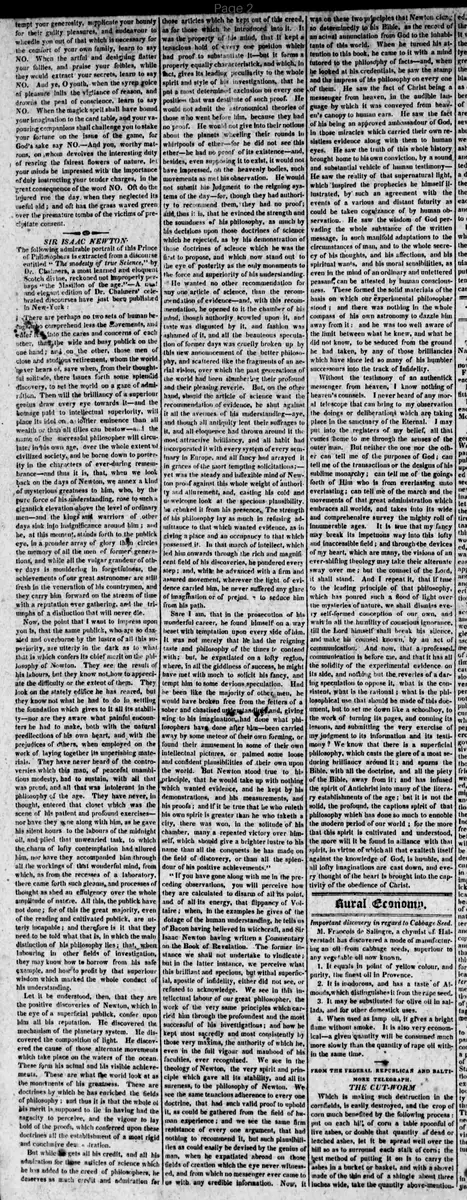
The following admirable portrait of this Prince of Philosophers is extracted from a discourse entitled "The modesty of true Science," by Dr. Chalmers, a most learned and eloquent Scotch divine, reckoned not improperly perhaps "the Massillon of the age." A neat and elegant edition of Dr. Chalmers' celebrated discourses have just been published in New-York:
There are perhaps no two sets of human beings who comprehend less the movements, and enter less into the cares and concerns of each other, than the wide and busy publick on the one hand; and on the other, those men of close and studious retirement, whom the world never hears of, save when, from their thoughtful solitude, there issues forth some splendid discovery, to set the world on a gaze of admiration. Then will the brilliancy of a superior genius draw every eye towards it—and the homage paid to intellectual superiority, will place its idol on a loftier eminence than all wealth or than all titles can bestow—and the name of the successful philosopher will circulate, in his own age, over the whole extent of civilized society, and be borne down to posterity in the characters of ever-during remembrance—and thus it is, that, when we look back on the days of Newton, we annex a kind of mysterious greatness to him, who, by the pure force of his understanding, rose to such a gigantick elevation above the level of ordinary men—and the kings and warriors of other days sink into insignificance around him; and he, at this moment, stands forth to the publick eye, in a prouder array of glory than circles the memory of all the men of former generations, and while all the vulgar grandeur of other days is mouldering in forgetfulness, the achievements of our great astronomer are still fresh in the veneration of his countrymen, and they carry him forward on the stream of time with a reputation ever gathering, and the triumphs of a distinction that will never die.
Now, the point that I want to impress upon you is, that the same publick, who are so dazed and overborne by the lustre of all this superiority, are utterly in the dark as to what that is which confers its chief merit on the philosophy of Newton. They see the result of his labours, but they know not how to appreciate the difficulty or the extent of them. They look on the stately edifice he has reared, but they know not what he had to do in settling the foundation which gives to it all its stability—nor are they aware what painful encounters he had to make, both with the natural predilections of his own heart, and with the prejudices of others, when employed on the work of laying together its unperishing materials. They have never heard of the controversies which this man, of peaceful unambitious modesty, had to sustain, with all that was proud, and all that was intolerant in the philosophy of the age. They have never, in thought, entered that closet which was the scene of his patient and profound exercises—nor have they gone along with him, as he gave his silent hours to the labours of the midnight oil, and plied that unwearied task, to which the charm of lofty contemplation had allured him, nor have they accompanied him through all the workings of that wonderful mind, from which, as from the recesses of a laboratory, there came forth such gleams, and processes of thought as shed an effulgency over the whole amplitude of nature. All this, the publick have not done; for of this the great majority, even of the reading and cultivated publick, are utterly incapable; and therefore is it that they need to be told what that is, in which the main distinction of his philosophy lies; that, when labouring in other fields of investigation, they may know how to borrow from his safe example, and how to profit by that superior wisdom which marked the whole conduct of his understanding.
Let it be understood, then, that they are the positive discoveries of Newton, which in the eye of a superficial publick, confer upon him all his reputation. He discovered the mechanism of the planetary system. He discovered the composition of light. He discovered the cause of those alternate movements which take place on the waters of the ocean. These form his actual and his visible achievements. These are what the world look at as the monuments of his greatness. These are doctrines by which he has enriched the fields of philosophy; and thus it is that the whole of his merit is supposed to lie in having had the sagacity to perceive, and the vigour to lay hold of the proofs, which conferred upon these doctrines all the establishment of a most rigid and conclusive demonstration.
But while he gets all his credit, and all his admiration for those articles of science which he has added to the creed of philosophers, he deserves as much credit and admiration for those articles which he kept out of the creed, as for those which he introduced into it. It was the property of his mind, that it kept a tenacious hold of every one position which had proof to substantiate it—but it forms a property equally characteristick, and which, in fact, gives its leading peculiarity to the whole spirit and style of his investigations, that he put a most determined exclusion on every one position that was destitute of such proof. He would not admit the astronomical theories of those who went before him, because they had no proof. He would not give into their notions about the planets wheeling their rounds in whirlpools of ether—for he did not see this ether—he had no proof of its existence—and, besides, even supposing it to exist, it would not have impressed, on the heavenly bodies, such movements as met his observation. He would not submit his judgment to the reigning systems of the day—for, though they had authority to recommend them, they had no proof; and, thus it is, that he evinced the strength and soundness of his philosophy, as much by his decisions upon those doctrines of science which he rejected, as by his demonstration of those doctrines of science which he was the first to propose, and which now stand out to the eye of posterity as the only monuments to the force and superiority of his understanding.
He wanted no other recommendation for any one article of science, than the recommendation of evidence—and, with this recommendation, he opened to it the chamber of his mind, though authority scowled upon it, and taste was disgusted by it, and fashion was ashamed of it, and all the beauteous speculation of former days was cruelly broken up by this new announcement of the better philosophy, and scattered like the fragments of an aerial vision, over which the past generations of the world had been slumbering their profound and their pleasing reverie. But, on the other hand, should the article of science want the recommendation of evidence, he shut against it all the avenues of his understanding—aye, and though all antiquity lent their suffrages to it, and all eloquence had thrown around it the most attractive brilliancy, and all habit had incorporated it with every system of every seminary in Europe, and all fancy had arrayed it in graces of the most tempting solicitations;—yet was the steady and inflexible mind of Newton proof against this whole weight of authority and allurement, and, casting his cold and unwelcome look at the specious plausibility, he rebuked it from his presence. The strength of his philosophy lay as much in refusing admittance to that which wanted evidence, as in giving a place and an occupancy to that which possessed it. In that march of intellect, which led him onwards through the rich and magnificent field of his discoveries, he pondered every step; and, while he advanced with a firm and assured movement, wherever the light of evidence carried him, he never suffered any glare of imagination or of prejudice to seduce him from his path.
Sure I am, that in the prosecution of his wonderful career, he found himself on a way beset with temptation upon every side of him. It was not merely that he had the reigning taste and philosophy of the times to contend with; but, he expatiated on a lofty region, where, in all the giddiness of success, he might have met with much to solicit his fancy, and tempt him to some devious speculation. Had he been like the majority of other men, he would have broken free from the fetters of a sober and chastised understanding, and, giving wing to his imagination, had done what philosophers have done after him—been carried away by some meteor of their own forming, or found their amusement in some of their own intellectual pictures, or palmed some loose and confident plausibilities of their own upon the world. But Newton stood true to his principle, that he would take up with nothing which wanted evidence, and he kept by his demonstrations, and his measurements, and his proofs; and if it be true that he who ruleth his own spirit is greater than he who taketh a city, there was won, in the solitude of his chamber, many a repeated victory over himself, which should give a brighter lustre to his name than all the conquests he has made on the field of discovery, or than all the splendour of his positive achievements."
"If you have gone along with me in the preceding observations, you will perceive how they are calculated to disarm of all its point, and of all its energy, that flippancy of Voltaire; when, in the examples he gives of the dotage of the human understanding, he tells us of Bacon having believed in witchcraft, and Sir Isaac Newton having written a Commentary on the Book of Revelation. The former instance we shall not undertake to vindicate; but in the latter instance, we perceive what this brilliant and specious, but withal superficial, apostle of infidelity, either did not see, or refused to acknowledge. We see in this intellectual labour of our great philosopher, the work of the very same principles which carried him through the profoundest and the most successful of his investigations; and how he kept most sacredly and most consistently by those very maxims, the authority of which he, even in the full vigour and manhood of his faculties, ever recognized. We see in the theology of Newton, the very spirit and principle which gave all its stability, and all its sureness, to the philosophy of Newton. We see the same tenacious adherence to every one doctrine, that had such valid proof to uphold it, as could be gathered from the field of human experience; and we see the same firm resistance of every one argument, that had nothing to recommend it, but such plausibilities as could easily be devised by the genius of man, when he expatiated abroad on those fields of creation which the eye never witnessed, and from which no messenger ever came to us with any credible information. Now, it was on these two principles that Newton clung so determinedly to his Bible, as the record of an actual annunciation from God to the inhabitants of this world. When he turned his attention to this book, he came to it with a mind tutored to the philosophy of facts—and, when he looked at its credentials, he saw the stamp and the impress of this philosophy on every one of them. He saw the act of Christ being a messenger from heaven, in the audible language by which it was conveyed from heaven's canopy to human ears. He saw the fact of his being an approved ambassador of God, in those miracles which carried their own resistless evidence along with them to human eyes. He saw the truth of this whole history brought home to his own conviction, by a sound and substantial vehicle of human testimony—He saw the reality of that supernatural light, which "inspired the prophecies he himself illustrated, by such an agreement with the events of a various and distant futurity as could be taken cognizance of, by human observation. He saw the wisdom of God pervading the whole substance of the written message, in such manifold adaptations to the circumstances of man, and to the whole secrecy of his thoughts, and his affections, and his spiritual wants, and his moral sensibilities, as even in the mind of an ordinary and unlettered peasant, can be attested by human consciousness. These formed the solid materials of the basis on which our experimental philosopher stood; and there was nothing in the whole compass of his own astronomy to dazzle him away from it : and he was too well aware of the limit between what he knew, and what he did not know, to be seduced from the ground he had taken, by any of those brilliancies which have since led so many of his humbler successors into the track of Infidelity.
Without the testimony of an authentick messenger from heaven, I know nothing of heaven's counsels. I never heard of any moral telescope that can bring to my observation the doings or deliberations which are taking place in the sanctuary of the Eternal. I may put into the registers of my belief, all that comes home to me through the senses of the outer man. But neither the one nor the other can tell me of the purposes of God; can tell me of the transactions or the designs of his sublime monarchy; can tell me of the goings forth of Him who is from everlasting unto everlasting; can tell me of the march and the movements of that great administration which embraces all worlds, and takes into its wide and comprehensive survey the mighty roll of innumerable ages. It is true that my fancy may break its impetuous way into this lofty and inaccessible field; and through the devices of my heart, which are many, the visions of an ever-shifting theology may take their alternate sway over me; but the counsel of the Lord, it shall stand. And I repeat it, that if true to the leading principle of that philosophy, which has poured such a flood of light over the mysteries of nature, we shall dismiss every self-formed conception of our own, and wait in all the humility of conscious ignorance, till the Lord himself shall break his silence, and make his counsel known, by an act of communication. And now, that a professed communication is before me, and that it has all the solidity of the experimental evidence on its side, and nothing but the reveries of a daring speculation to oppose it, what is the consistent, what is the rational; what is the philosophical use that should be made of this document, but to set me down like a schoolboy, to the work of turning its pages, and conning its lessons, and submitting the very exercise of my judgment to its information and its testimony? We know that there is a superficial philosophy, which casts the glare of a most seducing brilliancy around it; and spurns the Bible, with all the doctrine, and all the piety of the Bible, away from it; and has infused the spirit of Antichrist into many of the literary establishments of the age; but it is not the solid, the profound, the cautious spirit of that philosophy which has done so much to ennoble the modern period of our world ; for the more that this spirit is cultivated and understood, the more will it be found in alliance with that spirit, in virtue of which all that exalteth itself against the knowledge of God, is humble, and all lofty imaginations are cast down, and every thought of the heart is brought into the captivity of the obedience of Christ.
What sub-type of article is it?
Essay
What themes does it cover?
Religious
Moral Virtue
Political
What keywords are associated?
Newton Philosophy
Scientific Modesty
Evidence Based
Religious Faith
Intellectual Superiority
What entities or persons were involved?
By Dr. Chalmers
Literary Details
Title
The Modesty Of True Science
Author
By Dr. Chalmers
Subject
Portrait Of Sir Isaac Newton
Key Lines
There Are Perhaps No Two Sets Of Human Beings Who Comprehend Less The Movements, And Enter Less Into The Cares And Concerns Of Each Other, Than The Wide And Busy Publick On The One Hand; And On The Other, Those Men Of Close And Studious Retirement...
Let It Be Understood, Then, That They Are The Positive Discoveries Of Newton, Which In The Eye Of A Superficial Publick, Confer Upon Him All His Reputation.
He Wanted No Other Recommendation For Any One Article Of Science, Than The Recommendation Of Evidence...
We See In The Theology Of Newton, The Very Spirit And Principle Which Gave All Its Stability, And All Its Sureness, To The Philosophy Of Newton.
Without The Testimony Of An Authentick Messenger From Heaven, I Know Nothing Of Heaven's Counsels.